Paper I — Q2
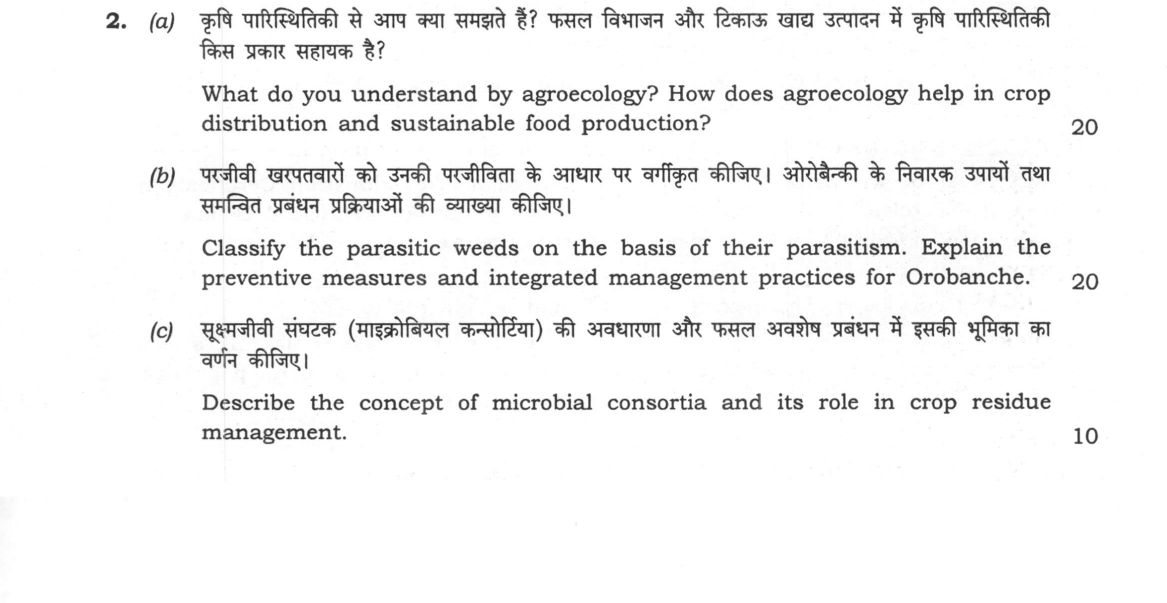
(a) What do you understand by agroecology? How does agroecology help in crop distribution and sustainable food production? (20…
What do you understand by agroecology? How does agroecology help in crop distribution and sustainable food production? 20 marks
Classify the parasitic weeds on the basis of their parasitism. Explain the preventive measures and integrated management practices for Orobanche. 20 marks
Describe the concept of microbial consortia and its role in crop residue management. 10 marks
हिंदी में प्रश्न पढ़ें
कृषि पारिस्थितिकी से आप क्या समझते हैं? फसल विभाजन और टिकाऊ खाद्य उत्पादन में कृषि पारिस्थितिकी किस प्रकार सहायक है? (20 अंक)
परजीवी खरपतवारों को उनकी परजीविता के आधार पर वर्गीकृत कीजिए। ओरोबैंकी के निवारक उपायों तथा समन्वित प्रबंधन प्रक्रियाओं की व्याख्या कीजिए। (20 अंक)
सूक्ष्मजीवी संघटक (माइक्रोबियल कंसोर्टिया) की अवधारणा और फसल अवशेष प्रबंधन में इसकी भूमिका का वर्णन कीजिए। (10 अंक)
Model answer
Written by UPSC Answer Check against this question's marking rubric, to the expected length. UPSC does not publish answers for Mains — this is one way to score well, not an official key.
Agroecology, Crop Distribution, and Sustainable Production
Agroecology is the integrative discipline that applies ecological principles to the design and management of sustainable agricultural systems. Rather than viewing farms as industrial input-output systems, it treats them as complex agroecosystems governed by biological interactions, nutrient cycling, and energy flows.
Agroecology optimizes crop distribution by aligning cropping systems with agro-climatic zoning and micro-ecological niches. By analyzing local soil profiles, hydrological regimes, and thermal indices, it replaces chemically forced monocultures with ecologically adapted spatial arrangements. It employs landscape-level diversification, intercropping, and agroforestry, ensuring that crops with complementary rooting depths and canopy architectures occupy suitable temporal and spatial niches.
For sustainable food production, agroecology minimizes reliance on synthetic chemical inputs by enhancing internal biological processes. It fosters biological nitrogen fixation through leguminous integration, regulates insect pests via natural trophic chains and habitat provision for predators, and builds soil structure through regular organic matter return. This strengthens systemic resilience against biotic stresses and climatic extremes such as droughts and heatwaves. In India, the scaling of natural farming models, such as Zero Budget Natural Farming (ZBNF) under the Bharatiya Prakritik Krishi Paddhati, operationalizes these agroecological principles to restore degraded soils while maintaining long-term food security.
Classification and Integrated Management of Parasitic Weeds
Parasitic weeds attach to host plants through specialized invasive roots called haustoria, which penetrate host tissues to siphon water, carbohydrates, and inorganic solutes. They are classified based on their physiological dependency and site of attachment:
- Degree of Parasitism:
- Holoparasites (Total parasites): Devoid of chlorophyll, they are entirely heterotrophic and completely dependent on the host for carbon, water, and minerals (e.g., Orobanche, Cuscuta).
- Hemiparasites (Partial parasites): Possess chlorophyll and perform photosynthesis, but rely on the host vascular system for water, nitrogen, and other inorganic nutrients (e.g., Striga, Loranthus).
- Site of Attachment:
- Total Stem Parasite: Cuscuta spp. (dodder).
- Partial Stem Parasite: Loranthus spp. (dendrophthoe).
- Total Root Parasite: Orobanche spp. (broomrape).
- Partial Root Parasite: Striga spp. (witchweed).
Orobanche is an underground root parasite that infests economically vital crops, particularly mustard and rapeseed in Rajasthan, Haryana, and Uttar Pradesh.
Preventive measures focus on avoiding seed introduction and exhausting the soil seed bank. Farmers must utilize certified, weed-free crop seeds and clean machinery thoroughly. Deep summer ploughing combined with soil solarization using clear polyethylene sheets raises topsoil temperatures sufficiently to kill dormant seeds. Crop rotation with non-host trap crops (such as sorghum, sunn hemp, or flax) induces "suicidal germination," wherein root exudates trigger weed seed germination in the absence of a compatible host, causing the seedlings to perish.
Integrated management requires combining cultural, biological, chemical, and genetic strategies. Hand-pulling of emergent flowering spikes prior to seed set prevents replenishment of the long-lived seed bank. Biological control utilizes host-specific fungal bioherbicides such as Fusarium oxysporum f. sp. orthoceras to cause vascular wilt in the parasite. Chemical control involves targeted applications of low-dose glyphosate (25 to 50 g/ha) at early vegetative stages of the host, or pre-emergence pendimethalin to inhibit haustorial establishment. Finally, deploying tolerant or resistant mustard genotypes developed through ICAR breeding programs suppresses haustorial penetration and restricts yield losses.
Microbial Consortia in Crop Residue Management
A microbial consortium is a synergistic association of two or more distinct, non-antagonistic microbial strains—comprising bacteria, fungi, and actinomycetes—that functionally complement each other in degrading complex substrates.
In crop residue management, these consortia target recalcitrant polymers present in crop stubble, notably cellulose, hemicellulose, and lignin. Fungal members (e.g., Trichoderma, Aspergillus) and actinomycetes secrete a suite of extracellular lignocellulolytic enzymes, including endoglucanases, cellobiohydrolases, xylanases, and laccases. These enzymes break structural bonds in tough straw, converting insoluble polymers into simpler oligosaccharides and organic acids. Bacterial components (e.g., Bacillus, Pseudomonas) metabolize these intermediate breakdown products, accelerating the composting process.
This coordinated enzymatic cleavage rapidly decomposes residues in situ within 20 to 25 days, directly preventing seasonal stubble burning. The breakdown accelerates nutrient mineralization, releasing locked-up nitrogen, phosphorus, and potassium back into the root zone while building soil organic carbon and improving moisture retention. ICAR-IARI's bio-formulation, the Pusa Decomposer, exemplifies how microbial consortia deliver an ecologically viable solution to residue burning in the rice-wheat cropping systems of the Indo-Gangetic Plains.
Integrating microbial residue decomposers, ecological weed regulation, and agroecological field design provides a unified pathway toward circular agriculture and sustainable crop intensification.
What "Explain" is asking you to do
Make the working of something clear — what sets it off, what follows from what, and what it produces. Explain is the Commission's mechanism word: it dominates the technical papers and the “explain why” stems, where the marks sit in the causal chain and not in the label.
Structure that answers it
State what it is → the initiating condition → the chain of cause, step by step → an instance where it plays out → what the chain produces
Where marks are lost
Describing what something looks like instead of why it works that way. Naming the stages without linking them reads as description too.
How this answer will be evaluated
Approach
Framework: Concept > Practice or process > Data > Indian application. (a) explain: definition/context > points in order > small example > short close | (b) explain: definition/context > points in order > small example > short close | (c) describe: define > structure or process in order > labelled diagram > significance Full marks: Precise definitions, specific examples, and clear linkages to Indian context.
Key points expected
- Precise definition of agroecology
- Link to crop distribution (climatic/soil factors)
- Mechanisms for sustainable food production
- Indian application or example
- Classification: Holoparasites vs Hemiparasites
- Preventive measures for Orobanche (seed hygiene)
- Integrated management practices (chemical/biological)
- Specific mention of Orobanche species (e.g., O. aegyptiaca)
Evaluation rubric
Each sub-part is marked on its own, against the marks and word limit printed on the paper.
- (a) Define agroecology and explain its role in crop distribution and sustainable food production. 20 marks
explain— definition/context → points in order → small example → short close
Must cover
- Precise definition of agroecology
- Link to crop distribution (climatic/soil factors)
- Mechanisms for sustainable food production
- Indian application or example
Loses marks
- Vague agronomic advice without ecological context
- MSP-only solutions for sustainability
Earns more
- Mention of specific agroecological zones
- Reference to soil health or biodiversity
- Mention of specific Indian schemes (e.g., PM-KISAN)
Extra mark
- Specific data on yield improvement
- Reference to a specific Indian state's policy
- (b) Classify parasitic weeds by parasitism type and explain preventive/integrated management for Orobanche. 20 marks
explain— definition/context → points in order → small example → short close
Must cover
- Classification: Holoparasites vs Hemiparasites
- Preventive measures for Orobanche (seed hygiene)
- Integrated management practices (chemical/biological)
- Specific mention of Orobanche species (e.g., O. aegyptiaca)
Loses marks
- Confusing parasitic weeds with non-parasitic weeds
- Vague management without specific practices
Earns more
- Mention of specific herbicides (e.g., imazamox)
- Reference to resistant crop varieties
- Mention of biological control agents
Extra mark
- Specific data on yield loss due to Orobanche
- Reference to a specific Indian research institute
- (c) Describe microbial consortia concept and its role in crop residue management. 10 marks
describe— define → structure or process in order → labelled diagram → significance
Must cover
- Definition of microbial consortia
- Role in crop residue decomposition
- Specific microbial groups involved (e.g., fungi, bacteria)
- Link to soil health or nutrient cycling
Loses marks
- Vague description without specific microbial roles
- Ignoring the 'consortia' aspect (focusing on single species)
Earns more
- Mention of specific enzymes (e.g., cellulase)
- Reference to composting or vermicomposting
- Mention of specific Indian agricultural practices
Extra mark
- Specific data on decomposition rates
- Reference to a specific Indian research study
Practice this exact question
Write your answer and it is marked point by point against the model answer above — what you covered, what you missed, what you got wrong.
Evaluate my answer →More from Agriculture 2023 Paper I
- Q1 Answer the following questions in about 150 words each: (a) Discuss the response of crop…
- Q2 (a) What do you understand by agroecology? How does agroecology help in crop distribution…
- Q3 (a) Give the specific features of organic farming and natural farming. Briefly discuss th…
- Q4 (a) Discuss the primary pathways of gaseous nitrogen losses from soil and the factors aff…
- Q5 Answer the following questions in about 150 words each: (a) Discuss the ways and means of…