Paper I — Q4
(a) Discuss the primary pathways of gaseous nitrogen losses from soil and the factors affecting nitrogen losses. (20 marks) (b)…
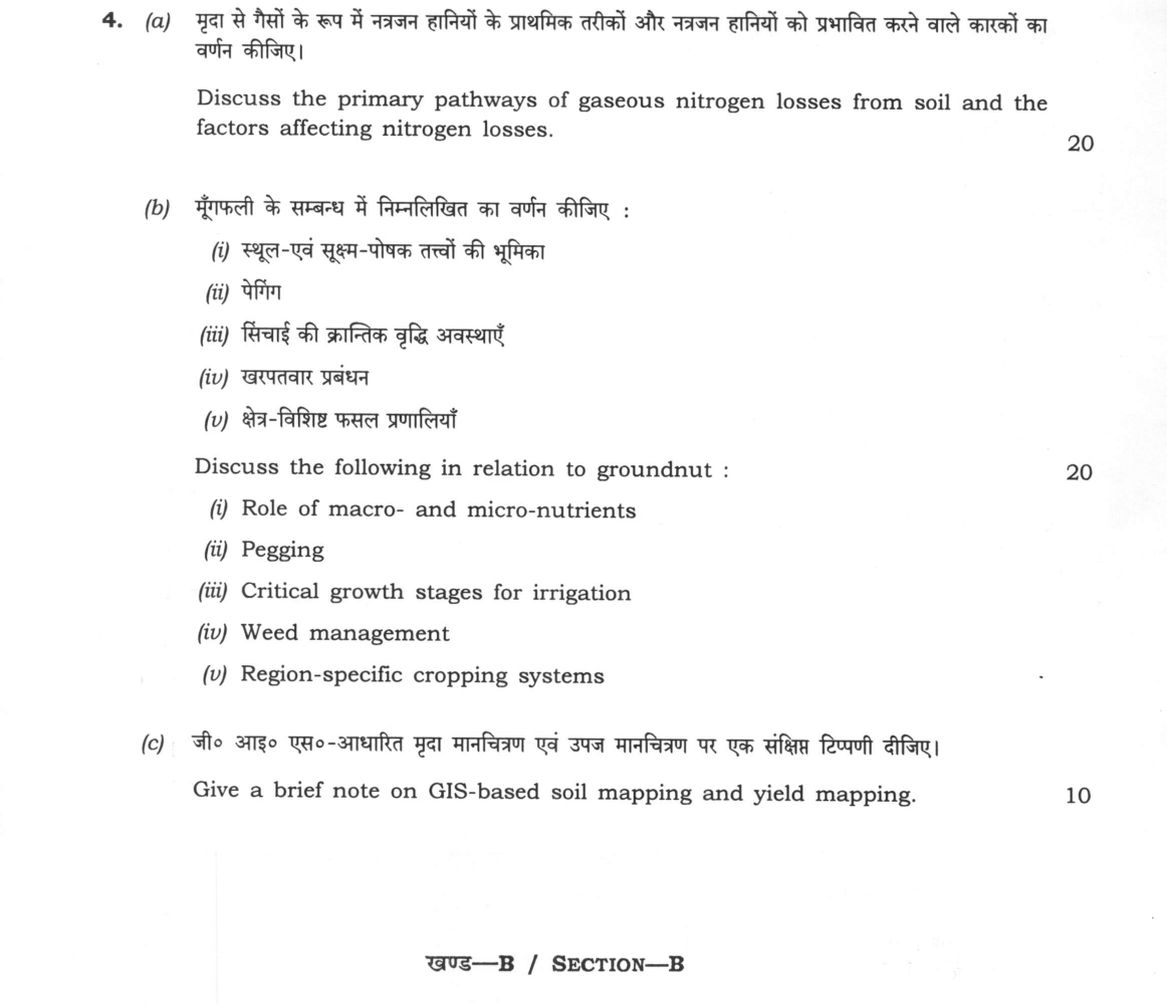
Discuss the primary pathways of gaseous nitrogen losses from soil and the factors affecting nitrogen losses. 20 marks
Discuss the following in relation to groundnut: Role of macro- and micro-nutrients
Pegging
Critical growth stages for irrigation
Weed management
Region-specific cropping systems 20 marks
Give a brief note on GIS-based soil mapping and yield mapping. 10 marks
हिंदी में प्रश्न पढ़ें
मृदा से गैसों के रूप में नाइट्रोजन हानियों के प्राथमिक तरीकों और नाइट्रोजन हानियों को प्रभावित करने वाले कारकों का वर्णन कीजिए। (20 अंक)
मूंगफली के संबंध में निम्नलिखित का वर्णन कीजिए : स्थूल-एवं सूक्ष्म-पोषक तत्वों की भूमिका
पैगिंग
सिंचाई की क्रांतिक वृद्धि अवस्थाएं
खरपतवार प्रबंधन
क्षेत्र-विशिष्ट फसल प्रणालियां (20 अंक)
जी० आई० एस०-आधारित मृदा मानचित्रण एवं उपज मानचित्रण पर एक संक्षिप्त टिप्पणी दीजिए। (10 अंक)
Model answer
Written by UPSC Answer Check against this question's marking rubric, to the expected length. UPSC does not publish answers for Mains — this is one way to score well, not an official key.
Gaseous Nitrogen Losses
Nitrogen losses from soil occur primarily through volatilization, denitrification, and chemo-denitrification. Ammonia volatilization is the conversion of ammonium (NH₄⁺) to ammonia gas (NH₃), driven by high soil pH, temperature, and the application of urea or ammonium-based fertilizers. Denitrification is the microbial reduction of nitrate (NO₃⁻) to gaseous forms (N₂, N_2O, NO) under anaerobic conditions. This process is favored by high soil moisture, low oxygen tension, and a high C:N ratio in organic matter. Chemo-denitrification involves the abiotic reduction of nitrite to nitric oxide, often occurring in acidic soils. Key factors influencing these losses include soil texture (clay soils retain more water, promoting denitrification), temperature (higher rates in warm seasons), and tillage practices (no-till systems may reduce volatilization but can increase denitrification in waterlogged zones).
Groundnut Cultivation
(i) Nutrient Roles Groundnut requires balanced nutrition. Nitrogen supports vegetative growth, though excess N reduces biological fixation. Phosphorus is critical for root development and energy transfer. Potassium enhances pod filling and oil content. Sulfur is vital for protein synthesis, while Magnesium is central to chlorophyll. Calcium is uniquely important for pod wall development and shelling percentage. Micronutrients are equally crucial: Molybdenum is essential for nitrogenase activity in root nodules; Boron ensures pollen viability and pod set; Zinc aids in enzyme function; Iron, Manganese, and Copper support photosynthesis and respiration. Deficiencies in Indian soils, particularly in micronutrients like Zn and B, often limit yields.
(ii) Pegging Pegging is the geotropic growth of the gynophore (peduncle) after fertilization. The peg grows downward into the soil, where it swells to form the pod. This process is highly sensitive to soil physical conditions. Soil crusting, compaction, or excessive moisture impedes peg penetration, leading to "blind pods" or reduced yield. Loose, friable soil is essential for successful pegging.
(iii) Irrigation Stages Critical irrigation stages are pegging (20-30 DAS), flowering (30-45 DAS), and pod development (50-60 DAS). Moisture stress during pegging reduces peg formation, while stress during pod development lowers shelling percentage and kernel weight. Drip irrigation is increasingly adopted in Gujarat and Tamil Nadu to maintain optimal soil moisture without waterlogging.
(iv) Weed Management Weeds compete for nutrients and light, particularly in the early stages. The critical weed-free period is 30-45 days after sowing (DAS). Integrated weed management includes pre-emergence herbicides like pendimethalin or fluchloralin, followed by post-emergence applications if necessary. Intercropping with cereals or legumes can also suppress weeds through canopy closure.
(v) Cropping Systems Region-specific systems optimize resource use. In Gujarat, kharif groundnut is often followed by rabi wheat or pulses. In Tamil Nadu, rice-groundnut rotation is common, leveraging residual moisture. In Andhra Pradesh, groundnut-redgram intercropping is prevalent, especially in Rayalaseema for rabi groundnut. These systems enhance soil health and economic returns.
GIS-Based Mapping
GIS-based soil mapping utilizes digital soil mapping (DSM) techniques, integrating remote sensing data, topography, and parent material to create detailed soil maps. In India, initiatives like the National Bureau of Soil Health and Plant Nutrition (NBSH) use GIS for soil health card distribution. Yield mapping is achieved through GPS-enabled combine harvesters that record yield data at specific locations. This data, integrated with NDVI (Normalized Difference Vegetation Index) from satellites, identifies spatial variability in productivity. Site-specific management, such as variable rate application of fertilizers, is then implemented to correct deficiencies and optimize yields. This precision agriculture approach enhances nitrogen use efficiency and sustainability in groundnut belts.
Conclusion
Sustainable groundnut production requires a holistic approach that minimizes gaseous nitrogen losses through efficient fertilizer management and leverages biological nitrogen fixation. Integrating precise nutrient management with GIS-based site-specific interventions ensures that resources are applied where needed, maximizing yield while minimizing environmental impact. This synergy between agronomy and technology is key to the future of Indian agriculture.
What "Discuss" is asking you to do
Lay the issue out from more than one side — how it arose, what is claimed for it, what is held against it, and where it now stands. UPSC attaches discuss to broad topics with several live dimensions, so coverage of the dimensions earns more than the strength of your opinion.
Structure that answers it
Set the issue up → the case as it is made → the case against → the dimension both sides leave out → where the balance now lies
Where marks are lost
Listing facts with no thread between them, or arguing one side throughout and calling it a discussion.
How this answer will be evaluated
Approach
Framework: Concept > Practice or process > Data > Indian application. (a) discuss: intro > 3-4 dimensions > example > balanced close | (b) discuss: intro > 3-4 dimensions > example > balanced close | (c) write short notes: define > 3-4 key features > one example > one-line significance Full marks: Comprehensive coverage of all sub-parts with specific examples, data, and Indian context
Key points expected
- Define denitrification and nitrification pathways
- Explain ammonia volatilization mechanism
- List factors: soil moisture, temperature, pH
- Link factors to specific loss pathways
- Detail role of P, K, and Zn in groundnut
- Define pegging and its soil requirements
- Identify flowering and pegging as critical stages
- List specific weeds and control methods
Evaluation rubric
Each sub-part is marked on its own, against the marks and word limit printed on the paper.
- (a) Intro > 3-4 dimensions > example > balanced close 20 marks
discuss— intro → 3-4 dimensions → example → balanced close
Must cover
- Define denitrification and nitrification pathways
- Explain ammonia volatilization mechanism
- List factors: soil moisture, temperature, pH
- Link factors to specific loss pathways
Loses marks
- Confusing leaching with gaseous loss
- Vague description of microbial processes
- Ignoring the role of soil aeration
Earns more
- Mention specific N2O emission factors
- Reference Indian soil types prone to loss
- Discuss management practices to mitigate loss
- Include chemical equations for reactions
Extra mark
- Cite specific IPCC emission factors
- Mention specific Indian research station data
- (b) Intro > 3-4 dimensions > example > balanced close 20 marks
discuss— intro → 3-4 dimensions → example → balanced close
Must cover
- Detail role of P, K, and Zn in groundnut
- Define pegging and its soil requirements
- Identify flowering and pegging as critical stages
- List specific weeds and control methods
Loses marks
- Generic advice not specific to groundnut
- Confusing pegging with pod development
- Ignoring the role of micronutrients
Earns more
- Name specific groundnut varieties (e.g., JG-11)
- Mention specific herbicides (e.g., Alachlor)
- Describe intercropping systems (e.g., with maize)
- Provide specific irrigation intervals
Extra mark
- Cite specific yield data for region-specific systems
- Mention specific government schemes for groundnut
- (c) Define > 3-4 key features > one example > one-line significance 10 marks
write short notes— define → 3-4 key features → one example → one-line significance
Must cover
- Define GIS-based soil mapping
- Define GIS-based yield mapping
- Mention remote sensing data usage
- Explain spatial analysis in mapping
Loses marks
- Confusing GIS with GPS
- Vague description of mapping process
- Ignoring the role of remote sensing
Earns more
- Mention specific software (e.g., ArcGIS)
- Reference specific Indian mapping projects
- Discuss data sources (e.g., Landsat, Sentinel)
- Explain interpolation techniques
Extra mark
- Cite specific Indian soil survey data
- Mention specific yield mapping case study
Practice this exact question
Write your answer and it is marked point by point against the model answer above — what you covered, what you missed, what you got wrong.
Evaluate my answer →More from Agriculture 2023 Paper I
- Q1 Answer the following questions in about 150 words each: (a) Discuss the response of crop…
- Q2 (a) What do you understand by agroecology? How does agroecology help in crop distribution…
- Q3 (a) Give the specific features of organic farming and natural farming. Briefly discuss th…
- Q4 (a) Discuss the primary pathways of gaseous nitrogen losses from soil and the factors aff…
- Q5 Answer the following questions in about 150 words each: (a) Discuss the ways and means of…
- Q6 (a) Elaborate on the various problems encountered in agricultural production at dryland a…
- Q7 (a) Write the main functions of Directorate of Marketing and Inspection. Discuss the role…