Paper I — Q3
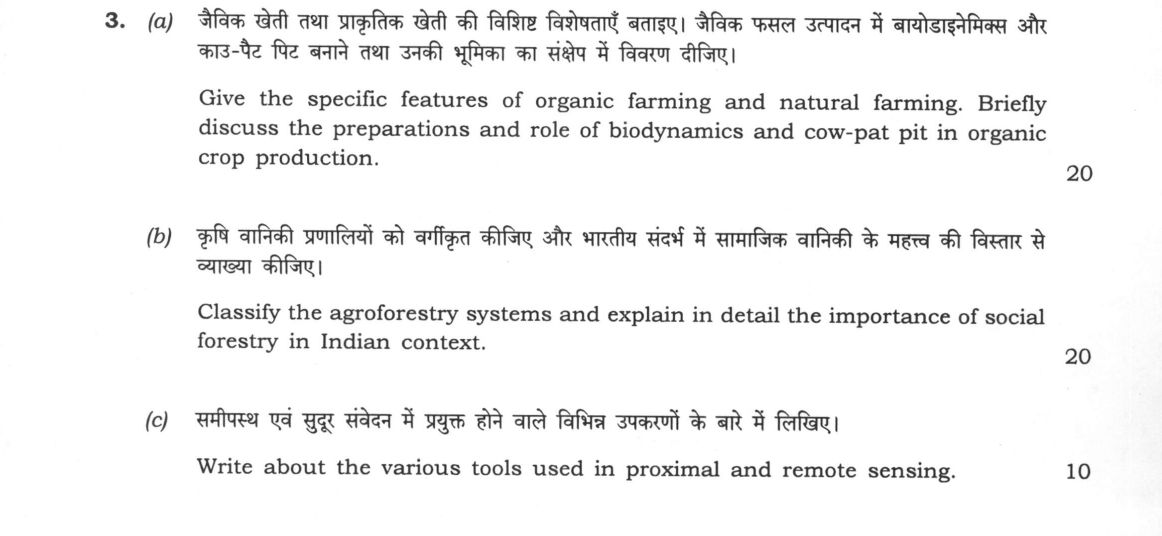
(a) Give the specific features of organic farming and natural farming. Briefly discuss the preparations and role of biodynamics…
Give the specific features of organic farming and natural farming. Briefly discuss the preparations and role of biodynamics and cow-pat pit in organic crop production. 20 marks
Classify the agroforestry systems and explain in detail the importance of social forestry in Indian context. 20 marks
Write about the various tools used in proximal and remote sensing. 10 marks
हिंदी में प्रश्न पढ़ें
जैविक खेती तथा प्राकृतिक खेती की विशिष्ट विशेषताएं बताइए। जैविक फसल उत्पादन में बायोडाइनैमिक्स और काऊ-पैट पिट बनाने तथा उनकी भूमिका का संक्षेप में विवरण दीजिए। (20 अंक)
कृषि वानिकी प्रणालियों को वर्गीकृत कीजिए और भारतीय संदर्भ में सामाजिक वानिकी के महत्व की विस्तार से व्याख्या कीजिए। (20 अंक)
समीपस्थ एवं सुदूर संवेदन में प्रयुक्त होने वाले विभिन्न उपकरणों के बारे में लिखिए। (10 अंक)
Model answer
Written by UPSC Answer Check against this question's marking rubric, to the expected length. UPSC does not publish answers for Mains — this is one way to score well, not an official key.
Organic and Natural Farming: Features, Biodynamics, and Agroforestry
Organic and natural farming represent a paradigm shift from input-intensive agriculture to ecologically integrated systems. While both reject synthetic agrochemicals, they differ fundamentally in philosophy and practice. Organic farming is a certified system that permits specific external inputs, such as organic manures, biopesticides, and mineral supplements, adhering to standards set by the National Standards for Organic Production (NSOP). In contrast, natural farming, often associated with the Fukuoka method and India’s Zero Budget Natural Farming (ZBNF), follows a "do-nothing" philosophy. It rejects all external inputs, including organic ones, relying instead on internal nutrient cycling through mulching, Jeevamrit (fermented cow dung and urine), and Beejamrit. Crucially, ZBNF does not reject all external matter; it permits natural inputs like jaggery and pulse flour to aid fermentation, but strictly prohibits synthetic chemicals and purchased organic fertilizers.
Biodynamics and Cow-Pat Pit Biodynamic agriculture, a subset of organic farming, utilizes specific preparations to enhance soil vitality. Compost preparations (BD 502–507) involve burying herbs (e.g., yarrow, chamomile, nettle) in animal horns or boxes to create microbial activators. These are applied to compost heaps to accelerate decomposition and improve soil structure. Distinct from these are spray preparations, such as BD 500 (cow manure) and BD 501 (quartz), which are applied directly to the field. The cow-pat pit is a central feature of natural farming. It involves burying cow dung in a pit, covering it with soil, and allowing it to ferment for six months. This process creates a potent microbial culture. When diluted and sprayed, it activates the soil microbiome, suppresses pathogens, and enhances nutrient availability without external fertilizers, thereby reducing costs and environmental load.
Agroforestry and Social Forestry Agroforestry integrates trees with crops or livestock. Structurally, it is classified into agrisilviculture (trees with crops), silvopastoral (trees with grazing), and agrosilvopastoral (all three). Functionally, systems are productive (e.g., Taungya, where crops are grown under young trees), protective (windbreaks), or social (fuelwood). In the Indian context, social forestry is critical for addressing the fuelwood and fodder deficit. It encompasses Joint Forest Management (JFM), where local communities share responsibility for forest conservation and benefits. Social forestry reclaims wastelands, provides employment to women and tribals through nursery management and plantation, and sequesters carbon. Success stories, such as the community-led afforestation in Sukhmajri (Haryana) and the JFM initiatives in Gujarat and Tamil Nadu, demonstrate how social forestry can restore degraded ecosystems while ensuring livelihood security. Unlike Van Mahotsav, which is an annual tree-planting festival, JFM is an institutional mechanism that empowers communities as stakeholders in forest governance.
Proximal and Remote Sensing Monitoring these sustainable systems requires advanced sensing technologies. Proximal sensing involves ground-level instruments that measure specific parameters at the source. Tools include handheld chlorophyll meters (SPAD) for assessing nitrogen status, soil moisture probes for irrigation scheduling, and NDVI sensors for plant vigor. These are cost-effective and precise for smallholder farmers. Remote sensing, conversely, observes the earth from a distance using satellites (Landsat, Sentinel-2) or UAVs (drones). It provides spatial data over large areas, enabling the mapping of crop health, detecting pest outbreaks, and monitoring deforestation. Spectral indices derived from satellite imagery allow for large-scale assessment of vegetation health. GIS integration of remote and proximal data supports precision agriculture, optimizing input use in organic and agroforestry systems.
Conclusion The transition to sustainable agriculture in India requires a synergistic approach. Organic and natural farming reduce chemical dependency, while agroforestry enhances biodiversity and resilience. However, challenges persist, including yield gaps in organic systems, conflicts over grazing rights in social forestry, and the high cost of remote sensing tools for small farmers. To address these, policies like the Paramparagat Krishi Vikas Yojana (PKVY) and the National Mission on Sustainable Agriculture must be strengthened. Integrating affordable proximal sensing with community-based social forestry can bridge the gap between technological potential and on-ground reality, ensuring that sustainable practices are both ecologically sound and economically viable for Indian farmers.
What "Discuss" is asking you to do
Lay the issue out from more than one side — how it arose, what is claimed for it, what is held against it, and where it now stands. UPSC attaches discuss to broad topics with several live dimensions, so coverage of the dimensions earns more than the strength of your opinion.
Structure that answers it
Set the issue up → the case as it is made → the case against → the dimension both sides leave out → where the balance now lies
Where marks are lost
Listing facts with no thread between them, or arguing one side throughout and calling it a discussion.
How this answer will be evaluated
Approach
Framework: Concept > Practice or process > Data > Indian application. (a) discuss: intro > 3-4 dimensions > example > balanced close | (b) explain: definition/context > points in order > small example > short close | (c) explain: definition/context > points in order > small example > short close Full marks: Comprehensive coverage of all sub-parts with specific examples, schemes, and tools.
Key points expected
- Specific features of organic farming
- Specific features of natural farming
- Preparation of biodynamics
- Role of cow-pat pit in crop production
- Classification of agroforestry systems
- Definition of social forestry
- Importance of social forestry in Indian context
- Specific Indian schemes or policies (e.g., National Afforestation Programme)
Evaluation rubric
Each sub-part is marked on its own, against the marks and word limit printed on the paper.
- (a) Features of organic/natural farming and role of biodynamics/cow-pat pit. 20 marks
discuss— intro → 3-4 dimensions → example → balanced close
Must cover
- Specific features of organic farming
- Specific features of natural farming
- Preparation of biodynamics
- Role of cow-pat pit in crop production
Loses marks
- Confusing organic with conventional farming
- Vague description of biodynamics without specific preparations
- Ignoring the 'natural farming' aspect of the question
Earns more
- Distinction between organic and natural farming
- Specific biodynamic preparations (e.g., 500-507)
- Mechanism of cow-pat pit (anaerobic digestion)
- Comparison of inputs used in both systems
Extra mark
- Reference to specific organic certification standards
- Diagram of cow-pat pit construction
- (b) Classification of agroforestry and importance of social forestry in India. 20 marks
explain— definition/context → points in order → small example → short close
Must cover
- Classification of agroforestry systems
- Definition of social forestry
- Importance of social forestry in Indian context
- Specific Indian schemes or policies (e.g., National Afforestation Programme)
Loses marks
- Failing to classify agroforestry systems
- Generic discussion of forestry without 'social' focus
- Ignoring the 'Indian context' requirement
Earns more
- Types of agroforestry (Agrosilviculture, Agrosilvopasture, etc.)
- Environmental benefits of social forestry
- Economic benefits for farmers
- Reference to specific Indian tree species used
Extra mark
- Data on forest cover increase due to social forestry
- Reference to specific state-level initiatives
- (c) Tools used in proximal and remote sensing. 10 marks
explain— definition/context → points in order → small example → short close
Must cover
- Definition of proximal sensing
- Definition of remote sensing
- Examples of proximal sensing tools
- Examples of remote sensing tools
Loses marks
- Confusing proximal and remote sensing
- Listing tools without explaining their function
- Ignoring one of the two sensing types
Earns more
- Specific proximal tools (e.g., chlorophyll meter, soil probe)
- Specific remote sensing platforms (e.g., satellites, drones)
- Sensors used in remote sensing (e.g., multispectral, hyperspectral)
- Applications of these tools in agriculture
Extra mark
- Comparison of spatial resolution of different tools
- Reference to specific satellite missions (e.g., Landsat, Sentinel)
Practice this exact question
Write your answer and it is marked point by point against the model answer above — what you covered, what you missed, what you got wrong.
Evaluate my answer →More from Agriculture 2023 Paper I
- Q1 Answer the following questions in about 150 words each: (a) Discuss the response of crop…
- Q2 (a) What do you understand by agroecology? How does agroecology help in crop distribution…
- Q3 (a) Give the specific features of organic farming and natural farming. Briefly discuss th…
- Q4 (a) Discuss the primary pathways of gaseous nitrogen losses from soil and the factors aff…
- Q5 Answer the following questions in about 150 words each: (a) Discuss the ways and means of…
- Q6 (a) Elaborate on the various problems encountered in agricultural production at dryland a…