Paper I — Q5
Answer the following questions in about 150 words each: (a) Discuss the ways and means of minimising erosion for conserving…
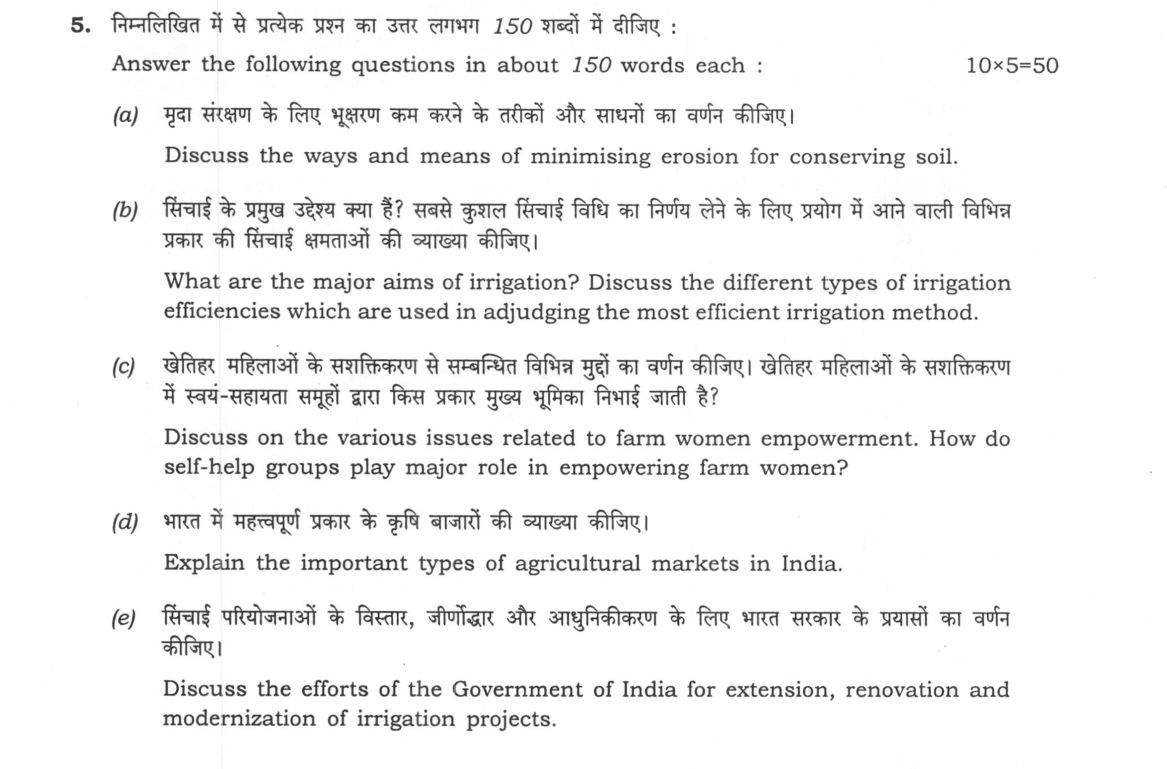
Answer the following questions in about 150 words each:
Discuss the ways and means of minimising erosion for conserving soil. 10 marks
What are the major aims of irrigation? Discuss the different types of irrigation efficiencies which are used in adjudging the most efficient irrigation method. 10 marks
Discuss on the various issues related to farm women empowerment. How do self-help groups play major role in empowering farm women? 10 marks
Explain the important types of agricultural markets in India. 10 marks
Discuss the efforts of the Government of India for extension, renovation and modernization of irrigation projects. 10 marks
हिंदी में प्रश्न पढ़ें
निम्नलिखित में से प्रत्येक प्रश्न का उत्तर लगभग 150 शब्दों में दीजिए :
मृदा संरक्षण के लिए भूक्षरण कम करने के तरीकों और साधनों का वर्णन कीजिए। (10 अंक)
सिंचाई के प्रमुख उद्देश्य क्या हैं? सबसे कुशल सिंचाई विधि का निर्णय लेने के लिए प्रयोग में आने वाली विभिन्न प्रकार की सिंचाई क्षमताओं की व्याख्या कीजिए। (10 अंक)
खेतीहर महिलाओं के सशक्तिकरण से सम्बन्धित विभिन्न मुद्दों का वर्णन कीजिए। खेतीहर महिलाओं के सशक्तिकरण में स्वयं-सहायता समूहों द्वारा किस प्रकार मुख्य भूमिका निभाई जाती है? (10 अंक)
भारत में महत्त्वपूर्ण प्रकार के कृषि बाजारों की व्याख्या कीजिए। (10 अंक)
सिंचाई परियोजनाओं के विस्तार, जीर्णोद्धार और आधुनिकीकरण के लिए भारत सरकार के प्रयासों का वर्णन कीजिए। (10 अंक)
Model answer
Written by UPSC Answer Check against this question's marking rubric, to the 150-word length. UPSC does not publish answers for Mains — this is one way to score well, not an official key.
(a) Ways and Means of Minimising Erosion for Conserving Soil
Soil erosion, defined as the detachment and transportation of topsoil, can be effectively predicted and mitigated using the framework of the Universal Soil Loss Equation (A = R · K · L · S · C · P), where conservation focuses on modifying the crop management (C) and conservation practice (P) factors.
Agronomic measures form the first line of defence on mild slopes (less than 2 percent). These include contour farming, strip cropping (alternating erosion-permitting crops like maize with erosion-resisting legumes), cover cropping, mulching, and conservation tillage. Maintaining an optimal carbon-to-nitrogen (C:N) ratio through organic additions builds soil aggregation and infiltration capacity, mitigating splash and sheet erosion.
Mechanical or engineering measures are deployed on steeper slopes to reduce runoff velocity and intercept surface flow. These comprise contour and graded bunding, bench terracing on hillsides, gully plugging, check dams, and contour trenching.
Vegetative and biological measures involve planting vetiver grass hedgerows, establishing shelterbelts and windbreaks to curb aeolian erosion, and adopting agroforestry or silvopasture systems. Integrating mechanical barriers with biological stabilization ensures comprehensive watershed conservation and restores degraded soil architecture.
(b) Major Aims and Efficiencies of Irrigation
The primary aims of irrigation are to provide an assured water supply during dry spells, act as insurance against drought, facilitate multiple and relay cropping systems, stabilize crop yields, and enable efficient nutrient solubilization and uptake.
Adjudging the most efficient irrigation method requires evaluating key irrigation efficiencies:
Water Conveyance Efficiency (E_c): The ratio of water delivered to the farm plot (W_f) to the water diverted from the source (W_d), expressed as E_c = (W_f / W_d) × 100. It assesses seepage and evaporation losses in canal networks.
Water Application Efficiency (Eₐ): The ratio of water stored in the root zone (Wₛ) to the water delivered to the plot (W_f), expressed as Eₐ = (Wₛ / W_f) × 100. Surface methods typically average 30 to 50 percent, whereas drip systems exceed 90 percent.
Water Distribution Efficiency (E_d): Measures the uniformity of water penetration throughout the root zone across the field: E_d = (1 - ȳ/d) × 100, where ȳ is the average numerical deviation from the mean depth applied (d).
Water Use Efficiency (WUE): Crop yield produced per unit of water consumed (kg/m³ or kg/ha-mm).
Maximizing these efficiencies enables a transition from wasteful flood irrigation to precision micro-irrigation.
(c) Farm Women Empowerment: Issues and the Role of Self-Help Groups
Despite the increasing feminization of agriculture, farm women face systemic constraints. Primary issues include lack of land titles (women hold under 14 percent of operational holdings), persistent gender wage disparities, limited access to institutional credit, inadequate agricultural extension services, and severe physical drudgery due to a lack of gender-friendly farm tools.
Self-Help Groups (SHGs) under the Deendayal Antyodaya Yojana-National Rural Livelihoods Mission (DAY-NRLM) have emerged as institutional drivers of empowerment by:
Facilitating collateral-free micro-credit and overcoming structural banking hurdles.
Promoting collective farming and group land leasing through initiatives like Kudumbashree in Kerala and the Development of Women and Children in Rural Areas (DWCRA) legacy models.
Building technical capacity via the Mahila Kisan Sashaktikaran Pariyojana (MKSP), training women in non-pesticidal management, seed production, and organic inputs.
Establishing Custom Hiring Centres managed by SHGs, which introduces drudgery-reducing implements (such as mechanical weeders and seed drills) and enhances collective bargaining power in market transactions.
Empowering farm women via institutional collectives directly improves household nutritional security and aggregate agricultural productivity.
(d) Important Types of Agricultural Markets in India
Agricultural markets in India are categorized on the basis of location, transaction volume, and regulatory structure:
Primary Rural Markets (Periodic Markets or Haats): Located in rural hinterlands, these periodic markets serve as the initial point of sale for smallholders disposing of marketable surpluses directly to local consumers or itinerant village traders.
Secondary Markets (Wholesale Mandis): Situated in district or taluka headquarters, these assembly markets handle aggregated produce. Commission agents (kachha and pucca arhtiyas) mediate bulk transactions between farmers, processors, and wholesalers.
Terminal or Consumer Markets: Located in metropolitan ports or major urban centers, these markets aggregate commodities for final domestic consumption, agro-processing industries, or export trade.
Regulated Markets: Established under state Agricultural Produce Market Committee (APMC) Acts to eliminate fraudulent practices, standardize weighing, and ensure transparent price discovery via open auctions.
Cooperative and Digital Markets: Producer-owned cooperatives (such as AMUL and NAFED) and Farmer Producer Organizations (FPOs) eliminate intermediaries. Modern integration is driven by the Electronic National Agriculture Market (e-NAM), creating a unified national digital trading platform across states.
Strengthening market infrastructure across these tiers is essential to compress supply chains and optimize farmer price realization.
(e) Government Efforts for Extension, Renovation, and Modernization of Irrigation Projects
To bridge the gap between Irrigation Potential Created (IPC) and Irrigation Potential Utilized (IPU), the Government of India has instituted several targeted interventions for Extension, Renovation, and Modernization (ERM):
Pradhan Mantri Krishi Sinchayee Yojana (PMKSY): Integrates the Accelerated Irrigation Benefits Programme (AIBP) to fast-track long-pending major and medium irrigation (MMI) projects, alongside the 'Har Khet Ko Pani' component to expand physical cultivable command areas.
Command Area Development and Water Management (CADWM): Focuses on on-farm development works, including canal relining, construction of field channels, and structural restoration to check conveyance leakages.
Participatory Irrigation Management (PIM): Enacts legal frameworks to devolve canal operation, equitable tail-end distribution, and water charge collection to Water Users Associations (WUAs).
Per Drop More Crop (PDMC): Promotes micro-irrigation systems (drip and sprinkler), fertigation, and precision water delivery within command areas.
Dam Rehabilitation and Improvement Project (DRIP): Supported by the World Bank, this project modernizes, structurally strengthens, and renovates aging dam assets across various states.
These interventions collectively shift Indian irrigation from supply-driven surface conveyance to demand-driven, water-secure, and climate-resilient water resource management.
What "Discuss" is asking you to do
Lay the issue out from more than one side — how it arose, what is claimed for it, what is held against it, and where it now stands. UPSC attaches discuss to broad topics with several live dimensions, so coverage of the dimensions earns more than the strength of your opinion.
Structure that answers it
Set the issue up → the case as it is made → the case against → the dimension both sides leave out → where the balance now lies
Where marks are lost
Listing facts with no thread between them, or arguing one side throughout and calling it a discussion.
How this answer will be evaluated
Approach
Framework: Concept > Practice or process > Data > Indian application. (a) discuss: intro > 3-4 dimensions > example > balanced close | (b) discuss: intro > 3-4 dimensions > example > balanced close | (c) discuss: intro > 3-4 dimensions > example > balanced close | (d) explain: definition/context > points in order > small example > short close | (e) discuss: intro > 3-4 dimensions > example > balanced close Full marks: Comprehensive coverage of all aspects with specific examples and data.
Key points expected
- Mechanical methods (terracing, bunding, check dams)
- Biological methods (afforestation, cover crops, mulching)
- Cultural methods (contour ploughing, strip cropping)
- Structural methods (drainage, gully plugging)
- Aims: crop production, water supply, flood control
- Definition of Conveyance Efficiency
- Definition of Distribution Efficiency
- Definition of Application Efficiency
Evaluation rubric
Each sub-part is marked on its own, against the marks and word limit printed on the paper.
- (a) Ways and means of minimising erosion for conserving soil. · 150 words
discuss— intro → 3-4 dimensions → example → balanced close
Must cover
- Mechanical methods (terracing, bunding, check dams)
- Biological methods (afforestation, cover crops, mulching)
- Cultural methods (contour ploughing, strip cropping)
- Structural methods (drainage, gully plugging)
Loses marks
- Vague agronomic advice without specific methods
- Ignoring the 'means' (structural) aspect
Earns more
- Mention of specific soil types (e.g., red, black)
- Reference to Watershed Management
- Linkage to soil fertility conservation
Extra mark
- Specific scheme name (e.g., PMKSY)
- Statistical data on erosion rates
- (b) Major aims of irrigation and different types of irrigation efficiencies. · 150 words
discuss— intro → 3-4 dimensions → example → balanced close
Must cover
- Aims: crop production, water supply, flood control
- Definition of Conveyance Efficiency
- Definition of Distribution Efficiency
- Definition of Application Efficiency
Loses marks
- Confusing distribution with application efficiency
- Failing to link efficiency to method selection
Earns more
- Mention of Overall Efficiency
- Comparison of surface vs. micro irrigation
- Linkage to water use efficiency
Extra mark
- Specific formula for efficiency calculation
- Recent scheme figure for micro irrigation
- (c) Issues related to farm women empowerment and role of self-help groups. · 150 words
discuss— intro → 3-4 dimensions → example → balanced close
Must cover
- Issues: land ownership, credit access, decision making
- Role of SHGs: financial inclusion, skill development
- Role of SHGs: social capital, collective bargaining
- Linkage to agricultural productivity
Loses marks
- Vague discussion of 'women's issues' without farm context
- Ignoring the specific role of SHGs
Earns more
- Mention of specific SHG schemes (e.g., NABARD)
- Reference to gender gap in agriculture
- Linkage to rural development
Extra mark
- Specific scheme name (e.g., SHG-Bank Linkage)
- Statistical data on women farmers
- (d) Important types of agricultural markets in India. · 150 words
explain— definition/context → points in order → small example → short close
Must cover
- Mandi (Agricultural Produce Market Committee)
- Wholesale markets (bulk trading)
- Retail markets (local consumption)
- Electronic markets (e-NAM)
Loses marks
- Confusing wholesale with retail markets
- Ignoring the electronic market aspect
Earns more
- Mention of APMC Act
- Reference to FPOs (Farmer Producer Organizations)
- Linkage to market infrastructure
Extra mark
- Specific scheme name (e.g., e-NAM)
- Statistical data on market share
- (e) Efforts of the Government of India for extension, renovation and modernization of irrigation projects. · 150 words
discuss— intro → 3-4 dimensions → example → balanced close
Must cover
- Extension: new canal projects, reservoirs
- Renovation: repair of old canals, check dams
- Modernization: micro irrigation, drip/sprinkler
- Linkage to water use efficiency
Loses marks
- Vague discussion of 'irrigation' without specific efforts
- Ignoring the 'modernization' aspect
Earns more
- Mention of PMKSY (Pradhan Mantri Krishi Sinchayee Yojana)
- Reference to 'Har Khet Ko Pani' (Every Drop to the Field)
- Linkage to crop diversification
Extra mark
- Specific scheme name (e.g., PMKSY)
- Statistical data on irrigation coverage
Practice this exact question
Write your answer and it is marked point by point against the model answer above — what you covered, what you missed, what you got wrong.
Evaluate my answer →More from Agriculture 2023 Paper I
- Q2 (a) What do you understand by agroecology? How does agroecology help in crop distribution…
- Q3 (a) Give the specific features of organic farming and natural farming. Briefly discuss th…
- Q4 (a) Discuss the primary pathways of gaseous nitrogen losses from soil and the factors aff…
- Q5 Answer the following questions in about 150 words each: (a) Discuss the ways and means of…
- Q6 (a) Elaborate on the various problems encountered in agricultural production at dryland a…
- Q7 (a) Write the main functions of Directorate of Marketing and Inspection. Discuss the role…
- Q8 (a) What is the need for agricultural price policy? Write its objectives. Discuss the cri…