Paper I — Q7
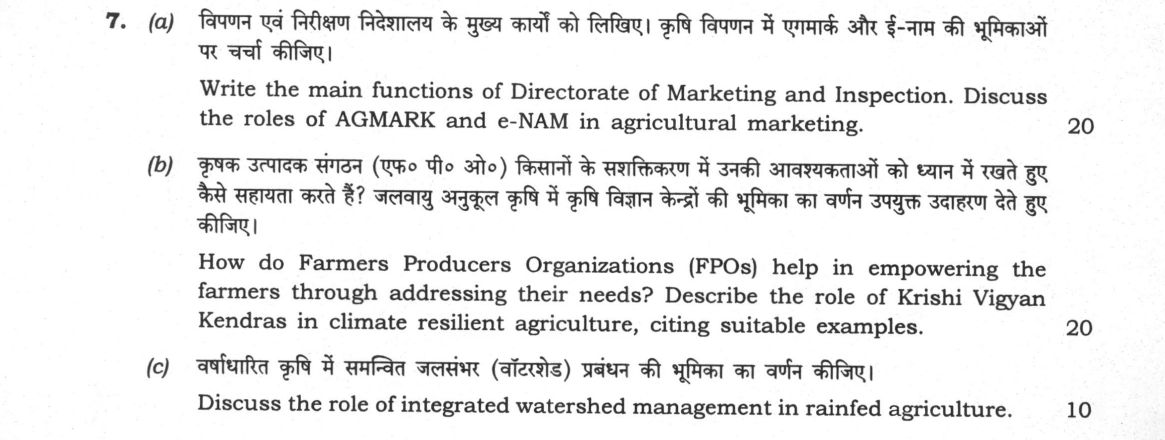
(a) Write the main functions of Directorate of Marketing and Inspection. Discuss the roles of AGMARK and e-NAM in agricultural…
Write the main functions of Directorate of Marketing and Inspection. Discuss the roles of AGMARK and e-NAM in agricultural marketing. 20 marks
How do Farmers Producers Organizations (FPOs) help in empowering the farmers through addressing their needs? Describe the role of Krishi Vigyan Kendras in climate resilient agriculture, citing suitable examples. 20 marks
Discuss the role of integrated watershed management in rainfed agriculture. 10 marks
हिंदी में प्रश्न पढ़ें
विपणन एवं निरीक्षण निदेशालय के मुख्य कार्यों को लिखिए। कृषि विपणन में एगमार्क और ई-नाम की भूमिकाओं पर चर्चा कीजिए। (20 अंक)
कृषक उत्पादक संगठन (एफ० पी० ओ०) किसानों के सशक्तिकरण में उनकी आवश्यकताओं को ध्यान में रखते हुए कैसे सहायता करते हैं? जलवायु अनुकूल कृषि में कृषि विज्ञान केन्द्रों की भूमिका का वर्णन उपयुक्त उदाहरण देते हुए कीजिए। (20 अंक)
वर्षाधारित कृषि में समन्वित जलसम्भर (वाटरशेड) प्रबन्धन की भूमिका का वर्णन कीजिए। (10 अंक)
Model answer
Written by UPSC Answer Check against this question's marking rubric, to the expected length. UPSC does not publish answers for Mains — this is one way to score well, not an official key.
India’s agricultural transformation relies on modern marketing infrastructure, institutional collectivization, and decentralized, climate-smart extension to enhance farm profitability and resilience.
DMI, AGMARK, and e-NAM in Agricultural Marketing The Directorate of Marketing and Inspection (DMI) under the Ministry of Agriculture spearheads marketing policy, standardization, market intelligence through AGMARKNET, and infrastructure development such as rural godowns. Legally backed by the Agricultural Produce (Grading and Marking) Act of 1937, AGMARK serves as a quality certification and grading system, standardizing agricultural and allied commodities for domestic consumption and export. Complementing physical grading, the electronic National Agriculture Market (e-NAM) serves as a pan-India trading portal integrating regulated APMC mandis. It facilitates transparent price discovery through e-auctions, quality assaying parameters, and warehouse-based trading utilizing electronic Negotiable Warehouse Receipts (e-NWRs). While hindered by interstate trade barriers and uneven assaying infrastructure, recent reforms, including the Platform-of-Platforms (PoP) and dedicated FPO trading modules, are strengthening supply chain integration.
Empowerment through FPOs and KVKs in Climate Resilience Farmer Producer Organizations (FPOs), supported by SFAC and NABARD, overcome the structural constraints of small and marginal landholdings by generating economies of scale. They empower farmers through collective input procurement at discounted rates, custom hiring centers, primary value addition, direct market linkages, and formal credit access, thereby eliminating intermediary exploitation.
Simultaneously, Krishi Vigyan Kendras (KVKs) act as first-line extension institutions for rapid technology transfer. In the domain of climate-resilient agriculture, particularly under the National Innovations in Climate Resilient Agriculture (NICRA) project, KVKs operationalize Climate-Smart Villages. They drive adaptation by introducing drought-tolerant and short-duration crop varieties (such as CR Dhan cultivars and dryland millets), demonstrating precision farming tools like laser land levelers and drip fertigation, and promoting bio-agent-based Integrated Pest Management (IPM) to cushion against extreme weather shifts.
Integrated Watershed Management in Rainfed Agriculture Integrated watershed management is the cornerstone of sustainability in rainfed areas, which constitute over half of India's cultivated land. By synchronizing ridge-to-valley treatments—such as contour bunding, percolation tanks, check dams, and vegetative barriers—it optimizes in-situ soil and moisture conservation, minimizes soil erosion, and accelerates groundwater recharge. This hydrological stabilization facilitates cropping system intensification, supports high-value crop diversification, and provides critical supplemental irrigation, thereby drought-proofing fragile agro-ecosystems.
Way Forward Sustained farm income security requires converging these domains: upgrading assaying facilities at e-NAM mandis, leveraging FPOs as aggregation nodes for climate-resilient produce validated by KVKs, and anchoring dryland farming inside rejuvenated watershed catchments.
What "Discuss" is asking you to do
Lay the issue out from more than one side — how it arose, what is claimed for it, what is held against it, and where it now stands. UPSC attaches discuss to broad topics with several live dimensions, so coverage of the dimensions earns more than the strength of your opinion.
Structure that answers it
Set the issue up → the case as it is made → the case against → the dimension both sides leave out → where the balance now lies
Where marks are lost
Listing facts with no thread between them, or arguing one side throughout and calling it a discussion.
How this answer will be evaluated
Approach
Framework: Concept > Practice or process > Data > Indian application. (a) discuss: intro > 3-4 dimensions > example > balanced close | (b) describe: define > structure or process in order > labelled diagram > significance | (c) discuss: intro > 3-4 dimensions > example > balanced close Full marks: Comprehensive, specific, and well-structured answers with named schemes, examples, and clear linkages.
Key points expected
- Functions of DM&I (e.g., APMC, grading, inspection)
- Role of AGMARK in quality assurance
- Role of e-NAM in market linkage
- Linkage to agricultural marketing efficiency
- How FPOs address farmer needs (e.g., input, credit, market)
- Role of Krishi Vigyan Kendras (KVKs) in extension
- Specific examples of climate resilient practices
- Linkage between FPOs and KVKs
Evaluation rubric
Each sub-part is marked on its own, against the marks and word limit printed on the paper.
- (a) Functions of DM&I and roles of AGMARK and e-NAM in agricultural marketing. 20 marks
discuss— intro → 3-4 dimensions → example → balanced close
Must cover
- Functions of DM&I (e.g., APMC, grading, inspection)
- Role of AGMARK in quality assurance
- Role of e-NAM in market linkage
- Linkage to agricultural marketing efficiency
Loses marks
- Vague description of DM&I without specific functions
- Confusing AGMARK with FSSAI or other certifications
Earns more
- Mention of specific DM&I acts (APMC, Weights & Measures)
- Specific e-NAM features (e.g., e-auction, single window)
Extra mark
- Recent e-NAM transaction volume or state count
- Specific AGMARK logo or standard example
- (b) FPOs in farmer empowerment and role of Krishi Vigyan Kendras in climate resilient agriculture. 20 marks
describe— define → structure or process in order → labelled diagram → significance
Must cover
- How FPOs address farmer needs (e.g., input, credit, market)
- Role of Krishi Vigyan Kendras (KVKs) in extension
- Specific examples of climate resilient practices
- Linkage between FPOs and KVKs
Loses marks
- Generic description of FPOs without specific needs addressed
- Vague mention of KVKs without specific climate practices
Earns more
- Mention of specific FPO schemes (e.g., PMFME)
- Specific KVK activities (e.g., training, demonstration)
Extra mark
- Named FPO success story
- Specific KVK location or project
- (c) Role of integrated watershed management in rainfed agriculture. 10 marks
discuss— intro → 3-4 dimensions → example → balanced close
Must cover
- Definition of integrated watershed management
- Specific components (e.g., check dams, contour bunds)
- Impact on rainfed agriculture (e.g., water retention, soil conservation)
- Linkage to agricultural productivity
Loses marks
- Vague description of watershed management without specific components
- Ignoring the 'integrated' aspect (e.g., only mentioning one component)
Earns more
- Mention of specific watershed schemes (e.g., DWR, MGNREGA)
- Specific examples of watershed structures
Extra mark
- Specific watershed project success story
- Data on water retention or yield increase
Practice this exact question
Write your answer and it is marked point by point against the model answer above — what you covered, what you missed, what you got wrong.
Evaluate my answer →More from Agriculture 2023 Paper I
- Q4 (a) Discuss the primary pathways of gaseous nitrogen losses from soil and the factors aff…
- Q5 Answer the following questions in about 150 words each: (a) Discuss the ways and means of…
- Q6 (a) Elaborate on the various problems encountered in agricultural production at dryland a…
- Q7 (a) Write the main functions of Directorate of Marketing and Inspection. Discuss the role…
- Q8 (a) What is the need for agricultural price policy? Write its objectives. Discuss the cri…