Paper I — Q6
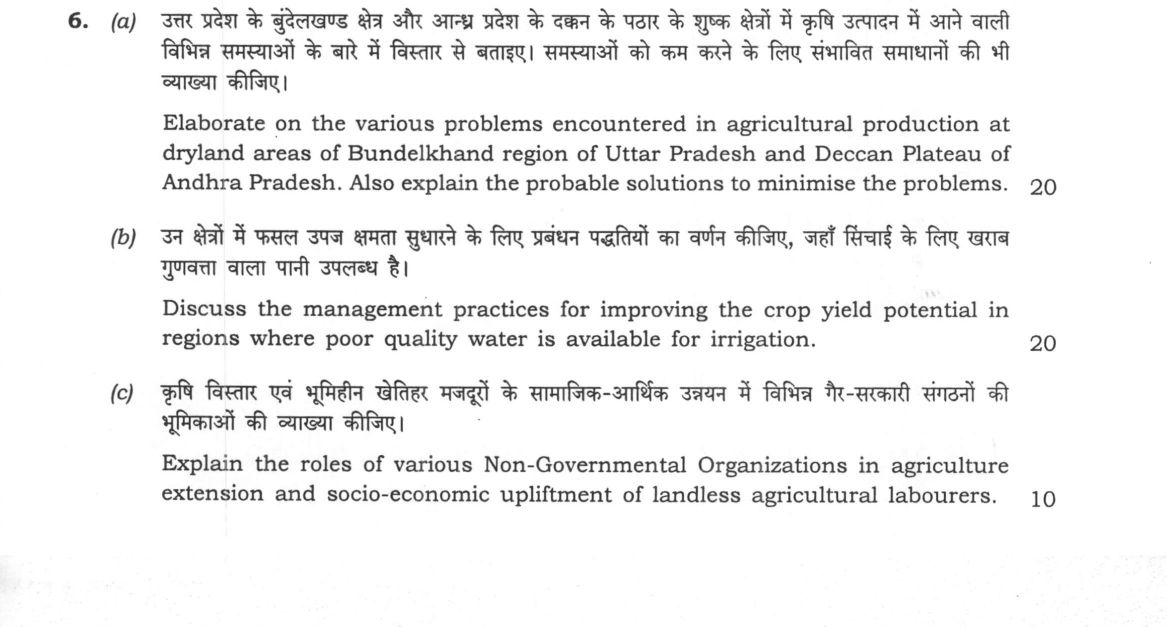
(a) Elaborate on the various problems encountered in agricultural production at dryland areas of Bundelkhand region of Uttar…
Elaborate on the various problems encountered in agricultural production at dryland areas of Bundelkhand region of Uttar Pradesh and Deccan Plateau of Andhra Pradesh. Also explain the probable solutions to minimise the problems. 20 marks
Discuss the management practices for improving the crop yield potential in regions where poor quality water is available for irrigation. 20 marks
Explain the roles of various Non-Governmental Organizations in agriculture extension and socio-economic upliftment of landless agricultural labourers. 10 marks
हिंदी में प्रश्न पढ़ें
उत्तर प्रदेश के बुन्देलखण्ड क्षेत्र और आन्ध्र प्रदेश के दक्कन के पठार के शुष्क क्षेत्रों में कृषि उत्पादन में आने वाली विभिन्न समस्याओं के बारे में विस्तार से बताइए। समस्याओं को कम करने के लिए संभावित समाधानों की भी व्याख्या कीजिए। (20 अंक)
उन क्षेत्रों में फसल उपज क्षमता सुधारने के लिए प्रबन्धन पद्धतियों का वर्णन कीजिए, जहाँ सिंचाई के लिए खराब गुणवत्ता वाला पानी उपलब्ध है। (20 अंक)
कृषि विस्तार एवं भूमिहीन खेतीहर मजदूरों के सामाजिक-आर्थिक उत्थान में विभिन्न गैर-सरकारी संगठनों की भूमिकाओं की व्याख्या कीजिए। (10 अंक)
Model answer
Written by UPSC Answer Check against this question's marking rubric, to the expected length. UPSC does not publish answers for Mains — this is one way to score well, not an official key.
Dryland Agriculture and Inclusive Extension: Challenges and Strategies
Dryland agriculture in India faces distinct biophysical and socio-economic hurdles, necessitating region-specific interventions and robust institutional support. The following analysis addresses the production constraints in key dryland zones, management of poor-quality water, and the role of NGOs in agricultural extension.
Biophysical Constraints and Solutions in Bundelkhand and Deccan Plateau
The Bundelkhand region of Uttar Pradesh and the Deccan Plateau of Andhra Pradesh represent two distinct dryland archetypes. Bundelkhand is characterized by erratic rainfall, typically ranging between 800–1000 mm with high inter-annual variability, shallow red or black soils, and undulating terrain prone to gully erosion. This leads to severe moisture stress and soil degradation. In contrast, the Deccan Plateau features Alfisols and Vertisols but suffers from deep moisture stress and rapid groundwater depletion due to over-extraction. Both regions face socio-economic vulnerabilities, including distress migration and debt traps, exacerbated by crop failure.
To mitigate these issues, a comparative approach is required. In Bundelkhand, watershed development under the National Watershed Development Programme for Arid and Semi-Arid Regions (NWDPRA) is critical. Specific interventions include farm ponds, gully plugging, and agroforestry with species like neem and babool to stabilize soils and enhance micro-climates. In the Deccan Plateau, conservation agriculture is paramount. The broadbed-furrow system and conservation furrows help retain moisture, while integrated nutrient management improves soil health. Institutional mechanisms such as Water User Associations (WUAs) and the creation of climate-resilient villages are essential for sustainable water governance. Additionally, promoting drought-resistant varieties like pigeon pea and sorghum, along with MGNREGA integration for rural infrastructure, provides a safety net for livelihoods.
Management of Poor Quality Water for Irrigation
Regions with saline (EC > 4 dS/m), sodic (SAR > 13), or saline-sodic water require precise agronomic and chemical management to maintain yield potential. It is crucial to distinguish between water and soil properties; while SAR classifies water sodicity, Exchangeable Sodium Percentage (ESP) is a soil indicator.
Reclamation and management strategies must be tailored to the specific water quality. For sodic soils (high ESP), gypsum application is the standard practice to replace exchangeable sodium with calcium in the soil matrix, improving permeability. Acidifying amendments like sulfuric acid are also used for sodic soil reclamation, not for salinity. Salinity, however, is managed through leaching with good-quality water and proper drainage design to remove salts from the root zone. Organic amendments such as farm yard manure (FYM) and green manure help buffer soil pH and improve structure.
Agronomic practices play a vital role. Crop-specific thresholds must be respected; for instance, salt-tolerant varieties like CSR-30 rice or KRL-210 wheat can be cultivated in saline conditions. Cropping system adjustments, such as replacing wheat with barley or mustard, can reduce salt accumulation. While drip and sprinkler irrigation improve water use efficiency, they do not inherently prevent salt accumulation and can cause leaf burn or concentrate salts at the wetting front if not managed with adequate leaching fractions. Therefore, a combination of mulching, raised bed planting, and controlled leaching is necessary to maintain soil health and crop yield.
Role of NGOs in Extension and Socio-Economic Upliftment
Non-Governmental Organizations (NGOs) bridge the gap between policy and ground reality, particularly for marginalized groups like landless agricultural laborers. In agricultural extension, NGOs facilitate technology demonstration, such as PRADAN’s promotion of System of Rice Intensification (SRI), and foster Farmer Producer Organizations (FPOs) for collective bargaining. They also drive participatory varietal selection and digital extension through linkages with Kisan Call Centres.
For landless laborers, NGOs focus on socio-economic upliftment through skill training, microfinance via Self-Help Groups (SHGs), and wage security facilitated through MGNREGA. Livelihood diversification is promoted through livestock-based activities like goat rearing and poultry, as seen in BAIF’s livestock development programs. MYRADA’s watershed plus approach and ActionAid’s climate adaptation initiatives provide holistic support. Furthermore, NGOs like Sehgal Foundation work on water security, while others facilitate land lease arrangements to ensure access to resources. Effective convergence with Agricultural Technology Management Agencies (ATMA), State Agricultural Universities, and district administration ensures that these interventions are scalable and sustainable.
Conclusion
Sustainable agriculture in dryland areas requires a multi-pronged strategy that addresses biophysical constraints through region-specific watershed and soil management, optimizes the use of poor-quality water through precise agronomic and chemical interventions, and leverages NGO partnerships for inclusive socio-economic development. This integrated approach is essential for ensuring food security and rural livelihood resilience.
What "Elaborate" is asking you to do
Give the full detailed account the question has compressed into a line — every dimension of it, with specifics. Elaborate rewards completeness and detail rather than clarification or argument: the examiner is checking whether you can fill out a topic without being told what its parts are.
Structure that answers it
State the proposition → first dimension in detail → second dimension in detail → the part the statement leaves implicit → the consolidated picture
Where marks are lost
Repeating the statement at greater length instead of adding substance. Elaborate also punishes narrowness: omitting a whole dimension costs more here than anywhere else in this family.
How this answer will be evaluated
Approach
Framework: Concept > Practice or process > Data > Indian application. (a) explain: definition/context > points in order > small example > short close | (b) discuss: intro > 3-4 dimensions > example > balanced close | (c) explain: definition/context > points in order > small example > short close Full marks: Comprehensive regional analysis with specific data, named schemes, and balanced solutions; clear distinction between regions and water types; detailed NGO roles with specific examples.
Key points expected
- Identify specific problems in Bundelkhand (UP) drylands
- Identify specific problems in Deccan Plateau (AP) drylands
- Explain probable solutions to minimize these problems
- Compare or contrast the two regions' challenges
- Identify types of poor quality water (saline, alkaline, etc.)
- Explain management practices for soil improvement
- Discuss crop selection and variety adaptation
- Mention irrigation techniques suitable for poor quality water
Evaluation rubric
Each sub-part is marked on its own, against the marks and word limit printed on the paper.
- (a) Detailed analysis of dryland agricultural problems in Bundelkhand and Deccan Plateau with specific solutions. 20 marks
explain— definition/context → points in order → small example → short close
Must cover
- Identify specific problems in Bundelkhand (UP) drylands
- Identify specific problems in Deccan Plateau (AP) drylands
- Explain probable solutions to minimize these problems
- Compare or contrast the two regions' challenges
Loses marks
- Vague generalities about dryland farming without regional specifics
- Confusing the two regions' problems
- Focusing only on problems without solutions
Earns more
- Mention specific crops affected in these regions
- Reference specific soil types (e.g., black soil, red soil)
- Discuss rainfall variability and drought patterns
- Mention specific government schemes for dryland farming
Extra mark
- Cite specific data on rainfall or yield in these regions
- Name specific research stations or institutions working in these areas
- (b) Management practices for improving crop yield with poor quality irrigation water. 20 marks
discuss— intro → 3-4 dimensions → example → balanced close
Must cover
- Identify types of poor quality water (saline, alkaline, etc.)
- Explain management practices for soil improvement
- Discuss crop selection and variety adaptation
- Mention irrigation techniques suitable for poor quality water
Loses marks
- Generic advice not specific to poor quality water
- Ignoring soil management aspects
- Not distinguishing between different water quality issues
Earns more
- Reference specific soil amendments (gypsum, organic matter)
- Name salt-tolerant crop varieties
- Discuss drainage and leaching requirements
- Mention specific research on water quality management
Extra mark
- Cite specific EC values or salinity thresholds
- Name specific schemes for water quality management
- (c) Roles of NGOs in agriculture extension and socio-economic upliftment of landless agricultural labourers. 10 marks
explain— definition/context → points in order → small example → short close
Must cover
- Explain NGO roles in agriculture extension
- Explain NGO roles in socio-economic upliftment
- Focus specifically on landless agricultural labourers
- Mention specific types of interventions by NGOs
Loses marks
- General NGO roles without focus on landless labourers
- Confusing NGO roles with government roles
- Ignoring the socio-economic dimension
Earns more
- Name specific NGOs working in this area
- Discuss skill development and training programs
- Mention microfinance or credit access initiatives
- Reference specific government-NGO partnerships
Extra mark
- Cite specific success stories or impact data
- Name specific schemes implemented by NGOs
Practice this exact question
Write your answer and it is marked point by point against the model answer above — what you covered, what you missed, what you got wrong.
Evaluate my answer →More from Agriculture 2023 Paper I
- Q3 (a) Give the specific features of organic farming and natural farming. Briefly discuss th…
- Q4 (a) Discuss the primary pathways of gaseous nitrogen losses from soil and the factors aff…
- Q5 Answer the following questions in about 150 words each: (a) Discuss the ways and means of…
- Q6 (a) Elaborate on the various problems encountered in agricultural production at dryland a…
- Q7 (a) Write the main functions of Directorate of Marketing and Inspection. Discuss the role…
- Q8 (a) What is the need for agricultural price policy? Write its objectives. Discuss the cri…