Paper II — Q1
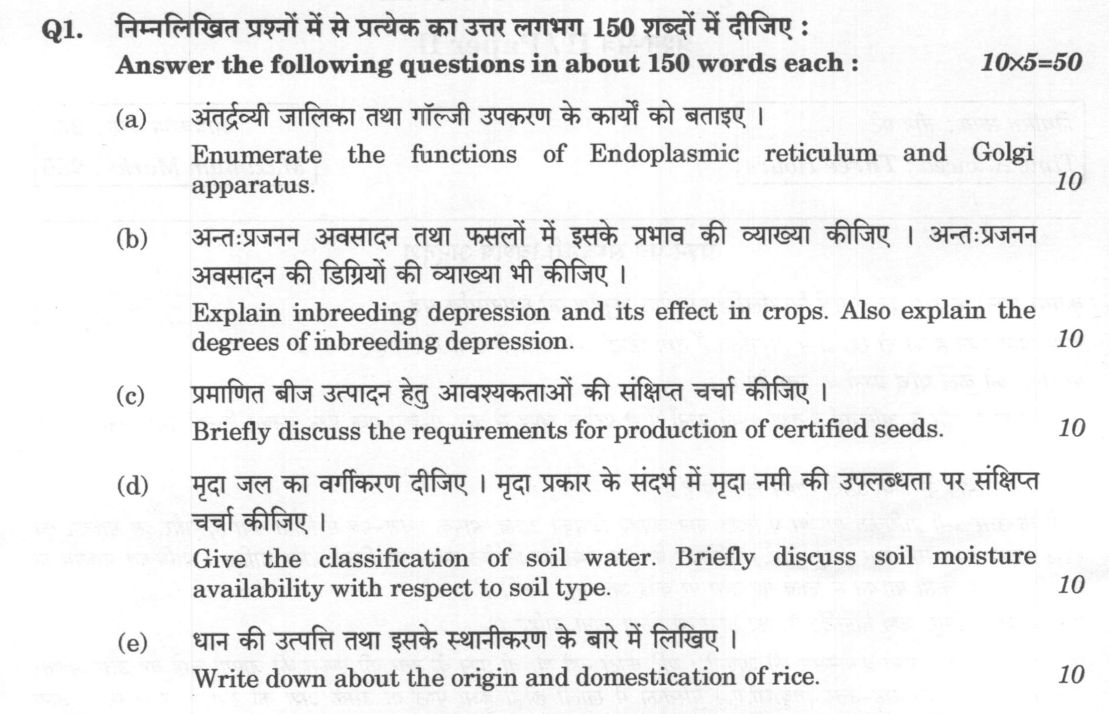
Answer the following questions in about 150 words each : 10×5=50 (a) Enumerate the functions of Endoplasmic reticulum and Golgi…
Answer the following questions in about 150 words each : 10×5=50
Enumerate the functions of Endoplasmic reticulum and Golgi apparatus. 10 marks
Explain inbreeding depression and its effect in crops. Also explain the degrees of inbreeding depression. 10 marks
Briefly discuss the requirements for production of certified seeds. 10 marks
Give the classification of soil water. Briefly discuss soil moisture availability with respect to soil type. 10 marks
Write down about the origin and domestication of rice. 10 marks
हिंदी में प्रश्न पढ़ें
निम्नलिखित प्रश्नों में से प्रत्येक का उत्तर लगभग 150 शब्दों में दीजिए : 10×5=50
अंतर्द्रव्यी जालिका तथा गॉल्जी उपकरण के कार्यों को बताइए । 10
अंतःप्रजनन अवसादन तथा फसलों में इसके प्रभाव की व्याख्या कीजिए । अंतःप्रजनन अवसादन की डिग्रियों की व्याख्या भी कीजिए । 10
प्रमाणित बीज उत्पादन हेतु आवश्यकताओं की संक्षिप्त चर्चा कीजिए । 10
मृदा जल का वर्गीकरण दीजिए । मृदा प्रकार के संदर्भ में मृदा नमी की उपलब्धता पर संक्षिप्त चर्चा कीजिए । 10
धान की उत्पत्ति तथा इसके स्थानीकरण के बारे में लिखिए । 10
Model answer
Written by UPSC Answer Check against this question's marking rubric, to the 150-word length. UPSC does not publish answers for Mains — this is one way to score well, not an official key.
Functions of Endoplasmic Reticulum and Golgi Apparatus
The Endoplasmic Reticulum (ER) and Golgi apparatus are integral components of the endomembrane system, performing distinct yet complementary roles in cellular metabolism. The ER, a network of membranous tubules, is primarily responsible for protein synthesis via ribosomes attached to the rough ER, lipid synthesis in the smooth ER, detoxification of drugs and poisons, and storage of calcium ions which regulate muscle contraction and cell signaling. The Golgi apparatus, a stack of flattened sacs, modifies, sorts, and packages proteins and lipids received from the ER. It adds carbohydrate groups to form glycoproteins, packages these molecules into vesicles for secretion or membrane insertion, and forms lysosomes containing hydrolytic enzymes. Together, they ensure the proper processing and distribution of cellular products.
Inbreeding Depression and Its Effects
Inbreeding depression refers to the reduced biological fitness in a given population resulting from inbreeding, which is the mating of closely related individuals. This phenomenon occurs because inbreeding increases homozygosity, exposing deleterious recessive alleles that were previously masked in heterozygous states. In crops, this leads to a significant loss of vigor, manifested as reduced yield, lower plant height, increased susceptibility to diseases, and higher mortality rates. The severity of inbreeding depression varies by crop and is classified into three degrees: mild, moderate, and severe. Crops like rice and wheat exhibit mild to moderate depression, allowing for self-pollination and line development. In contrast, cross-pollinated crops like maize and sorghum show severe depression, necessitating hybridization to maintain vigor. Understanding these degrees is crucial for breeding strategies, where self-pollinated crops can be improved through selection, while cross-pollinated crops rely on heterosis.
Requirements for Certified Seed Production
The production of certified seeds is governed by strict standards to ensure genetic purity and viability. The primary requirement is the use of foundation seed as the source material, which must be produced by the original breeder or an authorized agency. Field standards mandate specific isolation distances to prevent cross-contamination; for cross-pollinated crops like maize and pearl millet, the isolation distance for certified seed is 200 meters, whereas foundation seed requires 400 meters. Genetic purity must be maintained through roguing, where off-type plants are removed during growth stages. Seed standards include minimum germination percentages, which vary by crop; for instance, maize certified seed typically requires a germination rate of approximately 90%, not a broad range. Physical purity, freedom from weed seeds, and absence of pests are also critical. Finally, seeds must be inspected by certified seed agencies, labeled with details of the variety, lot number, and date of certification, and sold through authorized dealers to ensure traceability and quality assurance.
Classification of Soil Water and Moisture Availability
Soil water is classified into three categories based on the force holding it to soil particles: gravitational water, capillary water, and hygroscopic water. Gravitational water moves downward due to gravity and is available to plants only temporarily after rainfall. Capillary water is held in soil pores by capillary forces and is the primary source of water for plant roots. Hygroscopic water is held tightly to soil particles by molecular forces and is unavailable to plants. Soil moisture availability varies significantly with soil type. Sandy soils have large pores, leading to high gravitational water loss and low field capacity, resulting in poor water retention. Clay soils have small pores, retaining high amounts of capillary water but with poor aeration. Loamy soils, with a balanced mix of sand, silt, and clay, offer the best water-holding capacity and aeration, providing optimal moisture availability for crops. The available water is the difference between field capacity and the permanent wilting point, which is highest in loamy soils.
Origin and Domestication of Rice
Rice (Oryza sativa) originated in Asia, with two primary centers of domestication identified: the Indochina/India region and the Yangtze River valley in China. The wild progenitor of cultivated rice is Oryza rufipogon, with Oryza nivara often considered an intermediate stage in domestication. Archaeological evidence suggests that rice was first domesticated in the Ganga plains of India and the Yangtze valley of China around 8,000 to 10,000 years ago. Genetic studies indicate that japonica and indica varieties diverged from a common ancestor, with japonica likely originating in China and indica in India. Domestication involved the selection of traits such as non-shattering panicles, which allowed for easier harvesting, and increased grain size. The spread of rice from these centers to other parts of Asia and the world was facilitated by trade and migration, making it a staple crop in many cultures. The domestication of rice was a pivotal event in agricultural history, supporting the growth of early civilizations in South and East Asia.
What "Enumerate" is asking you to do
Produce the complete set of items asked for, countable and correctly named. The examiner marks against a checklist, so a missing item costs and an elaborated one gains nothing — where discussion is wanted the stem asks for it as a separate sub-part.
Structure that answers it
One line naming the basis on which the set is drawn → items numbered, each in a phrase or a single line → the discussion sub-part taken up separately, after the list is complete
Where marks are lost
Treating it as an essay. Six items named in six lines score better than three items explained at length.
How this answer will be evaluated
Approach
Framework: Concept > Practice or process > Data > Indian application. (a) enumerate: list the items in order > one line each > no commentary | (b) explain: definition/context > points in order > small example > short close | (c) discuss: intro > 3-4 dimensions > example > balanced close | (d) describe: define > structure or process in order > labelled diagram > significance | (e) write short notes: define > 3-4 key features > one example > one-line significance Full marks: All parts answered with specific details, named schemes/varieties, and correct command word application.
Key points expected
- Functions of Endoplasmic reticulum
- Functions of Golgi apparatus
- List format (no commentary)
- Definition of inbreeding depression
- Effect on crop yield/vigor
- Degrees of inbreeding depression
- Requirements for certified seed production
- Mention of seed certification agency (e.g., NHB)
Evaluation rubric
Each sub-part is marked on its own, against the marks and word limit printed on the paper.
- (a) List functions of Endoplasmic reticulum and Golgi apparatus. 10 marks · 150 words
enumerate— list the items in order → one line each → no commentary
Must cover
- Functions of Endoplasmic reticulum
- Functions of Golgi apparatus
- List format (no commentary)
Loses marks
- Writing paragraphs instead of a list
- Confusing ER and Golgi functions
Earns more
- Distinction between Rough and Smooth ER
- Mention of vesicle transport
Extra mark
- Mention of specific enzymes (e.g., glycosyltransferases)
- (b) Explain inbreeding depression, its effect in crops, and its degrees. 10 marks · 150 words
explain— definition/context → points in order → small example → short close
Must cover
- Definition of inbreeding depression
- Effect on crop yield/vigor
- Degrees of inbreeding depression
Loses marks
- Omitting the 'degrees' part of the question
- Vague agronomic advice without genetic basis
Earns more
- Mention of heterosis (hybrid vigor) as contrast
- Specific crop example (e.g., maize)
Extra mark
- Mention of specific genetic mechanism (e.g., recessive alleles)
- (c) Discuss requirements for production of certified seeds. 10 marks · 150 words
discuss— intro → 3-4 dimensions → example → balanced close
Must cover
- Requirements for certified seed production
- Mention of seed certification agency (e.g., NHB)
- Mention of isolation distance
Loses marks
- Vague agronomic advice
- MSP-only solutions
Earns more
- Mention of specific seed classes (Breeder, Foundation, Certified)
- Mention of seed testing lab
Extra mark
- Mention of specific scheme (e.g., National Seed Plan)
- (d) Classify soil water and discuss moisture availability by soil type. 10 marks · 150 words
describe— define → structure or process in order → labelled diagram → significance
Must cover
- Classification of soil water (Gravitational, Capillary, Hygroscopic)
- Soil moisture availability
- Relation to soil type (texture)
Loses marks
- Omitting the classification part
- Vague agronomic advice
Earns more
- Mention of field capacity and wilting point
- Mention of specific soil types (e.g., sandy vs clayey)
Extra mark
- Mention of specific water potential values
- (e) Write about the origin and domestication of rice. 10 marks · 150 words
write short notes— define → 3-4 key features → one example → one-line significance
Must cover
- Origin of rice
- Domestication of rice
- Mention of specific species (e.g., Oryza sativa)
Loses marks
- Vague agronomic advice
- MSP-only solutions
Earns more
- Mention of specific region (e.g., Yangtze River valley)
- Mention of specific time period (e.g., 10,000 years ago)
Extra mark
- Mention of specific archaeological site (e.g., Hemudu)
Practice this exact question
Write your answer and it is marked point by point against the model answer above — what you covered, what you missed, what you got wrong.
Evaluate my answer →More from Agriculture 2023 Paper II
- Q1 Answer the following questions in about 150 words each : 10×5=50 (a) Enumerate the functi…
- Q2 (a) Enlist the molecular models of cell membrane and explain the models given by S.J. Sin…
- Q3 (a) Describe the history of plant breeding in India. Write the objectives of plant breedi…
- Q4 (a) Discuss different forms of Intellectual Property Rights (IPR) in India. 20 (b) Give a…