Paper II — Q6
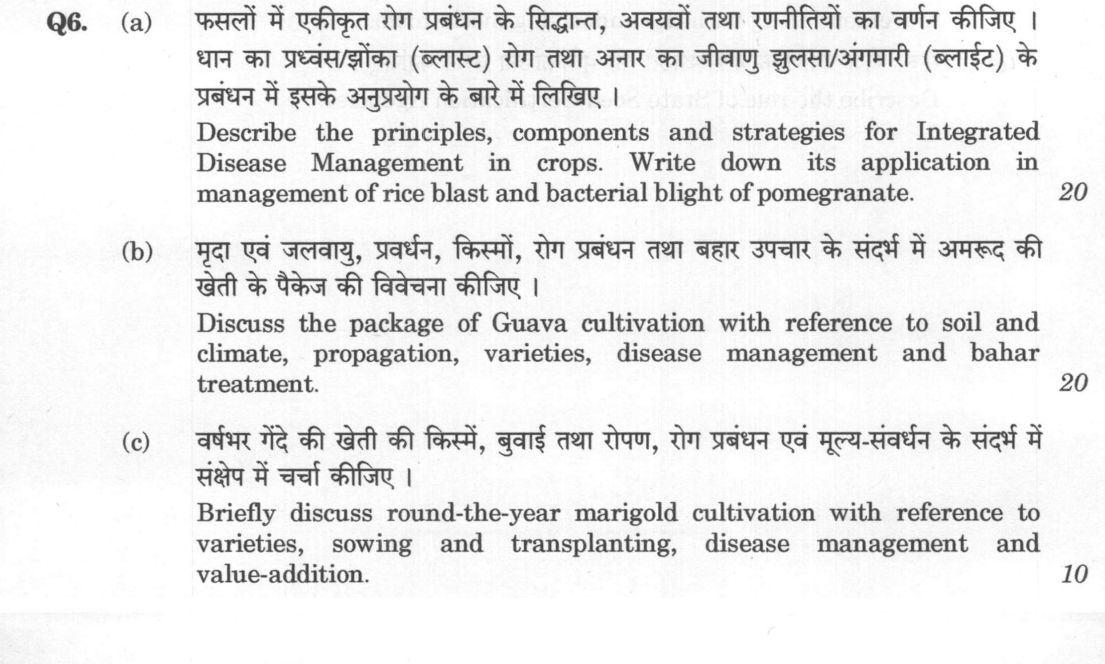
(a) Describe the principles, components and strategies for Integrated Disease Management in crops. Write down its application in…
Describe the principles, components and strategies for Integrated Disease Management in crops. Write down its application in management of rice blast and bacterial blight of pomegranate. 20 marks
Discuss the package of Guava cultivation with reference to soil and climate, propagation, varieties, disease management and bahar treatment. 20 marks
Briefly discuss round-the-year marigold cultivation with reference to varieties, sowing and transplanting, disease management and value-addition. 10 marks
हिंदी में प्रश्न पढ़ें
फसलों में एकीकृत रोग प्रबंधन के सिद्धांत, अवयवों तथा रणनीतियों का वर्णन कीजिए । धान का प्रघंस/झोंका (ब्लास्ट) रोग तथा अनार का जीवाणु झुलसा/अंगमारी (ब्लाइट) के प्रबंधन में इसके अनुप्रयोग के बारे में लिखिए । 20
मृदा एवं जलवायु, प्रवर्धन, किस्मों, रोग प्रबंधन तथा बहार उपचार के संदर्भ में अमरूद की खेती के पैकेज की विवेचना कीजिए । 20
वर्षभर गेंदे की खेती की किस्में, बुवाई तथा रोपण, रोग प्रबंधन एवं मूल्य-संवर्धन के संदर्भ में संक्षेप में चर्चा कीजिए । 10
Model answer
Written by UPSC Answer Check against this question's marking rubric, to the expected length. UPSC does not publish answers for Mains — this is one way to score well, not an official key.
Integrated Disease Management (IDM) in Crops
Integrated Disease Management (IDM) harmonizes cultural, biological, physical, host resistance, and chemical strategies to suppress phytopathogen populations below the Economic Injury Level (EIL) while minimizing agro-ecosystem disruption. Its core principles comprise pathogen exclusion, continuous surveillance, and multi-tactic intervention anchored to the Economic Threshold Level (ETL). The integration hierarchy prioritizes host resistance and cultural manipulation, supplemented by biocontrol agents, utilizing targeted chemical fungicides purely as a last-resort corrective measure.
In rice blast (Pyricularia oryzae), IDM involves cultivating blast-resistant varieties like IR64 or Pusa Basmati 1637, optimizing plant density, and adopting split nitrogen application to prevent succulent, disease-prone growth. Pre-sowing seed bio-priming with Trichoderma harzianum (4 g/kg) or Pseudomonas fluorescens (10 g/kg) limits seedling infection. If leaf blast exceeds the 5–10% ETL, need-based foliar sprays of tricyclazole 75 WP (0.6 g/L) or isoprothiolane are applied.
For bacterial blight of pomegranate (Xanthomonas axonopodis pv. punicae), IDM focuses on utilizing certified disease-free nursery stock and treating cuttings with hot water (50°C for 30 minutes). Field sanitation involves pruning infected shoots with sterilized secateurs, followed by 10% Bordeaux paste application on cut ends. Biocontrol involves root zone inoculation with Pseudomonas fluorescens. Prophylactic foliar sprays combine copper oxychloride (0.25%) with bactericides such as streptocycline (500 ppm) during high-risk humid flushes.
Package of Practices for Guava Cultivation
Guava (Psidium guajava) thrives across tropical and subtropical regions receiving 1000–2000 mm rainfall. It performs best in deep, well-drained sandy loam to clay loam soils with a pH of 5.5–7.0, showing moderate tolerance to salinity. Commercial multiplication relies on vegetative propagation—principally wedge grafting and air-layering—to maintain clonal fidelity, though budding is also practiced. Prominent varieties include Allahabad Safeda, Lucknow-49 (Sardar), Lalit (red-fleshed), and Taiwan Pink.
Bahar treatment regulates flowering across three seasons: Ambe bahar (February–March flowering), Mrig bahar (June–July flowering), and Hasta bahar (October flowering). To secure a superior winter harvest (Mrig bahar) and eliminate the rainy-season crop vulnerable to fruit fly (Bactrocera correcta), irrigation is withheld during April–May to induce leaf drop. Alternatively, deblossoming is achieved by spraying 10% urea or 600 ppm NAA during summer. Guava wilt (Fusarium oxysporum f. sp. psidii and Ganoderma lucidum) is managed by soil solarization, application of *Trichoderma viride*-enriched farmyard manure, and soil drenching with carbendazim (0.1%). Anthracnose (Colletotrichum gloeosporioides) is controlled through pruning and canopy sprays of copper oxychloride (0.3%).
Round-the-Year Marigold Cultivation
Continuous, year-round marigold (Tagetes spp.) production is achieved through staggered nursery sowings across three seasons: rainy (sown June–July), winter (sown August–September), and summer (sown January–February). Seedlings aged 30–40 days are transplanted into open fields or under protected shade-net structures with drip fertigation. African marigold cultivars (Pusa Narangi Gainda, Pusa Basanti Gainda) are preferred for winter and main-season loose flower harvests, whereas French marigold types (Pusa Arpita) offer heat tolerance for summer cultivation. Precision farming under protected structures safeguards offseason blooms from adverse weather and pest surges.
Key diseases include damping-off and collar rot (Rhizoctonia solani, Phytophthora spp.), managed by seed treatment with captan and soil drenching with metalaxyl-mancozeb (0.2%), while Alternaria leaf spot is contained with Mancozeb sprays (0.2%). Value addition includes industrial lutein and carotenoid extraction for poultry feed pigmentation and nutraceuticals, essential oil distillation for perfumery, and natural dye extraction for textiles. Proper post-harvest grading, pulsing with sucrose solutions, and moisture-controlled packaging significantly extend loose flower freshness and vase life for the garland trade.
Adopting integrated crop protection coupled with standardized horticultural management and precision floriculture provides a pathway toward ecological sustainability, crop intensification, and enhanced farm profitability.
What "Describe" is asking you to do
Give a full, ordered account of the thing named — its parts, stages or mechanism — in the sequence in which it actually exists or occurs. Most describe questions come from the science optionals, where the marks sit in correct technical detail and, where the stem says so, a labelled diagram.
Structure that answers it
One-line identification of the subject → the parts or stages in their real order, each with its defining detail → labelled diagram where the subject is structural → closing line on function or significance
Where marks are lost
Loose general prose where the examiner is ticking named parts, correct terminology and their sequence; and in the General Studies papers, turning to evaluation before the description is finished.
How this answer will be evaluated
Approach
Framework: Concept > Practice or process > Data > Indian application. (a) describe: define > structure or process in order > labelled diagram > significance | (b) discuss: intro > 3-4 dimensions > example > balanced close | (c) discuss: intro > 3-4 dimensions > example > balanced close Full marks: Comprehensive, specific, and well-structured answers with named varieties, specific chemicals, and clear application of concepts.
Key points expected
- Define IDM principles (prevention, suppression, monitoring)
- List IDM components (cultural, biological, chemical, host resistance)
- Management strategy for rice blast (Magnaporthe oryzae)
- Management strategy for pomegranate bacterial blight (Xanthomonas citri)
- Soil and climate requirements for Guava
- Propagation methods (seed, cutting, grafting)
- Named Guava varieties (e.g., Allahabad Safeda, Arka Mridula)
- Bahar treatment protocol (chemicals like KNO3, timing)
Evaluation rubric
Each sub-part is marked on its own, against the marks and word limit printed on the paper.
- (a) Define IDM principles, components, and strategies; apply to rice blast and pomegranate bacterial blight. 20 marks
describe— define → structure or process in order → labelled diagram → significance
Must cover
- Define IDM principles (prevention, suppression, monitoring)
- List IDM components (cultural, biological, chemical, host resistance)
- Management strategy for rice blast (Magnaporthe oryzae)
- Management strategy for pomegranate bacterial blight (Xanthomonas citri)
Loses marks
- Vague agronomic advice without specific agents
- Confusing blast with other rice diseases
- Ignoring the 'integrated' aspect (relying only on chemicals)
Earns more
- Specific fungicide/bactericide names (e.g., Tricyclazole, Copper oxychloride)
- Mention of resistant varieties (e.g., Pusa 44, Pusa 123)
- Specific cultural practices (e.g., deep ploughing, crop rotation)
- Biological control agents (e.g., Trichoderma, Pseudomonas)
Extra mark
- Mention of specific Indian research institute (e.g., ICAR-IARI)
- Reference to specific government scheme for crop protection
- (b) Detail Guava cultivation package: soil/climate, propagation, varieties, disease management, and bahar treatment. 20 marks
discuss— intro → 3-4 dimensions → example → balanced close
Must cover
- Soil and climate requirements for Guava
- Propagation methods (seed, cutting, grafting)
- Named Guava varieties (e.g., Allahabad Safeda, Arka Mridula)
- Bahar treatment protocol (chemicals like KNO3, timing)
Loses marks
- Generic fruit cultivation advice not specific to Guava
- Missing 'bahar treatment' details
- Vague variety names (e.g., 'white guava' instead of 'Allahabad Safeda')
Earns more
- Specific disease names (e.g., Anthracnose, Leaf spot)
- Specific spacing and pruning details
- Mention of specific fungicides for disease management
- Details on irrigation requirements
Extra mark
- Mention of specific state known for Guava (e.g., Maharashtra, Karnataka)
- Reference to specific market price or demand data
- (c) Briefly cover round-the-year Marigold cultivation: varieties, sowing/transplanting, disease management, value-addition. 10 marks
discuss— intro → 3-4 dimensions → example → balanced close
Must cover
- Marigold varieties (e.g., Single, Double, African, French)
- Sowing and transplanting schedule for round-the-year production
- Disease management (e.g., Damping off, Leaf blight)
- Value-addition methods (e.g., Dried flowers, essential oil, garlands)
Loses marks
- Ignoring 'round-the-year' aspect (only discussing one season)
- Vague value-addition (e.g., 'selling flowers' instead of 'dried flowers, oil')
- Missing disease management details
Earns more
- Specific sowing months for different seasons
- Specific fungicides for damping off
- Details on essential oil extraction
- Mention of specific market uses (e.g., temple offerings, decoration)
Extra mark
- Mention of specific state known for Marigold (e.g., Tamil Nadu, Karnataka)
- Reference to specific export data or market trends
Practice this exact question
Write your answer and it is marked point by point against the model answer above — what you covered, what you missed, what you got wrong.
Evaluate my answer →More from Agriculture 2023 Paper II
- Q3 (a) Describe the history of plant breeding in India. Write the objectives of plant breedi…
- Q4 (a) Discuss different forms of Intellectual Property Rights (IPR) in India. 20 (b) Give a…
- Q5 Answer the following questions in about 150 words each : 10×5=50 (a) Write down the const…
- Q6 (a) Describe the principles, components and strategies for Integrated Disease Management…
- Q7 (a) Enlist various photosynthetic pigments. Give a detailed account of chlorophyll synthe…
- Q8 (a) How has food production, including horticultural crops, changed in India during the l…