Paper II — Q3
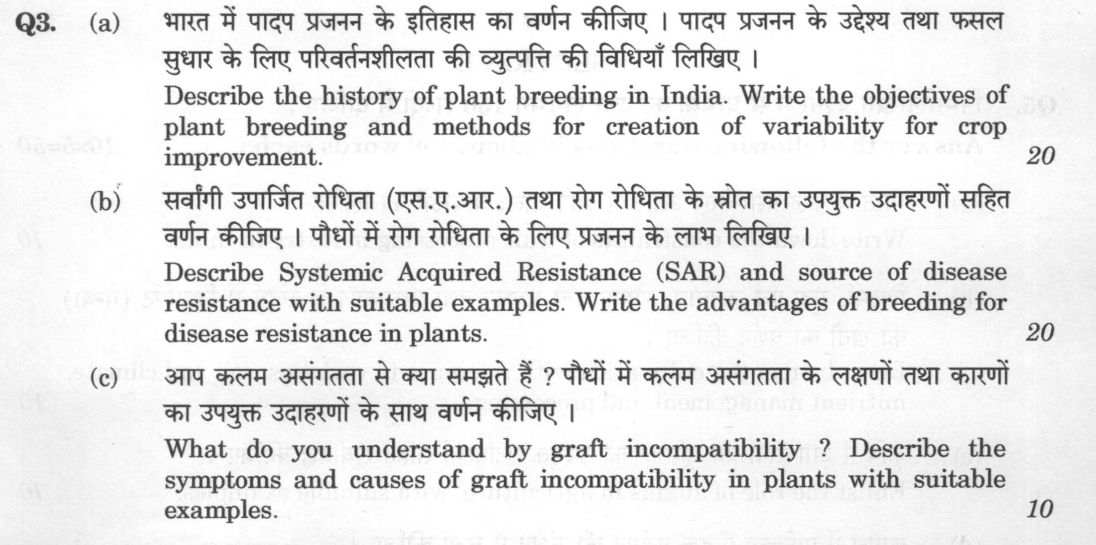
(a) Describe the history of plant breeding in India. Write the objectives of plant breeding and methods for creation of…
Describe the history of plant breeding in India. Write the objectives of plant breeding and methods for creation of variability for crop improvement. 20 marks
Describe Systemic Acquired Resistance (SAR) and source of disease resistance with suitable examples. Write the advantages of breeding for disease resistance in plants. 20 marks
What do you understand by graft incompatibility ? Describe the symptoms and causes of graft incompatibility in plants with suitable examples. 10 marks
हिंदी में प्रश्न पढ़ें
भारत में पादप प्रजनन के इतिहास का वर्णन कीजिए । पादप प्रजनन के उद्देश्य तथा फसल सुधार के लिए परिवर्तनशीलता की व्युत्पत्ति की विधियाँ लिखिए । 20
सर्वांगी उपार्जित रोधिता (एस.ए.आर.) तथा रोग रोधिता के स्रोत का उपयुक्त उदाहरणों सहित वर्णन कीजिए । पौधों में रोग रोधिता के लिए प्रजनन के लाभ लिखिए । 20
आप कलम असंगतता से क्या समझते हैं ? पौधों में कलम असंगतता के लक्षणों तथा कारणों का उपयुक्त उदाहरणों के साथ वर्णन कीजिए । 10
Model answer
Written by UPSC Answer Check against this question's marking rubric, to the expected length. UPSC does not publish answers for Mains — this is one way to score well, not an official key.
Plant Breeding and Crop Improvement in India
History of Plant Breeding The history of plant breeding in India is a continuum from indigenous selection to scientific precision. While the Vrikshayurveda (c. 600 BCE) documents ancient horticultural practices and plant health management, it serves as a precursor rather than a formal breeding record. Systematic breeding began with the establishment of the Royal Botanic Garden at Saharanpur in 1817, which focused on ornamental and economic species. The pivotal shift occurred with the founding of the Imperial Agricultural Research Institute (IARI) in 1905, marking the era of scientific crop improvement. Post-independence, the Green Revolution transformed Indian agriculture through the introduction of high-yielding varieties like IR8 rice and Sonalika wheat, coordinated by ICAR. The modern era is defined by molecular breeding, with institutions like NBPGR conserving germplasm and BARC advancing mutation breeding, ensuring a robust pipeline for food security.
Objectives and Methods for Variability The primary objectives of plant breeding are to enhance yield potential, improve nutritional quality, and confer tolerance to biotic stresses (pests, diseases) and abiotic stresses (drought, salinity). Additionally, breeding aims to widen the adaptability of crops to diverse agro-climatic zones. To achieve these goals, variability must be created. Key methods include:
- Hybridization: Crossing genetically diverse parents to combine desirable traits.
- Mutation Breeding: Inducing heritable changes using physical (radiation) or chemical mutagens, as practiced at BARC.
- Polyploidy: Doubling chromosome sets to increase vigor and size.
- Genetic Engineering: Introducing specific genes for traits like Bt cotton.
- Somaclonal Variation: Exploiting genetic instability during tissue culture.
Systemic Acquired Resistance (SAR) SAR is an inducible, systemic defense mechanism triggered by a localized infection, providing broad-spectrum resistance against subsequent attacks. The signaling pathway involves the accumulation of salicylic acid (SA), which activates the NPR1 gene. This leads to the expression of Pathogenesis-Related (PR) proteins that inhibit pathogen growth. For instance, in tobacco, a localized TMV infection triggers SAR, protecting the entire plant from secondary TMV or bacterial attacks.
Sources of Disease Resistance Resistance sources are distinct from the type of resistance (vertical/horizontal). Actual sources include:
- Wild Relatives: E.g., Oryza rufipogon for blast resistance in rice.
- Landraces: Traditional varieties like Pusa wheat strains resistant to stem rust.
- Mutants: Spontaneous or induced lines with novel resistance genes.
- Transgenic Lines: Plants engineered with resistance genes from unrelated species.
Advantages of Breeding for Resistance Breeding for disease resistance offers significant advantages: it reduces the dependency on chemical pesticides, thereby lowering production costs and minimizing environmental pollution. It ensures durability when multiple resistance genes are pyramided, and it is a cost-effective, long-term solution compared to repeated chemical applications.
Graft Incompatibility Graft incompatibility is the failure of a scion and rootstock to form a functional vascular union, despite technical success in the grafting procedure. Symptoms:
- Immediate: Necrosis at the graft union, overgrowth of callus tissue, or failure of the scion to bud.
- Delayed: The graft initially succeeds but fails after a few seasons due to vascular discontinuity, leading to premature death or reduced vigor.
- Physiological: Chlorosis, stunted growth, or abnormal fruiting.
Causes:
- Genetic Incongruity: Incompatibility genes in the rootstock or scion.
- Biochemical Barriers: Differences in hormone levels or metabolic pathways.
- Viral Transmission: Pathogens moving from rootstock to scion.
- Tissue Differences: Mismatch in cambial alignment or cell wall composition.
Examples:
- Citrus: Sweet orange scions on trifoliate orange rootstocks often show delayed incompatibility.
- Pome Fruits: Pear scions on quince rootstocks may exhibit overgrowth.
- Mango: Certain rootstock-scion combinations at IIHR show reduced longevity due to vascular incompatibility.
Conclusion Effective crop improvement in India requires an integrated approach. By combining traditional knowledge with modern tools like SAR exploitation and precise grafting techniques, India can develop resilient, high-yielding crop varieties. Institutions like IARI, NBPGR, and IIHR must continue to collaborate, leveraging germplasm resources to address emerging challenges in climate change and disease pressure.
What "Describe" is asking you to do
Give a full, ordered account of the thing named — its parts, stages or mechanism — in the sequence in which it actually exists or occurs. Most describe questions come from the science optionals, where the marks sit in correct technical detail and, where the stem says so, a labelled diagram.
Structure that answers it
One-line identification of the subject → the parts or stages in their real order, each with its defining detail → labelled diagram where the subject is structural → closing line on function or significance
Where marks are lost
Loose general prose where the examiner is ticking named parts, correct terminology and their sequence; and in the General Studies papers, turning to evaluation before the description is finished.
How this answer will be evaluated
Approach
Framework: Concept > Practice or process > Data > Indian application. (a) describe: define > structure or process in order > labelled diagram > significance | (b) describe: define > structure or process in order > labelled diagram > significance | (c) describe: define > structure or process in order > labelled diagram > significance Full marks: Precise, specific, and well-structured with named examples and Indian context.
Key points expected
- History of plant breeding in India
- Objectives of plant breeding
- Methods for creation of variability
- Context of crop improvement
- Description of Systemic Acquired Resistance (SAR)
- Sources of disease resistance with examples
- Advantages of breeding for disease resistance
- Suitable examples for resistance sources
Evaluation rubric
Each sub-part is marked on its own, against the marks and word limit printed on the paper.
- (a) Chronological history of Indian plant breeding, its objectives, and methods for creating variability. 20 marks
describe— define → structure or process in order → labelled diagram → significance
Must cover
- History of plant breeding in India
- Objectives of plant breeding
- Methods for creation of variability
- Context of crop improvement
Loses marks
- Vague agronomic advice without specific methods
- MSP-only solutions or generic history
Earns more
- Mention of specific Indian institutions (e.g., IARI, ICAR)
- Specific examples of variability methods (mutation, hybridization)
- Linkage of objectives to Indian crop needs
Extra mark
- Named Indian scientist or specific variety
- Recent scheme or policy figure
- (b) Description of SAR, sources of disease resistance, and advantages of breeding for resistance. 20 marks
describe— define → structure or process in order → labelled diagram → significance
Must cover
- Description of Systemic Acquired Resistance (SAR)
- Sources of disease resistance with examples
- Advantages of breeding for disease resistance
- Suitable examples for resistance sources
Loses marks
- Confusing SAR with local resistance
- Vague agronomic advice without specific examples
Earns more
- Distinction between SAR and SISR
- Specific pathogen-plant interaction examples
- Economic or agronomic advantages of resistance
Extra mark
- Named cultivar with specific resistance
- Recent scheme or policy figure
- (c) Definition of graft incompatibility, its symptoms, and causes with examples. 10 marks
describe— define → structure or process in order → labelled diagram → significance
Must cover
- Definition of graft incompatibility
- Symptoms of graft incompatibility
- Causes of graft incompatibility
- Suitable examples of incompatibility
Loses marks
- Vague agronomic advice without specific causes
- Confusing symptoms with general plant stress
Earns more
- Physiological or anatomical causes
- Specific plant species examples
- Distinction between physiological and anatomical
Extra mark
- Named specific graft combination
- Recent scheme or policy figure
Practice this exact question
Write your answer and it is marked point by point against the model answer above — what you covered, what you missed, what you got wrong.
Evaluate my answer →More from Agriculture 2023 Paper II
- Q1 Answer the following questions in about 150 words each : 10×5=50 (a) Enumerate the functi…
- Q2 (a) Enlist the molecular models of cell membrane and explain the models given by S.J. Sin…
- Q3 (a) Describe the history of plant breeding in India. Write the objectives of plant breedi…
- Q4 (a) Discuss different forms of Intellectual Property Rights (IPR) in India. 20 (b) Give a…
- Q5 Answer the following questions in about 150 words each : 10×5=50 (a) Write down the const…
- Q6 (a) Describe the principles, components and strategies for Integrated Disease Management…