Paper II — Q5
Answer the following questions in about 150 words each : 10×5=50 (a) Write down the constraints of fruit processing industry in…
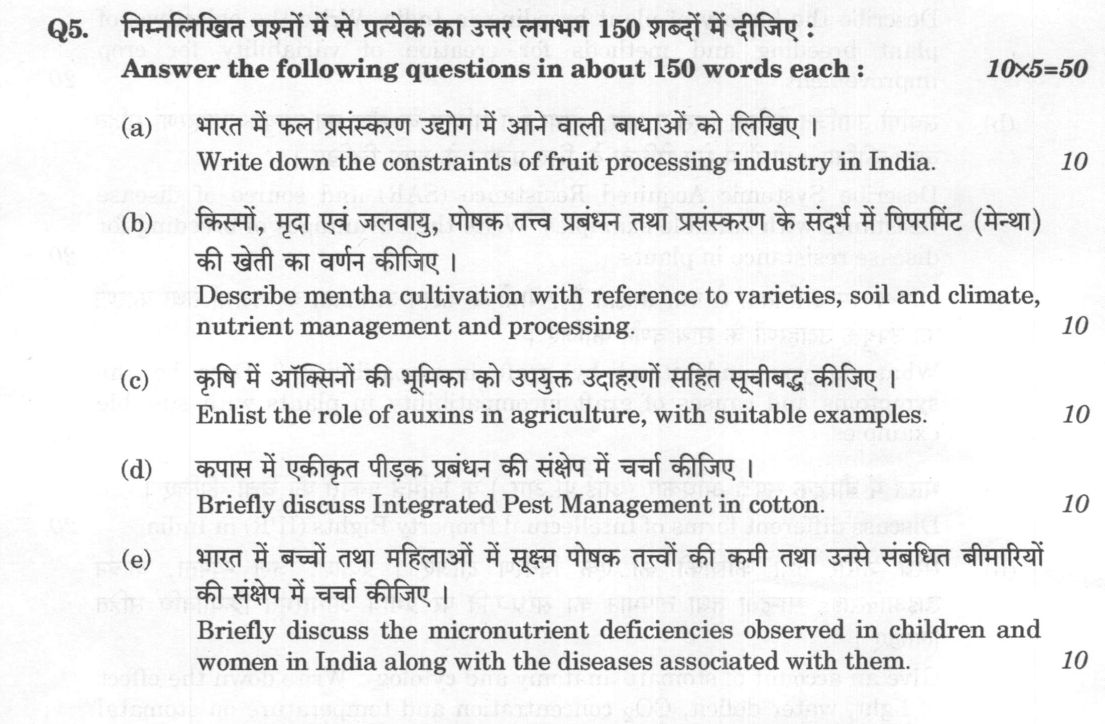
Answer the following questions in about 150 words each : 10×5=50
Write down the constraints of fruit processing industry in India. 10 marks
Describe mentha cultivation with reference to varieties, soil and climate, nutrient management and processing. 10 marks
Enlist the role of auxins in agriculture, with suitable examples. 10 marks
Briefly discuss Integrated Pest Management in cotton. 10 marks
Briefly discuss the micronutrient deficiencies observed in children and women in India along with the diseases associated with them. 10 marks
हिंदी में प्रश्न पढ़ें
निम्नलिखित प्रश्नों में से प्रत्येक का उत्तर लगभग 150 शब्दों में दीजिए : 10×5=50
भारत में फल प्रसंस्करण उद्योग में आने वाली बाधाओं को लिखिए । 10
किस्मों, मृदा एवं जलवायु, पोषक तत्व प्रबंधन तथा प्रसंस्करण के संदर्भ में पिपरमिंट (मेंथा) की खेती का वर्णन कीजिए । 10
कृषि में ऑक्सिनों की भूमिका को उपयुक्त उदाहरणों सहित सूचीबद्ध कीजिए । 10
कपास में एकीकृत पीड़क प्रबंधन की संक्षेप में चर्चा कीजिए । 10
भारत में बच्चों तथा महिलाओं में सूक्ष्म पोषक तत्वों की कमी तथा उनसे संबंधित बीमारियों की संक्षेप में चर्चा कीजिए । 10
Model answer
Written by UPSC Answer Check against this question's marking rubric, to the 150-word length. UPSC does not publish answers for Mains — this is one way to score well, not an official key.
India’s agricultural sector faces multifaceted challenges ranging from post-harvest losses to nutritional security. Addressing these requires a holistic approach to processing infrastructure, horticultural cultivation, plant physiology, pest management, and public health.
Constraints of Fruit Processing Industry The fruit processing industry in India is hindered by several structural and logistical constraints. First, raw material availability is highly seasonal, leading to price volatility and supply gaps during off-seasons. Second, the high perishability of fruits results in significant post-harvest losses, exacerbated by inadequate cold chain infrastructure from farm to factory. Third, small and fragmented landholdings often lead to inconsistent fruit quality and size, making standardization difficult for industrial processing. Fourth, there is a lack of dedicated processing-grade varieties that are bred specifically for long shelf life and uniformity rather than fresh market appeal. Additionally, high energy costs for refrigeration and processing, coupled with limited export competitiveness due to stringent Sanitary and Phytosanitary (SPS) barriers in global markets, further constrain growth.
Mentha Cultivation Mentha cultivation involves specific agronomic practices. Key varieties include Mentha arvensis, M. piperita, and M. spicata, with popular Indian cultivars like Kosi and Saksham. The crop thrives in well-drained sandy loam soils with a pH of 6.5–7.5. It prefers a subtropical climate with moderate temperatures and 100–150 cm of well-distributed rainfall. Nutrient management emphasizes nitrogen application to promote vegetative growth, alongside balanced phosphorus and potassium. Processing primarily involves steam distillation of the leaves to extract essential oils, such as menthol and menthone, which are used in the pharmaceutical, food, and fragrance industries.
Role of Auxins in Agriculture Auxins play diverse roles in agricultural practices. They are crucial for root initiation in vegetative propagation; Indole-3-butyric acid (IBA) is commonly used to induce rooting in cuttings of plants like grapes and roses. Auxins maintain apical dominance, which can be manipulated to control plant architecture. In fruit production, Naphthaleneacetic acid (NAA) is used to induce parthenocarpy in tomatoes, producing seedless fruits. Synthetic auxins like 2,4-D are widely used as herbicides for weed control, particularly against broad-leaved weeds in cereal crops. Furthermore, auxins are employed for fruit thinning to improve fruit size and quality, and to prevent pre-harvest fruit drop in crops like apples and citrus.
Integrated Pest Management in Cotton IPM in cotton integrates multiple control strategies to manage pests sustainably. Cultural methods include crop rotation with non-host crops and the use of trap crops; for instance, castor is used as a trap crop for Spodoptera litura, while marigold attracts Helicoverpa armigera. Biological control utilizes natural enemies such as Trichogramma wasps, Chrysoperla larvae, and the bacterium Bacillus thuringiensis (Bt). Host plant resistance is achieved through the cultivation of Bt cotton, which expresses Cry proteins toxic to Helicoverpa armigera and pink bollworm, a primary pest. Chemical control is employed only as a last resort, using selective pesticides when pest populations exceed Economic Threshold Levels (ETLs). Broad-spectrum systemic insecticides like neonicotinoids are used judiciously to avoid resistance and protect beneficial insects.
Micronutrient Deficiencies Micronutrient deficiencies significantly impact the health of children and women in India. Iron deficiency leads to Iron Deficiency Anemia (IDA), prevalent among pregnant women and young children, causing fatigue and impaired cognitive development. Iodine deficiency results in goitre and cretinism, affecting thyroid function and intellectual disability. Zinc deficiency contributes to stunting, impaired immune function, and increased susceptibility to infections. Vitamin A deficiency causes night blindness and xerophthalmia, leading to blindness if untreated. Folate deficiency is associated with neural tube defects in newborns. Data from NFHS-5 highlights the persistence of these issues, necessitating continued focus on interventions like the Integrated Child Development Services (ICDS) and the Pradhan Mantri Matru Vandana Yojana (PMMVY) to improve nutritional outcomes.
What "Describe" is asking you to do
Give a full, ordered account of the thing named — its parts, stages or mechanism — in the sequence in which it actually exists or occurs. Most describe questions come from the science optionals, where the marks sit in correct technical detail and, where the stem says so, a labelled diagram.
Structure that answers it
One-line identification of the subject → the parts or stages in their real order, each with its defining detail → labelled diagram where the subject is structural → closing line on function or significance
Where marks are lost
Loose general prose where the examiner is ticking named parts, correct terminology and their sequence; and in the General Studies papers, turning to evaluation before the description is finished.
How this answer will be evaluated
Approach
Framework: Concept > Practice or process > Data > Indian application. (a) write short notes: define > 3-4 key features > one example > one-line significance | (b) describe: define > structure or process in order > labelled diagram > significance | (c) enumerate: list the items in order > one line each > no commentary | (d) discuss: intro > 3-4 dimensions > example > balanced close | (e) discuss: intro > 3-4 dimensions > example > balanced close Full marks: Comprehensive, specific, and well-structured answers with named examples and data.
Key points expected
- Seasonality of raw material supply
- High cost of processing equipment
- Inadequate cold chain infrastructure
- Quality and standardization issues
- Specific varieties (e.g., Mentha arvensis, M. piperita)
- Soil and climate requirements
- Nutrient management details
- Processing methods (e.g., essential oil extraction)
Evaluation rubric
Each sub-part is marked on its own, against the marks and word limit printed on the paper.
- (a) List specific constraints of the fruit processing industry in India. 10 marks · 150 words
write short notes— define → 3-4 key features → one example → one-line significance
Must cover
- Seasonality of raw material supply
- High cost of processing equipment
- Inadequate cold chain infrastructure
- Quality and standardization issues
Loses marks
- Vague generalities without specific examples
- Focusing on general agriculture rather than processing
Earns more
- Mention of specific schemes (e.g., PMFME)
- Reference to FSSAI standards
- Export market constraints
Extra mark
- Specific data on processing capacity
- Reference to specific state initiatives
- (b) Describe mentha cultivation covering varieties, soil, climate, nutrients, and processing. 10 marks · 150 words
describe— define → structure or process in order → labelled diagram → significance
Must cover
- Specific varieties (e.g., Mentha arvensis, M. piperita)
- Soil and climate requirements
- Nutrient management details
- Processing methods (e.g., essential oil extraction)
Loses marks
- Missing any of the four specified aspects
- Vague agronomic advice without specifics
Earns more
- Specific spacing and sowing time
- Mention of specific processing techniques (steam distillation)
- Reference to major producing regions
Extra mark
- Specific yield figures
- Reference to specific market applications
- (c) List the roles of auxins in agriculture with suitable examples. 10 marks · 150 words
enumerate— list the items in order → one line each → no commentary
Must cover
- Rooting of cuttings
- Parthenocarpy (seedless fruit production)
- Weed control (herbicides)
- Fruit retention
Loses marks
- Listing roles without examples
- Confusing auxins with other plant hormones
Earns more
- Specific auxin names (e.g., IAA, NAA, 2,4-D)
- Specific crop examples (e.g., banana, tomato)
- Mechanism of action
Extra mark
- Specific dosage rates
- Reference to specific commercial products
- (d) Briefly discuss Integrated Pest Management (IPM) in cotton. 10 marks · 150 words
discuss— intro → 3-4 dimensions → example → balanced close
Must cover
- Cultural practices (e.g., crop rotation)
- Biological control (e.g., Trichogramma)
- Chemical control (threshold-based)
- Monitoring and scouting
Loses marks
- Focusing only on chemical control
- Vague description without specific components
Earns more
- Specific pest names (e.g., pink bollworm, aphids)
- Specific biological agents
- Reference to specific IPM guidelines
Extra mark
- Specific economic threshold levels
- Reference to specific government schemes
- (e) Discuss micronutrient deficiencies in children and women in India and associated diseases. 10 marks · 150 words
discuss— intro → 3-4 dimensions → example → balanced close
Must cover
- Iron deficiency (Anemia)
- Iodine deficiency (Goiter, cretinism)
- Vitamin A deficiency (Night blindness)
- Zinc deficiency (Growth retardation)
Loses marks
- Listing deficiencies without associated diseases
- Focusing on macronutrients instead of micronutrients
Earns more
- Specific disease names
- Reference to specific government programs (e.g., ICDS, POSHAN Abhiyaan)
- Specific vulnerable populations
Extra mark
- Specific prevalence data
- Reference to specific fortification programs
Practice this exact question
Write your answer and it is marked point by point against the model answer above — what you covered, what you missed, what you got wrong.
Evaluate my answer →More from Agriculture 2023 Paper II
- Q2 (a) Enlist the molecular models of cell membrane and explain the models given by S.J. Sin…
- Q3 (a) Describe the history of plant breeding in India. Write the objectives of plant breedi…
- Q4 (a) Discuss different forms of Intellectual Property Rights (IPR) in India. 20 (b) Give a…
- Q5 Answer the following questions in about 150 words each : 10×5=50 (a) Write down the const…
- Q6 (a) Describe the principles, components and strategies for Integrated Disease Management…
- Q7 (a) Enlist various photosynthetic pigments. Give a detailed account of chlorophyll synthe…
- Q8 (a) How has food production, including horticultural crops, changed in India during the l…