Paper II — Q8
(a) How has food production, including horticultural crops, changed in India during the last one decade ? Write down its impact…
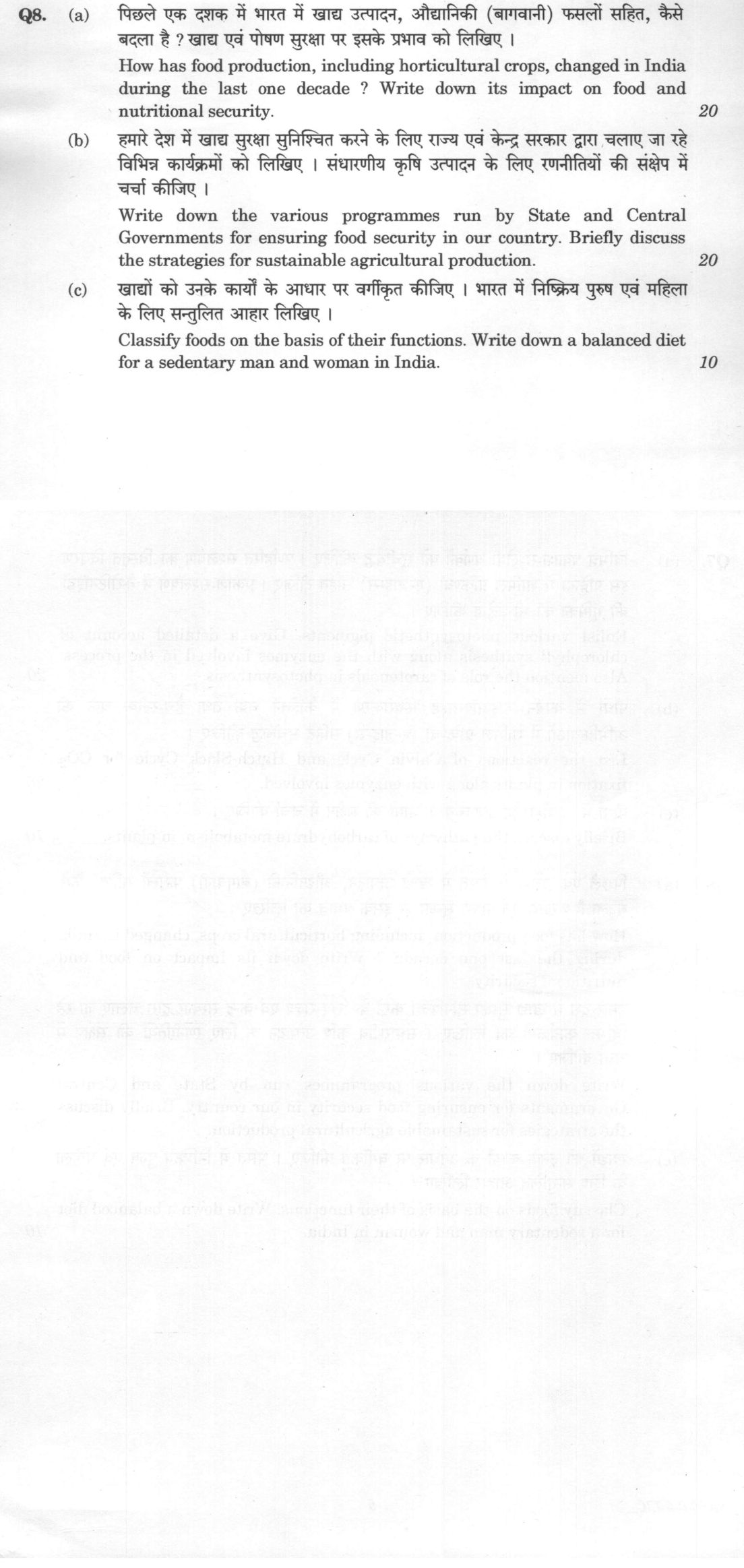
How has food production, including horticultural crops, changed in India during the last one decade ? Write down its impact on food and nutritional security. 20 marks
Write down the various programmes run by State and Central Governments for ensuring food security in our country. Briefly discuss the strategies for sustainable agricultural production. 20 marks
Classify foods on the basis of their functions. Write down a balanced diet for a sedentary man and woman in India. 10 marks
हिंदी में प्रश्न पढ़ें
पिछले एक दशक में भारत में खाद्य उत्पादन, औद्यानिकी (बागवानी) फसलों सहित, कैसे बदला है ? खाद्य एवं पोषण सुरक्षा पर इसके प्रभाव को लिखिए । 20
हमारे देश में खाद्य सुरक्षा सुनिश्चित करने के लिए राज्य एवं केन्द्र सरकार द्वारा चलाए जा रहे विभिन्न कार्यक्रमों को लिखिए । संधारणीय कृषि उत्पादन के लिए रणनीतियों की संक्षेप में चर्चा कीजिए । 20
खाद्यों को उनके कार्यों के आधार पर वर्गीकृत कीजिए । भारत में निश्क्रिय पुरुष एवं महिला के लिए संतुलित आहार लिखिए । 10
Model answer
Written by UPSC Answer Check against this question's marking rubric, to the expected length. UPSC does not publish answers for Mains — this is one way to score well, not an official key.
India’s food system has undergone a structural transformation over the last decade, shifting from a singular focus on calorie sufficiency to a complex interplay of production diversification, entitlement-based security, and nutritional adequacy. This trajectory highlights the critical need to align agricultural output with dietary requirements to achieve holistic food security.
Part (a): Production Trends and Nutritional Impact
Between 2014 and 2024, India’s foodgrain production rose from approximately 250 million tonnes to over 330 million tonnes, marking record highs. However, this growth is characterized by plateauing yields in major cereal crops like wheat and rice, driven by diminishing returns on inputs. Concurrently, horticultural production has surged, with fruits and vegetables now contributing significantly to the agricultural GDP, often surpassing the value of foodgrains. This shift represents a "diversification dividend," reducing absolute cereal dependency and enhancing access to micronutrients essential for combating hidden hunger.
Despite aggregate growth, a production-security paradox persists. Higher output coexists with persistent undernutrition and stunting, particularly in eastern India, while northwestern states face different nutritional challenges. Climate-induced volatility, including erratic monsoons and heat stress, disrupts supply chains, affecting the affordability and availability of nutrient-dense foods. Thus, while quantity has improved, the quality and equitable distribution of nutrition remain critical bottlenecks.
Part (b): Government Programmes and Sustainable Strategies
The Central Government ensures food security through entitlement-based schemes like the National Food Security Act (NFSA), which guarantees subsidized grains to 67% of the population, and the Pradhan Mantri Garib Kalyan Yojana (PMGKAY), which provided free rations during crises. The Pradhan Mantri POSHAN Abhiyaan focuses on nutritional outcomes for children and women, while PM-KISAN provides direct income support to farmers. State initiatives complement these efforts; for instance, Karnataka’s Anna Bhagya scheme provides subsidized rice or cash transfers to eligible households, ensuring access without mandating free distribution. These programmes distinguish between direct food entitlements and input support, creating a multi-layered safety net.
Sustainable agricultural production strategies are increasingly prioritized to ensure long-term viability. The revival of millets, highlighted by the International Year of Millets 2023, promotes climate-resilient, nutrient-rich crops with lower water footprints. Natural farming and precision agriculture are being promoted to reduce chemical dependency and optimize resource use. Water-use efficiency initiatives, such as "Per Drop More Crop," aim to maximize yield per unit of water, crucial in water-stressed regions. Additionally, the development and dissemination of climate-resilient varieties ensure that production remains stable despite environmental shocks.
Part (c): Functional Classification and Balanced Diet
Foods are classified by their physiological functions: energy-giving foods (carbohydrates and fats) provide calories; body-building foods (proteins and minerals) support tissue growth and repair; and protective foods (vitamins and antioxidants) regulate body processes and prevent disease.
For a sedentary adult in India, the ICMR-NIN Recommended Dietary Allowances (RDAs) guide balanced diet composition. A sedentary man requires approximately 2320 kcal, while a sedentary woman requires 1900 kcal.
For a sedentary man, a balanced diet includes 300g of cereals, 85g of pulses, 100g of vegetables, 100g of fruits, 10g of fats and oils, and 20g of sugar. This composition ensures adequate energy and protein intake while providing essential micronutrients.
For a sedentary woman, the diet comprises 250g of cereals, 60g of pulses, 100g of vegetables, 100g of fruits, 10g of fats and oils, and 15g of sugar. The lower caloric requirement is met by slightly reduced cereal and pulse intake, maintaining the same protective food proportions to support overall health.
In conclusion, India’s food security trajectory is defined by a shift from mere production to nutritional quality and sustainability. While production metrics have improved, the challenge lies in bridging the gap between availability and accessibility through robust entitlement schemes and sustainable agricultural practices. A balanced diet, aligned with ICMR-NIN guidelines, remains the cornerstone of individual nutritional security, necessitating policy interventions that promote diverse, nutrient-dense food systems.
What "Describe" is asking you to do
Give a full, ordered account of the thing named — its parts, stages or mechanism — in the sequence in which it actually exists or occurs. Most describe questions come from the science optionals, where the marks sit in correct technical detail and, where the stem says so, a labelled diagram.
Structure that answers it
One-line identification of the subject → the parts or stages in their real order, each with its defining detail → labelled diagram where the subject is structural → closing line on function or significance
Where marks are lost
Loose general prose where the examiner is ticking named parts, correct terminology and their sequence; and in the General Studies papers, turning to evaluation before the description is finished.
How this answer will be evaluated
Approach
Framework: Concept > Practice or process > Data > Indian application. (a) trace: start point > the stages in sequence > end point > what changed | (b) highlight: name the salient points > one line of substance each > close | (c) describe: define > structure or process in order > labelled diagram > significance Full marks: Comprehensive, data-driven, specific schemes and strategies, clear functional classification.
Key points expected
- Quantitative changes in food grain production
- Growth in horticultural crop production
- Impact on food security (availability/access)
- Impact on nutritional security (diversity)
- Central government food security schemes (e.g., PDS, NFSA)
- State government food security initiatives
- Strategies for sustainable agricultural production
- Link between production and security
Evaluation rubric
Each sub-part is marked on its own, against the marks and word limit printed on the paper.
- (a) Trace changes in food and horticultural production over the last decade and their impact on security. 20 marks
trace— start point → the stages in sequence → end point → what changed
Must cover
- Quantitative changes in food grain production
- Growth in horticultural crop production
- Impact on food security (availability/access)
- Impact on nutritional security (diversity)
Loses marks
- Vague statements without data or trends
- Ignoring the horticultural component
- Confusing food security with nutritional security
Earns more
- Mention of specific horticultural crops (fruits/vegetables)
- Reference to recent production data/trends
- Link to changing dietary patterns
Extra mark
- Specific production figures for the last decade
- Reference to specific horticultural zones
- (b) Highlight government programmes for food security and strategies for sustainable production. 20 marks
highlight— name the salient points → one line of substance each → close
Must cover
- Central government food security schemes (e.g., PDS, NFSA)
- State government food security initiatives
- Strategies for sustainable agricultural production
- Link between production and security
Loses marks
- Listing schemes without explaining their role
- Ignoring the sustainable production aspect
- Vague agronomic advice without specific strategies
Earns more
- Specific names of schemes (e.g., PM-KISAN, PMFBY)
- Mention of sustainable practices (organic, drip)
- Reference to institutional mechanisms (FCI, NAFED)
Extra mark
- Recent scheme figures or allocations
- Specific state-level programme names
- (c) Describe food classification by function and a balanced diet for sedentary Indians. 10 marks
describe— define → structure or process in order → labelled diagram → significance
Must cover
- Classification of foods by function (energy, body-building, protective)
- Balanced diet for a sedentary man
- Balanced diet for a sedentary woman
- Specific food items for each category
Loses marks
- Vague classification without functional basis
- Ignoring the sedentary lifestyle aspect
- Not differentiating between male and female needs
Earns more
- Caloric requirements for sedentary lifestyle
- Specific Indian food examples
- Mention of micronutrients
Extra mark
- Specific RDA values for sedentary adults
- Reference to ICMR dietary guidelines
Practice this exact question
Write your answer and it is marked point by point against the model answer above — what you covered, what you missed, what you got wrong.
Evaluate my answer →More from Agriculture 2023 Paper II
- Q5 Answer the following questions in about 150 words each : 10×5=50 (a) Write down the const…
- Q6 (a) Describe the principles, components and strategies for Integrated Disease Management…
- Q7 (a) Enlist various photosynthetic pigments. Give a detailed account of chlorophyll synthe…
- Q8 (a) How has food production, including horticultural crops, changed in India during the l…