Paper II — Q7
(a) Enlist various photosynthetic pigments. Give a detailed account of chlorophyll synthesis along with the enzymes involved in…
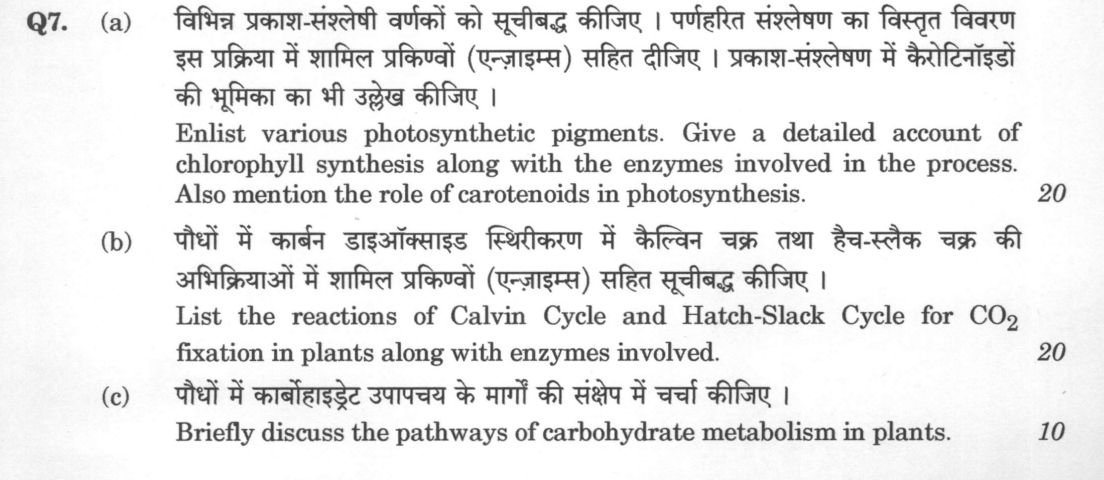
Enlist various photosynthetic pigments. Give a detailed account of chlorophyll synthesis along with the enzymes involved in the process. Also mention the role of carotenoids in photosynthesis. 20 marks
List the reactions of Calvin Cycle and Hatch-Slack Cycle for CO₂ fixation in plants along with enzymes involved. 20 marks
Briefly discuss the pathways of carbohydrate metabolism in plants. 10 marks
हिंदी में प्रश्न पढ़ें
विभिन्न प्रकाश-संश्लेषी वर्णकों को सूचीबद्ध कीजिए । पर्णहरित संश्लेषण का विस्तृत विवरण इस प्रक्रिया में शामिल प्रकिण्वों (एन्जाइम्स) सहित दीजिए । प्रकाश-संश्लेषण में कैरोटिनॉइडों की भूमिका का भी उल्लेख कीजिए । 20
पौधों में कार्बन डाइऑक्साइड स्थिरीकरण में कैल्विन चक्र तथा हैच-स्लैक चक्र की अभिक्रियाओं में शामिल प्रकिण्वों (एन्जाइम्स) सहित सूचीबद्ध कीजिए । 20
पौधों में कार्बोहाइड्रेट उपापचय के मार्गों की संक्षेप में चर्चा कीजिए । 10
Model answer
Written by UPSC Answer Check against this question's marking rubric, to the expected length. UPSC does not publish answers for Mains — this is one way to score well, not an official key.
Photosynthesis is the biochemical foundation of plant productivity, converting solar energy into chemical energy. The efficiency of this process depends on pigment composition, carbon fixation mechanisms, and subsequent metabolic pathways.
Photosynthetic Pigments and Chlorophyll Synthesis Photosynthetic pigments are classified into chlorophylls (a, b, c, d, and bacteriochlorophylls), carotenoids (carotenes and xanthophylls), and phycobilins (phycoerythrin and phycocyanin). Chlorophyll biosynthesis begins with glutamate, converted to 5-aminolevulinic acid (ALA) by glutamate-1-semialdehyde aminotransferase and glutamyl-tRNA reductase. ALA is dehydrated to porphobilinogen by ALA dehydratase. Porphobilinogen deaminase condenses four units to form hydroxymethylbilane, which cyclizes to uroporphyrinogen III. Uroporphyrinogen III decarboxylase and coproporphyrinogen oxidase sequentially convert this to protoporphyrinogen IX and protoporphyrin IX. Mg-chelatase inserts magnesium into protoporphyrin IX. Mg-protoporphyrin IX methyltransferase adds a methyl group, followed by Mg-protoporphyrin IX monomethyl ester cyclase (oxidative cyclase), which converts it to protochlorophyllide. Protochlorophyllide oxidoreductase reduces this to chlorophyllide a. Chlorophyll synthase esterifies chlorophyllide a with phytyl diphosphate to form chlorophyll a. In higher plants, chlorophyll a oxygenase converts chlorophyll a to chlorophyll b. Carotenoids serve as accessory pigments, absorbing light in the 400–550 nm range and transferring energy to chlorophyll a. Crucially, they provide photoprotection via the xanthophyll cycle: under high light, violaxanthin is de-epoxidized to antheraxanthin and then zeaxanthin, which quench triplet chlorophyll and singlet oxygen. Under low light, zeaxanthin is epoxidized back to violaxanthin. Carotenoids also stabilize LHCII structures.
Calvin and Hatch-Slack Cycles The Calvin Cycle (C3) fixes CO2 in the stroma. It comprises three phases. In carboxylation, RuBisCO catalyzes the reaction: 3 RuBP + 3 CO2 → 6 3-Phosphoglycerate (3-PGA). In reduction, phosphoglycerate kinase and glyceraldehyde-3-phosphate dehydrogenase use ATP and NADPH to convert 3-PGA to glyceraldehyde-3-phosphate (G3P). In regeneration, a series of enzymes including aldolase, fructose-1,6-bisphosphatase, sedoheptulose-1,7-bisphosphatase, transketolase, triose phosphate isomerase, ribose-5-phosphate isomerase, ribulose-5-phosphate epimerase, and phosphoribulokinase regenerate RuBP. Net stoichiometry is 3 CO2 → 1 G3P.
The Hatch-Slack Cycle (C4) spatially separates initial fixation from the Calvin Cycle. In mesophyll cells, PEP carboxylase (PEPC) fixes CO2 to phosphoenolpyruvate (PEP) to form oxaloacetate, which is reduced to malate or transaminated to aspartate. These C4 acids move to bundle sheath cells. In NAD-ME type C4 plants, malate is decarboxylated by NADP-malic enzyme to release CO2 for RuBisCO, producing pyruvate. In NAD-ME type, NAD-malic enzyme is used. In PCK type, PEP carboxykinase decarboxylates malate to PEP. In aspartate-type C4, aspartate is transaminated to oxaloacetate, which is then decarboxylated. Pyruvate or PEP returns to mesophyll cells, where pyruvate phosphate dikinase (PPDK) regenerates PEP using ATP. This mechanism concentrates CO2 around RuBisCO, minimizing photorespiration.
Carbohydrate Metabolism Photosynthates undergo several metabolic pathways. Glycolysis (EMP pathway) converts glucose to pyruvate in the cytosol, generating ATP and NADH. Pyruvate enters mitochondria for the TCA cycle, where it is fully oxidized to CO2, producing NADH, FADH2, and GTP for oxidative phosphorylation. The oxidative pentose phosphate pathway (OPPP) generates NADPH for biosynthesis and ribose-5-phosphate for nucleotide synthesis. Gluconeogenesis converts non-carbohydrate precursors to glucose, supporting sucrose and starch synthesis. In oilseeds, the glyoxylate cycle converts stored fats to carbohydrates. These pathways integrate to partition photosynthates between growth, storage, and maintenance, determining crop yield.
In conclusion, the intricate interplay of pigment-mediated light harvesting, efficient carbon fixation via C3 or C4 pathways, and diverse carbohydrate metabolism ensures optimal energy capture and utilization. Understanding these processes is vital for enhancing crop productivity in India, particularly in developing stress-tolerant varieties that maintain high photosynthetic efficiency under varying environmental conditions.
What "Enumerate" is asking you to do
Produce the complete set of items asked for, countable and correctly named. The examiner marks against a checklist, so a missing item costs and an elaborated one gains nothing — where discussion is wanted the stem asks for it as a separate sub-part.
Structure that answers it
One line naming the basis on which the set is drawn → items numbered, each in a phrase or a single line → the discussion sub-part taken up separately, after the list is complete
Where marks are lost
Treating it as an essay. Six items named in six lines score better than three items explained at length.
How this answer will be evaluated
Approach
Framework: Concept > Practice or process > Data > Indian application. (a) explain: definition/context > points in order > small example > short close | (b) enumerate: list the items in order > one line each > no commentary | (c) discuss: intro > 3-4 dimensions > example > balanced close Full marks: Comprehensive, accurate, with all enzymes and pathways clearly detailed.
Key points expected
- List chlorophylls a/b and carotenoids (xanthophylls/carotenes)
- Detail chlorophyll synthesis pathway (ALA to Chl a)
- Name specific enzymes (e.g., ChlM, ChlH, ChlG)
- Explain carotenoid roles (photoprotection, light harvesting)
- List Calvin cycle reactions (C3 fixation)
- Name Calvin cycle enzymes (Rubisco, PEP carboxylase)
- List Hatch-Slack cycle reactions (C4 fixation)
- Name Hatch-Slack enzymes (PEP carboxylase, NADP-ME)
Evaluation rubric
Each sub-part is marked on its own, against the marks and word limit printed on the paper.
- (a) List pigments, detail chlorophyll synthesis with enzymes, and explain carotenoid roles. 20 marks
explain— definition/context → points in order → small example → short close
Must cover
- List chlorophylls a/b and carotenoids (xanthophylls/carotenes)
- Detail chlorophyll synthesis pathway (ALA to Chl a)
- Name specific enzymes (e.g., ChlM, ChlH, ChlG)
- Explain carotenoid roles (photoprotection, light harvesting)
Loses marks
- Omitting enzymes in synthesis
- Confusing carotenoid roles with chlorophyll
- Vague description of pigment types
Earns more
- Mention Mg2+ insertion step
- Note role of light in synthesis
- Distinguish xanthophylls from carotenes
- Mention non-photochemical quenching
Extra mark
- Draw the biosynthetic pathway diagram
- Mention specific carotenoid names (e.g., lutein, neoxanthin)
- (b) List reactions of Calvin and Hatch-Slack cycles with specific enzymes. 20 marks
enumerate— list the items in order → one line each → no commentary
Must cover
- List Calvin cycle reactions (C3 fixation)
- Name Calvin cycle enzymes (Rubisco, PEP carboxylase)
- List Hatch-Slack cycle reactions (C4 fixation)
- Name Hatch-Slack enzymes (PEP carboxylase, NADP-ME)
Loses marks
- Mixing up C3 and C4 enzymes
- Omitting key reactions
- Confusing the two cycles
Earns more
- Distinguish mesophyll vs bundle sheath steps
- Mention malate/aspartate transport
- Note ATP/NADPH requirements
- Mention decarboxylation step
Extra mark
- Draw the C4 cycle diagram
- Mention specific C4 plant examples
- (c) Briefly discuss carbohydrate metabolism pathways in plants. 10 marks
discuss— intro → 3-4 dimensions → example → balanced close
Must cover
- Mention glycolysis pathway
- Mention TCA cycle
- Mention pentose phosphate pathway
- Mention starch/sucrose synthesis
Loses marks
- Omitting major pathways
- Confusing animal and plant metabolism
- Vague description of pathways
Earns more
- Note location of pathways
- Mention key enzymes
- Note energy yield
- Mention regulation points
Extra mark
- Draw a simple metabolic map
- Mention specific plant examples
Practice this exact question
Write your answer and it is marked point by point against the model answer above — what you covered, what you missed, what you got wrong.
Evaluate my answer →More from Agriculture 2023 Paper II
- Q4 (a) Discuss different forms of Intellectual Property Rights (IPR) in India. 20 (b) Give a…
- Q5 Answer the following questions in about 150 words each : 10×5=50 (a) Write down the const…
- Q6 (a) Describe the principles, components and strategies for Integrated Disease Management…
- Q7 (a) Enlist various photosynthetic pigments. Give a detailed account of chlorophyll synthe…
- Q8 (a) How has food production, including horticultural crops, changed in India during the l…