Paper II — Q4
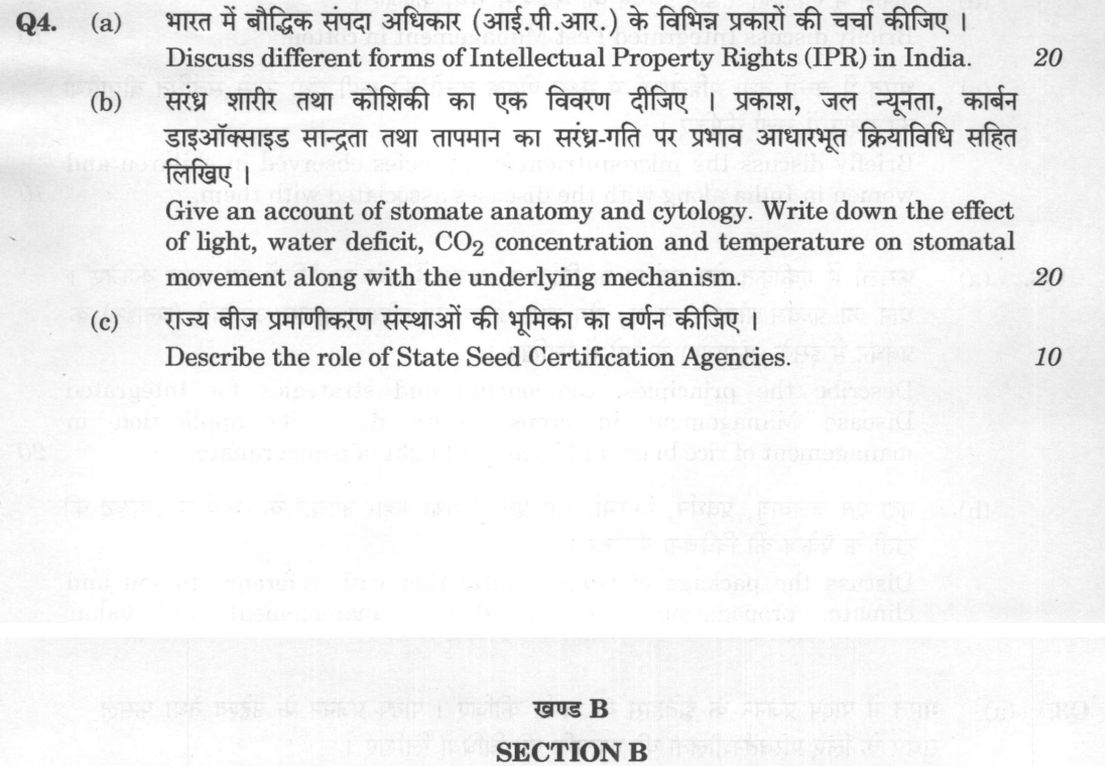
(a) Discuss different forms of Intellectual Property Rights (IPR) in India. 20 (b) Give an account of stomate anatomy and…
Discuss different forms of Intellectual Property Rights (IPR) in India. 20 marks
Give an account of stomate anatomy and cytology. Write down the effect of light, water deficit, CO₂ concentration and temperature on stomatal movement along with the underlying mechanism. 20 marks
Describe the role of State Seed Certification Agencies. 10 marks
हिंदी में प्रश्न पढ़ें
भारत में बौद्धिक संपदा अधिकार (आई.पी.आर.) के विभिन्न प्रकारों की चर्चा कीजिए । 20
स्तंभ शरीर तथा कोशिकी का एक विवरण दीजिए । प्रकाश, जल न्यूनता, कार्बन डाइऑक्साइड सान्द्रता तथा तापमान का स्तंभ-गति पर प्रभाव आधारभूत क्रियाविधि सहित लिखिए । 20
राज्य बीज प्रमाणीकरण संस्थाओं की भूमिका का वर्णन कीजिए । 10
Model answer
Written by UPSC Answer Check against this question's marking rubric, to the expected length. UPSC does not publish answers for Mains — this is one way to score well, not an official key.
Intellectual Property Rights (IPR), plant physiology, and seed certification form the triad of modern agricultural governance in India, balancing innovation, biological efficiency, and quality assurance.
Forms of IPR in India India’s IPR framework is multi-layered, governed by various statutes to comply with TRIPS while safeguarding national interests. Patents are governed by the Patents Act, 1970. A critical distinction exists between product and process patents; India primarily grants process patents for pharmaceuticals and chemicals, a stance reinforced by the Novartis v. Union of India (2013) judgment, which denied patent protection to Imatinib Mesylate, thereby keeping generic drugs affordable. Compulsory licensing under Section 92 allows the government to authorize third parties to manufacture patented products for public interest, as seen in the 2012 issuance of the first compulsory license for a cancer drug. Plant Variety Protection is distinct, governed by the PPV&FR Act, 2001. It grants breeder’s rights for 10 years (15 for trees/vines) but explicitly preserves farmer’s rights to save, use, exchange, and sell farm-saved seed, creating a necessary tension between commercial breeding and traditional farming. Geographical Indications (GIs) under the GIs Act, 1999, protect products like Darjeeling Tea and Alphonso Mango, linking quality to origin. Trademarks and Copyrights protect brand identity and literary works, respectively. Additionally, Industrial Designs and Semiconductor Integrated Circuits Layout-Design rights protect aesthetic and technological innovations in agri-inputs. This diverse regime ensures that while global standards are met, local realities like farmer’s rights and public health are not compromised.
Stomate Anatomy and Cytology Stomata are microscopic pores in the epidermis, flanked by two kidney-shaped guard cells that regulate gas exchange. In dicots, they are often accompanied by subsidiary cells which lack chloroplasts and facilitate guard cell movement. Cytologically, guard cells are distinct from surrounding epidermal cells due to their high density of chloroplasts (for photosynthesis), numerous mitochondria (for ATP), and a large central vacuole. The cell wall is asymmetrically thickened, with the inner wall being more elastic than the outer, allowing the cells to change shape.
Mechanisms of Stomatal Movement Stomatal opening is driven by osmotic turgor changes resulting from ion transport, not electro-osmosis. In the presence of light, specifically blue light, phototropins activate the plasma membrane H⁺-ATPase pump. This pumps protons out of the guard cell, hyperpolarizing the membrane and opening voltage-gated K⁺ channels. The influx of K⁺ ions, accompanied by anions like malate (synthesized from pyruvate), lowers the water potential. Water enters via osmosis, increasing turgor pressure and opening the pore. Red light contributes indirectly by driving photosynthesis, which consumes CO₂ and raises pH, further aiding K⁺ uptake.
Abiotic Stress Responses Water deficit triggers the synthesis of Abscisic Acid (ABA) in roots, which travels to leaves. ABA binds to receptors in guard cells, activating anion channels that cause K⁺ efflux, leading to turgor loss and closure. CO₂ concentration is sensed via carbonic anhydrase; high external CO₂ leads to its entry, lowering cytoplasmic pH and inhibiting K⁺ uptake, causing closure. Temperature affects membrane fluidity and enzyme kinetics; extreme heat can denature proteins or increase transpiration rates, triggering ABA-mediated closure to prevent desiccation.
Role of State Seed Certification Agencies (SSCAs) SSCAs are autonomous statutory bodies established under the Seeds Act, 1966, operating independently from the advisory Central Seed Committee. Their primary role is to ensure the genetic and physical purity of seeds. They conduct field inspections at various growth stages to verify varietal purity and disease status. Crucially, they perform Grow-Out Tests (GOT) to assess genetic and varietal purity, distinguishing them from laboratory tests which evaluate germination, moisture, and seed health. Upon meeting standards, SSCAs issue seed certification tags: a white tag for foundation seed and a blue tag for certified seed. This system ensures that farmers receive high-quality, genetically true seeds, linking directly to the Central Seed Committee’s standards but executing them through independent statutory authority.
Conclusion Collectively, IPR frameworks incentivize innovation while protecting public interest, physiological understanding allows for stress-resilient crop management, and seed certification ensures that these genetic gains reach the farmer’s field in pure form. This integrated approach is essential for sustainable agricultural productivity in India.
What "Discuss" is asking you to do
Lay the issue out from more than one side — how it arose, what is claimed for it, what is held against it, and where it now stands. UPSC attaches discuss to broad topics with several live dimensions, so coverage of the dimensions earns more than the strength of your opinion.
Structure that answers it
Set the issue up → the case as it is made → the case against → the dimension both sides leave out → where the balance now lies
Where marks are lost
Listing facts with no thread between them, or arguing one side throughout and calling it a discussion.
How this answer will be evaluated
Approach
(a) discuss: intro > 3-4 dimensions > example > balanced close | (b) describe: define > structure or process in order > labelled diagram > significance | (c) describe: define > structure or process in order > labelled diagram > significance Full marks: Comprehensive coverage of all sub-parts with specific Indian legal references and detailed biological mechanisms.
Key points expected
- Patents (Inventions Act 1970)
- Plant Variety Protection (PVP Act 2001)
- Geographical Indications (GI Act 2004)
- Copyright (Copyright Act 1957)
- Guard cell structure (thick inner wall)
- Cytology (chloroplasts, tonoplast)
- Mechanism of opening (K+ influx/turgor)
- Mechanism of closing (ABA/water deficit)
Evaluation rubric
Each sub-part is marked on its own, against the marks and word limit printed on the paper.
- (a) Overview of IPR forms in India with specific focus on agricultural relevance. 20 marks
discuss— intro → 3-4 dimensions → example → balanced close
Must cover
- Patents (Inventions Act 1970)
- Plant Variety Protection (PVP Act 2001)
- Geographical Indications (GI Act 2004)
- Copyright (Copyright Act 1957)
Loses marks
- Generic definitions without Indian context
- Confusing PVP with Patents
- Ignoring the agricultural application
Earns more
- TRIPS agreement compliance
- Farmers' rights under PVP
- Specific agricultural GI examples
- Role of IPR in agri-innovation
Extra mark
- Specific case law on IPR
- Recent amendments to PVP Act
- (b) Detailed anatomy/cytology of stomata and mechanisms of movement under environmental stress. 20 marks
describe— define → structure or process in order → labelled diagram → significance
Must cover
- Guard cell structure (thick inner wall)
- Cytology (chloroplasts, tonoplast)
- Mechanism of opening (K+ influx/turgor)
- Mechanism of closing (ABA/water deficit)
Loses marks
- Confusing stomata with lenticels
- Missing the turgor pressure mechanism
- Vague description of environmental effects
Earns more
- Role of light (blue light phototropin)
- Effect of CO2 concentration
- Effect of temperature
- Subsidiary cells
Extra mark
- Labelled diagram of stomatal complex
- Specific mention of aquaporins
- (c) Functions and responsibilities of State Seed Certification Agencies. 10 marks
describe— define → structure or process in order → labelled diagram → significance
Must cover
- Field inspection of seed crops
- Testing for purity and germination
- Issuing certification labels
- Monitoring seed quality
Loses marks
- Confusing with seed production agencies
- Ignoring the certification process
- Vague generalities about seed quality
Earns more
- Role in preventing adulteration
- Coordination with National Bureau
- Legal authority under Seeds Act
Extra mark
- Specific state agency name
- Recent seed quality statistics
Practice this exact question
Write your answer and it is marked point by point against the model answer above — what you covered, what you missed, what you got wrong.
Evaluate my answer →More from Agriculture 2023 Paper II
- Q1 Answer the following questions in about 150 words each : 10×5=50 (a) Enumerate the functi…
- Q2 (a) Enlist the molecular models of cell membrane and explain the models given by S.J. Sin…
- Q3 (a) Describe the history of plant breeding in India. Write the objectives of plant breedi…
- Q4 (a) Discuss different forms of Intellectual Property Rights (IPR) in India. 20 (b) Give a…
- Q5 Answer the following questions in about 150 words each : 10×5=50 (a) Write down the const…
- Q6 (a) Describe the principles, components and strategies for Integrated Disease Management…
- Q7 (a) Enlist various photosynthetic pigments. Give a detailed account of chlorophyll synthe…