Paper II — Q2
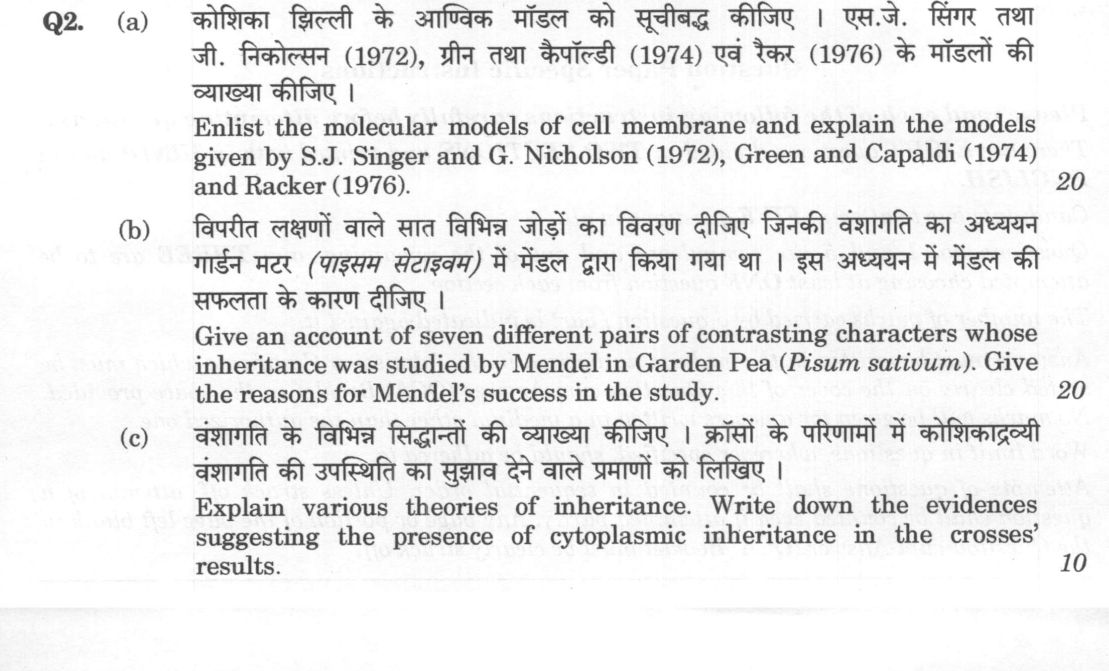
(a) Enlist the molecular models of cell membrane and explain the models given by S.J. Singer and G. Nicholson (1972), Green and…
Enlist the molecular models of cell membrane and explain the models given by S.J. Singer and G. Nicholson (1972), Green and Capaldi (1974) and Racker (1976). 20 marks
Give an account of seven different pairs of contrasting characters whose inheritance was studied by Mendel in Garden Pea (Pisum sativum). Give the reasons for Mendel's success in the study. 20 marks
Explain various theories of inheritance. Write down the evidences suggesting the presence of cytoplasmic inheritance in the crosses' results. 10 marks
हिंदी में प्रश्न पढ़ें
कोशिका झिल्ली के आणविक मॉडल को सूचीबद्ध कीजिए । एस.जे. सिंगर तथा जी. निकोल्सन (1972), ग्रीन तथा कैपाल्डी (1974) एवं रैकर (1976) के मॉडलों की व्याख्या कीजिए । 20
विपरीत लक्षणों वाले सात विभिन्न जोड़ों का विवरण दीजिए जिनकी वंशागति का अध्ययन गार्डन मटर (पाइसम सेटाइवम) में मेंडल द्वारा किया गया था । इस अध्ययन में मेंडल की सफलता के कारण दीजिए । 20
वंशागति के विभिन्न सिद्धांतों की व्याख्या कीजिए । क्रॉसों के परिणामों में कोशिकाद्रव्यी वंशागति की उपस्थिति का संकेत देने वाले प्रमाणों को लिखिए । 10
Model answer
Written by UPSC Answer Check against this question's marking rubric, to the expected length. UPSC does not publish answers for Mains — this is one way to score well, not an official key.
The evolution of biological understanding spans from the structural elucidation of the cell membrane to the mechanistic decoding of heredity. While membrane biology transitioned from static lipid layers to dynamic protein-lipid interactions, genetics moved from classical Mendelian ratios to the recognition of cytoplasmic factors.
Molecular Models of the Cell Membrane The structural conception of the membrane evolved through several key models. Overton (1899) proposed that membranes are permeable to lipophilic substances, suggesting a lipid nature. Langmuir (1917) demonstrated that lipids form monolayers at the air-water interface. Gorter and Grendel (1925) deduced a lipid bilayer structure based on surface area calculations. The Danielli-Davson (1935) "sandwich" model proposed a lipid bilayer coated with protein layers. Robertson’s (1958) unit membrane model described a static trilaminar structure.
S.J. Singer and G. Nicholson (1972) introduced the Fluid Mosaic Model, which revolutionized membrane biology. They proposed that the lipid bilayer is fluid, allowing lateral movement of lipids and proteins. Proteins are not in a continuous layer but are embedded as a mosaic; integral proteins span the bilayer, while peripheral proteins attach to the surface. This model explains membrane asymmetry and the dynamic nature of transport.
Green and Capaldi (1974) refined this with the Lipid-Globular Protein Mosaic Model. Unlike the continuous protein layer of Danielli-Davson, they posited that globular proteins are embedded within a continuous lipid bilayer. These proteins are arranged in a mosaic pattern, interacting with lipids to facilitate specific functions, yet the lipid continuity is maintained.
Racker (1976) proposed the Subunit Model (or Complex Mosaic). Based on reconstitution experiments, Racker suggested that the membrane is not a continuous bilayer but consists of repeating lipoprotein subunits. Each subunit has a protein core surrounded by a lipid shell. These subunits pack together to form the membrane, creating a discontinuous lipid layer. This model emphasizes specific lipid-protein associations essential for transport functions.
**Mendel’s Experiments in *Pisum sativum*** Gregor Mendel studied seven contrasting character pairs in garden peas to establish the laws of inheritance:
- Stem Height: Tall (dominant) vs. Dwarf (recessive).
- Flower Position: Axial (dominant) vs. Terminal (recessive).
- Pod Shape: Inflated (dominant) vs. Constricted (recessive).
- Pod Color: Green (dominant) vs. Yellow (recessive).
- Seed Shape: Round (dominant) vs. Wrinkled (recessive).
- Seed Color: Yellow (dominant) vs. Green (recessive).
- Flower Color: Violet (dominant) vs. White (recessive).
Mendel’s success was due to several strategic choices. He selected Pisum sativum for its true-breeding lines and distinct, discrete traits. He performed controlled self-pollination and cross-pollination to ensure genetic purity. By studying one character at a time (monohybrid crosses), he avoided the complexity of multiple variables. Furthermore, he applied statistical analysis to large sample sizes, allowing him to identify consistent 3:1 and 9:3:3:1 ratios, which revealed the particulate nature of heredity.
Theories of Inheritance and Cytoplasmic Inheritance Early theories included Preformationism, which suggested organisms pre-exist in gametes, and Pangenesis (Darwin), which proposed "gemmules" from body parts mix in gametes. The Germ Plasm Theory (Weismann) distinguished hereditary germ cells from somatic cells, rejecting acquired inheritance. The Chromosomal Theory (Sutton-Boveri) linked chromosomes to Mendelian factors. Epigenesis describes the gradual development of an organism from an undifferentiated egg. The Modern Synthetic Theory integrates Mendelian genetics with Darwinian evolution, recognizing mutation and selection.
Cytoplasmic Inheritance Cytoplasmic inheritance, or maternal inheritance, occurs when traits are encoded by DNA in mitochondria or chloroplasts, which are transmitted primarily through the egg. Evidence includes:
- Plastid Inheritance: In Mirabilis jalapa (4-o’clock plant), leaf variegation is maternally inherited. Crosses between variegated and green plants yield offspring with the phenotype of the female parent, as chloroplasts are passed via the cytoplasm of the egg.
- Mitochondrial Inheritance: In yeast, "petite" mutants (defective respiration) are maternally inherited. In Drosophila, sensitivity to CO2 is linked to sigma virus in mitochondria.
- Male Sterility: In maize and Indian sorghum, cytoplasmic male sterility (CMS) is maternally inherited. This is crucial for hybrid seed production in Indian agriculture, where CMS lines are used to produce high-yielding hybrid varieties without manual emasculation.
In conclusion, the progression from static membrane models to the fluid mosaic and subunit models highlights the dynamic nature of cellular boundaries. Similarly, the discovery of cytoplasmic inheritance expanded the nuclear-centric Mendelian framework, providing practical tools like CMS for crop improvement.
What "Explain" is asking you to do
Make the working of something clear — what sets it off, what follows from what, and what it produces. Explain is the Commission's mechanism word: it dominates the technical papers and the “explain why” stems, where the marks sit in the causal chain and not in the label.
Structure that answers it
State what it is → the initiating condition → the chain of cause, step by step → an instance where it plays out → what the chain produces
Where marks are lost
Describing what something looks like instead of why it works that way. Naming the stages without linking them reads as description too.
How this answer will be evaluated
Approach
(a) explain: definition/context > points in order > small example > short close | (b) account for: state the phenomenon > the causes in order of weight > conclusion | (c) explain: definition/context > points in order > small example > short close Full marks: Precise models, all 7 pairs, clear cytoplasmic evidence
Key points expected
- Enlist molecular models of cell membrane
- Explain Singer and Nicholson (1972) model
- Explain Green and Capaldi (1974) model
- Explain Racker (1976) model
- List seven pairs of contrasting characters
- Identify organism as Pisum sativum
- Give reasons for Mendel's success
- Mention self-fertilization or distinct traits
Evaluation rubric
Each sub-part is marked on its own, against the marks and word limit printed on the paper.
- (a) List molecular models and detail the specific proposals of Singer & Nicholson, Green & Capaldi, and Racker. 20 marks
explain— definition/context → points in order → small example → short close
Must cover
- Enlist molecular models of cell membrane
- Explain Singer and Nicholson (1972) model
- Explain Green and Capaldi (1974) model
- Explain Racker (1976) model
Loses marks
- Confusing Green & Capaldi with Davson-Danielli
- Omitting specific years or names
- Vague description of protein arrangement
Earns more
- Mention fluid mosaic concept
- Mention integral protein orientation
- Mention enzyme orientation
Extra mark
- Labelled diagram of fluid mosaic model
- Comparison table of the three models
- (b) List seven contrasting character pairs in Pisum sativum and state reasons for Mendel's success. 20 marks
account for— state the phenomenon → the causes in order of weight → conclusion
Must cover
- List seven pairs of contrasting characters
- Identify organism as Pisum sativum
- Give reasons for Mendel's success
- Mention self-fertilization or distinct traits
Loses marks
- Listing fewer than seven pairs
- Vague reasons like 'good luck'
- Confusing characters with genotypes
Earns more
- Mention true-breeding lines
- Mention statistical analysis
- Mention short generation time
Extra mark
- Table listing the 7 pairs
- Mention specific traits like seed shape
- (c) Explain inheritance theories and provide evidence for cytoplasmic inheritance from cross results. 10 marks
explain— definition/context → points in order → small example → short close
Must cover
- Explain various theories of inheritance
- Write evidences for cytoplasmic inheritance
- Reference crosses' results
Loses marks
- Ignoring the 'cytoplasmic' aspect
- Confusing with nuclear inheritance
- No specific evidence from crosses
Earns more
- Mention maternal inheritance
- Mention organelle DNA
- Mention non-Mendelian ratios
Extra mark
- Example of mitochondrial inheritance
- Mention specific cross outcome
Practice this exact question
Write your answer and it is marked point by point against the model answer above — what you covered, what you missed, what you got wrong.
Evaluate my answer →More from Agriculture 2023 Paper II
- Q1 Answer the following questions in about 150 words each : 10×5=50 (a) Enumerate the functi…
- Q2 (a) Enlist the molecular models of cell membrane and explain the models given by S.J. Sin…
- Q3 (a) Describe the history of plant breeding in India. Write the objectives of plant breedi…
- Q4 (a) Discuss different forms of Intellectual Property Rights (IPR) in India. 20 (b) Give a…
- Q5 Answer the following questions in about 150 words each : 10×5=50 (a) Write down the const…