Paper I — Q1
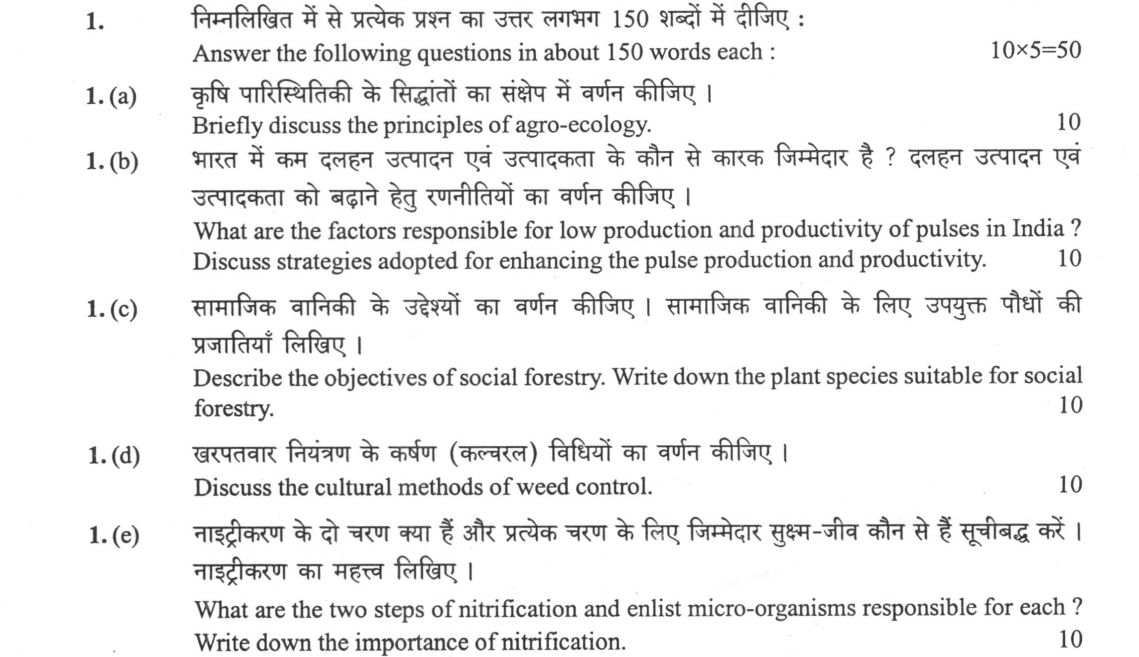
Answer the following questions in about 150 words each: (a) Briefly discuss the principles of agro-ecology. 10 marks (b) What are…
Answer the following questions in about 150 words each: Briefly discuss the principles of agro-ecology. 10 marks
What are the factors responsible for low production and productivity of pulses in India? Discuss strategies adopted for enhancing the pulse production and productivity. 10 marks
Describe the objectives of social forestry. Write down the plant species suitable for social forestry. 10 marks
Discuss the cultural methods of weed control. 10 marks
What are the two steps of nitrification and enlist micro-organisms responsible for each? Write down the importance of nitrification. 10 marks
हिंदी में प्रश्न पढ़ें
निम्नलिखित में से प्रत्येक प्रश्न का उत्तर लगभग 150 शब्दों में दीजिए : कृषि पारिस्थितिकी के सिद्धांतों का संक्षेप में वर्णन कीजिए । 10
भारत में कम दलहन उत्पादन एवं उत्पादकता के कौन से कारक जिम्मेदार हैं ? दलहन उत्पादन एवं उत्पादकता को बढ़ाने हेतु रणनीतियों का वर्णन कीजिए । 10
सामाजिक वानिकी के उद्देश्यों का वर्णन कीजिए । सामाजिक वानिकी के लिए उपयुक्त पौधों की प्रजातियाँ लिखिए । 10
खरपतवार नियंत्रण के कर्षण (कल्चरल) विधियों का वर्णन कीजिए । 10
नाइट्रीकरण के दो चरण क्या हैं और प्रत्येक चरण के लिए जिम्मेदार सूक्ष्म-जीव कौन से हैं सूचीबद्ध करें । नाइट्रीकरण का महत्व लिखिए । 10
Model answer
Written by UPSC Answer Check against this question's marking rubric, to the 150-word length. UPSC does not publish answers for Mains — this is one way to score well, not an official key.
(a) Principles of Agro-ecology
Agro-ecology applies ecological concepts to design and manage sustainable, resilient agricultural systems. As articulated by Miguel Altieri and the FAO’s Ten Elements of Agroecology, its core principles integrate biological and socio-economic dimensions:
Biodiversity and Ecosystem Services: It promotes genetic, species, and structural diversity across temporal and spatial scales—such as polycultures, agroforestry, and crop-livestock integration—to enhance beneficial biological interactions and natural pest regulation.
Nutrient Cycling and Soil Health: It optimizes closed-loop nutrient cycling and biological nitrogen fixation, enhancing soil organic matter and soil microbial activity while minimizing external synthetic inputs.
Energy and Resource Efficiency: It harnesses natural flows, maximizing solar radiation capture, water-use efficiency, and biomass recycling to sustain farm productivity.
Socio-Economic Integration: It fosters co-creation of knowledge, combining traditional agronomic wisdom with modern science, while supporting equitable local food systems, resilience, and circular economies.
In India, agro-ecological principles underpin initiatives like Bharatiya Prakritik Krishi Paddhati, transforming resource-intensive farming into self-sustaining, climate-resilient production landscapes.
---
(b) Factors for Low Pulse Productivity and Enhancement Strategies
Pulse cultivation in India faces several structural, biotic, and abiotic constraints:
Abiotic Factors: Over 80% of pulses are grown under rainfed conditions in marginal, degraded soils prone to moisture stress, terminal drought, and extreme heat during pod development.
Biotic Factors: Susceptibility to severe pests such as the pod borer (Helicoverpa armigera) and destructive diseases like vascular wilt (Fusarium oxysporum), sterility mosaic disease, and dry root rot.
Agronomic and Market Constraints: Low seed replacement rates, suboptimal fertilizer application, and inadequate institutional procurement compared to cereals.
Enhancement Strategies: The government has scaled targeted interventions under the National Food Security Mission (NFSM-Pulses) and Cluster Frontline Demonstrations (CFLDs). Breeding programmes have released high-yielding, short-duration, and disease-resistant varieties such as JG-11 (chickpea), Pusa-16 (pigeonpea), and Samrat. Agronomic expansion focuses on utilizing rice fallows in eastern India and promoting intercropping. Market stability is driven through enhanced Minimum Support Price (MSP) operations, buffer stocking via NAFED, and risk mitigation under the Pradhan Mantri Fasal Bima Yojana (PMFBY).
---
(c) Objectives and Species for Social Forestry
Social forestry, formally recognized by the National Commission on Agriculture (1976), aims to manage and protect forests and afforest barren lands to aid rural environmental and social development.
Key Objectives: The primary objective is meeting the basic rural demands for fuelwood, fodder, small timber, and non-timber forest produce, thereby reducing anthropogenic pressure on natural forest reserves. It provides rural employment and income generation on degraded community lands, village common lands, and roadsides. Environmentally, it aids in soil conservation, microclimate stabilization, and windbreak creation while fostering community participation through Joint Forest Management.
Suitable Plant Species: Species selection prioritizes fast growth, multi-purpose utility, coppicing ability, and tolerance to stress:
- Acacia nilotica (Babul) – highly adapted to arid, saline soils; provides fuelwood and fodder.
- Dalbergia sissoo (Shisham) – excellent nitrogen-fixing timber and shade tree.
- Eucalyptus tereticornis (Safeda) – fast-growing pole timber and pulpwood for farm forestry.
- Leucaena leucocephala (Subabul) – rich source of palatable green fodder and fuel.
- Azadirachta indica (Neem) – hardy, pest-resistant tree offering medicine, oil, and shade.
- Prosopis cineraria (Khejri) – vital silvopastoral tree for arid zones.
---
(d) Cultural Methods of Weed Control
Cultural weed management involves manipulating cropping practices to give the crop an ecological and competitive advantage over weeds, minimizing reliance on chemical herbicides.
Preventive and Field Hygiene Practices: Utilizing certified, weed-free seed lots, cleaning farm machinery between plots, and managing irrigation channels prevent weed seed dissemination.
Tillage and Land Preparation: Summer deep ploughing exposes underground propagules of perennial weeds to solar desiccation. The stale seedbed technique encourages weed emergence prior to final shallow tillage and sowing. In lowland rice, continuous shallow flooding suppresses broadleaf and grassy weeds.
Crop Husbandry and Spatial Manipulation: Adjusting planting dates to avoid peaks of weed emergence, employing higher seed rates, and narrowing row spacing achieve rapid canopy closure, depriving weeds of light.
Biological Suppression and Rotation: Diversified crop rotations break weed life cycles adapted to mono-cropping. Intercropping with competitive smother crops (e.g., cowpea, green gram) and utilizing allelopathic crops (e.g., sorghum, rye) naturally suppress weed germination and establishment.
---
(e) Nitrification Steps, Micro-organisms, and Importance
Nitrification is the two-step biological oxidation of reduced nitrogen (ammonium) to oxidized nitrogen (nitrate) carried out by specialized chemoautotrophic aerobic micro-organisms:
Step 1: Ammonia Oxidation Ammonium (NH₄⁺) is converted into nitrite (NO₂⁻): 2NH₄⁺ + 3O₂ → 2NO₂⁻ + 4H⁺ + 2H_2O + Energy This conversion is primarily mediated by obligate autotrophs such as Nitrosomonas, Nitrosococcus, and Nitrosospira.
Step 2: Nitrite Oxidation Nitrite (NO₂⁻), which is toxic to plants, is oxidized into nitrate (NO₃⁻): 2NO₂⁻ + O₂ → 2NO₃⁻ + Energy This reaction is facilitated by nitrifying bacteria such as Nitrobacter and Nitrococcus.
Agronomic and Soil Importance: Nitrification transforms immobile ammonium into nitrate (NO₃⁻), the predominant form of inorganic nitrogen absorbed by most non-wetland upland crops. However, nitrate is highly mobile and prone to leaching into groundwater or loss via denitrification in anaerobic conditions. The reaction generates H⁺ ions, contributing over time to soil acidification. Managing nitrification rates using nitrification inhibitors (e.g., Neem-coated urea) is critical for enhancing nitrogen-use efficiency in crop production.
What "Discuss" is asking you to do
Lay the issue out from more than one side — how it arose, what is claimed for it, what is held against it, and where it now stands. UPSC attaches discuss to broad topics with several live dimensions, so coverage of the dimensions earns more than the strength of your opinion.
Structure that answers it
Set the issue up → the case as it is made → the case against → the dimension both sides leave out → where the balance now lies
Where marks are lost
Listing facts with no thread between them, or arguing one side throughout and calling it a discussion.
How this answer will be evaluated
Approach
Framework: Concept > Practice or process > Data > Indian application. (a) discuss: intro > 3-4 dimensions > example > balanced close | (b) discuss: intro > 3-4 dimensions > example > balanced close | (c) describe: define > structure or process in order > labelled diagram > significance | (d) discuss: intro > 3-4 dimensions > example > balanced close | (e) explain: definition/context > points in order > small example > short close Full marks: Comprehensive, specific, and well-structured answers with named examples and schemes
Key points expected
- Define agro-ecology as a science and movement
- Explain principles: biodiversity, nutrient cycling, pest regulation
- Mention soil health and water management
- Link to sustainable food systems
- List factors: low yield, poor seed, climate, pests
- Mention specific pests (e.g., pod borer, yellow mosaic virus)
- Discuss strategies: high-yielding varieties (HYVs), bio-control
- Mention government schemes (e.g., PM-PRASAD, Mission for Integrated Development)
Evaluation rubric
Each sub-part is marked on its own, against the marks and word limit printed on the paper.
- (a) Intro > 3-4 dimensions > example > balanced close 10 marks · 150 words
discuss— intro → 3-4 dimensions → example → balanced close
Must cover
- Define agro-ecology as a science and movement
- Explain principles: biodiversity, nutrient cycling, pest regulation
- Mention soil health and water management
- Link to sustainable food systems
Loses marks
- Confusing agro-ecology with general organic farming
- Vague statements without specific principles
- Ignoring the ecological basis of the system
Earns more
- Reference to IPM (Integrated Pest Management)
- Mention of organic farming or zero-budget farming
- Reference to FAO or ICRISAT definitions
Extra mark
- Specific example of an agro-ecological system (e.g., rice-fish)
- Mention of specific Indian policy (e.g., NABARD support)
- (b) Intro > 3-4 dimensions > example > balanced close 10 marks · 150 words
discuss— intro → 3-4 dimensions → example → balanced close
Must cover
- List factors: low yield, poor seed, climate, pests
- Mention specific pests (e.g., pod borer, yellow mosaic virus)
- Discuss strategies: high-yielding varieties (HYVs), bio-control
- Mention government schemes (e.g., PM-PRASAD, Mission for Integrated Development)
Loses marks
- Generic advice without specific strategies
- Ignoring the role of government schemes
- Confusing pulses with cereals
Earns more
- Specific variety names (e.g., JG-11, PDM-1)
- Mention of intercropping or crop rotation
- Reference to specific state performance (e.g., Maharashtra, Madhya Pradesh)
Extra mark
- Specific data on production gap
- Mention of specific research institute (e.g., IARI, ICAR)
- (c) Define > structure or process in order > labelled diagram > significance 10 marks · 150 words
describe— define → structure or process in order → labelled diagram → significance
Must cover
- Define social forestry (planting trees on wastelands)
- List objectives: fuel, fodder, timber, environmental protection
- Mention specific plant species (e.g., Eucalyptus, Acacia, Teak)
- Link to community participation and livelihood
Loses marks
- Confusing social forestry with agroforestry
- Vague objectives without specific benefits
- Ignoring the role of community participation
Earns more
- Mention of specific schemes (e.g., National Afforestation Programme)
- Reference to specific state initiatives
- Mention of specific benefits (e.g., carbon sequestration)
Extra mark
- Specific example of a successful social forestry project
- Mention of specific research on social forestry
- (d) Intro > 3-4 dimensions > example > balanced close 10 marks · 150 words
discuss— intro → 3-4 dimensions → example → balanced close
Must cover
- Define cultural methods of weed control
- List methods: tillage, mulching, crop rotation, intercropping
- Explain how each method works
- Mention benefits and limitations
Loses marks
- Confusing cultural methods with chemical or biological methods
- Vague descriptions without specific methods
- Ignoring the limitations of cultural methods
Earns more
- Specific example of a cultural method (e.g., zero-till)
- Mention of specific crops where cultural methods are effective
- Reference to specific research on cultural methods
Extra mark
- Specific data on weed reduction
- Mention of specific government scheme promoting cultural methods
- (e) Definition/context > points in order > small example > short close 10 marks · 150 words
explain— definition/context → points in order → small example → short close
Must cover
- Define nitrification (conversion of ammonia to nitrate)
- Explain the two steps: ammonification and nitrification
- Name the microorganisms responsible for each step
- Mention the importance of nitrification in the nitrogen cycle
Loses marks
- Confusing nitrification with denitrification
- Vague descriptions without specific steps
- Ignoring the role of microorganisms
Earns more
- Specific names of microorganisms (e.g., Nitrosomonas, Nitrobacter)
- Mention of specific conditions for nitrification (e.g., pH, temperature)
- Reference to specific research on nitrification
Extra mark
- Specific example of a nitrification process in a specific ecosystem
- Mention of specific government scheme related to soil health
Practice this exact question
Write your answer and it is marked point by point against the model answer above — what you covered, what you missed, what you got wrong.
Evaluate my answer →More from Agriculture 2024 Paper I
- Q1 Answer the following questions in about 150 words each: (a) Briefly discuss the principle…
- Q2 (a) Write down the physical environmental factors affecting the crop production. Discuss…
- Q3 (a) What is the Arnon and Stout (1939) criteria for plant nutrient essentiality? Give acc…
- Q4 (a) Explain the term conventional and conservation tillage. Give account of their compara…