Paper I — Q5
Answer the following questions in about 150 words each: (a) Write down the principles involved in Integrated Watershed…
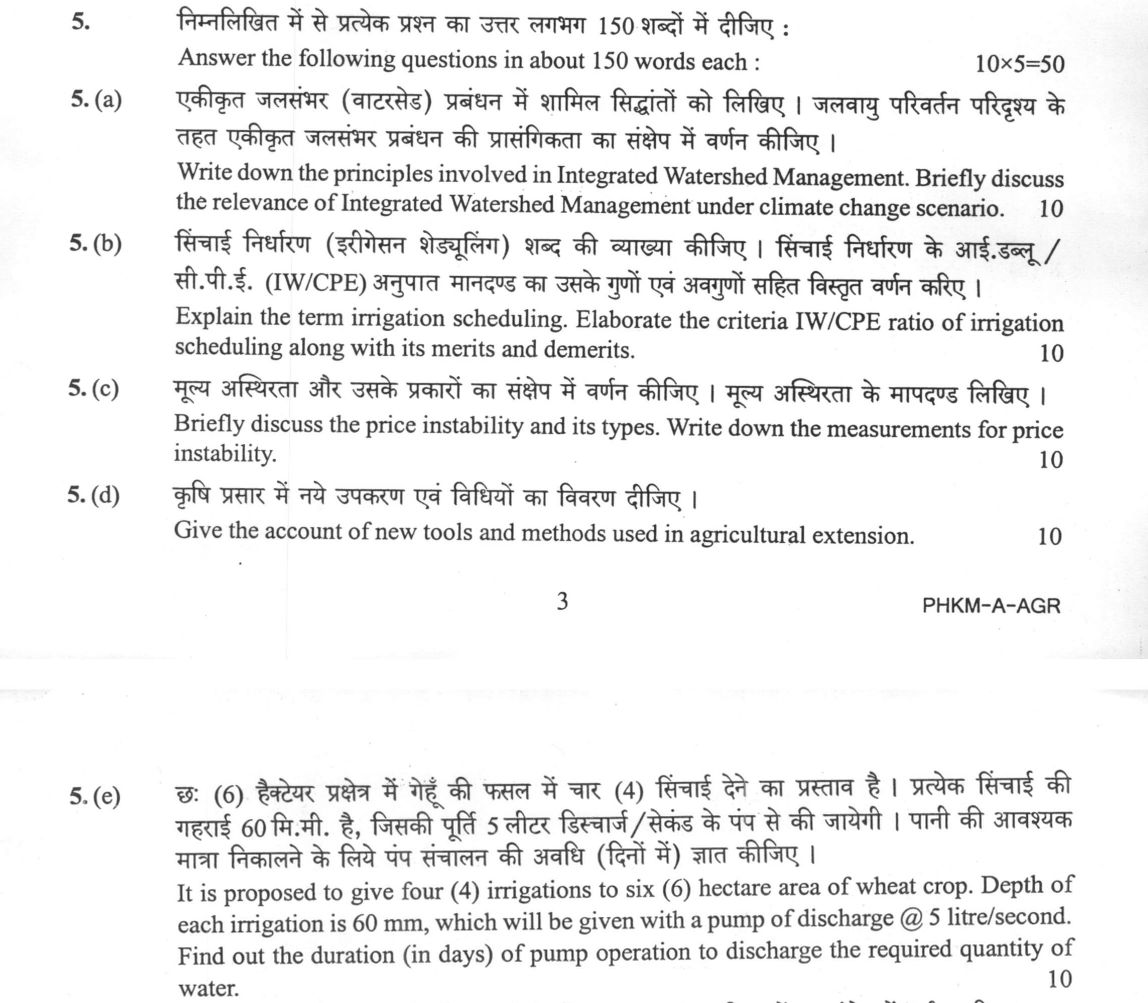
Answer the following questions in about 150 words each: Write down the principles involved in Integrated Watershed Management. Briefly discuss the relevance of Integrated Watershed Management under climate change scenario. 10 marks
Explain the term irrigation scheduling. Elaborate the criteria IW/CPE ratio of irrigation scheduling along with its merits and demerits. 10 marks
Briefly discuss the price instability and its types. Write down the measurements for price instability. 10 marks
Give the account of new tools and methods used in agricultural extension. 10 marks
It is proposed to give four (4) irrigations to six (6) hectare area of wheat crop. Depth of each irrigation is 60 mm, which will be given with a pump of discharge @ 5 litre/second. Find out the duration (in days) of pump operation to discharge the required quantity of water. 10 marks
हिंदी में प्रश्न पढ़ें
निम्नलिखित में से प्रत्येक प्रश्न का उत्तर लगभग 150 शब्दों में दीजिए : एकीकृत जलसंभर (वाटरशेड) प्रबंधन में शामिल सिद्धांतों को लिखिए । जलवायु परिवर्तन परिदृश्य के तहत एकीकृत जलसंभर प्रबंधन की प्रासंगिकता का संक्षेप में वर्णन कीजिए । 10
सिंचाई निर्धारण (इरिगेशन शेड्यूलिंग) शब्द की व्याख्या कीजिए । सिंचाई निर्धारण के आई.डब्लू./सी.पी.ई. (IW/CPE) अनुपात मानदण्ड का उसके गुणों एवं अवगुणों सहित विस्तृत वर्णन करिए । 10
मूल्य अस्थिरता और उसके प्रकारों का संक्षेप में वर्णन कीजिए । मूल्य अस्थिरता के मापदण्ड लिखिए । 10
कृषि प्रसार में नये उपकरण एवं विधियों का विवरण दीजिए । 10
छ: (6) हेक्टेयर प्रक्षेत्र में गेहूं की फसल में चार (4) सिंचाई देने का प्रस्ताव है । प्रत्येक सिंचाई की गहराई 60 मि.मी. है, जिसकी पूर्ति 5 लीटर दिश्चार्ज/सेकंड के पंप से की जायेगी । पानी की आवश्यक मात्रा निकालने के लिये पंप संचालन की अवधि (दिनों में) ज्ञात कीजिए । 10
Model answer
Written by UPSC Answer Check against this question's marking rubric, to the 150-word length. UPSC does not publish answers for Mains — this is one way to score well, not an official key.
Integrated Watershed Management (IWM) operates on principles of multi-disciplinary integration, people’s participation, and sustainable resource use. It treats the watershed as a holistic unit, linking land, water, and vegetation management. Under climate change, IWM is critical for mitigating erratic rainfall impacts. By enhancing soil organic matter, it facilitates carbon sequestration and improves water retention, thereby reducing drought vulnerability. Furthermore, structured interventions like check dams and afforestation promote groundwater recharge, ensuring water security during prolonged dry spells and stabilizing agricultural yields against climatic shocks.
Irrigation Scheduling refers to the strategic timing and depth of irrigation to match crop water requirements, optimizing yield per unit of water. The IW/CPE ratio (Irrigation Water/Cumulative Pan Evaporation) is a key criterion. Irrigation is triggered when the ratio reaches a threshold, typically between 0.6 and 0.9, depending on soil and crop. The merit of this method is its simplicity and reliance on easily measurable pan evaporation data, making it field-friendly. However, its demerit lies in its failure to account for specific soil hydraulic properties or varying crop sensitivity at different growth stages, potentially leading to over- or under-irrigation if not calibrated locally.
Price Instability refers to the erratic fluctuations in agricultural commodity prices, which disrupt farm income and market planning. The primary types are seasonal (variations between harvest and lean seasons), cyclical (long-term business cycles), secular/trend (long-term upward or downward shifts), and irregular/random (unpredictable shocks due to weather or policy). To measure this instability, economists use the Coefficient of Variation (CV), which standardizes volatility relative to the mean price. Another key metric is the Price Instability Index, often derived from the standard deviation of price changes. These tools help quantify risk for policy interventions like price support schemes.
New Tools in Agricultural Extension have revolutionized knowledge dissemination. ICT-based tools like Kisan Call Centres, the mKisan SMS platform, and WhatsApp groups provide real-time market and weather information. Precision agriculture tools, including drones for crop health monitoring and soil sensors, enable data-driven decision-making. Participatory methods such as Farmer Field Schools (FFS) and FPO-based extension foster peer learning. Additionally, AI/ML applications are emerging for pest prediction and yield estimation. These tools bridge the information gap, ensuring timely, accurate, and personalized advice reaches farmers, thereby enhancing adoption rates of modern technologies.
Calculation for Pump Operation Duration:
First, determine the total volume of water required. Area = 6 hectares = 60,000 m². Depth per irrigation = 60 mm = 0.06 m. Number of irrigations = 4. Total Volume = Area × Depth × Number of Irrigations Total Volume = 60,000 m² × 0.06 m × 4 = 14,400 m³.
Next, determine the pump’s discharge rate in cubic meters per second. Discharge = 5 litres/second. Since 1,000 litres = 1 m³, Discharge = 5/1000 = 0.005 m³/s.
Calculate the total time in seconds. Time (seconds) = Total Volume / Discharge Rate Time = 14,400 m³ / 0.005 m³/s = 2,880,000 seconds.
Finally, convert seconds to days. Seconds in a day = 60 minutes/hour × 60 seconds/minute × 24 hours/day = 86,400 seconds. Duration (days) = 2,880,000 / 86,400 = 33.33 days.
Thus, the pump must operate for approximately 33.33 days to complete the required irrigation.
What "Explain" is asking you to do
Make the working of something clear — what sets it off, what follows from what, and what it produces. Explain is the Commission's mechanism word: it dominates the technical papers and the “explain why” stems, where the marks sit in the causal chain and not in the label.
Structure that answers it
State what it is → the initiating condition → the chain of cause, step by step → an instance where it plays out → what the chain produces
Where marks are lost
Describing what something looks like instead of why it works that way. Naming the stages without linking them reads as description too.
How this answer will be evaluated
Approach
Framework: Concept > Practice or process > Data > Indian application. (a) discuss: intro > 3-4 dimensions > example > balanced close | (b) explain: definition/context > points in order > small example > short close | (c) discuss: intro > 3-4 dimensions > example > balanced close | (d) account for: state the phenomenon > the causes in order of weight > conclusion | (e) calculate: given > formula > substitution > result with units > interpretation Full marks: All parts: complete, specific, with Indian context and named examples
Key points expected
- Principles: holistic, participatory, sustainable, multi-sectoral
- Climate change: increased variability, extreme events
- IWM relevance: resilience, adaptation, water security
- Balanced close on IWM's role in climate adaptation
- Definition: timing and amount of irrigation
- IW/CPE ratio: irrigation water to crop water requirement
- Merits: water efficiency, yield optimization
- Demerits: complexity, monitoring requirements
Evaluation rubric
Each sub-part is marked on its own, against the marks and word limit printed on the paper.
- (a) Principles of IWM and its relevance under climate change. 10 marks · 150 words
discuss— intro → 3-4 dimensions → example → balanced close
Must cover
- Principles: holistic, participatory, sustainable, multi-sectoral
- Climate change: increased variability, extreme events
- IWM relevance: resilience, adaptation, water security
- Balanced close on IWM's role in climate adaptation
Loses marks
- Vague principles without specific IWM components
- No link between IWM and climate change
- Generic environmental advice without watershed focus
Earns more
- Mentions specific IWM components (soil, water, vegetation)
- Links to Indian context (e.g., PMKSY, watershed missions)
- References climate change impacts on water availability
- Mentions stakeholder participation in IWM
Extra mark
- Names a specific Indian watershed program
- Cites a climate change projection for India
- (b) Irrigation scheduling definition and IW/CPE ratio criteria with merits/demerits. 10 marks · 150 words
explain— definition/context → points in order → small example → short close
Must cover
- Definition: timing and amount of irrigation
- IW/CPE ratio: irrigation water to crop water requirement
- Merits: water efficiency, yield optimization
- Demerits: complexity, monitoring requirements
Loses marks
- No clear definition of irrigation scheduling
- Confuses IW/CPE with other ratios
- Lists merits/demerits without explanation
Earns more
- Explains CPE (crop water requirement) calculation
- Mentions specific crop examples (wheat, rice)
- Discusses soil moisture monitoring methods
- Links to water conservation in Indian agriculture
Extra mark
- Names a specific irrigation scheduling software
- Cites a study on IW/CPE ratio effectiveness
- (c) Price instability types and measurements. 10 marks · 150 words
discuss— intro → 3-4 dimensions → example → balanced close
Must cover
- Definition: price volatility in agricultural markets
- Types: seasonal, cyclical, structural, random
- Measurements: coefficient of variation, standard deviation
- Impact on farmers and market stability
Loses marks
- No clear distinction between price instability types
- Vague measurements without specific indicators
- No link to agricultural context
Earns more
- Mentions specific crops with high price instability
- Discusses government interventions (MSP, buffer stocks)
- Links to market infrastructure and supply chains
- References Indian agricultural market context
Extra mark
- Names a specific price monitoring agency
- Cites a recent price instability event in India
- (d) New tools and methods in agricultural extension. 10 marks · 150 words
account for— state the phenomenon → the causes in order of weight → conclusion
Must cover
- Digital tools: mobile apps, SMS, video
- Remote sensing and GIS for extension
- Participatory methods: FGDs, field days
- ICT integration in extension services
Loses marks
- Only traditional methods without new tools
- Vague description of digital tools
- No link to Indian extension context
Earns more
- Names specific apps (e.g., Kisan Suvidha, mKisan)
- Discusses drone technology in extension
- Mentions AI and machine learning applications
- References Indian extension system (Krishi Vigyan Kendras)
Extra mark
- Names a specific digital extension platform
- Cites a study on digital extension effectiveness
- (e) Duration of pump operation for 4 irrigations on 6 ha wheat. 10 marks
calculate— given → formula → substitution → result with units → interpretation
Must cover
- Given: 4 irrigations, 6 ha, 60 mm depth, 5 L/s
- Volume: 6 ha × 60 mm × 4 = 1440 m³
- Duration: Volume / Discharge = 1440 m³ / 5 L/s
- Convert to days: 288,000 s / 86,400 s/day
Loses marks
- Incorrect volume calculation
- Unit conversion errors
- No final answer in days
Earns more
- Shows unit conversion (mm to m, L to m³)
- States assumptions (uniform application, no losses)
- Provides final answer with units (days)
- Checks reasonableness of result
Extra mark
- Mentions practical considerations (pump efficiency)
- Discusses scheduling of 4 irrigations over time
Practice this exact question
Write your answer and it is marked point by point against the model answer above — what you covered, what you missed, what you got wrong.
Evaluate my answer →More from Agriculture 2024 Paper I
- Q2 (a) Write down the physical environmental factors affecting the crop production. Discuss…
- Q3 (a) What is the Arnon and Stout (1939) criteria for plant nutrient essentiality? Give acc…
- Q4 (a) Explain the term conventional and conservation tillage. Give account of their compara…
- Q5 Answer the following questions in about 150 words each: (a) Write down the principles inv…
- Q6 (a) Briefly discuss the crop management practices for stabilising yield in dryland areas.…
- Q7 (a) Discuss the chronological developments of National Extension System of India after in…
- Q8 (a) Explain different types of farming. Discuss the factors affecting types of farming. 2…