Paper I — Q6
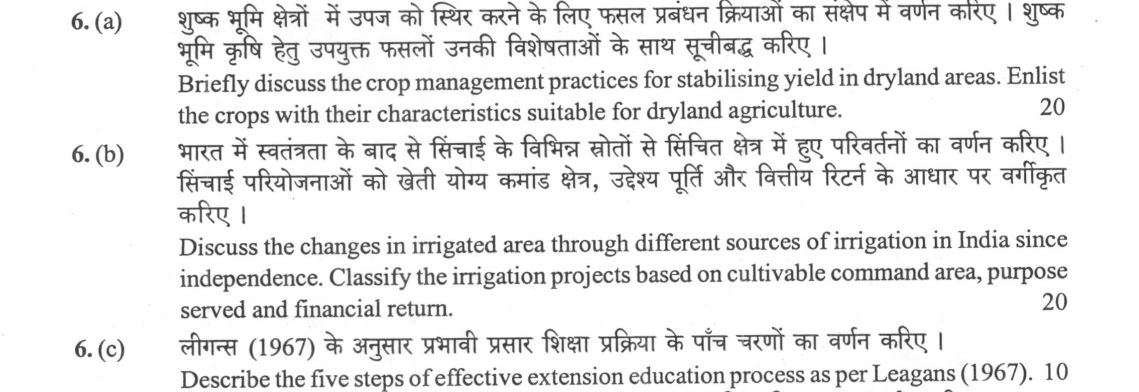
(a) Briefly discuss the crop management practices for stabilising yield in dryland areas. Enlist the crops with their…
Briefly discuss the crop management practices for stabilising yield in dryland areas. Enlist the crops with their characteristics suitable for dryland agriculture. 20 marks
Discuss the changes in irrigated area through different sources of irrigation in India since independence. Classify the irrigation projects based on cultivable command area, purpose served and financial return. 20 marks
Describe the five steps of effective extension education process as per Leagans (1967). 10 marks
हिंदी में प्रश्न पढ़ें
शुष्क भूमि क्षेत्रों में उपज को स्थिर करने के लिए फसल प्रबंधन क्रियाओं का संक्षेप में वर्णन करिए । शुष्क भूमि कृषि हेतु उपयुक्त फसलों उनकी विशेषताओं के साथ सूचीबद्ध करिए । 20
भारत में स्वतंत्रता के बाद से सिंचाई के विभिन्न स्रोतों से सिंचित क्षेत्र में हुए परिवर्तनों का वर्णन करिए । सिंचाई परियोजनाओं को खेती योग्य कमांड क्षेत्र, उद्देश्य पूर्ति और वित्तीय रिटर्न के आधार पर वर्गीकृत करिए । 20
लीगंस (1967) के अनुसार प्रभावी प्रसार शिक्षा प्रक्रिया के पांच चरणों का वर्णन करिए । 10
Model answer
Written by UPSC Answer Check against this question's marking rubric, to the expected length. UPSC does not publish answers for Mains — this is one way to score well, not an official key.
Part (a): Dryland Crop Management and Suitable Crops
Stabilizing yield in dryland areas, which constitute 52% of India’s net sown area, requires an integrated approach focusing on moisture conservation, soil health, and contingency planning. Moisture conservation is paramount; practices include mulching with straw or plastic to reduce evaporation, contour bunding to check runoff, and the application of anti-transpirants. It is crucial to distinguish between film-forming agents, such as waxes or emulsions that create a physical barrier, and metabolic agents like phenylmercuric acetate (PMA), which chemically induce stomatal closure to limit transpiration. Soil management involves deep tillage to break hardpans and improve water infiltration, alongside zero-till sowing to preserve soil moisture. Nutrient management shifts towards micro-dosing of fertilizers at the root zone to maximize efficiency and reduce leaching, supplemented by foliar feeding during stress periods. Contingency planning involves timely sowing of short-duration varieties and the use of drought-tolerant hybrids developed by ICAR institutes.
Crops suitable for drylands possess specific physiological traits: deep root systems to access sub-soil moisture, C4 photosynthetic pathways for higher water-use efficiency, and mechanisms for drought escape (short duration) or tolerance (osmotic adjustment). Key examples include millets like Bajra (pearl millet), Jowar (sorghum), and Ragi (finger millet), which are highly resilient to low rainfall. Pulses such as Pigeonpea and Mungbean fix nitrogen and tolerate moderate drought. Oilseeds like Castor and Groundnut are also well-adapted. Recent advancements include ICAR-developed hybrids of pearl millet and sorghum that offer higher yields under water-limited conditions.
Part (b): Irrigation Trends and Project Classification
Since independence, India’s irrigation landscape has undergone a radical structural shift. At independence, canal irrigation dominated, accounting for approximately 40% of the net irrigated area, while groundwater extraction was primarily through dug wells, contributing about 28-29% of the total. Tube wells and borewells were negligible. By the 2010s, this hierarchy inverted. Canal irrigation’s share declined to roughly 25% due to the stagnation of new large-scale projects and waterlogging issues. Conversely, groundwater irrigation surged to over 60% of the net irrigated area, driven by the proliferation of tube wells and borewells, leading to severe depletion in states like Rajasthan and Andhra Pradesh. Tank irrigation has remained relatively stagnant, while micro-irrigation (drip and sprinkler) emerged post-1980s and has expanded significantly under the PMKSY scheme, covering over 60 lakh hectares recently.
Irrigation projects are classified based on three criteria. First, by Cultivable Command Area (CCA): Major projects have a CCA of 10,000 hectares or more (e.g., Bhakra Nangal, Sardar Sarovar); Medium projects range between 2,000 and 10,000 hectares; Minor projects are under 2,000 hectares. Second, by purpose: Single-purpose projects serve only irrigation (e.g., some minor canals), whereas Multi-purpose projects serve irrigation, power generation, flood control, and navigation (e.g., Bhakra Nangal). Third, by financial return: Productive irrigation projects are economically viable and generate revenue, while Protective irrigation projects are undertaken for flood control or ecological balance, often with negative financial returns but high social utility.
Part (c): Leagans’ Extension Education Process
Leagans (1967) outlined a five-step problem-solving process for extension education, which is systematic and participatory. The first step is Collecting facts about the situation, where the extension worker gathers data on the farmer’s current practices, resources, and constraints through observation and interviews. The second step is Analyzing and interpreting the situation, involving the identification of gaps between the current state and the desired state, and understanding the root causes of low productivity. The third step is Selecting, defining, and limiting the problem, where the most critical issue is isolated from other secondary problems to focus efforts effectively. The fourth step is Determining possible solutions and making the decision, where alternatives are evaluated based on feasibility, cost, and impact, and a consensus is reached with the farmer. The final step is Taking action and accepting responsibility, where the chosen solution is implemented, and the extension worker supports the farmer in monitoring outcomes and adapting strategies as needed.
Conclusion
Effective agricultural development in India requires the convergence of dryland management technologies, rational irrigation policy, and robust extension mechanisms. While the shift to groundwater has boosted production, it has compromised sustainability; thus, a return to canal-based and micro-irrigation systems is essential. Applying Leagans’ problem-solving framework ensures that these technologies are adopted contextually by farmers, bridging the gap between research and farm practice for holistic, climate-resilient agriculture.
What "Discuss" is asking you to do
Lay the issue out from more than one side — how it arose, what is claimed for it, what is held against it, and where it now stands. UPSC attaches discuss to broad topics with several live dimensions, so coverage of the dimensions earns more than the strength of your opinion.
Structure that answers it
Set the issue up → the case as it is made → the case against → the dimension both sides leave out → where the balance now lies
Where marks are lost
Listing facts with no thread between them, or arguing one side throughout and calling it a discussion.
How this answer will be evaluated
Approach
(a) discuss: intro > 3-4 dimensions > example > balanced close | (b) discuss: intro > 3-4 dimensions > example > balanced close | (c) describe: define > structure or process in order > labelled diagram > significance Full marks: Comprehensive coverage of all sub-parts with specific examples, data, and correct classifications.
Key points expected
- Practices for moisture conservation (mulching, zero-till)
- Practices for drought resistance (drip, stress-tolerant varieties)
- List of crops (e.g., Bajra, Moong, Groundnut)
- Characteristics of listed crops (short duration, low water need)
- Trend of irrigated area by source (canals, wells, tanks)
- Classification by Cultivable Command Area (CCA)
- Classification by purpose (irrigation, power, flood control)
- Classification by financial return (economic viability)
Evaluation rubric
Each sub-part is marked on its own, against the marks and word limit printed on the paper.
- (a) Crop management practices for dryland yield stability and a list of suitable crops with characteristics. 20 marks
discuss— intro → 3-4 dimensions → example → balanced close
Must cover
- Practices for moisture conservation (mulching, zero-till)
- Practices for drought resistance (drip, stress-tolerant varieties)
- List of crops (e.g., Bajra, Moong, Groundnut)
- Characteristics of listed crops (short duration, low water need)
Loses marks
- Vague advice without specific agronomic practices
- Listing irrigated crops as suitable for dryland
- Ignoring the 'characteristics' requirement for crops
Earns more
- Mention of specific drought-tolerant varieties (e.g., HD 2967)
- Reference to soil health management (compost, biochar)
- Discussion of crop diversification strategies
- Mention of specific dryland zones (e.g., Deccan plateau)
Extra mark
- Reference to specific government schemes (e.g., PM-KISAN)
- Data on yield stability indices for specific crops
- (b) Changes in irrigated area by source since independence and classification of projects by CCA, purpose, and return. 20 marks
discuss— intro → 3-4 dimensions → example → balanced close
Must cover
- Trend of irrigated area by source (canals, wells, tanks)
- Classification by Cultivable Command Area (CCA)
- Classification by purpose (irrigation, power, flood control)
- Classification by financial return (economic viability)
Loses marks
- Failing to distinguish between 'gross' and 'net' command area
- Ignoring the 'financial return' classification
- Providing only current data without historical trend
Earns more
- Mention of specific data points (e.g., % share of canals vs wells)
- Reference to specific large projects (e.g., Bhakra Nangal)
- Discussion of the shift from canals to groundwater
- Mention of 'Command Area Development' (CAD) concept
Extra mark
- Reference to specific CCA figures for a major project
- Mention of the 'National Water Policy' impact
- (c) The five steps of the effective extension education process as per Leagans (1967). 10 marks
describe— define → structure or process in order → labelled diagram → significance
Must cover
- Step 1: Diagnosis of problem/need
- Step 2: Planning of action
- Step 3: Implementation of plan
- Step 4: Evaluation of results
Loses marks
- Listing steps in the wrong order
- Confusing 'Diagnosis' with 'Planning'
- Failing to mention 'Evaluation' or 'Feedback'
Earns more
- Mention of 'Feedback' as the 5th step
- Brief explanation of each step's objective
- Reference to the 'Leagans' model specifically
- Mention of the cyclical nature of the process
Extra mark
- A simple diagram of the 5-step cycle
- Example of a specific extension activity using the steps
Practice this exact question
Write your answer and it is marked point by point against the model answer above — what you covered, what you missed, what you got wrong.
Evaluate my answer →More from Agriculture 2024 Paper I
- Q3 (a) What is the Arnon and Stout (1939) criteria for plant nutrient essentiality? Give acc…
- Q4 (a) Explain the term conventional and conservation tillage. Give account of their compara…
- Q5 Answer the following questions in about 150 words each: (a) Write down the principles inv…
- Q6 (a) Briefly discuss the crop management practices for stabilising yield in dryland areas.…
- Q7 (a) Discuss the chronological developments of National Extension System of India after in…
- Q8 (a) Explain different types of farming. Discuss the factors affecting types of farming. 2…