Paper I — Q8
(a) Explain different types of farming. Discuss the factors affecting types of farming. 20 marks (b) Explain the term water use…
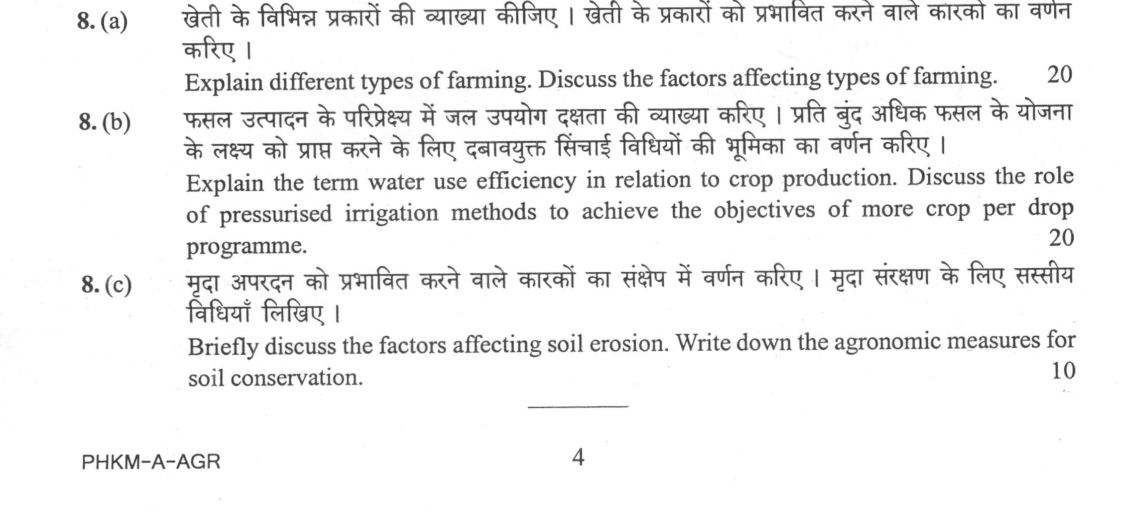
Explain different types of farming. Discuss the factors affecting types of farming. 20 marks
Explain the term water use efficiency in relation to crop production. Discuss the role of pressurised irrigation methods to achieve the objectives of more crop per drop programme. 20 marks
Briefly discuss the factors affecting soil erosion. Write down the agronomic measures for soil conservation. 10 marks
हिंदी में प्रश्न पढ़ें
खेती के विभिन्न प्रकारों की व्याख्या कीजिए । खेती के प्रकारों को प्रभावित करने वाले कारकों का वर्णन करिए । 20
फसल उत्पादन के परिप्रेक्ष्य में जल उपयोग दक्षता की व्याख्या करिए । प्रति बूंद अधिक फसल के योजना के लक्ष्य को प्राप्त करने के लिए दबावयुक्त सिंचाई विधियों की भूमिका का वर्णन करिए । 20
मृदा अपरदन को प्रभावित करने वाले कारकों का संक्षेप में वर्णन करिए । मृदा संरक्षण के लिए सस्यीय विधियाँ लिखिए । 10
Model answer
Written by UPSC Answer Check against this question's marking rubric, to the expected length. UPSC does not publish answers for Mains — this is one way to score well, not an official key.
Types of Farming and Determinants
Farming systems evolve through the interplay of agro-ecological conditions and socio-economic imperatives. They are categorized based on commercial orientation into subsistence and commercial farming; input intensity into intensive and extensive systems; enterprise mix into arable, pastoral, and mixed farming; and operational models into shifting cultivation (such as Jhum in North-Eastern states), ley farming, organic farming (fully adopted in Sikkim), and contract farming (widely practiced for potato in Punjab).
The adoption of a specific farming type is governed by physical factors (climate, topography, and soil determine biological feasibility), economic conditions (capital availability, landholding size, and market proximity dictate commercial viability), social factors (land tenure systems and dietary habits), technological capacity (irrigation access, mechanization, and hybrid seeds), and institutional support (minimum support prices, credit delivery, and enabling regulatory frameworks).
Water Use Efficiency and Pressurised Irrigation
Water Use Efficiency (WUE) quantifies the ratio of biological or economic crop yield to the volume of water consumed, expressed as kg/m³ or kg/ha-mm. It comprises Crop WUE (WUEₜ, yield per unit evapotranspiration), Irrigation WUE (WUEᵢ, yield increase per unit irrigation water applied), and economic Water Productivity (WP). At the physiological level, intrinsic WUE measures the ratio of carbon assimilation to stomatal conductance (A/gₛ), whereas extrinsic WUE measures carbon assimilation relative to total transpiration (A/E).
Under the Pradhan Mantri Krishi Sinchayee Yojana (PMKSY)–Per Drop More Crop initiative, pressurized irrigation minimizes conveyance, evaporation, and deep percolation losses. Drip irrigation systems (utilizing point-source emitters, inline drippers, or subsurface drip lines) deliver water directly to the crop root zone along with dissolved nutrients via fertigation, achieving 40% to 70% water savings and nutrient use efficiencies above 90%. Sprinkler systems (including fixed, semi-permanent, and centre-pivot configurations) simulate uniform rainfall over undulating topographies, reducing water use by 30% to 50% without requiring prior land leveling.
Soil Erosion Factors and Agronomic Measures
Soil erosion involves detachment and transport of topsoil, modeled functionally by the Universal Soil Loss Equation (A = R × K × LS × C × P), where soil loss (A) depends on rainfall erosivity (R, kinetic energy of precipitation), soil erodibility (K, texture and organic matter content), topography (LS, slope length and steepness), crop canopy and cover management (C), and support conservation practices (P).
Agronomic conservation mitigates erosion by dissipating raindrop kinetic energy and reducing runoff velocity through non-structural field practices. Contour farming establishes ridges perpendicular to the slope to retard runoff. Strip cropping alternates erosion-permitting row crops with erosion-resisting dense legumes. Cover crops and organic mulching shield the soil surface from splash detachment and aggregate breakdown. Diversified crop rotations and zero-tillage preserve soil organic matter, root networks, and surface residues. Agroforestry models, including alley cropping and windbreak shelterbelts, stabilize soil matrices and intercept wind and overland flow.
Synergizing diversified farming systems with micro-irrigation and agronomic soil conservation provides the technical pathway to achieve climate-resilient sustainable intensification across India's agro-ecological zones.
What "Explain" is asking you to do
Make the working of something clear — what sets it off, what follows from what, and what it produces. Explain is the Commission's mechanism word: it dominates the technical papers and the “explain why” stems, where the marks sit in the causal chain and not in the label.
Structure that answers it
State what it is → the initiating condition → the chain of cause, step by step → an instance where it plays out → what the chain produces
Where marks are lost
Describing what something looks like instead of why it works that way. Naming the stages without linking them reads as description too.
How this answer will be evaluated
Approach
Framework: Concept > Practice or process > Data > Indian application. (a) explain: definition/context > points in order > small example > short close | (b) explain: definition/context > points in order > small example > short close | (c) discuss: intro > 3-4 dimensions > example > balanced close Full marks: Precise definitions, specific examples, and clear linkages between factors and outcomes.
Key points expected
- Define subsistence, intensive, commercial, and mixed farming
- Distinguish between dry and irrigated farming
- Link climate, soil, and market to farming type
- Mention land tenure and labor availability as factors
- Define WUE as crop yield per unit water consumed
- Explain drip and sprinkler irrigation mechanisms
- Link pressurized systems to reduced evaporation/leaching
- Discuss precision application of water and nutrients
Evaluation rubric
Each sub-part is marked on its own, against the marks and word limit printed on the paper.
- (a) Define and categorize farming types, then analyze the factors determining their adoption. 20 marks
explain— definition/context → points in order → small example → short close
Must cover
- Define subsistence, intensive, commercial, and mixed farming
- Distinguish between dry and irrigated farming
- Link climate, soil, and market to farming type
- Mention land tenure and labor availability as factors
Loses marks
- Confusing 'intensive' with 'commercial' farming
- Ignoring socio-economic factors in the discussion
- Vague definitions without specific examples
Earns more
- Reference to 'Jhum' or 'Shifting' cultivation
- Mention of 'Rabi' and 'Kharif' cropping patterns
- Reference to 'Green Revolution' impact on commercial farming
- Mention of 'Organic' or 'Sustainable' farming trends
Extra mark
- Reference to 'PM-KISAN' scheme
- Mention of 'National Agricultural Market' (e-NAM)
- (b) Define water use efficiency (WUE) and explain how pressurized irrigation achieves 'more crop per drop'. 20 marks
explain— definition/context → points in order → small example → short close
Must cover
- Define WUE as crop yield per unit water consumed
- Explain drip and sprinkler irrigation mechanisms
- Link pressurized systems to reduced evaporation/leaching
- Discuss precision application of water and nutrients
Loses marks
- Confusing 'water use efficiency' with 'water use effectiveness'
- Failing to link pressurized systems to specific water savings
- Ignoring the role of soil type in WUE
Earns more
- Mention of 'Micro-irrigation' technology
- Reference to 'Soil Moisture Sensors'
- Comparison of WUE in flood vs. drip irrigation
- Mention of 'Drip Fertigation'
Extra mark
- Reference to 'Per Drop More Crop' scheme
- Mention of 'National Water Mission'
- (c) Identify factors causing soil erosion and list agronomic measures for conservation. 10 marks
discuss— intro → 3-4 dimensions → example → balanced close
Must cover
- Identify rainfall, wind, and slope as erosion factors
- Mention 'Contour Ploughing' as a conservation measure
- Mention 'Terracing' or 'Check Dams'
- Mention 'Cover Crops' or 'Mulching'
Loses marks
- Listing only physical factors, ignoring human activity
- Confusing 'erosion' with 'leaching'
- Vague measures like 'plant trees' without specific context
Earns more
- Reference to 'Riparian Buffer Zones'
- Mention of 'Windbreaks' or 'Shelterbelts'
- Reference to 'Conservation Tillage'
- Mention of 'Crop Rotation'
Extra mark
- Reference to 'Soil Health Card' scheme
- Mention of 'National Mission for Sustainable Agriculture'
Practice this exact question
Write your answer and it is marked point by point against the model answer above — what you covered, what you missed, what you got wrong.
Evaluate my answer →More from Agriculture 2024 Paper I
- Q5 Answer the following questions in about 150 words each: (a) Write down the principles inv…
- Q6 (a) Briefly discuss the crop management practices for stabilising yield in dryland areas.…
- Q7 (a) Discuss the chronological developments of National Extension System of India after in…
- Q8 (a) Explain different types of farming. Discuss the factors affecting types of farming. 2…