Paper I — Q2
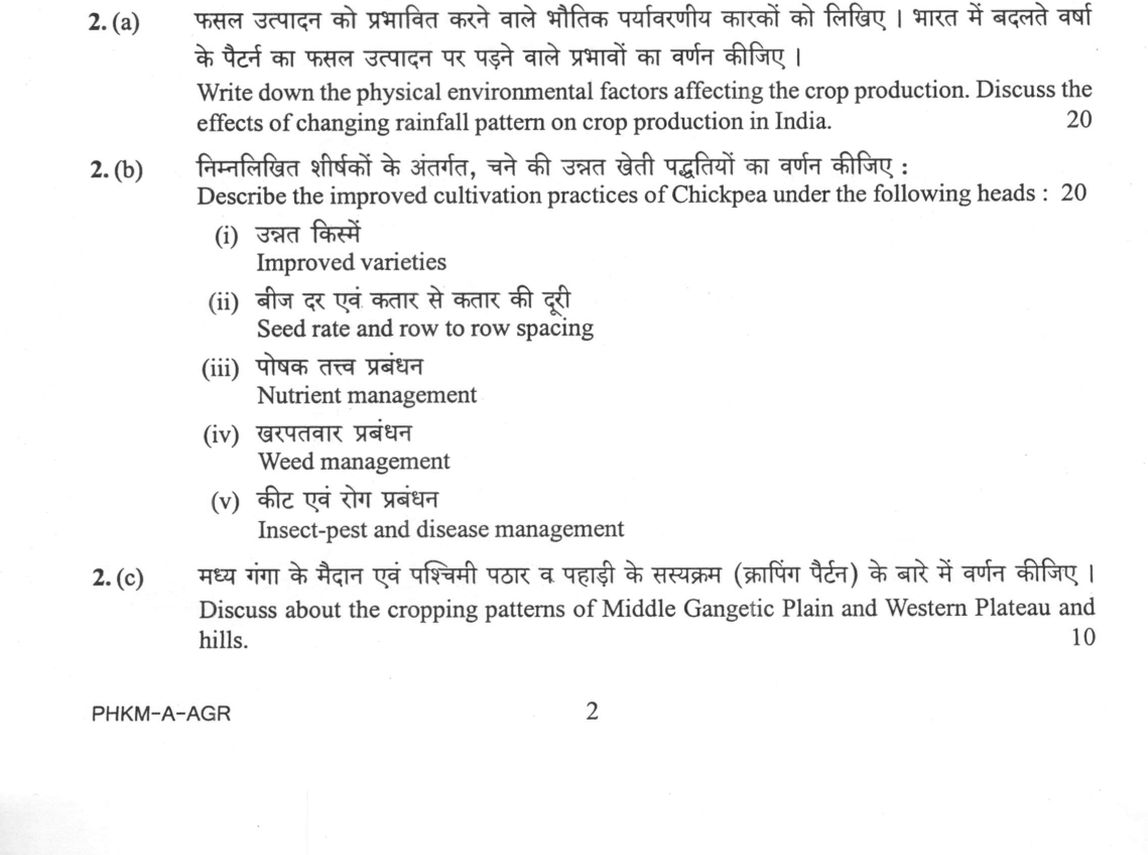
(a) Write down the physical environmental factors affecting the crop production. Discuss the effects of changing rainfall pattern…
Write down the physical environmental factors affecting the crop production. Discuss the effects of changing rainfall pattern on crop production in India. 20 marks
Describe the improved cultivation practices of Chickpea under the following heads: 20 marks Improved varieties
Seed rate and row to row spacing
Nutrient management
Weed management
Insect-pest and disease management
Discuss about the cropping patterns of Middle Gangetic Plain and Western Plateau and hills. 10 marks
हिंदी में प्रश्न पढ़ें
फसल उत्पादन को प्रभावित करने वाले भौतिक पर्यावरणीय कारकों को लिखिए । भारत में बदलते वर्षा के पैटर्न का फसल उत्पादन पर पड़ने वाले प्रभावों का वर्णन कीजिए । 20
निम्नलिखित शीर्षकों के अंतर्गत, चने की उन्नत खेती पद्धतियों का वर्णन कीजिए : 20 उन्नत किस्में
बीज दर एवं कतार से कतार की दूरी
पोषक तत्व प्रबंधन
खरपतवार प्रबंधन
कीट एवं रोग प्रबंधन
मध्य गंगा के मैदान एवं पश्चिमी पठार व पहाड़ी के सस्यक्रम (क्रॉपिंग पैटर्न) के बारे में वर्णन कीजिए । 10
Model answer
Written by UPSC Answer Check against this question's marking rubric, to the expected length. UPSC does not publish answers for Mains — this is one way to score well, not an official key.
Crop production in India is fundamentally constrained by physical environmental factors, with rainfall variability posing the most acute threat to food security.
Physical Environmental Factors and Rainfall Variability The primary physical factors governing crop growth include temperature, light, humidity, wind, and edaphic conditions such as soil texture, structure, depth, and moisture-holding capacity. Temperature dictates metabolic rates and phenology, while light intensity and duration drive photosynthesis. Humidity influences transpiration and disease pressure, and wind affects pollination and physical damage. Soil properties determine water and nutrient availability.
Changing rainfall patterns significantly disrupt these dynamics. A delayed monsoon onset, as seen in recent years, compresses the kharif sowing window, leading to reduced crop duration and yield. Spatially uneven distribution causes simultaneous drought in some regions and waterlogging in others. For instance, erratic rainfall has caused kharif crop failures in Maharashtra and Andhra Pradesh, while excess rainfall in the Northeast leads to lodging and disease. Conversely, deficit rainfall during the rabi season induces moisture stress in wheat and chickpea, reducing grain fill. Extreme events like cyclones and unseasonal rains further exacerbate losses, necessitating climate-resilient agronomy.
Improved Cultivation Practices of Chickpea Chickpea (Cicer arietinum) is a vital rabi pulse. Its improved cultivation involves:
(i) Improved Varieties: Selection depends on the type. Desi types, such as JG 16, are known for high yield potential and early maturity. Kabuli types, including JAKI 9218 and JG 11, are preferred for their larger seed size and specific market preferences. Both groups now include varieties with resistance to Fusarium wilt and Ascochyta blight, enhancing stability under stress.
(ii) Seed Rate and Spacing: The standard seed rate is 80–100 kg/ha. Spacing varies by type to optimize light interception and air circulation. Desi chickpea is typically sown at 30 cm row-to-row and 10 cm plant-to-plant spacing. Kabuli chickpea, having a larger canopy, requires wider spacing, often 30 cm row-to-row and 15 cm plant-to-plant, to prevent overcrowding and disease incidence.
(iii) Nutrient Management: Chickpea is a legume but requires basal application of phosphorus and potassium. The recommended dose is 20 kg N, 40 kg P₂O₅, and 20 kg K₂O per hectare. Nitrogen is often applied as a top dressing if soil nitrogen is low, though excessive nitrogen can reduce nodulation. Sulfur (20 kg/ha) is also beneficial for protein synthesis.
(iv) Weed Management: Weeds compete for moisture and nutrients. Pre-plant incorporated herbicides like Fluchloralin (1.0 kg a.i./ha) are applied before sowing and incorporated into the soil. Pre-emergence herbicides such as Pendimethalin (1.0 kg a.i./ha) can be applied within two days after sowing. Hand weeding at 30–45 days after sowing is often necessary for complete control.
(v) Insect-Pest and Disease Management: Integrated Pest Management (IPM) is crucial. The major pest, Helicoverpa armigera (pod borer), is managed by pheromone traps, yellow sticky traps, and selective insecticide sprays (e.g., Emamectin benzoate) only when the economic threshold is crossed. Fusarium wilt, a soil-borne disease, is managed by growing resistant varieties, crop rotation with non-hosts like maize or wheat, and soil solarization.
Cropping Patterns: Middle Gangetic Plain vs. Western Plateau The Middle Gangetic Plain, with its fertile alluvial soil and assured irrigation, supports high-intensity cropping patterns (180–200% intensity). The dominant system is Rice-Wheat, often followed by pulses or oilseeds. Sugarcane-based systems are also prevalent in areas with deep groundwater. This region relies heavily on irrigation and high-input agriculture.
In contrast, the Western Plateau and Hills (parts of Maharashtra, Karnataka, and Madhya Pradesh) are predominantly rainfed. Cropping patterns are adapted to drought and lower soil fertility. Sorghum-based systems (Sorghum-Gram, Sorghum-Groundnut) are common, as are millet-based systems (Pearl millet, Bajra). Cotton is a major cash crop in the black soil regions. Crop intensity is lower (100–150%), and practices focus on moisture conservation, such as mulching and intercropping with drought-tolerant pulses.
Conclusion Addressing the challenges of Indian agriculture requires a holistic approach. While physical factors like rainfall variability dictate the baseline constraints, improved agronomic practices for crops like chickpea can enhance resilience. Furthermore, aligning cropping patterns with agro-ecological realities—high-intensity irrigated systems in the Gangetic Plain versus drought-adapted rainfed systems in the Western Plateau—is essential for sustainable intensification and food security.
What "Discuss" is asking you to do
Lay the issue out from more than one side — how it arose, what is claimed for it, what is held against it, and where it now stands. UPSC attaches discuss to broad topics with several live dimensions, so coverage of the dimensions earns more than the strength of your opinion.
Structure that answers it
Set the issue up → the case as it is made → the case against → the dimension both sides leave out → where the balance now lies
Where marks are lost
Listing facts with no thread between them, or arguing one side throughout and calling it a discussion.
How this answer will be evaluated
Approach
Framework: Concept > Practice or process > Data > Indian application. (a) discuss: intro > 3-4 dimensions > example > balanced close | (b) describe: define > structure or process in order > labelled diagram > significance | (c) discuss: intro > 3-4 dimensions > example > balanced close Full marks: Precise data, named varieties, specific schemes, clear regional distinctions.
Key points expected
- List 4-5 physical factors (soil, climate, water, topography)
- Define 'changing rainfall pattern' (erratic, delayed, intense)
- Link rainfall changes to specific crop failures (e.g., kharif)
- Mention mitigation strategies (drip, micro-irrigation, insurance)
- Name specific improved varieties (e.g., JG-11, L-550)
- Give exact seed rate (kg/ha) and spacing (cm)
- Specify nutrient doses (NPK) and timing
- Identify key pests (pod borer) and diseases (blight)
Evaluation rubric
Each sub-part is marked on its own, against the marks and word limit printed on the paper.
- (a) List physical factors and analyze the impact of rainfall variability on Indian agriculture. 20 marks
discuss— intro → 3-4 dimensions → example → balanced close
Must cover
- List 4-5 physical factors (soil, climate, water, topography)
- Define 'changing rainfall pattern' (erratic, delayed, intense)
- Link rainfall changes to specific crop failures (e.g., kharif)
- Mention mitigation strategies (drip, micro-irrigation, insurance)
Loses marks
- Vague listing of factors without explanation
- Ignoring the 'changing pattern' aspect (only discussing rain)
Earns more
- Reference to IMD data or specific drought/flood years
- Mention of PMFBY (insurance) or PMKSY (irrigation)
Extra mark
- Specific data on rainfall deviation in a region
- Mention of specific climate-resilient crop varieties
- (b) Detail improved chickpea cultivation practices under the five specified heads. 20 marks
describe— define → structure or process in order → labelled diagram → significance
Must cover
- Name specific improved varieties (e.g., JG-11, L-550)
- Give exact seed rate (kg/ha) and spacing (cm)
- Specify nutrient doses (NPK) and timing
- Identify key pests (pod borer) and diseases (blight)
Loses marks
- General agronomic advice without specific doses/spacing
- Missing any of the five specified heads
Earns more
- Mention of specific herbicides for weed management
- Reference to biological control agents
Extra mark
- Mention of specific government scheme for pulses
- Reference to specific research institute (e.g., IARI)
- (c) Compare cropping patterns of Middle Gangetic Plain and Western Plateau/Hills. 10 marks
discuss— intro → 3-4 dimensions → example → balanced close
Must cover
- Identify Middle Gangetic crops (rice, wheat, sugarcane)
- Identify Western Plateau crops (cotton, groundnut, pulses)
- Link patterns to soil/climatic differences (alluvial vs. black soil)
- Mention specific regions (e.g., UP/Bihar vs. MP/Gujarat)
Loses marks
- Confusing the two regions' crops
- Failing to link patterns to environmental factors
Earns more
- Mention of specific irrigation sources (canals vs. wells)
- Reference to specific crop seasons (Rabi/Kharif)
Extra mark
- Mention of specific government schemes for these regions
- Reference to specific crop productivity data
Practice this exact question
Write your answer and it is marked point by point against the model answer above — what you covered, what you missed, what you got wrong.
Evaluate my answer →More from Agriculture 2024 Paper I
- Q1 Answer the following questions in about 150 words each: (a) Briefly discuss the principle…
- Q2 (a) Write down the physical environmental factors affecting the crop production. Discuss…
- Q3 (a) What is the Arnon and Stout (1939) criteria for plant nutrient essentiality? Give acc…
- Q4 (a) Explain the term conventional and conservation tillage. Give account of their compara…
- Q5 Answer the following questions in about 150 words each: (a) Write down the principles inv…