Paper I — Q4
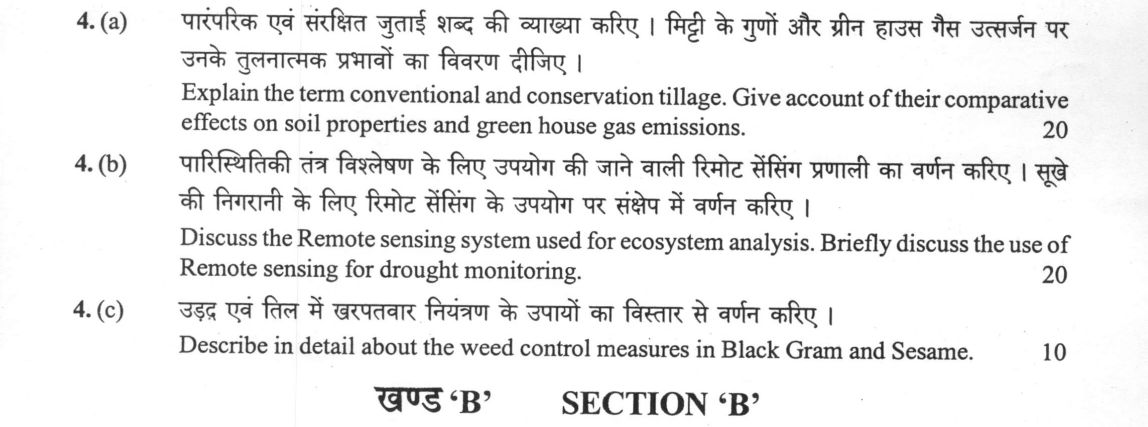
(a) Explain the term conventional and conservation tillage. Give account of their comparative effects on soil properties and…
Explain the term conventional and conservation tillage. Give account of their comparative effects on soil properties and green house gas emissions. 20 marks
Discuss the Remote sensing system used for ecosystem analysis. Briefly discuss the use of Remote sensing for drought monitoring. 20 marks
Describe in detail about the weed control measures in Black Gram and Sesame. 10 marks
हिंदी में प्रश्न पढ़ें
पारंपरिक एवं संरक्षित जुताई शब्द की व्याख्या करिए । मिट्टी के गुणों और ग्रीन हाउस गैस उत्सर्जन पर उनके तुलनात्मक प्रभावों का विवरण दीजिए । 20
पारिस्थितिकी तंत्र विश्लेषण के लिए उपयोग की जाने वाली रिमोट सेंसिंग प्रणाली का वर्णन करिए । सूखे की निगरानी के लिए रिमोट सेंसिंग के उपयोग पर संक्षेप में वर्णन करिए । 20
उड़द एवं तिल में खरपतवार नियंत्रण के उपायों का विस्तार से वर्णन करिए । 10
Model answer
Written by UPSC Answer Check against this question's marking rubric, to the expected length. UPSC does not publish answers for Mains — this is one way to score well, not an official key.
Sustainable agriculture demands a paradigm shift from exploitative practices to climate-smart interventions. This response elucidates the agronomic and remote sensing frameworks essential for modern ecosystem management.
Conventional vs. Conservation Tillage Conventional tillage involves intensive soil manipulation, including inversion and pulverization, to control weeds and incorporate residues. In contrast, conservation tillage (CT) minimizes soil disturbance, retaining crop residues as mulch. The causal mechanism of CT lies in reduced physical disruption, which preserves soil structure.
Comparatively, conventional tillage increases soil bulk density and destroys aggregates, leading to poor water infiltration and higher runoff. CT, however, enhances aggregate stability and porosity. Crucially, CT sequesters organic carbon; by reducing oxidation of soil organic matter, it acts as a carbon sink, potentially sequestering 0.1–0.5 t C/ha/year. Regarding Green House Gas (GHG) emissions, conventional tillage releases significant CO2 from accelerated decomposition and increases N2O via nitrification-denitrification cycles due to exposed soil. CT reduces fuel-based CO2 emissions by 50–70% due to fewer tractor passes. Furthermore, CT improves soil microbial biomass and enzymatic activity, fostering a healthier rhizosphere. Notably, no-till systems can enhance methane (CH4) oxidation in certain soils due to improved aeration, though this varies with soil type.
Remote Sensing for Ecosystem Analysis and Drought Remote sensing provides spatially explicit data for ecosystem analysis using optical, thermal, and microwave sensors. Optical sensors like Landsat and Sentinel-2 capture reflected radiation to calculate vegetation indices. The Normalized Difference Vegetation Index (NDVI) and Enhanced Vegetation Index (EVI) quantify greenness and canopy density. Leaf Area Index (LAI) is derived from these indices or radiative transfer models, serving as a critical structural parameter. Light-use efficiency models then utilize LAI as an input, along with radiation data, to estimate Net Primary Productivity (NPP), thereby modeling ecosystem productivity. Microwave sensors (SAR) penetrate cloud cover, providing all-weather data on soil moisture and biomass.
For drought monitoring, remote sensing integrates meteorological and biophysical data. The Standardized Precipitation Index (SPI) quantifies precipitation deficits. Vegetation-based indices, such as the Vegetation Condition Index (VCI) and Temperature Condition Index (TCI), detect stress by comparing current NDVI anomalies against historical baselines and land surface temperatures. In India, the National Agricultural Drought Assessment and Monitoring System (NADAMS) utilizes these remote sensing parameters to provide early warning systems, correlating NDVI anomalies with rainfall data to predict crop yield losses before they manifest physically.
Weed Control in Black Gram and Sesame Black Gram (Vigna mungo) has a critical weed-free period of 15–30 days after sowing (DAS). Major weeds include Trianthema portulacastrum and Digitaria sanguinalis. Management involves cultural practices like optimal seed rate and spacing to accelerate canopy closure. Mechanical control requires one hand weeding at 20 DAS. Chemical control employs pre-emergence herbicides like pendimethalin and post-emergence quizalofop-ethyl for grasses.
Sesame (Sesamum indicum) exhibits slow initial growth, making it highly susceptible to weeds like Cyperus rotundus and Portulaca oleracea. The stale seedbed technique, involving pre-sowing tillage to germinate weeds followed by a second tillage, is effective. Mulching suppresses weeds and conserves moisture. Hand weeding is required twice, at 20 and 40 DAS. Where permitted, pre-plant incorporation of oxadiazon or fluchloralin provides residual control, while isoproturon may be used for broadleaf weeds, ensuring an Integrated Weed Management (IWM) approach.
Conclusion The convergence of conservation tillage, remote sensing, and integrated weed management forms the backbone of climate-smart agriculture. By preserving soil health, leveraging satellite data for precise drought and ecosystem monitoring, and adopting targeted weed control, India can enhance agricultural resilience and sustainability.
What "Explain" is asking you to do
Make the working of something clear — what sets it off, what follows from what, and what it produces. Explain is the Commission's mechanism word: it dominates the technical papers and the “explain why” stems, where the marks sit in the causal chain and not in the label.
Structure that answers it
State what it is → the initiating condition → the chain of cause, step by step → an instance where it plays out → what the chain produces
Where marks are lost
Describing what something looks like instead of why it works that way. Naming the stages without linking them reads as description too.
How this answer will be evaluated
Approach
Framework: Concept > Practice or process > Data > Indian application. (a) explain: definition/context > points in order > small example > short close | (b) discuss: intro > 3-4 dimensions > example > balanced close | (c) describe: define > structure or process in order > labelled diagram > significance Full marks: Precise definitions, specific indices/satellites, named herbicides, clear comparative analysis
Key points expected
- Define conventional tillage (inversion, residue removal)
- Define conservation tillage (no-till, residue retention)
- Compare effects on soil properties (organic C, structure, moisture)
- Compare effects on greenhouse gas emissions (CO2, N2O, CH4)
- Explain remote sensing systems (satellites, sensors, platforms)
- Describe application in ecosystem analysis (NDVI, land cover)
- Explain remote sensing for drought monitoring (VCI, SPI)
- Mention specific satellites or indices used
Evaluation rubric
Each sub-part is marked on its own, against the marks and word limit printed on the paper.
- (a) Define conventional vs conservation tillage and compare their effects on soil and GHG. 20 marks
explain— definition/context → points in order → small example → short close
Must cover
- Define conventional tillage (inversion, residue removal)
- Define conservation tillage (no-till, residue retention)
- Compare effects on soil properties (organic C, structure, moisture)
- Compare effects on greenhouse gas emissions (CO2, N2O, CH4)
Loses marks
- Vague definitions without operational details
- Failing to distinguish between the two systems clearly
- Ignoring the greenhouse gas component
Earns more
- Mention specific tillage implements (e.g., disc harrow vs no-till drill)
- Reference to soil carbon sequestration potential
- Mention of specific Indian context (e.g., rice-wheat system)
Extra mark
- Cite specific study or data on GHG reduction percentages
- Mention specific Indian scheme promoting conservation tillage
- (b) Discuss remote sensing systems for ecosystem analysis and its use in drought monitoring. 20 marks
discuss— intro → 3-4 dimensions → example → balanced close
Must cover
- Explain remote sensing systems (satellites, sensors, platforms)
- Describe application in ecosystem analysis (NDVI, land cover)
- Explain remote sensing for drought monitoring (VCI, SPI)
- Mention specific satellites or indices used
Loses marks
- Generic description of remote sensing without ecosystem focus
- Failing to link remote sensing to drought monitoring specifically
- Lack of specific indices or satellite names
Earns more
- Mention specific satellites (e.g., Landsat, Sentinel, IRS)
- Explain specific indices (NDVI, VCI, TCI)
- Reference to Indian remote sensing agencies (ISRO, NRSC)
Extra mark
- Cite specific drought monitoring program in India
- Mention specific resolution or temporal frequency of data
- (c) Describe weed control measures in Black Gram and Sesame. 10 marks
describe— define → structure or process in order → labelled diagram → significance
Must cover
- List cultural weed control measures for Black Gram
- List cultural weed control measures for Sesame
- Mention chemical weed control (herbicides) for both
- Specify timing of weed control operations
Loses marks
- Generic weed control advice not specific to these crops
- Failing to distinguish between Black Gram and Sesame measures
- Ignoring chemical control options
Earns more
- Name specific herbicides used (e.g., pendimethalin, imazethapyr)
- Mention specific weed species in these crops
- Reference to integrated weed management
Extra mark
- Cite specific dose of herbicide
- Mention specific Indian variety of Black Gram or Sesame
Practice this exact question
Write your answer and it is marked point by point against the model answer above — what you covered, what you missed, what you got wrong.
Evaluate my answer →More from Agriculture 2024 Paper I
- Q1 Answer the following questions in about 150 words each: (a) Briefly discuss the principle…
- Q2 (a) Write down the physical environmental factors affecting the crop production. Discuss…
- Q3 (a) What is the Arnon and Stout (1939) criteria for plant nutrient essentiality? Give acc…
- Q4 (a) Explain the term conventional and conservation tillage. Give account of their compara…
- Q5 Answer the following questions in about 150 words each: (a) Write down the principles inv…
- Q6 (a) Briefly discuss the crop management practices for stabilising yield in dryland areas.…
- Q7 (a) Discuss the chronological developments of National Extension System of India after in…