Paper I — Q7
(a) Discuss the chronological developments of National Extension System of India after independence. 20 marks (b) Briefly discuss…
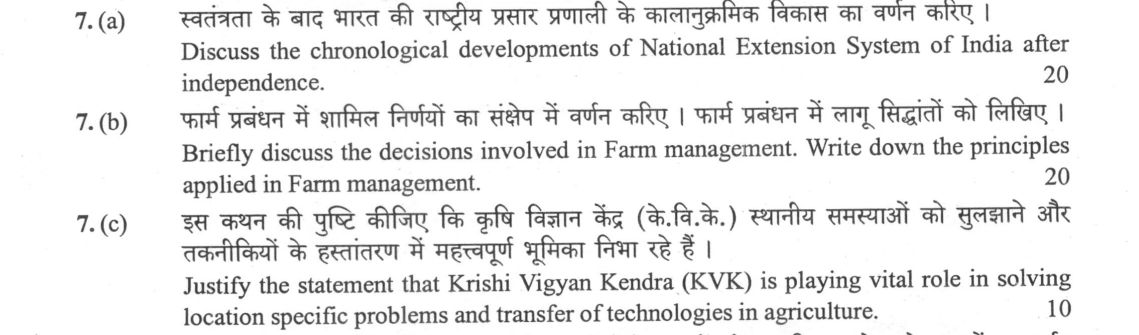
Discuss the chronological developments of National Extension System of India after independence. 20 marks
Briefly discuss the decisions involved in Farm management. Write down the principles applied in Farm management. 20 marks
Justify the statement that Krishi Vigyan Kendra (KVK) is playing vital role in solving location specific problems and transfer of technologies in agriculture. 10 marks
हिंदी में प्रश्न पढ़ें
स्वतंत्रता के बाद भारत की राष्ट्रीय प्रसार प्रणाली के कालानुक्रमिक विकास का वर्णन करिए । 20
फार्म प्रबंधन में शामिल निर्णयों का संक्षेप में वर्णन करिए । फार्म प्रबंधन में लागू सिद्धांतों को लिखिए । 20
इस कथन की पुष्टि कीजिए कि कृषि विज्ञान केंद्र (के.वि.के.) स्थानीय समस्याओं को सुलझाने और तकनीकियों के हस्तांतरण में महत्वपूर्ण भूमिका निभा रहे हैं । 10
Model answer
Written by UPSC Answer Check against this question's marking rubric, to the expected length. UPSC does not publish answers for Mains — this is one way to score well, not an official key.
India’s agricultural transformation has been driven by the evolving interplay between institutional extension architectures, micro-level farm economics, and grassroots technology refinement.
Chronological Developments of the National Extension System
India’s extension system evolved from community welfare to specialized, pluralistic models across distinct phases:
Community-based approach (1950s): Post-independence extension began with the Community Development Programme (1952) and National Extension Service (1953), addressing broad rural development through multi-purpose village-level workers.
Commodity and production-oriented approach (1960s): Chronic food deficits led to targeted production programs like the Intensive Agricultural District Programme (IADP, 1960) and Intensive Agricultural Area Programme (IAAP), laying the technical foundation for the Green Revolution.
Structured methodology (1970s–1980s): The World Bank-assisted Training and Visit (T&V) System (1974) professionalized extension under State Departments of Agriculture with fixed visit schedules, followed by the National Agricultural Extension Project (NAEP) to bridge research-extension gaps.
Farming Systems and decentralization (1990s–2000s): The Agricultural Technology Management Agency (ATMA, 1998) decentralized extension, fostering participatory, multi-agency convergence across State Agricultural Universities (SAUs), ICAR institutes, NGOs, and the private sector.
Digital and pluralistic era (2010s onwards): Recent decades witnessed a transition to ICT-led models like Kisan Call Centres (KCC), the mKisan portal, and Agri-tech platforms for real-time, customized advisories.
Farm Management Decisions and Principles
Farm management integrates physical sciences with economic theory to optimize resource use through three levels of decision-making:
- Strategic decisions determine the long-term farm structure, such as what to produce, enterprise selection (crops, horticulture, dairy), and the scale of farm operations.
- Tactical decisions involve medium-term execution regarding how to produce, including input combinations, mechanization levels, and financing.
- Operational decisions involve routine, day-to-day choices regarding the timing of sowing, irrigation scheduling, pesticide application, and marketing channels.
These decisions rely on core economic principles:
- Law of Diminishing Marginal Returns, identifying the rational zone of input application.
- Principle of Substitution (Factor-Factor and Product-Product), identifying least-cost input combinations and highest-revenue enterprise mixes.
- Principle of Equi-Marginal Returns, ensuring limited capital is allocated where marginal returns are equal across competing enterprises.
- Principle of Opportunity Cost, evaluating returns foregone from the next best alternative use of resources.
- Cost-Benefit Analysis and Minimum Loss Principle, determining profit-maximizing output levels and economic viability.
Role of Krishi Vigyan Kendras (KVKs)
Established under ICAR as institutional front-line extension centres, KVKs address location-specific agricultural constraints through On-Farm Testing (OFT) to assess agro-ecological suitability and Frontline Demonstrations (FLD) to showcase production potentials. KVKs produce quality bio-inputs and certified seeds while imparting vocational skill training to farmers, rural youth, and extension functionaries.
KVKs achieve effective dissemination through institutional convergence with ATMA, district line departments, NGOs, and private agribusinesses. Their impact is evident in the deployment of climate-resilient crop varieties and natural resource management practices under the National Innovations in Climate Resilient Agriculture (NICRA) project, the design of Integrated Farming System (IFS) models for smallholders, location-specific livelihood interventions in tribal belts, and the mobilization of farmer-to-farmer extension networks.
To maximize agricultural productivity, India must sustain this integrated framework where decentralized KVK validation, sound farm-level economic decision-making, and pluralistic digital extension converge at the farm gate.
What "Discuss" is asking you to do
Lay the issue out from more than one side — how it arose, what is claimed for it, what is held against it, and where it now stands. UPSC attaches discuss to broad topics with several live dimensions, so coverage of the dimensions earns more than the strength of your opinion.
Structure that answers it
Set the issue up → the case as it is made → the case against → the dimension both sides leave out → where the balance now lies
Where marks are lost
Listing facts with no thread between them, or arguing one side throughout and calling it a discussion.
How this answer will be evaluated
Approach
(a) discuss: intro > 3-4 dimensions > example > balanced close | (b) discuss: intro > 3-4 dimensions > example > balanced close | (c) justify: claim > 3-4 reasons > evidence > conclusion Full marks: Comprehensive, specific, and well-structured answers with clear examples and accurate details.
Key points expected
- Pre-1969: State-level extension and lack of coordination
- 1969: Establishment of ICAR and KVKs
- 1970s: National Extension Service (NES) and ICAR-DAU
- 1980s: KVKs operationalization and 100% coverage
- Decisions: Crop selection, input use, labor, marketing
- Principles: Specialization, diversification, risk management
- Principles: Profitability, sustainability, resource allocation
- Linking decisions to specific principles
Evaluation rubric
Each sub-part is marked on its own, against the marks and word limit printed on the paper.
- (a) Chronological evolution of the National Extension System (NES) post-independence. 20 marks
discuss— intro → 3-4 dimensions → example → balanced close
Must cover
- Pre-1969: State-level extension and lack of coordination
- 1969: Establishment of ICAR and KVKs
- 1970s: National Extension Service (NES) and ICAR-DAU
- 1980s: KVKs operationalization and 100% coverage
Loses marks
- Vague generalities without specific years
- Confusing KVKs with ICAR or DAU
- Ignoring the pre-1969 state of extension
Earns more
- Mention of 1969 ICAR Act
- Reference to 1970s NES structure
- Mention of 1980s KVK expansion
- Reference to 1990s/2000s reforms (e.g., e-extension)
Extra mark
- Specific dates of KVK establishment
- Mention of specific committees (e.g., 1969)
- (b) Decisions in farm management and the principles applied. 20 marks
discuss— intro → 3-4 dimensions → example → balanced close
Must cover
- Decisions: Crop selection, input use, labor, marketing
- Principles: Specialization, diversification, risk management
- Principles: Profitability, sustainability, resource allocation
- Linking decisions to specific principles
Loses marks
- Listing decisions without explaining them
- Listing principles without linking to decisions
- Vague agronomic advice without management context
Earns more
- Mention of 'Law of Diminishing Returns'
- Reference to 'Opportunity Cost'
- Mention of 'Risk and Uncertainty'
- Reference to 'Economies of Scale'
Extra mark
- Specific example of a farm decision
- Mention of 'Linear Programming' or 'Decision Trees'
- (c) Role of KVKs in solving location-specific problems and technology transfer. 10 marks
justify— claim → 3-4 reasons → evidence → conclusion
Must cover
- KVKs as 'last mile' extension centers
- Solving location-specific problems (e.g., soil, climate)
- Technology transfer: Demonstration, training, advisory
- Linking KVKs to local farmers and research
Loses marks
- Vague generalities about KVKs
- Ignoring the 'location-specific' aspect
- Confusing KVKs with other extension agencies
Earns more
- Mention of 'Frontline Demonstrations' (FLDs)
- Reference to 'Farmer Field Schools' (FFS)
- Mention of 'e-extension' or 'mobile apps'
- Reference to 'KVKs as nodal centers'
Extra mark
- Specific example of a KVK success story
- Mention of 'KVKs as 'Krishi Vigyan Kendra''
Practice this exact question
Write your answer and it is marked point by point against the model answer above — what you covered, what you missed, what you got wrong.
Evaluate my answer →More from Agriculture 2024 Paper I
- Q4 (a) Explain the term conventional and conservation tillage. Give account of their compara…
- Q5 Answer the following questions in about 150 words each: (a) Write down the principles inv…
- Q6 (a) Briefly discuss the crop management practices for stabilising yield in dryland areas.…
- Q7 (a) Discuss the chronological developments of National Extension System of India after in…
- Q8 (a) Explain different types of farming. Discuss the factors affecting types of farming. 2…