Paper I — Q3
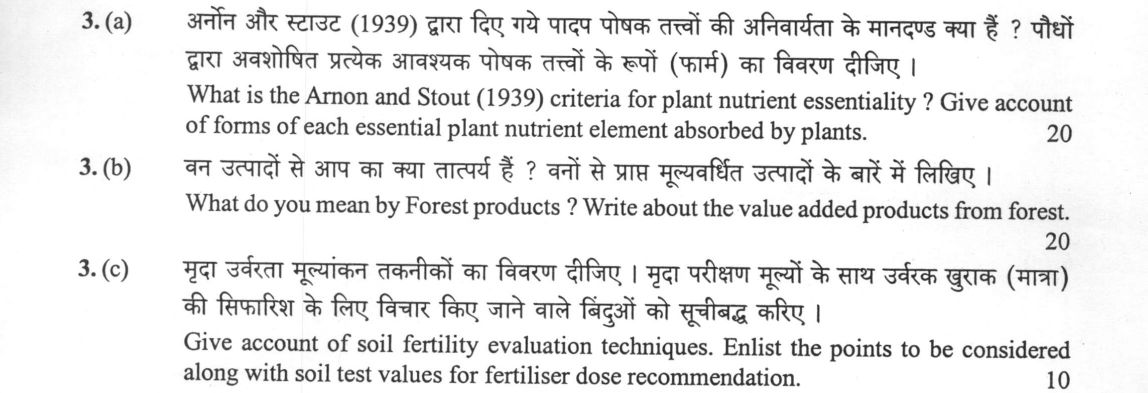
(a) What is the Arnon and Stout (1939) criteria for plant nutrient essentiality? Give account of forms of each essential plant…
What is the Arnon and Stout (1939) criteria for plant nutrient essentiality? Give account of forms of each essential plant nutrient element absorbed by plants. 20 marks
What do you mean by Forest products? Write about the value added products from forest. 20 marks
Give account of soil fertility evaluation techniques. Enlist the points to be considered along with soil test values for fertiliser dose recommendation. 10 marks
हिंदी में प्रश्न पढ़ें
अर्नोन और स्टाउट (1939) द्वारा दिए गए पादप पोषक तत्वों की अनिवार्यता के मानदण्ड क्या हैं ? पौधों द्वारा अवशोषित प्रत्येक आवश्यक पोषक तत्वों के रूपों (फॉर्म) का विवरण दीजिए । 20
वन उत्पादों से आप का क्या तात्पर्य है ? वनों से प्राप्त मूल्यवर्धित उत्पादों के बारे में लिखिए । 20
मृदा उर्वरता मूल्यांकन तकनीकों का विवरण दीजिए । मृदा परीक्षण मूल्यों के साथ उर्वरक खुराक (मात्रा) की सिफारिश के लिए विचार किए जाने वाले बिन्दुओं को सूचीबद्ध करिए । 10
Model answer
Written by UPSC Answer Check against this question's marking rubric, to the expected length. UPSC does not publish answers for Mains — this is one way to score well, not an official key.
Arnon and Stout Criteria and Forms of Absorbed Nutrients
Arnon and Stout (1939), later refined in 1954, formulated three fundamental criteria to determine the essentiality of a plant nutrient:
- Life Cycle Completion: A plant must be unable to complete its vegetative or reproductive life cycle in the absolute absence of the element.
- Irreplaceability: The requirement of the element is specific and cannot be replaced or substituted by any other mineral element (e.g., substitution of potassium by sodium cannot correct potassium deficiency).
- Direct Metabolic Action: The element must be directly involved in plant nutrition and metabolism, functioning as an essential constituent of a vital cellular metabolite (e.g., nitrogen in proteins, magnesium in chlorophyll) or as an enzymatic activator, rather than simply improving external soil conditions.
Plants absorb the seventeen essential elements predominantly from soil solution and the atmosphere in specific ionic or molecular forms across distinct valency states:
- Carbon (C), Hydrogen (H), Oxygen (O): Absorbed from air and water as carbon dioxide (CO₂), water (H_2O), and molecular oxygen (O₂).
- Nitrogen (N): Absorbed as nitrate (NO₃⁻) and ammonium (NH₄⁺).
- Phosphorus (P): Absorbed as primary orthophosphate (H_2PO₄⁻) and secondary orthophosphate (HPO₄²⁻).
- Potassium (K): Absorbed as monovalent potassium cation (K⁺).
- Calcium (Ca) and Magnesium (Mg): Absorbed as divalent cations Ca²⁺ and Mg²⁺.
- Sulphur (S): Absorbed as sulphate anion (SO₄²⁻).
- Iron (Fe): Absorbed as ferrous (Fe²⁺) and ferric (Fe³⁺) ions.
- Manganese (Mn), Zinc (Zn), Copper (Cu): Absorbed as divalent cations Mn²⁺, Zn²⁺, and Cu²⁺.
- Boron (B): Absorbed un-ionized as boric acid (H_3BO₃) or borate (H_2BO₃⁻).
- Molybdenum (Mo): Absorbed as molybdate anion (MoO₄²⁻).
- Chlorine (Cl): Absorbed as chloride anion (Cl⁻).
- Nickel (Ni): Absorbed as nickelous cation (Ni²⁺).
Forest Products and Value Addition
Forest products refer to all tangible, biological materials harvested from forest ecosystems. They are broadly categorized into Major Forest Products (commercial timber, roundwood, and fuelwood) and Non-Wood Forest Products (NWFPs/NTFPs, encompassing all non-timber biological materials such as gums, medicinal plants, and fibers harvested for human utility).
Value addition processes transform raw forest resources into diverse commercial products:
- Wood-based products: Primary timber is mechanically and chemically processed into engineered wood (plywood, veneers, particle boards, laminated strand lumber) and converted into wood pulp for paper, paperboard, and cellulose derivatives like rayon.
- Non-wood forest products: Forest exotics and indigenous flora yield refined industrial resins (rosin and turpentine from Pinus roxburghii), vegetable tannins (Acacia mearnsii) used in the leather industry, natural water-soluble gums (gum karaya, gum arabic), essential oils (sandalwood, eucalyptus, lemongrass), and standardized pharmaceutical extracts (reserpine from Rauvolfia serpentina, baccoside from Bacopa monnieri).
- Emerging products: Advanced manufacturing yields high-density bamboo composites (bamboo lumber, corrugated sheets), activated charcoal and biochar, nanocellulose fibers for biodegradable packaging, and bioactive nutraceuticals, actively commercialized in India through initiatives like the Pradhan Mantri Van Dhan Yojana.
Soil Fertility Evaluation and Fertilizer Recommendation
Soil fertility evaluation determines the capacity of a soil to supply plant nutrients and is assessed through three complementary approaches:
- Chemical methods: Laboratory extraction of available nutrients from soil samples, including available N (alkaline permanganate method), available P (Olsen’s method for alkaline soils, Bray’s method for acidic soils), available K (neutral normal ammonium acetate extraction), available S (CaCl₂ extraction), and micronutrients (DTPA extraction for Fe, Zn, Cu, Mn; hot water extraction for B).
- Biological methods: Utilizing microbiological assays (Aspergillus niger for P and K; Azotobacter plaque test) and seedling exhaustion techniques (Neubauer and Stanford-DeMent methods) to quantify biological nutrient availability.
- Visual diagnostic symptoms: Identifying characteristic nutrient deficiency or toxicity patterns (chlorosis, interveinal chlorosis, necrosis, anthocyanin accumulation) on specific plant organs based on the mobile or immobile nature of the nutrients within plant tissues.
While soil test values provide baseline available nutrient pools, translating them into calibrated fertilizer doses requires integrating several agronomic and socio-economic factors:
- Crop type and genetic potential: Differential nutrient demand and rooting depth across crop species and high-yielding varieties/hybrids.
- Targeted yield equations: Soil Test Crop Response (STCR) models that calculate exact fertilizer requirements based on defined production targets.
- Nutrient use efficiency (NUE): Efficiency factors of soil available nutrients and applied chemical fertilizers.
- Soil moisture and irrigation: Water availability regimes directly governing nutrient mass flow and diffusion.
- Cropping system and residual effects: Preceding legume crops, green manuring, and organic residue recycling.
- Economic feasibility: Value-Cost Ratio (VCR), marginal returns, input costs, and the farmer's resource endowment.
- Agro-climatic factors: Ambient temperature, rainfall intensity, and risk of nutrient losses through leaching or volatilization.
An Integrated Nutrient Management (INM) strategy combines the physiological understanding of nutrient absorption forms with accurate soil fertility evaluation and utilizes forest-based organic biomass, biochar, and green leaf litters to maintain soil organic carbon, optimize fertilizer use efficiency, and ensure long-term soil health.
What "Describe" is asking you to do
Give a full, ordered account of the thing named — its parts, stages or mechanism — in the sequence in which it actually exists or occurs. Most describe questions come from the science optionals, where the marks sit in correct technical detail and, where the stem says so, a labelled diagram.
Structure that answers it
One-line identification of the subject → the parts or stages in their real order, each with its defining detail → labelled diagram where the subject is structural → closing line on function or significance
Where marks are lost
Loose general prose where the examiner is ticking named parts, correct terminology and their sequence; and in the General Studies papers, turning to evaluation before the description is finished.
How this answer will be evaluated
Approach
(a) explain: definition/context > points in order > small example > short close | (b) explain: definition/context > points in order > small example > short close | (c) explain: definition/context > points in order > small example > short close Full marks: Comprehensive coverage of all parts with specific examples and accurate technical details.
Key points expected
- State Arnon & Stout (1939) three criteria for essentiality
- List all 17 essential plant nutrient elements
- Specify ionic forms (e.g., NO3-, NH4+, H2PO4-) for each element
- Distinguish between macronutrients and micronutrients
- Define forest products (timber and non-timber)
- List major timber products (logs, sawn timber, plywood)
- List major non-timber products (resins, gums, medicinal plants)
- Explain the concept of value addition (processing, packaging)
Evaluation rubric
Each sub-part is marked on its own, against the marks and word limit printed on the paper.
- (a) Define Arnon & Stout criteria and list absorption forms of all essential elements. 20 marks
explain— definition/context → points in order → small example → short close
Must cover
- State Arnon & Stout (1939) three criteria for essentiality
- List all 17 essential plant nutrient elements
- Specify ionic forms (e.g., NO3-, NH4+, H2PO4-) for each element
- Distinguish between macronutrients and micronutrients
Loses marks
- Listing elements without their specific ionic absorption forms
- Confusing essential elements with beneficial elements (e.g., Na, Si)
Earns more
- Mention specific deficiency symptoms for key elements
- Note the role of chelation in micronutrient uptake
- Reference the specific year 1939 in the definition
Extra mark
- Mention the specific experiment (hydroponics) used to establish criteria
- Include a table format for the 17 elements and their forms
- (b) Define forest products and detail value-added products from forests. 20 marks
explain— definition/context → points in order → small example → short close
Must cover
- Define forest products (timber and non-timber)
- List major timber products (logs, sawn timber, plywood)
- List major non-timber products (resins, gums, medicinal plants)
- Explain the concept of value addition (processing, packaging)
Loses marks
- Focusing only on timber and ignoring non-timber products
- Vague description of value addition without specific examples
Earns more
- Give specific examples of value-added products (e.g., essential oils, paper)
- Mention economic importance of forest products in India
- Differentiate between primary and secondary forest products
Extra mark
- Mention specific Indian forest products (e.g., lac, honey, sandalwood)
- Reference specific forest-based industries (e.g., paper mills, plywood units)
- (c) Describe soil fertility evaluation techniques and points for fertilizer dose recommendation. 10 marks
explain— definition/context → points in order → small example → short close
Must cover
- List soil fertility evaluation techniques (soil testing, plant analysis)
- Explain the process of soil testing (sampling, lab analysis)
- List points to consider for fertilizer dose recommendation
- Mention the relationship between soil test values and fertilizer dose
Loses marks
- Ignoring the relationship between soil test values and fertilizer dose
- Vague description of soil fertility evaluation techniques
Earns more
- Mention specific soil test parameters (pH, NPK, CEC)
- Explain the concept of critical soil test values
- Reference the soil test-crop response (STCR) method
Extra mark
- Mention specific Indian soil testing programs (e.g., Soil Health Card)
- Include a diagram of soil sampling process
Practice this exact question
Write your answer and it is marked point by point against the model answer above — what you covered, what you missed, what you got wrong.
Evaluate my answer →More from Agriculture 2024 Paper I
- Q1 Answer the following questions in about 150 words each: (a) Briefly discuss the principle…
- Q2 (a) Write down the physical environmental factors affecting the crop production. Discuss…
- Q3 (a) What is the Arnon and Stout (1939) criteria for plant nutrient essentiality? Give acc…
- Q4 (a) Explain the term conventional and conservation tillage. Give account of their compara…
- Q5 Answer the following questions in about 150 words each: (a) Write down the principles inv…
- Q6 (a) Briefly discuss the crop management practices for stabilising yield in dryland areas.…