Paper II — Q1
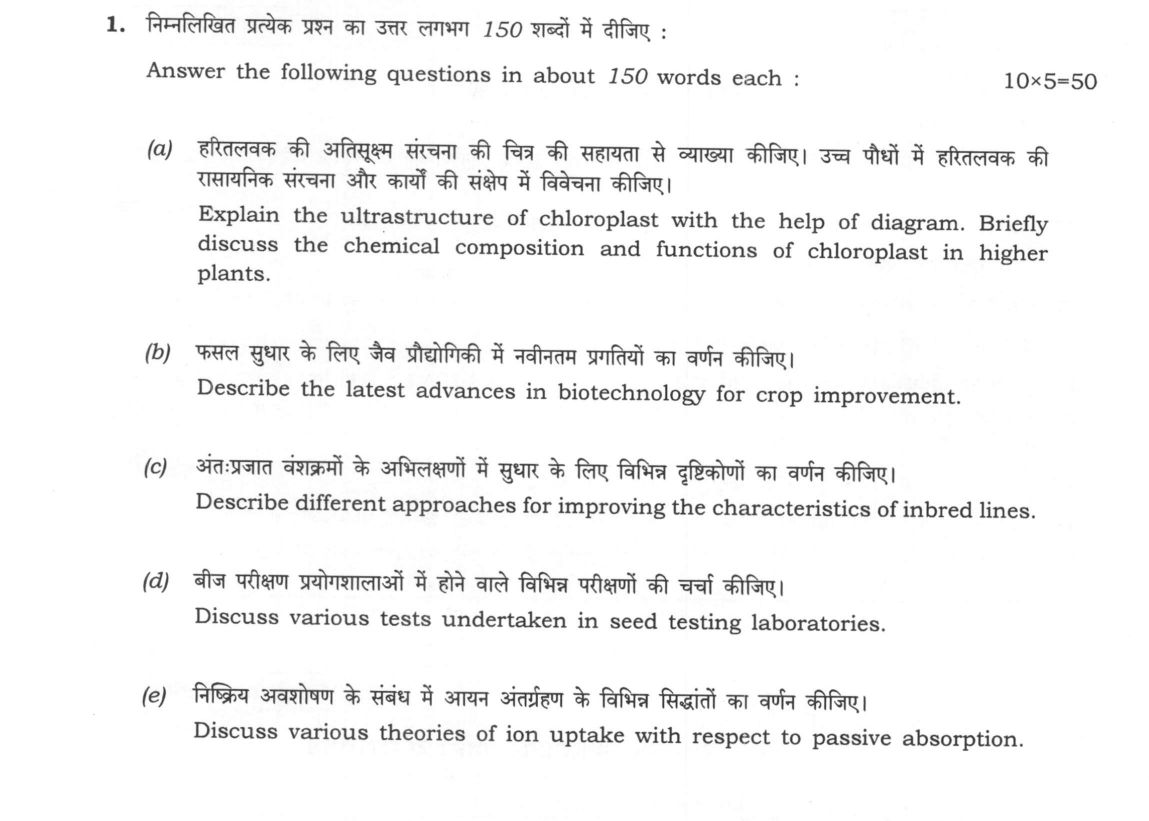
Answer the following questions in about 150 words each: (a) Explain the ultrastructure of chloroplast with the help of diagram…
Answer the following questions in about 150 words each:
Explain the ultrastructure of chloroplast with the help of diagram. Briefly discuss the chemical composition and functions of chloroplast in higher plants. 10 marks
Describe the latest advances in biotechnology for crop improvement. 10 marks
Describe different approaches for improving the characteristics of inbred lines. 10 marks
Discuss various tests undertaken in seed testing laboratories. 10 marks
Discuss various theories of ion uptake with respect to passive absorption. 10 marks
हिंदी में प्रश्न पढ़ें
निम्नलिखित प्रत्येक प्रश्न का उत्तर लगभग 150 शब्दों में दीजिए :
हरितलवक की अतिसूक्ष्म संरचना की चित्र की सहायता से व्याख्या कीजिए। उच्च पौधों में हरितलवक की रासायनिक संरचना और कार्यों की संक्षेप में विवेचना कीजिए। (10 अंक)
फसल सुधार के लिए जैव प्रौद्योगिकी में नवीनतम प्रगतियों का वर्णन कीजिए। (10 अंक)
अंतःप्रजात वंशजों के अभिलक्षणों में सुधार के लिए विभिन्न दृष्टिकोणों का वर्णन कीजिए। (10 अंक)
बीज परीक्षण प्रयोगशालाओं में होने वाले विभिन्न परीक्षणों की चर्चा कीजिए। (10 अंक)
निष्क्रिय अवशोषण के संबंध में आयन अंतर्ग्रहण के विभिन्न सिद्धांतों का वर्णन कीजिए। (10 अंक)
Model answer
Written by UPSC Answer Check against this question's marking rubric, to the 150-word length. UPSC does not publish answers for Mains — this is one way to score well, not an official key.
Chloroplast Ultrastructure and Function
The chloroplast is a double-membrane-bound organelle comprising an outer envelope, an intermembrane space, and an inner envelope. The inner space, the stroma, contains ribosomes, circular DNA, and enzymes for the Calvin cycle. Suspended within the stroma is the thylakoid system, organized into stacked grana and unstacked stroma lamellae. The thylakoid membranes house the photosystems, electron transport chain, and ATP synthase. Chemically, chloroplasts contain chlorophylls a and b, carotenoids, lipids, and proteins. Their primary function is photosynthesis: light reactions occur in thylakoids, generating ATP and NADPH, while the Calvin cycle in the stroma fixes CO2 into sugars. Additionally, they synthesize starch, fatty acids, and amino acids. In C4 plants, initial CO2 fixation occurs in mesophyll cytosol via PEP carboxylase, not in the chloroplast stroma, before being transported to bundle-sheath chloroplasts for the Calvin cycle.
Biotechnology Advances in Crop Improvement
Recent biotechnological advances have revolutionized crop improvement. CRISPR-Cas9 gene editing allows precise modification of endogenous genes; while SDN-1 edits involve small indels, SDN-3 edits often require the introduction of a donor template or foreign DNA sequence, meaning they are not always free of foreign DNA. Marker-assisted selection (MAS) accelerates breeding by selecting plants based on molecular markers linked to desirable traits. Genomic selection predicts breeding values using genome-wide markers, enhancing efficiency in complex traits. RNA interference (RNAi) silences specific genes to improve stress tolerance. Synthetic biology enables the design of novel metabolic pathways. Speed breeding uses controlled light cycles to shorten generation time. Doubled haploid (DH) technology, including CENH3-mediated haploid induction followed by chromosome doubling, achieves complete homozygosity in a single generation, drastically reducing breeding cycles. Stacked GM traits, such as Bt and herbicide tolerance, provide multi-pest resistance.
Improving Inbred Line Characteristics
Improving inbred lines involves several approaches. Conventional pedigree selection identifies superior homozygous lines over multiple generations. Backcross breeding introgresses specific desirable alleles from a donor into a recurrent parent while maintaining the genetic background. Recurrent selection enhances general combining ability (GCA) by selecting superior individuals each cycle; however, only reciprocal recurrent selection (RRS) effectively improves both GCA and specific combining ability (SCA). Cytoplasmic male sterility (CMS) systems facilitate hybrid seed production by providing sterile female lines. Doubled haploid technology accelerates the development of homozygous inbred lines from heterozygous F1 hybrids. Molecular marker-assisted introgression allows precise transfer of beneficial alleles, such as disease resistance genes, into elite inbred backgrounds without dragging along linked deleterious traits, thereby improving agronomic performance and stability.
Seed Testing Laboratory Protocols
Seed testing laboratories conduct standardized tests to ensure seed quality. Purity analysis determines the percentage of pure seed, other crop seeds, and inert matter, both physically and genetically. Germination testing assesses the percentage of seeds that produce normal seedlings under optimal conditions; accelerated aging tests evaluate stress tolerance. Vigour testing includes electrical conductivity assays, where ion leakage indicates membrane integrity, and the tetrazolium test, which stains living cells blue. Moisture content is determined using the oven-drying method at 103°C for 24 hours; maintaining moisture below critical thresholds is essential for seed longevity. Seed health testing detects pathogens using blotter or agar plate methods, incubating seeds to observe fungal or bacterial growth. These tests ensure that seeds meet regulatory standards for germination, vigour, and health, guaranteeing successful crop establishment and yield potential.
Theories of Passive Ion Uptake
Passive absorption of ions occurs without metabolic energy expenditure, driven by electrochemical gradients. The Donnan equilibrium theory posits that fixed anions in the cell wall create an electrical potential difference, attracting cations and repelling anions, leading to unequal distribution of ions across the membrane. Ion exchange theory suggests that root surfaces possess cation exchange capacity (CEC), where ions in the soil solution exchange with ions adsorbed on the root surface, facilitating uptake. Mass flow and diffusion explain ion movement along concentration and electrochemical potential gradients. Diffusion moves ions from high to low concentration, while mass flow transports ions with the bulk movement of water through the apoplast. These mechanisms allow plants to absorb essential nutrients like potassium and nitrate efficiently, especially when soil concentrations are high, complementing active transport mechanisms that require ATP for accumulation against gradients.
What "Explain" is asking you to do
Make the working of something clear — what sets it off, what follows from what, and what it produces. Explain is the Commission's mechanism word: it dominates the technical papers and the “explain why” stems, where the marks sit in the causal chain and not in the label.
Structure that answers it
State what it is → the initiating condition → the chain of cause, step by step → an instance where it plays out → what the chain produces
Where marks are lost
Describing what something looks like instead of why it works that way. Naming the stages without linking them reads as description too.
How this answer will be evaluated
Approach
Framework: Concept > Practice or process > Data > Indian application. (a) explain: definition/context > points in order > small example > short close | (b) describe: define > structure or process in order > labelled diagram > significance | (c) describe: define > structure or process in order > labelled diagram > significance | (d) discuss: intro > 3-4 dimensions > example > balanced close | (e) discuss: intro > 3-4 dimensions > example > balanced close Full marks: Precise technical terminology, clear diagrams, specific examples, and logical flow.
Key points expected
- Labelled diagram of thylakoid and stroma
- Composition: lipids, proteins, pigments
- Function: photosynthesis and ATP synthesis
- Distinction between grana and stroma
- Gene editing (CRISPR-Cas9) applications
- Transgenic crops for stress tolerance
- Molecular markers for selection
- Tissue culture for rapid propagation
Evaluation rubric
Each sub-part is marked on its own, against the marks and word limit printed on the paper.
- (a) Diagrammatic ultrastructure, chemical composition, and functions of chloroplast. · 150 words
explain— definition/context → points in order → small example → short close
Must cover
- Labelled diagram of thylakoid and stroma
- Composition: lipids, proteins, pigments
- Function: photosynthesis and ATP synthesis
- Distinction between grana and stroma
Loses marks
- Missing or unlabelled diagram
- Confusing chloroplast with mitochondria
Earns more
- Mention of Calvin cycle location
- Reference to photosystems I and II
Extra mark
- Specific pigment names (Chlorophyll a/b)
- (b) Latest biotechnological advances for crop improvement. · 150 words
describe— define → structure or process in order → labelled diagram → significance
Must cover
- Gene editing (CRISPR-Cas9) applications
- Transgenic crops for stress tolerance
- Molecular markers for selection
- Tissue culture for rapid propagation
Loses marks
- Vague mention of 'modern technology'
- Ignoring the 'latest' aspect of the prompt
Earns more
- Specific Indian biotech crop examples
- Mention of Bt cotton or Brinjal
Extra mark
- Reference to specific Indian research institute
- (c) Approaches for improving inbred line characteristics. · 150 words
describe— define → structure or process in order → labelled diagram → significance
Must cover
- Backcrossing for trait introgression
- Mutagenesis (chemical/radiation)
- Selection for heterosis potential
- Genetic recombination strategies
Loses marks
- Confusing inbred lines with hybrids
- Lack of specific breeding techniques
Earns more
- Mention of specific inbred line traits
- Reference to hybrid vigor
Extra mark
- Specific example of an improved inbred line
- (d) Various tests in seed testing laboratories. · 150 words
discuss— intro → 3-4 dimensions → example → balanced close
Must cover
- Germination and viability tests
- Purity and physical analysis
- Moisture content determination
- Genetic purity and varietal identity
Loses marks
- Listing tests without explaining purpose
- Ignoring the 'laboratory' context
Earns more
- Mention of ISTA or national standards
- Reference to specific lab equipment
Extra mark
- Specific test names (e.g., Tetrazolium test)
- (e) Theories of ion uptake regarding passive absorption. · 150 words
discuss— intro → 3-4 dimensions → example → balanced close
Must cover
- Diffusion and osmosis mechanisms
- Mass flow hypothesis
- Role of concentration gradients
- Distinction from active transport
Loses marks
- Confusing passive with active uptake
- Lack of theoretical framework
Earns more
- Mention of specific ions (K+, NO3-)
- Reference to root pressure
Extra mark
- Specific equation or formula for diffusion
Practice this exact question
Write your answer and it is marked point by point against the model answer above — what you covered, what you missed, what you got wrong.
Evaluate my answer →More from Agriculture 2024 Paper II
- Q1 Answer the following questions in about 150 words each: (a) Explain the ultrastructure of…
- Q2 (a) What is chromosomal aberration? Briefly discuss the changes in chromosomal structure…
- Q3 (a) What is allopolyploidy? Describe its applications and limitations in crops. (20 marks…
- Q4 (a) Give an account of cytoplasmic genetic male sterility and its utilization in plant br…