Paper II — Q6
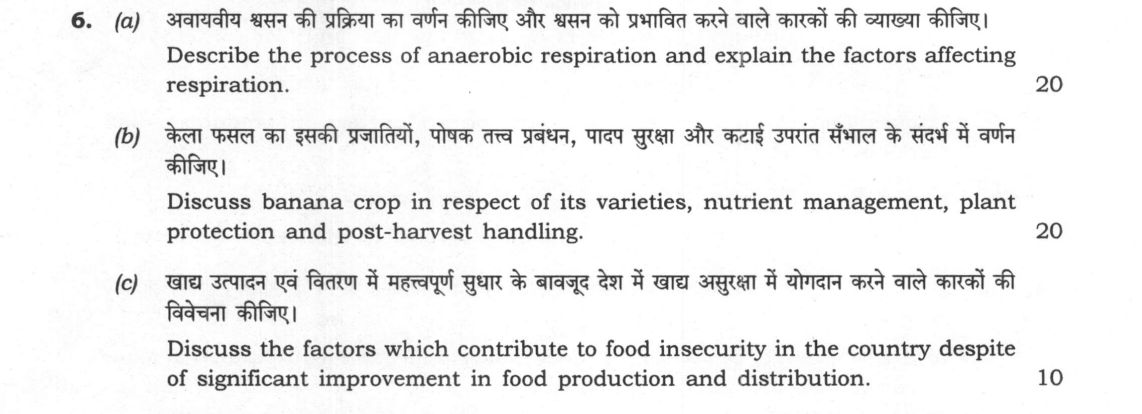
(a) Describe the process of anaerobic respiration and explain the factors affecting respiration. (20 marks) (b) Discuss banana…
Describe the process of anaerobic respiration and explain the factors affecting respiration. 20 marks
Discuss banana crop in respect of its varieties, nutrient management, plant protection and post-harvest handling. 20 marks
Discuss the factors which contribute to food insecurity in the country despite of significant improvement in food production and distribution. 10 marks
हिंदी में प्रश्न पढ़ें
अवायवीय श्वसन की प्रक्रिया का वर्णन कीजिए और श्वसन को प्रभावित करने वाले कारकों की व्याख्या कीजिए। (20 अंक)
केला फसल का इसकी प्रजातियों, पोषक तत्व प्रबंधन, पादप सुरक्षा और कटाई उपरांत संभाल के संदर्भ में वर्णन कीजिए। (20 अंक)
खाद उत्पादन एवं वितरण में महत्वपूर्ण सुधार के बावजूद देश में खाद असुरक्षा में योगदान करने वाले कारकों की विवेचना कीजिए। (10 अंक)
Model answer
Written by UPSC Answer Check against this question's marking rubric, to the expected length. UPSC does not publish answers for Mains — this is one way to score well, not an official key.
Anaerobic Respiration and Factors Influencing Respiration
Anaerobic respiration begins in the cytoplasm with glycolysis, breaking glucose into pyruvate to yield a net of 2 ATP and 2 NADH, compared to 36–38 ATP generated under aerobic respiration. In the absence of oxygen, pyruvate is reduced via fermentation pathways: alcoholic fermentation produces ethanol and CO₂ (catalysed by pyruvate decarboxylase and alcohol dehydrogenase), whereas lactic acid fermentation yields lactate (via lactate dehydrogenase) to regenerate NAD⁺.
Respiration rates are governed by temperature (operating under a Q₁₀ temperature coefficient of 2.0 to 2.5 within physiological limits), moisture availability, oxygen concentration (Pasteur effect and critical extinction point), respiratory substrate type (glucose versus lipids or organic acids), mechanical injury or bruising which induces wound respiration, and hormonal regulation such as ethylene-mediated climacteric surges. Anaerobic processes are industrially harnessed in silage making and controlled-atmosphere fruit storage, whereas poor soil aeration and waterlogging trigger root hypoxia, severely impeding nutrient uptake and crop vigour.
Banana Cultivation Dynamics
India cultivates diverse commercial cultivars: Dwarf Cavendish and Robusta (high-yielding table varieties), Poovan (hardy and widely adapted), Nendran (Kerala’s primary processing and culinary variety), Red Banana, and the GI-tagged Hill Banana (Virupakshi).
Nutrient management mandates an application of approximately 200:100:200 g N:P_2O₅:K_2O per plant, delivered through split schedules or drip fertigation, alongside foliar sprays to correct Zn, Fe, and Mn deficiencies. Integrated pest and disease management addresses Panama wilt (Fusarium oxysporum f. sp. cubense TR4) via soil solarization and biocontrol, Sigatoka leaf spot through systemic fungicides, Banana Bunchy Top Virus by controlling the aphid vector (Pentalonia nigronervosa), and burrowing nematodes (Radopholus similis) through corm paring and nematicides. Post-harvest handling involves dehanding, washing, precooling, maintaining cold chain storage at 13–14°C, and ripening in ethylene gas chambers (100 ppm) to ensure uniform ripening.
Food and Nutritional Insecurity Drivers
Despite bumper harvests and record buffer stocks, food insecurity persists due to purchasing power deficits and unequal physical access. The calorie-versus-nutritional security gap remains wide, as diets lack diversification, driving widespread micronutrient malnutrition. High post-harvest supply chain losses, climate-induced crop shocks, and pronounced regional disparities in eastern and tribal belts further compound insecurity. Policy bottlenecks include National Food Security Act (NFSA) targeting errors, Public Distribution System (PDS) leakages, buffer stock rot, and ad-hoc export-import restrictions. A sustainable way forward requires converging NFSA entitlements with POSHAN Abhiyaan, expanding millets and pulses in public procurement, and modernizing storage infrastructure to ensure holistic nutritional resilience.
What "Describe" is asking you to do
Give a full, ordered account of the thing named — its parts, stages or mechanism — in the sequence in which it actually exists or occurs. Most describe questions come from the science optionals, where the marks sit in correct technical detail and, where the stem says so, a labelled diagram.
Structure that answers it
One-line identification of the subject → the parts or stages in their real order, each with its defining detail → labelled diagram where the subject is structural → closing line on function or significance
Where marks are lost
Loose general prose where the examiner is ticking named parts, correct terminology and their sequence; and in the General Studies papers, turning to evaluation before the description is finished.
How this answer will be evaluated
Approach
Framework: Concept > Practice or process > Data > Indian application. (a) describe: define > structure or process in order > labelled diagram > significance | (b) discuss: intro > 3-4 dimensions > example > balanced close | (c) discuss: intro > 3-4 dimensions > example > balanced close Full marks: Precise biological/agronomic details, specific varieties/schemes, logical flow.
Key points expected
- Define anaerobic respiration (glycolysis + fermentation)
- Sequence: Glucose to Pyruvate to Ethanol/CO2 or Lactic Acid
- Factors: O2 concentration, temperature, substrate availability
- Significance: Energy yield (2 ATP) vs aerobic
- Varieties: Cavendish, Robusta, or local (e.g., Nendran)
- Nutrient management: High K requirement, NPK ratio
- Plant protection: Bunchy top disease, Panama wilt, nematodes
- Post-harvest: Ethylene control, ripening, cold chain
Evaluation rubric
Each sub-part is marked on its own, against the marks and word limit printed on the paper.
- (a) Stepwise process of anaerobic respiration and factors affecting it. 20 marks
describe— define → structure or process in order → labelled diagram → significance
Must cover
- Define anaerobic respiration (glycolysis + fermentation)
- Sequence: Glucose to Pyruvate to Ethanol/CO2 or Lactic Acid
- Factors: O2 concentration, temperature, substrate availability
- Significance: Energy yield (2 ATP) vs aerobic
Loses marks
- Confusing anaerobic with aerobic respiration steps
- Vague factors without physiological explanation
Earns more
- Equation: C6H12O6 -> 2C2H5OH + 2CO2 + Energy
- Mention of Pasteur effect (O2 inhibits fermentation)
- Distinction between alcoholic and lactic acid fermentation
Extra mark
- Labelled diagram of glycolysis pathway
- Reference to specific enzymes (e.g., Pyruvate decarboxylase)
- (b) Banana crop management: varieties, nutrients, protection, post-harvest. 20 marks
discuss— intro → 3-4 dimensions → example → balanced close
Must cover
- Varieties: Cavendish, Robusta, or local (e.g., Nendran)
- Nutrient management: High K requirement, NPK ratio
- Plant protection: Bunchy top disease, Panama wilt, nematodes
- Post-harvest: Ethylene control, ripening, cold chain
Loses marks
- Generic advice applicable to any crop
- Ignoring post-harvest losses (major issue in India)
Earns more
- Specific spacing (e.g., 2.5m x 2.5m)
- Mention of tissue culture for disease-free planting
- Specific fungicide/insecticide names for protection
Extra mark
- Reference to specific Indian scheme (e.g., PM-KISAN for inputs)
- Data on shelf-life extension via 1-MCP treatment
- (c) Factors causing food insecurity despite production gains. 10 marks
discuss— intro → 3-4 dimensions → example → balanced close
Must cover
- Poverty and low purchasing power
- Inequality in distribution (regional/class)
- Post-harvest losses (supply chain inefficiency)
- Nutritional quality vs caloric quantity
Loses marks
- Focusing only on production failure (question says production improved)
- Vague statements without specific factors
Earns more
- Mention of NFSA (National Food Security Act) limitations
- Impact of climate change on stability
- Urbanization and food waste
Extra mark
- Reference to specific data (e.g., IPCR report figures)
- Mention of specific state-level disparities
Practice this exact question
Write your answer and it is marked point by point against the model answer above — what you covered, what you missed, what you got wrong.
Evaluate my answer →More from Agriculture 2024 Paper II
- Q3 (a) What is allopolyploidy? Describe its applications and limitations in crops. (20 marks…
- Q4 (a) Give an account of cytoplasmic genetic male sterility and its utilization in plant br…
- Q5 Answer the following questions in about 150 words each: (a) Explain the properties and fu…
- Q6 (a) Describe the process of anaerobic respiration and explain the factors affecting respi…
- Q7 (a) Define water stress. Discuss the effects of water stress on anatomical and physiologi…
- Q8 (a) Explain the mode of action of organophosphate and Bacillus thuringiensis which are us…