Paper II — Q8
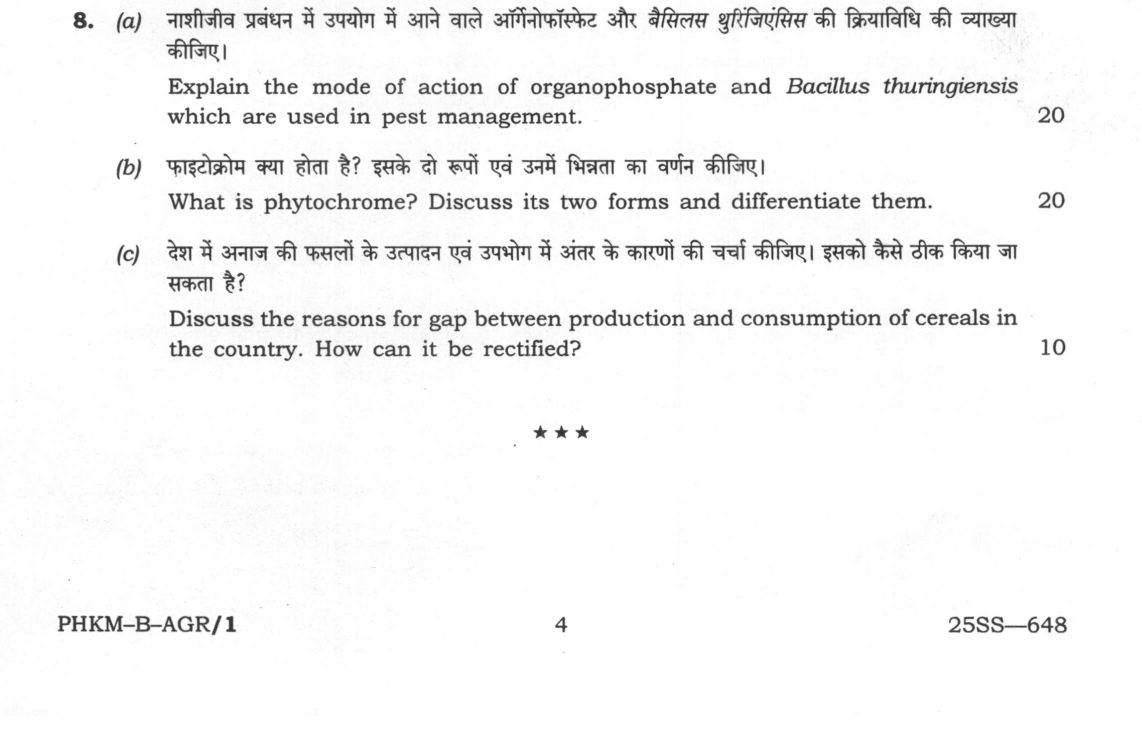
(a) Explain the mode of action of organophosphate and Bacillus thuringiensis which are used in pest management. (20 marks) (b)…
Explain the mode of action of organophosphate and Bacillus thuringiensis which are used in pest management. 20 marks
What is phytochrome? Discuss its two forms and differentiate them. 20 marks
Discuss the reasons for gap between production and consumption of cereals in the country. How can it be rectified? 10 marks
हिंदी में प्रश्न पढ़ें
नाशीजीव प्रबंधन में उपयोग में आने वाले ऑर्गेनोफॉस्फेट और बैसिलस थुरिंजिएंसिस की क्रियाविधि की व्याख्या कीजिए। (20 अंक)
फाइटोक्रोम क्या होता है? इसके दो रूपों एवं उनमें भिन्नता का वर्णन कीजिए। (20 अंक)
देश में अनाज की फसलों के उत्पादन एवं उपभोग में अंतर के कारणों की चर्चा कीजिए। इसको कैसे ठीक किया जा सकता है? (10 अंक)
Model answer
Written by UPSC Answer Check against this question's marking rubric, to the expected length. UPSC does not publish answers for Mains — this is one way to score well, not an official key.
Pest Management and Cereal Security: Scientific Mechanisms and Policy Interventions
Effective pest management and food security in India rely on understanding biological mechanisms and addressing structural inefficiencies. The following analysis examines the modes of action of key biocontrol and chemical agents, the photoreceptive mechanisms in plants, and the structural gaps in cereal supply chains.
**Mode of Action: Organophosphates and *Bacillus thuringiensis***
Organophosphates (OPs) function as broad-spectrum neurotoxins. Their primary mechanism involves the irreversible inhibition of the enzyme acetylcholinesterase (AChE) in the synaptic cleft of the nervous system. Under normal conditions, AChE hydrolyzes the neurotransmitter acetylcholine (ACh) after it has triggered a nerve impulse. When OPs bind to the active site of AChE, ACh accumulates in the synapse, leading to continuous stimulation of post-synaptic receptors. This results in uncontrolled muscle contractions, paralysis, and death in the target organism. Because AChE is conserved across many animals, OPs are non-specific, posing significant risks to mammals, birds, and beneficial insects, which complicates their use in Integrated Pest Management (IPM).
In contrast, Bacillus thuringiensis (Bt) produces crystal (Cry) proteins that are toxic only to specific insect orders, primarily Lepidoptera, Diptera, and Coleoptera. The mode of action is highly specific: the Cry protein is ingested by the susceptible insect and activated by alkaline proteases in the midgut. The activated protein binds to specific receptors on the midgut epithelial cells, forming pores. This disrupts the osmotic balance, causing cell lysis, gut perforation, and eventual death of the insect. While Bt is generally considered safe for non-target organisms, it is not universally harmless; certain beneficial Lepidoptera, such as silkworms and some wild butterflies, possess receptors that make them susceptible to specific Cry toxins. This specificity allows Bt to be integrated into IPM strategies with minimal disruption to ecological balance compared to OPs.
Phytochrome: Structure, Forms, and Function
Phytochrome is a photoreversible chromoprotein that acts as a light sensor in plants, regulating growth and development. It consists of a protein moiety and a chromophore, phytochromobilin, which absorbs light. Phytochrome exists in two interconvertible forms: Pr (red-absorbing) and Pfr (far-red-absorbing).
Pr is the biologically inactive form, absorbing light maximally at 660 nm (red light). Upon absorption of red light, Pr undergoes photoconversion to Pfr. Pfr is the biologically active form, absorbing light maximally at 730 nm (far-red light). Pfr is less stable than Pr and can revert to Pr through two mechanisms: photoconversion by far-red light and a slow, temperature-dependent thermal process known as dark reversion.
The physiological roles of these forms are distinct. The Pr-to-Pfr conversion is critical for seed germination in light-sensitive seeds, as Pfr promotes the breakdown of dormancy. In mature plants, the ratio of Pfr to Pr determines shade avoidance responses; a high Pfr/Pr ratio indicates full sunlight, while a low ratio (due to far-red enrichment from reflected light) triggers elongation to escape shade. Furthermore, phytochrome mediates photoperiodism, influencing flowering time by sensing day length. The interplay between Pr and Pfr allows plants to adapt their growth strategies to environmental light conditions.
The Cereal Production-Consumption Gap
Despite India being a major cereal producer, a gap exists between production and effective consumption, driven primarily by post-harvest losses and distribution inefficiencies. Contrary to common misconceptions, post-harvest losses for cereals are estimated at 4–6% by the Central Institute of Post-Harvest Engineering and Technology (CIPHET), not the higher figures often cited for perishables. These losses occur due to inadequate storage infrastructure, leading to spoilage from moisture, pests, and fungi. Additionally, distribution inefficiencies within the Food Corporation of India (FCI) network result in regional imbalances, where surplus areas face storage crises while deficit areas face shortages.
To rectify this, a multi-pronged approach is necessary. First, investment in improved storage technologies, such as hermetic storage and PUSA bins, can significantly reduce post-harvest losses. Second, decentralizing FCI operations and strengthening the National Food Security Act (NFSA) targeting mechanisms can improve the efficiency of grain distribution. Third, promoting value addition and processing infrastructure under the Pradhan Mantri Kisan Sampada Yojana (PMKSY) can enhance the shelf life and marketability of cereals. Finally, crop diversification incentives can reduce the pressure on cereal-centric agriculture, ensuring a more balanced and resilient food system.
Conclusion
Scientific pest management through specific biocontrol agents and precise photoreceptive understanding enhances agricultural productivity. However, translating this productivity into food security requires addressing post-harvest losses and distribution inefficiencies. A holistic strategy combining biological precision with robust infrastructure and policy reform is essential to close the cereal gap and ensure sustainable food security in India.
What "Explain" is asking you to do
Make the working of something clear — what sets it off, what follows from what, and what it produces. Explain is the Commission's mechanism word: it dominates the technical papers and the “explain why” stems, where the marks sit in the causal chain and not in the label.
Structure that answers it
State what it is → the initiating condition → the chain of cause, step by step → an instance where it plays out → what the chain produces
Where marks are lost
Describing what something looks like instead of why it works that way. Naming the stages without linking them reads as description too.
How this answer will be evaluated
Approach
(a) explain: definition/context > points in order > small example > short close | (b) discuss: intro > 3-4 dimensions > example > balanced close | (c) discuss: intro > 3-4 dimensions > example > balanced close Full marks: Precise biochemical mechanisms for (a) and (b); specific, actionable rectification measures for (c).
Key points expected
- Inhibition of acetylcholinesterase by organophosphates
- Bt crystal protein (Cry) ingestion by larvae
- Alkali solubilization of Bt toxin in gut
- Binding to midgut epithelial cells
- Definition of phytochrome as a photoreceptor
- Pr form (red light absorbing) characteristics
- Pfr form (far-red light absorbing) characteristics
- Reversibility of Pr-Pfr interconversion
Evaluation rubric
Each sub-part is marked on its own, against the marks and word limit printed on the paper.
- (a) Mechanism of action for both organophosphates and Bt in pest management. 20 marks
explain— definition/context → points in order → small example → short close
Must cover
- Inhibition of acetylcholinesterase by organophosphates
- Bt crystal protein (Cry) ingestion by larvae
- Alkali solubilization of Bt toxin in gut
- Binding to midgut epithelial cells
Loses marks
- Confusing Bt with other biopesticides
- Vague description of 'poisoning' without mechanism
Earns more
- Mention of specific OP compounds (e.g., Malathion)
- Specific Bt strain (e.g., Bt kurstaki)
- Mention of non-target organism safety
Extra mark
- Diagram of Bt toxin binding site
- Mention of resistance management strategies
- (b) Definition of phytochrome and detailed differentiation of its two forms. 20 marks
discuss— intro → 3-4 dimensions → example → balanced close
Must cover
- Definition of phytochrome as a photoreceptor
- Pr form (red light absorbing) characteristics
- Pfr form (far-red light absorbing) characteristics
- Reversibility of Pr-Pfr interconversion
Loses marks
- Confusing phytochrome with cryptochrome
- Failing to mention the reversible nature
Earns more
- Mention of specific wavelengths (660nm, 730nm)
- Role in seed germination or flowering
- Mention of phytochrome A vs B
Extra mark
- Diagram of the Pr/Pfr equilibrium
- Mention of specific plant response (e.g., shade avoidance)
- (c) Reasons for cereal production-consumption gap and rectification measures. 10 marks
discuss— intro → 3-4 dimensions → example → balanced close
Must cover
- Reasons for gap (e.g., post-harvest losses, storage)
- Reasons for gap (e.g., dietary shift, waste)
- Rectification: Storage infrastructure (e.g., silos)
- Rectification: Policy or processing measures
Loses marks
- Only listing reasons without rectification
- Vague suggestions like 'better management'
Earns more
- Mention of specific loss percentages
- Mention of FCI or specific storage schemes
- Mention of food processing industries
Extra mark
- Mention of specific recent government initiative
- Data on specific cereal (e.g., rice vs wheat)
Practice this exact question
Write your answer and it is marked point by point against the model answer above — what you covered, what you missed, what you got wrong.
Evaluate my answer →More from Agriculture 2024 Paper II
- Q5 Answer the following questions in about 150 words each: (a) Explain the properties and fu…
- Q6 (a) Describe the process of anaerobic respiration and explain the factors affecting respi…
- Q7 (a) Define water stress. Discuss the effects of water stress on anatomical and physiologi…
- Q8 (a) Explain the mode of action of organophosphate and Bacillus thuringiensis which are us…