Paper II — Q3
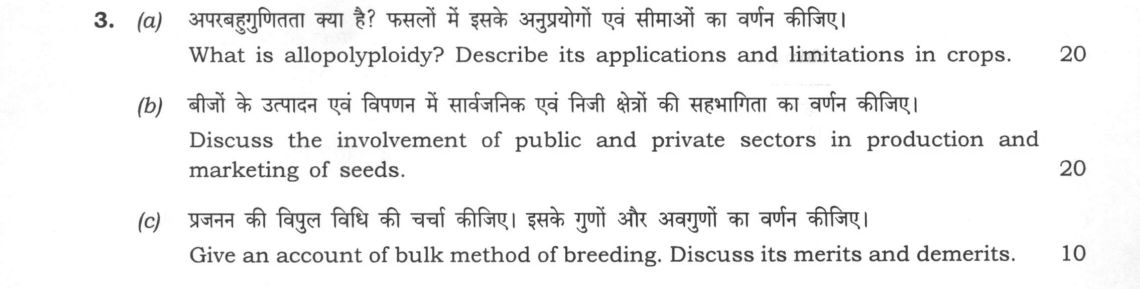
(a) What is allopolyploidy? Describe its applications and limitations in crops. (20 marks) (b) Discuss the involvement of public…
What is allopolyploidy? Describe its applications and limitations in crops. 20 marks
Discuss the involvement of public and private sectors in production and marketing of seeds. 20 marks
Give an account of bulk method of breeding. Discuss its merits and demerits. 10 marks
हिंदी में प्रश्न पढ़ें
अपरबहुगुणितता क्या है? फसलों में इसके अनुप्रयोगों एवं सीमाओं का वर्णन कीजिए। (20 अंक)
बीजों के उत्पादन एवं विपणन में सार्वजनिक एवं निजी क्षेत्रों की सहभागिता का वर्णन कीजिए। (20 अंक)
प्रजनन की विपुल विधि की चर्चा कीजिए। इसके गुणों और अवगुणों का वर्णन कीजिए। (10 अंक)
Model answer
Written by UPSC Answer Check against this question's marking rubric, to the expected length. UPSC does not publish answers for Mains — this is one way to score well, not an official key.
Allopolyploidy in Crop Improvement
Allopolyploidy refers to the condition where an organism contains two or more distinct sets of chromosomes derived from the hybridization of two or more divergent species, followed by chromosome doubling. Unlike autopolyploidy, which involves the duplication of homologous genomes from the same species, allopolyploidy combines non-homologous or homeologous genomes. Chromosome doubling occurs either spontaneously through unreduced gametes or artificially using mitotic inhibitors like colchicine.
Its major applications include:
- Creation of synthetic amphidiploids and new crops, such as Triticale (wheat × rye) and Raphanobrassica (radish × cabbage).
- Bridging species to facilitate alien gene transfer for biotic and abiotic stress resistance (e.g., transferring rust resistance from Aegilops to wheat).
- Restoration of fertility in sterile wide-cross F1 hybrids by providing homologous pairing partners.
However, limitations include initial F1 hybrid sterility, cytological instability resulting in multivalent pairing and aneuploidy, reduced fertility or seed set, and long breeding cycles required to stabilize polyploid genomes.
Public and Private Sector Involvement in Seed Production and Marketing
The Indian seed system functions on a complementary division of labour. The public sector (ICAR institutes, State Agricultural Universities, National Seeds Corporation, and State Seeds Corporations) dominates the production of high-volume, low-margin breeder and foundation seeds, primarily for self-pollinated food crops (paddy, wheat), pulses, and oilseeds to ensure national food security. Conversely, the private sector leads in high-value, research-intensive commercial hybrids (cotton, maize, pearl millet, single-cross hybrids, and vegetables) and proprietary transgenic traits (e.g., Bt cotton).
Marketing operates through licensed agro-dealer networks, public extension outlets, primary agricultural credit societies (PACS), and emerging digital e-commerce channels. The policy interface is governed by the Seeds Act 1966 and the Protection of Plant Varieties and Farmers' Rights (PPV&FR) Act 2001, which balances corporate breeders’ intellectual property with farmers’ traditional rights to save, use, and exchange seed (Section 39). Ongoing policy debates, including the draft Seeds Bill, navigate the trade-off between price caps and maintaining investment incentives for private R&D, while safeguarding national seed sovereignty.
Bulk Method of Plant Breeding
Developed by Nilson-Ehle, the bulk method advances segregating generations (F2 to F6) en masse without artificial selection or pedigree record-keeping, allowing natural selection to act. Individual plant selection is delayed until F6 or F7 when homozygosity reaches approximately 97–98%, followed by progeny evaluation and replicated multi-location yield trials from F8 onwards. Unlike the pedigree method, it maintains no ancestral records, and unlike Single Seed Descent (SSD), it exploits competitive natural selection.
Merits: It is simple, inexpensive, and requires minimal labour during early generations. It preserves vast genetic variability in large populations and effectively increases the frequency of cold-, drought-, or disease-resistant genotypes under natural epiphytotics.
Demerits: The lack of ancestry records precludes pedigree analysis. Poorly competitive but agronomically superior genotypes may be eliminated by natural selection. It is inefficient for traits with low heritability and necessitates large field areas over prolonged generation cycles.
An integrated approach harmonizing cytogenetic innovations, rigorous breeding methodologies, and public-private synergy is vital to fortify India's seed delivery systems and long-term nutritional security.
What "Describe" is asking you to do
Give a full, ordered account of the thing named — its parts, stages or mechanism — in the sequence in which it actually exists or occurs. Most describe questions come from the science optionals, where the marks sit in correct technical detail and, where the stem says so, a labelled diagram.
Structure that answers it
One-line identification of the subject → the parts or stages in their real order, each with its defining detail → labelled diagram where the subject is structural → closing line on function or significance
Where marks are lost
Loose general prose where the examiner is ticking named parts, correct terminology and their sequence; and in the General Studies papers, turning to evaluation before the description is finished.
How this answer will be evaluated
Approach
(a) describe: define > structure or process in order > labelled diagram > significance | (b) discuss: intro > 3-4 dimensions > example > balanced close | (c) describe: define > structure or process in order > labelled diagram > significance Full marks: Precise definitions, specific crop examples, named institutions, and clear distinction between public/private roles.
Key points expected
- Precise definition of allopolyploidy (interspecific hybridization + chromosome doubling)
- Mechanism of formation (e.g., somatic doubling, colchicine treatment)
- Specific applications in crops (e.g., Triticale, Bread wheat, Cotton)
- Specific limitations (e.g., sterility, genetic instability, long breeding cycles)
- Role of public sector (e.g., State Seed Corporations, KVKs, certification)
- Role of private sector (e.g., commercial production, marketing networks)
- Comparison of production methods (public vs private)
- Comparison of marketing channels (government schemes vs private retail)
Evaluation rubric
Each sub-part is marked on its own, against the marks and word limit printed on the paper.
- (a) Define allopolyploidy and detail its applications and limitations in crop improvement. 20 marks
describe— define → structure or process in order → labelled diagram → significance
Must cover
- Precise definition of allopolyploidy (interspecific hybridization + chromosome doubling)
- Mechanism of formation (e.g., somatic doubling, colchicine treatment)
- Specific applications in crops (e.g., Triticale, Bread wheat, Cotton)
- Specific limitations (e.g., sterility, genetic instability, long breeding cycles)
Loses marks
- Confusing allopolyploidy with autopolyploidy
- Vague applications without naming specific crops
- Ignoring the 'limitations' aspect of the question
Earns more
- Mention of specific chromosome numbers (e.g., 2n=4x)
- Reference to specific Indian crop varieties (e.g., Triticale varieties)
- Distinction between autopolyploidy and allopolyploidy
Extra mark
- Mention of specific Indian research institute (e.g., IARI, ICAR)
- Reference to a specific named cultivar (e.g., Triticale 'Kalyan')
- (b) Analyze the roles of public and private sectors in seed production and marketing. 20 marks
discuss— intro → 3-4 dimensions → example → balanced close
Must cover
- Role of public sector (e.g., State Seed Corporations, KVKs, certification)
- Role of private sector (e.g., commercial production, marketing networks)
- Comparison of production methods (public vs private)
- Comparison of marketing channels (government schemes vs private retail)
Loses marks
- Treating public and private sectors as identical
- Ignoring the 'marketing' aspect of the question
- Vague generalities without naming specific institutions
Earns more
- Mention of specific public institutions (e.g., State Seed Corporation)
- Mention of specific private companies (e.g., Mahyco, Syngenta)
- Reference to the Seeds Act or Seed Rules
Extra mark
- Mention of a specific government scheme (e.g., Seed Development Fund)
- Reference to specific market share data
- (c) Explain the bulk method of breeding and list its merits and demerits. 10 marks
describe— define → structure or process in order → labelled diagram → significance
Must cover
- Step-by-step process of bulk method (sowing, harvesting, bulk sampling)
- Specific merits (e.g., low cost, simple, good for self-pollinated crops)
- Specific demerits (e.g., slow, no selection pressure, genetic drift)
- Mention of specific crops where it is used (e.g., wheat, rice)
Loses marks
- Confusing bulk method with single seed descent
- Ignoring the 'demerits' aspect of the question
- Vague description without specific steps
Earns more
- Mention of specific number of generations (e.g., 6-8 generations)
- Reference to specific Indian crop varieties developed via bulk method
Extra mark
- Mention of a specific named cultivar (e.g., 'HD-2967' wheat)
- Reference to a specific research institute (e.g., IARI)
Practice this exact question
Write your answer and it is marked point by point against the model answer above — what you covered, what you missed, what you got wrong.
Evaluate my answer →More from Agriculture 2024 Paper II
- Q1 Answer the following questions in about 150 words each: (a) Explain the ultrastructure of…
- Q2 (a) What is chromosomal aberration? Briefly discuss the changes in chromosomal structure…
- Q3 (a) What is allopolyploidy? Describe its applications and limitations in crops. (20 marks…
- Q4 (a) Give an account of cytoplasmic genetic male sterility and its utilization in plant br…
- Q5 Answer the following questions in about 150 words each: (a) Explain the properties and fu…
- Q6 (a) Describe the process of anaerobic respiration and explain the factors affecting respi…