Paper II — Q4
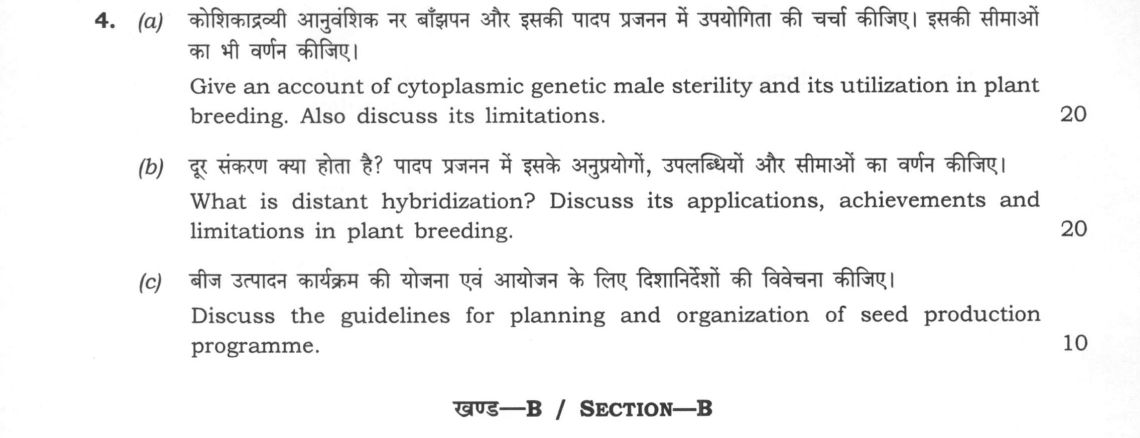
(a) Give an account of cytoplasmic genetic male sterility and its utilization in plant breeding. Also discuss its limitations…
Give an account of cytoplasmic genetic male sterility and its utilization in plant breeding. Also discuss its limitations. 20 marks
What is distant hybridization? Discuss its applications, achievements and limitations in plant breeding. 20 marks
Discuss the guidelines for planning and organization of seed production programme. 10 marks
हिंदी में प्रश्न पढ़ें
कोशिकाद्रव्यी आनुवंशिक नर बाँझपन और इसकी पादप प्रजनन में उपयोगिता की चर्चा कीजिए। इसकी सीमाओं का भी वर्णन कीजिए। (20 अंक)
दूर संकरण क्या होता है? पादप प्रजनन में इसके अनुप्रयोगों, उपलब्धियों और सीमाओं का वर्णन कीजिए। (20 अंक)
बीज उत्पादन कार्यक्रम की योजना एवं आयोजन के लिए दिशानिर्देशों की विवेचना कीजिए। (10 अंक)
Model answer
Written by UPSC Answer Check against this question's marking rubric, to the expected length. UPSC does not publish answers for Mains — this is one way to score well, not an official key.
Cytoplasmic Genetic Male Sterility (CGMS)
CGMS results from mitochondrial genes inducing pollen sterility (S-cytoplasm) unless suppressed by dominant nuclear restorer genes (R_), whereas normal cytoplasm (N) yields fertile plants. Commercial hybrid seed production exploits this through a three-line system: the male-sterile female A-line (S-rr), its isogenic male-fertile maintainer B-line (N-rr), and a male-fertile pollinator R-line (N-RR or S-RR). Crossing A × B multiplies the sterile line, while A × R produces fertile F₁ hybrid seed. In India, CGMS revolutionized hybrid breeding, yielding landmark releases in sorghum (CSH series via CK-60A), pearl millet (HB series via Tift 23A), and rice (Pusa RH-10 and PRH-122 utilizing WA-cytoplasm lines like IR58025A and Pusa 6A), alongside transgenic barnase-barstar alternatives in mustard (DMH-11).
However, CGMS faces serious limitations: narrow cytoplasmic uniformity causes extreme genetic vulnerability, exemplified by the 1970 Southern corn leaf blight epidemic in US Texas-cytoplasm maize; scarcity of effective nuclear restorer genes restricts parental choices; and sterility expression is often unstable under temperature and humidity fluctuations.
Distant Hybridization
Distant hybridization involves inter-specific or inter-generic crosses designed to introgress alien genes for biotic and abiotic stress resistance into cultivated crops. Pre- and post-fertilization barriers are overcome through in vitro embryo rescue, bridge crosses, reciprocal pollinations, and chromosome doubling via colchicine. Globally, it yielded the synthetic amphiploid cereal Triticale (Secale cereale × Triticum spp.) and resynthesized Brassica napus. In India, significant milestones include introgressing grassy stunt virus resistance into cultivated rice from the wild ancestor Oryza nivara, and developing superior inter-specific hybrid cottons (Gossypium hirsutum × G. barbadense).
Key limitations encompass cross-incompatibility, F₁ hybrid inviability or sterility, severe linkage drag where deleterious wild alleles persist alongside target traits, and exceptionally long breeding cycles required to restore normal agronomic architecture through recurrent backcrossing.
Seed Production Planning and Organization
Establishing an efficient seed programme requires precise spatial and temporal isolation distances to prevent cross-pollination and physical contamination. Mandatory roguing must be executed across vegetative, pre-flowering, flowering, and pre-harvest stages to eliminate off-types, diseased plants, and pollen shedders. Seed multiplication follows a strict generation system: Breeder seed produced by the originating plant breeder is multiplied into Foundation seed by public or private agencies, which is subsequently multiplied into Certified seed distributed to farmers.
This process is institutionally regulated by the Central Seed Committee, State Seed Certification Agencies, and notified seed testing laboratories under the statutory framework of the Seeds Act 1966, the Seed Rules 1968, and the New Policy on Seed Development 1988. Harmonizing CGMS-based hybrid breeding and distant gene introgression with stringent statutory seed certification remains pivotal for sustaining India's crop productivity, nutritional quality, and climate-resilient food security.
What "Discuss" is asking you to do
Lay the issue out from more than one side — how it arose, what is claimed for it, what is held against it, and where it now stands. UPSC attaches discuss to broad topics with several live dimensions, so coverage of the dimensions earns more than the strength of your opinion.
Structure that answers it
Set the issue up → the case as it is made → the case against → the dimension both sides leave out → where the balance now lies
Where marks are lost
Listing facts with no thread between them, or arguing one side throughout and calling it a discussion.
How this answer will be evaluated
Approach
(a) account for: state the phenomenon > the causes in order of weight > conclusion | (b) discuss: intro > 3-4 dimensions > example > balanced close | (c) discuss: intro > 3-4 dimensions > example > balanced close Full marks: Comprehensive, specific, and well-structured answers with named examples and schemes.
Key points expected
- Define CMS and cytoplasmic-nuclear interaction
- Explain restoration of fertility (Rf gene)
- Describe three-line hybrid system (A, B, R lines)
- List limitations (e.g., heterosis, maintenance cost)
- Define distant hybridization (interspecific/intergeneric)
- List applications (e.g., introgression, new germplasm)
- Cite specific achievements (e.g., Triticale, Cytoplasmic male sterility)
- Discuss limitations (e.g., sterility, chromosome incompatibility)
Evaluation rubric
Each sub-part is marked on its own, against the marks and word limit printed on the paper.
- (a) Mechanism of CMS, breeding application, and limitations. 20 marks
account for— state the phenomenon → the causes in order of weight → conclusion
Must cover
- Define CMS and cytoplasmic-nuclear interaction
- Explain restoration of fertility (Rf gene)
- Describe three-line hybrid system (A, B, R lines)
- List limitations (e.g., heterosis, maintenance cost)
Loses marks
- Confusing CMS with GMS (Genetic Male Sterility)
- Vague description of the three-line system
- Ignoring the 'limitations' part of the question
Earns more
- Mention specific CMS types (e.g., Wa, Tz, S)
- Reference specific crops (e.g., Rice, Maize, Mustard)
- Mention heterosis utilization in F1 hybrids
Extra mark
- Name specific Indian hybrid varieties (e.g., Pusa, HMT)
- Mention specific research institute (e.g., IARI, ICAR)
- (b) Definition, applications, achievements, and limitations of distant hybridization. 20 marks
discuss— intro → 3-4 dimensions → example → balanced close
Must cover
- Define distant hybridization (interspecific/intergeneric)
- List applications (e.g., introgression, new germplasm)
- Cite specific achievements (e.g., Triticale, Cytoplasmic male sterility)
- Discuss limitations (e.g., sterility, chromosome incompatibility)
Loses marks
- Confusing distant hybridization with cross-pollination
- Vague description of applications
- Ignoring the 'limitations' part of the question
Earns more
- Mention techniques to overcome sterility (e.g., colchicine, embryo rescue)
- Reference specific crops (e.g., Wheat, Rice, Potato)
- Mention specific Indian achievements (e.g., Triticale in India)
Extra mark
- Name specific Indian hybrid varieties (e.g., Triticale varieties)
- Mention specific research institute (e.g., IARI, ICAR)
- (c) Guidelines for planning and organizing a seed production programme. 10 marks
discuss— intro → 3-4 dimensions → example → balanced close
Must cover
- Define seed production programme
- List guidelines for planning (e.g., area, variety, schedule)
- List guidelines for organization (e.g., isolation, certification)
- Mention specific crops (e.g., Rice, Wheat, Mustard)
Loses marks
- Confusing seed production with seed marketing
- Vague description of guidelines
- Ignoring the 'organization' part of the question
Earns more
- Mention specific Indian schemes (e.g., National Seed Policy)
- Reference specific institutions (e.g., NBPGR, State Seed Agencies)
- Mention specific guidelines (e.g., isolation distance, certification)
Extra mark
- Name specific Indian hybrid varieties (e.g., Pusa, HMT)
- Mention specific research institute (e.g., IARI, ICAR)
Practice this exact question
Write your answer and it is marked point by point against the model answer above — what you covered, what you missed, what you got wrong.
Evaluate my answer →More from Agriculture 2024 Paper II
- Q1 Answer the following questions in about 150 words each: (a) Explain the ultrastructure of…
- Q2 (a) What is chromosomal aberration? Briefly discuss the changes in chromosomal structure…
- Q3 (a) What is allopolyploidy? Describe its applications and limitations in crops. (20 marks…
- Q4 (a) Give an account of cytoplasmic genetic male sterility and its utilization in plant br…
- Q5 Answer the following questions in about 150 words each: (a) Explain the properties and fu…
- Q6 (a) Describe the process of anaerobic respiration and explain the factors affecting respi…
- Q7 (a) Define water stress. Discuss the effects of water stress on anatomical and physiologi…