Paper II — Q5
Answer the following questions in about 150 words each: (a) Explain the properties and functions of enzymes in plants. (10…
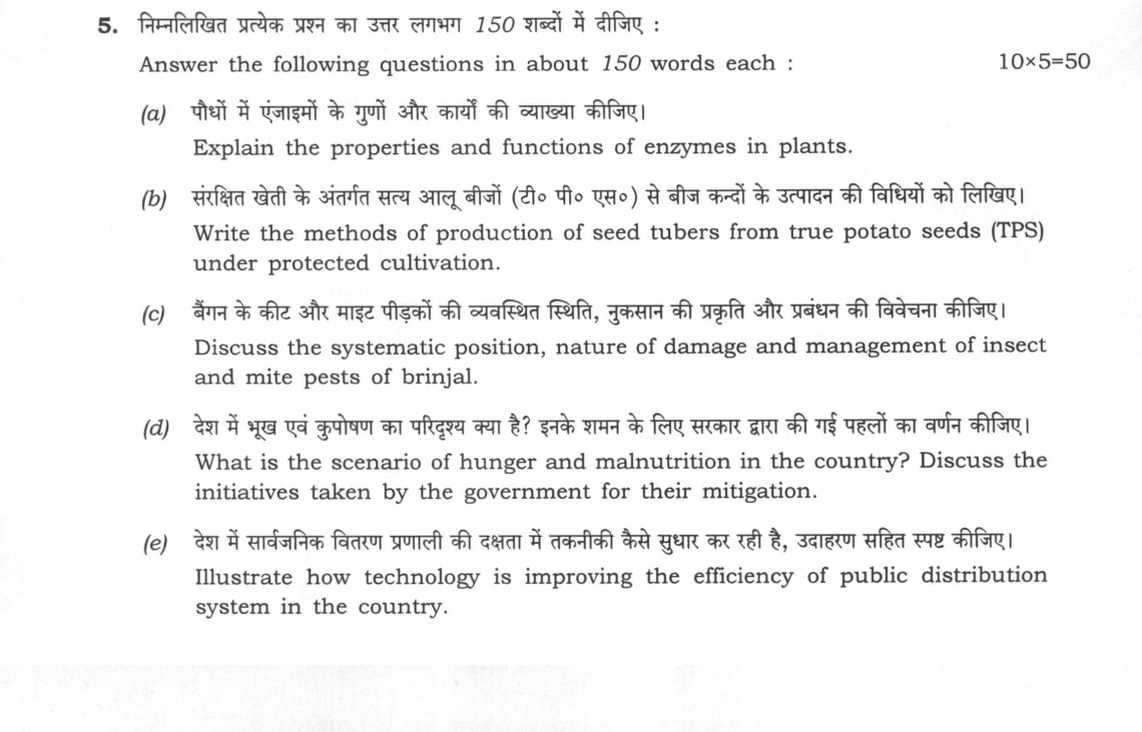
Answer the following questions in about 150 words each:
Explain the properties and functions of enzymes in plants. 10 marks
Write the methods of production of seed tubers from true potato seeds (TPS) under protected cultivation. 10 marks
Discuss the systematic position, nature of damage and management of insect and mite pests of brinjal. 10 marks
What is the scenario of hunger and malnutrition in the country? Discuss the initiatives taken by the government for their mitigation. 10 marks
Illustrate how technology is improving the efficiency of public distribution system in the country. 10 marks
हिंदी में प्रश्न पढ़ें
निम्नलिखित प्रत्येक प्रश्न का उत्तर लगभग 150 शब्दों में दीजिए :
पौधों में एन्जाइमों के गुणों और कार्यों की व्याख्या कीजिए। (10 अंक)
संरक्षित खेती के अंतर्गत सत्य आलू बीजों (टी. पी. एस.) से बीज कंदों के उत्पादन की विधियों को लिखिए। (10 अंक)
बैंगन के कीट और माइट पीड़कों की व्यवस्थित स्थिति, नुकसान की प्रकृति और प्रबंधन की विवेचना कीजिए। (10 अंक)
देश में भूख एवं कुपोषण का परिदृश्य क्या है? इनके शमन के लिए सरकार द्वारा की गई पहलों का वर्णन कीजिए। (10 अंक)
देश में सार्वजनिक वितरण प्रणाली की दक्षता में तकनीकी कैसे सुधार कर रही है, उदाहरण सहित स्पष्ट कीजिए। (10 अंक)
Model answer
Written by UPSC Answer Check against this question's marking rubric, to the 150-word length. UPSC does not publish answers for Mains — this is one way to score well, not an official key.
Enzymes in Plants: Properties, Functions, and Agricultural Applications
(a) Enzymes: Properties and Functions Enzymes are biological catalysts, primarily proteins, that accelerate biochemical reactions in plants without being consumed. Their defining properties include high specificity, where an enzyme acts on a particular substrate or reaction type, and sensitivity to environmental factors like temperature and pH, which can denature their active sites. They are also reversible and require cofactors for optimal activity. Functionally, enzymes are central to plant metabolism. RuBisCO catalyzes carbon fixation in the Calvin cycle, driving photosynthesis. Cytochrome oxidase facilitates electron transport in respiration, releasing energy for growth. Nitrogenase, found in root nodules of legumes, fixes atmospheric nitrogen into ammonia, a critical step for soil fertility. Furthermore, enzymes like IAA oxidase regulate hormone levels, controlling growth patterns. Understanding these mechanisms allows for targeted interventions in crop physiology and stress tolerance.
(b) Production of Seed Tubers from True Potato Seeds (TPS) The production of virus-free seed tubers from True Potato Seeds (TPS) under protected cultivation follows a structured protocol to ensure genetic purity and health. The process begins with the sowing of TPS in nursery trays or beds within a greenhouse or net house. This protected environment shields the delicate seedlings from pests and diseases, particularly viruses that compromise yield. Once the seedlings reach a robust stage, they are transplanted into larger pots or raised beds within the same protected structure. Under controlled conditions, these plants develop into minitubers. These minitubers are then harvested and can be used for further multiplication in the field or as certified seed tubers. This method, often supported by collaborations between institutions like CIP and CPRI, offers a significant advantage over conventional vegetative propagation by eliminating the accumulation of viral loads, thereby ensuring higher yields and better quality potatoes for farmers.
(c) Insect and Mite Pests of Brinjal Brinjal (Solanum melongena) faces pressure from various insect and mite pests. The Shoot and Fruit Borer (Leucinodes orbonalis) belongs to the class Insecta, order Lepidoptera, and family Pyralidae. It causes damage by boring into shoots and fruits, leading to wilting and rotting. The Whitefly (Bemisia tabaci), classified under Insecta, Hemiptera, and Aleyrodidae, feeds on sap and acts as a vector for various plant viruses, reducing plant vigor. Spider mites (Tetranychus spp.), belonging to Arachnida, Acari, and Tetranychidae, suck cell contents, causing stippling and leaf yellowing. Management strategies employ an Integrated Pest Management (IPM) approach. This includes the use of pheromone traps for monitoring and mass trapping of borers, the deployment of biocontrol agents like Trichogramma for eggs, and the careful application of acaricides for mites. While Bt brinjal offers genetic resistance to certain lepidopteran pests, its adoption is subject to regulatory and public debate. A balanced IPM strategy ensures sustainable control without excessive chemical reliance.
(d) Hunger and Malnutrition in India India continues to grapple with a complex nutritional landscape. According to NFHS-5 data, approximately 35.5% of children under five are stunted, and 32.1% are underweight, indicating chronic malnutrition. Simultaneously, there is a rising trend in obesity and lifestyle disorders, creating a "double burden" of malnutrition. To mitigate these issues, the government has launched several initiatives. POSHAN Abhiyaan (Prime Minister’s Overarching Scheme for Holistic Nourishment) focuses on convergent actions across sectors to reduce stunting and anemia. The Pradhan Mantri Garib Kalyan Yojana (PMGKAY) provides free food grains to eligible households, enhancing food security. The Annapurna scheme supports the elderly, while the distribution of fortified rice and the Saksham Anganwadi Kendra initiative aim to improve the nutritional quality of meals in ICDS centers. These measures collectively address both availability and accessibility of nutritious food, aiming to improve the overall health outcomes of the population.
(e) Technology in Public Distribution System (PDS) Technology is revolutionizing the efficiency and transparency of the Public Distribution System (PDS). The introduction of e-POS devices with biometric authentication ensures that only eligible beneficiaries receive their allotted rations, reducing leakage and ghost beneficiaries. Aadhaar seeding links beneficiary identities to unique IDs, preventing duplication and fraud. The One Nation One Ration Card (ONORC) initiative allows portability, enabling migrants to access rations at any Fair Price Shop across India. GPS-enabled vehicles track the movement of food grains from warehouses to shops, ensuring timely delivery and minimizing pilferage. Furthermore, blockchain pilots in states like Tamil Nadu and Kerala are being explored to create an immutable record of grain transactions, enhancing accountability. These technological interventions streamline operations, reduce administrative costs, and ensure that food security benefits reach the intended poor and vulnerable sections of society more effectively.
What "Explain" is asking you to do
Make the working of something clear — what sets it off, what follows from what, and what it produces. Explain is the Commission's mechanism word: it dominates the technical papers and the “explain why” stems, where the marks sit in the causal chain and not in the label.
Structure that answers it
State what it is → the initiating condition → the chain of cause, step by step → an instance where it plays out → what the chain produces
Where marks are lost
Describing what something looks like instead of why it works that way. Naming the stages without linking them reads as description too.
How this answer will be evaluated
Approach
Framework: Concept > Practice or process > Data > Indian application. (a) explain: definition/context > points in order > small example > short close | (b) explain: definition/context > points in order > small example > short close | (c) discuss: intro > 3-4 dimensions > example > balanced close | (d) discuss: intro > 3-4 dimensions > example > balanced close | (e) explain: definition/context > points in order > small example > short close Full marks: Precise technical terms, specific scheme names, and clear logical flow.
Key points expected
- Definition of enzymes as biological catalysts
- Properties: specificity, temperature/pH sensitivity, reversibility
- Function: Photosynthesis (Rubisco) or Respiration (Krebs cycle)
- Function: Cell wall modification (Cellulase) or defense
- Sowing of True Potato Seeds (TPS) in trays
- Nursery management (temperature, humidity, light)
- Transplanting to protected field (polyhouse)
- Harvesting of seed tubers (not food tubers)
Evaluation rubric
Each sub-part is marked on its own, against the marks and word limit printed on the paper.
- (a) Definition of enzymes, their key properties, and specific physiological functions in plants. · 150 words
explain— definition/context → points in order → small example → short close
Must cover
- Definition of enzymes as biological catalysts
- Properties: specificity, temperature/pH sensitivity, reversibility
- Function: Photosynthesis (Rubisco) or Respiration (Krebs cycle)
- Function: Cell wall modification (Cellulase) or defense
Loses marks
- Confusing enzymes with hormones
- Vague statements without specific examples
Earns more
- Mention of co-enzymes or vitamins
- Example of enzyme inhibition in plants
Extra mark
- Specific enzyme name (e.g., PEP carboxylase)
- Reference to industrial application (e.g., pectinase)
- (b) Step-by-step process of producing seed tubers from TPS under protected cultivation. · 150 words
explain— definition/context → points in order → small example → short close
Must cover
- Sowing of True Potato Seeds (TPS) in trays
- Nursery management (temperature, humidity, light)
- Transplanting to protected field (polyhouse)
- Harvesting of seed tubers (not food tubers)
Loses marks
- Describing conventional seed potato production
- Omitting the 'protected' aspect of cultivation
Earns more
- Mention of specific variety (e.g., Kufri Jyoti)
- Details on soil sterilization or substrate
Extra mark
- Mention of specific agency (e.g., IARI, ICAR)
- Cost-benefit analysis of TPS vs conventional
- (c) Systematic position, damage nature, and management of brinjal insect/mite pests. · 150 words
discuss— intro → 3-4 dimensions → example → balanced close
Must cover
- Systematic position of key pest (e.g., Brinjal fruit borer)
- Nature of damage (fruit boring, leaf mining, mite stippling)
- Cultural management (crop rotation, sanitation)
- Chemical/Biological management (specific insecticide or Trichogramma)
Loses marks
- Confusing brinjal pests with tomato pests
- Ignoring the 'systematic position' requirement
Earns more
- Mention of specific mite (e.g., Red spider mite)
- Use of pheromone traps
Extra mark
- Specific chemical name (e.g., Emamectin benzoate)
- Mention of resistant variety
- (d) Current scenario of hunger/malnutrition and government mitigation initiatives. · 150 words
discuss— intro → 3-4 dimensions → example → balanced close
Must cover
- Scenario: NFHS data or Global Hunger Index rank
- Initiative: PM-POSHAN (Mid-day Meal) scheme
- Initiative: ICDS (Anganwadi) or PDS
- Initiative: National Food Security Act (NFSA)
Loses marks
- General talk without naming specific schemes
- Ignoring the 'scenario' part of the question
Earns more
- Mention of 'Poshan Abhiyan'
- Reference to 'One Nation One Ration Card'
Extra mark
- Specific target year (e.g., 2025 for malnutrition)
- Mention of specific state performance
- (e) How technology improves the efficiency of the Public Distribution System (PDS). · 150 words
explain— definition/context → points in order → small example → short close
Must cover
- Aadhaar-based authentication (DBT)
- One Nation One Ration Card (ONORC) for portability
- e-NAM or digital monitoring of stocks
- Reduction of leakage/fake beneficiaries
Loses marks
- Vague mention of 'digitalization' without specifics
- Focusing on private sector tech rather than PDS
Earns more
- Mention of 'e-PDS' system
- Use of CCTV in godowns
Extra mark
- Mention of 'PM-GKAY' digital integration
- Specific app name (e.g., POSHAN Tracker)
Practice this exact question
Write your answer and it is marked point by point against the model answer above — what you covered, what you missed, what you got wrong.
Evaluate my answer →More from Agriculture 2024 Paper II
- Q2 (a) What is chromosomal aberration? Briefly discuss the changes in chromosomal structure…
- Q3 (a) What is allopolyploidy? Describe its applications and limitations in crops. (20 marks…
- Q4 (a) Give an account of cytoplasmic genetic male sterility and its utilization in plant br…
- Q5 Answer the following questions in about 150 words each: (a) Explain the properties and fu…
- Q6 (a) Describe the process of anaerobic respiration and explain the factors affecting respi…
- Q7 (a) Define water stress. Discuss the effects of water stress on anatomical and physiologi…
- Q8 (a) Explain the mode of action of organophosphate and Bacillus thuringiensis which are us…