Paper II — Q2
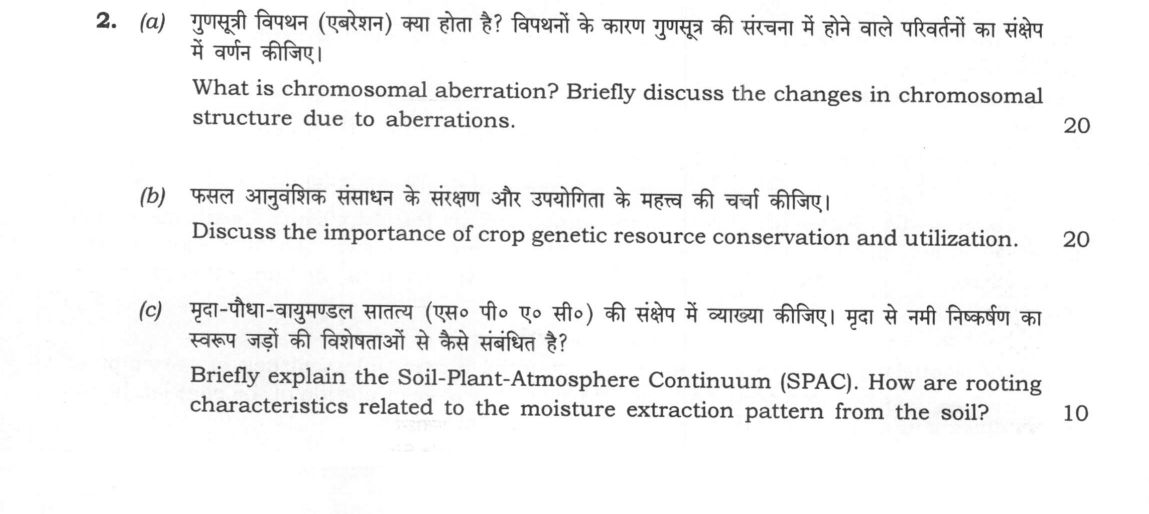
(a) What is chromosomal aberration? Briefly discuss the changes in chromosomal structure due to aberrations. (20 marks) (b)…
What is chromosomal aberration? Briefly discuss the changes in chromosomal structure due to aberrations. 20 marks
Discuss the importance of crop genetic resource conservation and utilization. 20 marks
Briefly explain the Soil-Plant-Atmosphere Continuum (SPAC). How are rooting characteristics related to the moisture extraction pattern from the soil? 10 marks
हिंदी में प्रश्न पढ़ें
गुणसूत्री विपथन (एबरेशन) क्या होता है? विपथनों के कारण गुणसूत्र की संरचना में होने वाले परिवर्तनों का संक्षेप में वर्णन कीजिए। (20 अंक)
फसल आनुवंशिक संसाधन के संरक्षण और उपयोगिता के महत्व की चर्चा कीजिए। (20 अंक)
मृदा-पौधा-वायुमण्डल सातत्य (एस० पी० ए सी०) की संक्षेप में व्याख्या कीजिए। मृदा से नमी निष्कर्षण का स्वरूप जड़ों की विशेषताओं से कैसे संबंधित है? (10 अंक)
Model answer
Written by UPSC Answer Check against this question's marking rubric, to the expected length. UPSC does not publish answers for Mains — this is one way to score well, not an official key.
Chromosomal Aberrations and Structural Alterations
Chromosomal aberrations refer to structural or numerical changes in chromosomes that depart from the standard diploid complement, induced spontaneously or via physical (gamma rays, X-rays) and chemical (ethyl methane sulfonate) mutagenic agents. Structural aberrations are classified into intrachromosomal changes occurring within the same chromosome—such as deletions (loss of segments, e.g., Cri-du-chat syndrome), duplications (repeated segments), and inversions (180-degree segment rotations)—and interchromosomal changes between non-homologous chromosomes, mainly reciprocal translocations (exchange of non-homologous segments, as seen in Secale cereale). These rearrangements alter gene dosage, modify linkage groups, and cause meiotic irregularities that drive evolutionary divergence and breeding variability.
Crop Genetic Resource Conservation and Utilization
Crop genetic resource (CGR) conservation provides essential biological insurance against genetic erosion caused by monoculture, acting as a reservoir of resistance genes for evolving biotic and abiotic stresses, such as wild introgressions for rice blast resistance at IRRI. Conservation is operationalized through core and mini-core collections that capture maximum diversity with minimal redundancy, pre-breeding to bridge wild relatives with elite lines, and participatory plant breeding to sustain landraces. In India, ex-situ conservation is spearheaded by the ICAR-National Bureau of Plant Genetic Resources (NBPGR) at New Delhi, which houses the world's second-largest National Genebank, complemented by specialized facilities such as the cryopreservation of Citrus germplasm at the ICAR-Central Citrus Research Institute, Nagpur.
Soil-Plant-Atmosphere Continuum and Rooting Dynamics
The Soil-Plant-Atmosphere Continuum (SPAC) is an integrated thermodynamic system where water moves along a continuous, descending gradient of water potential (Ψ), moving sequentially from soil (Ψₛₒᵢₗ) to root (Ψᵣₒₒₜ), xylem, leaf (Ψ_leaf), and the transpiratory atmosphere (Ψₐₜₘ, where Ψₛₒᵢₗ > Ψᵣₒₒₜ > Ψ_leaf > Ψₐₜₘ). Moisture extraction along this gradient is governed by rooting depth, root length density, and distribution architecture. In Indian cropping systems, shallow fibrous root systems (e.g., rice) restrict water uptake to upper soil layers (0–30 cm), predisposing crops to surface dry spells. Conversely, deep tap root systems (e.g., cotton, pigeonpea) extract moisture from subsoil profiles exceeding one meter, sustaining transpiration during extended dry intervals.
Integrating germplasm conservation with root-trait phenotyping provides the strategic pathway to deploy drought-tolerant ideotypes, ensuring climate resilience and sustainable crop production.
What "Discuss" is asking you to do
Lay the issue out from more than one side — how it arose, what is claimed for it, what is held against it, and where it now stands. UPSC attaches discuss to broad topics with several live dimensions, so coverage of the dimensions earns more than the strength of your opinion.
Structure that answers it
Set the issue up → the case as it is made → the case against → the dimension both sides leave out → where the balance now lies
Where marks are lost
Listing facts with no thread between them, or arguing one side throughout and calling it a discussion.
How this answer will be evaluated
Approach
Framework: Concept > Practice or process > Data > Indian application. (a) discuss: intro > 3-4 dimensions > example > balanced close | (b) discuss: intro > 3-4 dimensions > example > balanced close | (c) explain: definition/context > points in order > small example > short close Full marks: Comprehensive, accurate, with specific examples and clear mechanisms.
Key points expected
- Define chromosomal aberration as structural change
- Explain deletion and duplication mechanisms
- Explain inversion and translocation types
- Mention phenotypic consequences of aberrations
- Define crop genetic resources (CGR)
- Explain conservation methods (in-situ/ex-situ)
- Discuss utilization in breeding programs
- Mention role in food security
Evaluation rubric
Each sub-part is marked on its own, against the marks and word limit printed on the paper.
- (a) Define chromosomal aberration and detail structural changes. 20 marks
discuss— intro → 3-4 dimensions → example → balanced close
Must cover
- Define chromosomal aberration as structural change
- Explain deletion and duplication mechanisms
- Explain inversion and translocation types
- Mention phenotypic consequences of aberrations
Loses marks
- Confusing structural with numerical
- Vague description of mechanisms
- Ignoring phenotypic effects
Earns more
- Reference to specific plant examples
- Distinction between reciprocal/non-reciprocal
- Mention of Robertsonian translocation
- Link to genetic mapping
Extra mark
- Diagram of translocation heterozygote
- Reference to specific mutation
- (b) Discuss importance of crop genetic resource conservation and utilization. 20 marks
discuss— intro → 3-4 dimensions → example → balanced close
Must cover
- Define crop genetic resources (CGR)
- Explain conservation methods (in-situ/ex-situ)
- Discuss utilization in breeding programs
- Mention role in food security
Loses marks
- Ignoring conservation methods
- Vague discussion of utilization
- No mention of food security
Earns more
- Reference to NBPGR or ICAR
- Mention of specific crop varieties
- Discussion of germplasm banks
- Link to climate resilience
Extra mark
- Reference to IGPME
- Mention of specific gene bank
- (c) Explain SPAC and relate rooting to moisture extraction. 10 marks
explain— definition/context → points in order → small example → short close
Must cover
- Define Soil-Plant-Atmosphere Continuum
- Explain water movement mechanism
- Relate root depth to extraction
- Mention transpiration pull
Loses marks
- Ignoring root characteristics
- Vague explanation of SPAC
- No mention of transpiration
Earns more
- Reference to root architecture
- Mention of hydraulic conductivity
- Discussion of water potential
- Link to drought tolerance
Extra mark
- Diagram of SPAC
- Mention of specific root types
Practice this exact question
Write your answer and it is marked point by point against the model answer above — what you covered, what you missed, what you got wrong.
Evaluate my answer →More from Agriculture 2024 Paper II
- Q1 Answer the following questions in about 150 words each: (a) Explain the ultrastructure of…
- Q2 (a) What is chromosomal aberration? Briefly discuss the changes in chromosomal structure…
- Q3 (a) What is allopolyploidy? Describe its applications and limitations in crops. (20 marks…
- Q4 (a) Give an account of cytoplasmic genetic male sterility and its utilization in plant br…
- Q5 Answer the following questions in about 150 words each: (a) Explain the properties and fu…