Paper II — Q7
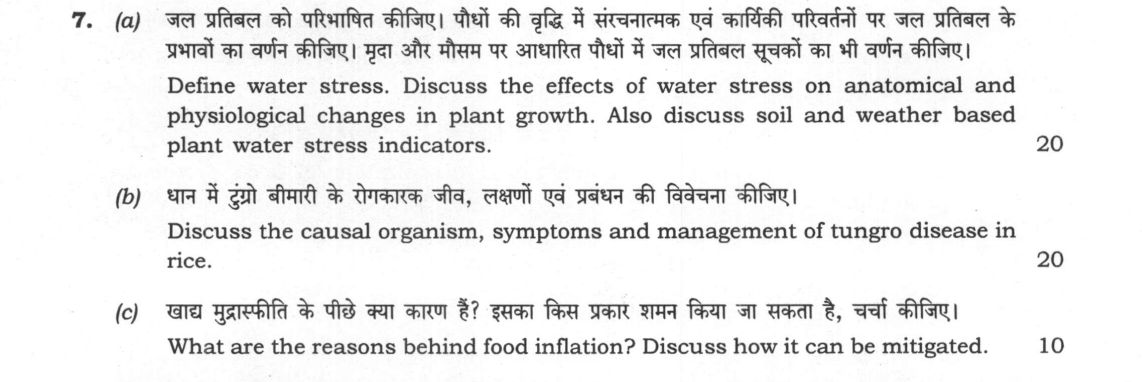
(a) Define water stress. Discuss the effects of water stress on anatomical and physiological changes in plant growth. Also…
Define water stress. Discuss the effects of water stress on anatomical and physiological changes in plant growth. Also discuss soil and weather based plant water stress indicators. 20 marks
Discuss the causal organism, symptoms and management of tungro disease in rice. 20 marks
What are the reasons behind food inflation? Discuss how it can be mitigated. 10 marks
हिंदी में प्रश्न पढ़ें
जल प्रतिबल को परिभाषित कीजिए। पौधों की वृद्धि में संरचनात्मक एवं कार्यिकी परिवर्तनों पर जल प्रतिबल के प्रभावों का वर्णन कीजिए। मृदा और मौसम पर आधारित पौधों में जल प्रतिबल सूचकों का भी वर्णन कीजिए। (20 अंक)
धान में टुंग्रो बीमारी के रोगकारक जीव, लक्षणों एवं प्रबंधन की विवेचना कीजिए। (20 अंक)
खाद मुद्रास्फीति के पीछे क्या कारण हैं? इसका किस प्रकार शमन किया जा सकता है, चर्चा कीजिए। (10 अंक)
Model answer
Written by UPSC Answer Check against this question's marking rubric, to the expected length. UPSC does not publish answers for Mains — this is one way to score well, not an official key.
Water Stress: Anatomical, Physiological Changes, and Indicators
Water stress occurs when plant transpiration exceeds root water absorption, causing internal plant water deficit; this physiological state differs from meteorological drought, which is a prolonged atmospheric precipitation deficiency.
Anatomically, water stress restricts cell turgor, causing reduced cell elongation and leaf expansion, reduction in xylem vessel diameter to prevent cavitation, an increased root-shoot ratio as roots proliferate deeper, and leaf rolling to reduce surface exposure. Physiologically, it induces rapid Abscisic Acid (ABA) accumulation, precipitating stomatal closure, reduced carbon dioxide assimilation, impaired photosynthesis, and loss of membrane integrity. Plants counter this via osmotic adjustment, accumulating compatible solutes like proline and soluble sugars.
Plant water stress indicators are classified into: Soil-based indicators: Soil moisture tension measured via tensiometers, Available Water Capacity (AWC) thresholds, and soil depletion up to the permanent wilting coefficient. Weather-based indicators: Standardized by ICAR, these include Evapotranspiration (ET) deficit, thermal infrared canopy temperature (canopy-to-air temperature differential), and the Crop Water Stress Index (CWSI) derived from vapor pressure deficits.
Rice Tungro Disease: Etiology, Symptoms, and Management
Rice tungro disease is caused by an obligate viral complex: Rice Tungro Bacilliform Virus (RTBV, a double-stranded DNA virus causing symptom severity) and Rice Tungro Spherical Virus (RTSV, a single-stranded RNA virus required for vector transmission). The complex is transmitted semi-persistently by the green leafhopper (Nephotettix virescens).
Prevalent in endemic tracts of Tamil Nadu, Andhra Pradesh, and West Bengal, characteristic symptoms include marked plant stunting, leaf discoloration turning yellow-to-orange beginning from the tips, reduced tillering, delayed flowering, and sterile, discolored panicles.
Management relies on an integrated approach: Host-plant resistance: Deploying resistant cultivars like IR36, IR64, and Vikramarya. Vector control: Nursery and field application of systemic insecticides like imidacloprid or thiamethoxam. Cultural practices: Synchronous planting across contiguous tracts, destruction of weed hosts, and roguing of early infected hills. Nutrient management: Applying balanced NPK fertilization while avoiding excessive basal nitrogen.
Food Inflation: Drivers and Mitigation Strategies
Recent food inflation episodes (2022–2023) highlight dual pressures: Demand-side drivers: Sustained economic growth leading to rising disposable incomes, urbanization, and structural dietary diversification toward high-value proteins, fruits, and dairy. Supply-side drivers: Extreme weather shocks (heatwaves affecting wheat, unseasonal rains hitting horticulture), rising input costs (fertilizer, diesel), supply-chain bottlenecks, and upward revisions in Minimum Support Prices (MSP).
Mitigation requires coordinated interventions: open market buffer stock operations by the Food Corporation of India (FCI); dynamic export-import calibrations (tariff adjustments, export curbs); price stabilization through PM-AASHA; pan-India market integration via e-NAM; and protecting vulnerable populations through the Targeted Public Distribution System (TPDS).
Way Forward
Mitigating agricultural volatility requires integrating stress-tolerant breeding with real-time agro-meteorological monitoring (CWSI) and prophylactic pest surveillance. Safeguarding farm yields from climatic and pathological stresses forms the operational baseline for curbing food supply shocks and stabilizing consumer inflation.
What "Discuss" is asking you to do
Lay the issue out from more than one side — how it arose, what is claimed for it, what is held against it, and where it now stands. UPSC attaches discuss to broad topics with several live dimensions, so coverage of the dimensions earns more than the strength of your opinion.
Structure that answers it
Set the issue up → the case as it is made → the case against → the dimension both sides leave out → where the balance now lies
Where marks are lost
Listing facts with no thread between them, or arguing one side throughout and calling it a discussion.
How this answer will be evaluated
Approach
Framework: Concept > Practice or process > Data > Indian application. (a) discuss: intro > 3-4 dimensions > example > balanced close | (b) discuss: intro > 3-4 dimensions > example > balanced close | (c) analyse: intro > causes > effects > stakeholders/linkages > way forward Full marks: Comprehensive, specific, and well-structured with named varieties/schemes.
Key points expected
- Define water stress (deficit or excess water)
- Anatomical changes (e.g., leaf rolling, root growth)
- Physiological changes (e.g., stomatal closure, ABA)
- Soil and weather based indicators (e.g., soil moisture, ET)
- Identify causal organism (Tungro virus + phytoplasma)
- Describe specific symptoms (yellowing, stunting)
- Management strategies (resistant varieties, vector control)
- Mention specific rice varieties (e.g., IR36, IR64)
Evaluation rubric
Each sub-part is marked on its own, against the marks and word limit printed on the paper.
- (a) Define water stress and detail its anatomical/physiological impacts plus soil/weather indicators. 20 marks
discuss— intro → 3-4 dimensions → example → balanced close
Must cover
- Define water stress (deficit or excess water)
- Anatomical changes (e.g., leaf rolling, root growth)
- Physiological changes (e.g., stomatal closure, ABA)
- Soil and weather based indicators (e.g., soil moisture, ET)
Loses marks
- Vague agronomic advice without physiological basis
- Confusing water stress with other stresses
Earns more
- Mention specific plant types (mud vs weather based)
- Link to specific crops (e.g., rice, wheat)
- Mention specific indicators (e.g., VWC, RWHI)
Extra mark
- Mention specific Indian schemes for water management
- Reference specific research data on yield loss
- (b) Detail the causal organism, symptoms, and management of tungro disease in rice. 20 marks
discuss— intro → 3-4 dimensions → example → balanced close
Must cover
- Identify causal organism (Tungro virus + phytoplasma)
- Describe specific symptoms (yellowing, stunting)
- Management strategies (resistant varieties, vector control)
- Mention specific rice varieties (e.g., IR36, IR64)
Loses marks
- Confusing tungro with other rice diseases
- Vague management advice without specific varieties
Earns more
- Mention vector (green leafhopper)
- Discuss integrated pest management (IPM)
- Mention specific Indian varieties (e.g., Pusa 44)
Extra mark
- Mention specific government schemes for disease control
- Reference specific research on tungro resistance
- (c) Analyze reasons for food inflation and suggest mitigation strategies. 10 marks
analyse— intro → causes → effects → stakeholders/linkages → way forward
Must cover
- Identify key reasons (supply, demand, policy)
- Suggest specific mitigation strategies
- Link to Indian context (e.g., MSP, buffer stocks)
Loses marks
- MSP-only solutions without broader context
- Vague advice without specific policy names
Earns more
- Mention specific schemes (e.g., PM-KISAN, NFCC)
- Discuss post-harvest losses
- Mention specific data on inflation rates
Extra mark
- Reference specific committee reports (e.g., Swaminathan)
- Mention specific international comparisons
Practice this exact question
Write your answer and it is marked point by point against the model answer above — what you covered, what you missed, what you got wrong.
Evaluate my answer →More from Agriculture 2024 Paper II
- Q4 (a) Give an account of cytoplasmic genetic male sterility and its utilization in plant br…
- Q5 Answer the following questions in about 150 words each: (a) Explain the properties and fu…
- Q6 (a) Describe the process of anaerobic respiration and explain the factors affecting respi…
- Q7 (a) Define water stress. Discuss the effects of water stress on anatomical and physiologi…
- Q8 (a) Explain the mode of action of organophosphate and Bacillus thuringiensis which are us…