Paper I — Q1
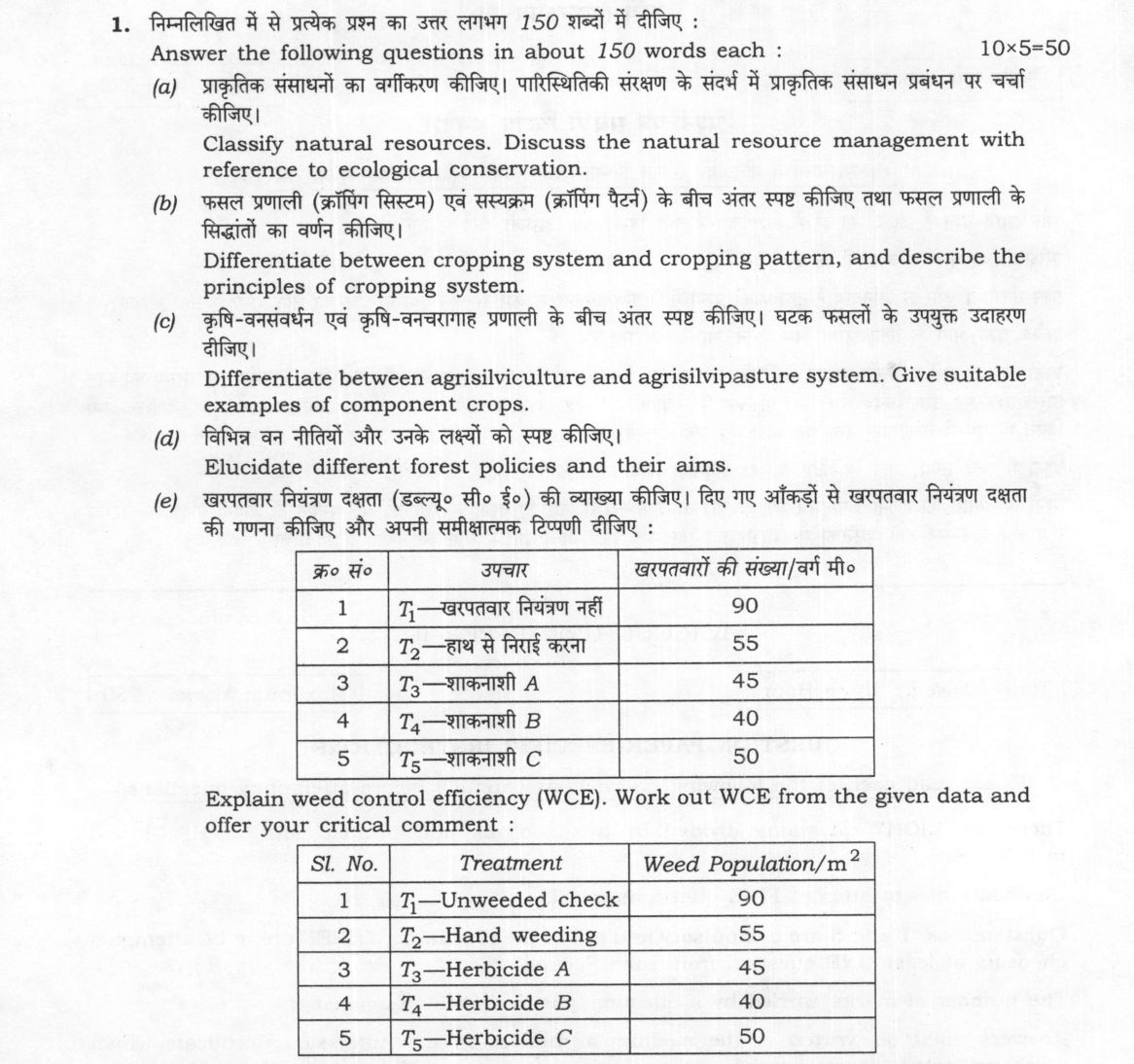
Answer the following questions in about 150 words each: (a) Classify natural resources. Discuss the natural resource management…
Answer the following questions in about 150 words each:
Classify natural resources. Discuss the natural resource management with reference to ecological conservation. 10 marks
Differentiate between cropping system and cropping pattern, and describe the principles of cropping system. 10 marks
Differentiate between agrisilviculture and agrisilvipasture system. Give suitable examples of component crops. 10 marks
Elucidate different forest policies and their aims. 10 marks
Explain weed control efficiency (WCE). Work out WCE from the given data and offer your critical comment:
| Sl. No. | Treatment | Weed Population/m² | |
|---|---|---|---|
| 1 | T₁—Unweeded check | 90 | |
| 2 | T₂—Hand weeding | 55 | |
| 3 | T₃—Herbicide A | 45 | |
| 4 | T₄—Herbicide B | 40 | |
| 5 | T₅—Herbicide C | 50 | (10 marks) |
हिंदी में प्रश्न पढ़ें
निम्नलिखित में से प्रत्येक प्रश्न का उत्तर लगभग 150 शब्दों में दीजिए :
प्राकृतिक संसाधनों का वर्गीकरण कीजिए। परिस्थितिकी संरक्षण के संदर्भ में प्राकृतिक संसाधन प्रबंधन पर चर्चा कीजिए। (10 अंक)
फसल प्रणाली (क्रॉपिंग सिस्टम) एवं सस्यक्रम (क्रॉपिंग पैटर्न) के बीच अंतर स्पष्ट कीजिए तथा फसल प्रणाली के सिद्धांतों का वर्णन कीजिए। (10 अंक)
कृषि-वनसंवर्धन एवं कृषि-वनचरागाह प्रणाली के बीच अंतर स्पष्ट कीजिए। घटक फसलों के उपयुक्त उदाहरण दीजिए। (10 अंक)
विभिन्न वन नीतियों और उनके लक्ष्यों को स्पष्ट कीजिए। (10 अंक)
खरपतवार नियंत्रण दक्षता (डब्ल्यू. सी. ई.) की व्याख्या कीजिए। दिए गए आँकड़ों से खरपतवार नियंत्रण दक्षता की गणना कीजिए और अपनी समीक्षात्मक टिप्पणी दीजिए :
| क्र. सं. | उपचार | खरपतवारों की संख्या/वर्ग मी. | |
|---|---|---|---|
| 1 | T₁—खरपतवार नियंत्रण नहीं | 90 | |
| 2 | T₂—हाथ से निराई करना | 55 | |
| 3 | T₃—शाकनाशी A | 45 | |
| 4 | T₄—शाकनाशी B | 40 | |
| 5 | T₅—शाकनाशी C | 50 | (10 अंक) |
Model answer
Written by UPSC Answer Check against this question's marking rubric, to the 150-word length. UPSC does not publish answers for Mains — this is one way to score well, not an official key.
(a) Natural Resources and Ecological Conservation
Natural resources are broadly classified based on renewability into renewable resources (solar radiation, fresh water, biomass) and non-renewable resources (fossil fuels, metallic and non-metallic minerals). Based on origin, they are grouped into biotic resources (forests, wildlife, crops, soil microbes) and abiotic resources (land, rocks, minerals, air).
Natural Resource Management (NRM) aligns human resource utilization with ecological carrying capacity to ensure long-term ecosystem stability. Implementing a ridge-to-valley watershed approach (as under the PMKSY-Watershed Development component) arrests topsoil erosion, enhances in-situ moisture retention, and recharges depleted aquifers. Sustainable management integrates conservation tillage, agro-ecological zoning, and optimal resource cycling to preserve vital ecosystem services such as carbon sequestration, nutrient cycling, and hydrological regulation. Decentralized community participation, exemplified by Joint Forest Management Committees and Water Users Associations, ensures that resource stewardship balances immediate economic livelihoods with the imperative of biodiversity preservation and ecological resilience.
(b) Cropping System vs. Cropping Pattern and Principles
Distinction: Cropping pattern denotes the spatial and temporal arrangement of crops on a specific land area over a given period (e.g., Rice-Wheat or Cotton-Wheat systems). In contrast, a cropping system represents the cropping pattern combined with the complete management regime and bio-physical interactions between crops, soil, water, climate, and available farm inputs over time.
Principles of Cropping System:
- Resource Use Efficiency: Maximizing the interception of photosynthetically active radiation, rooting depth utilization, and moisture extraction across spatial strata.
- Biological Compatibility and Complementarity: Selecting crop combinations with non-overlapping peak nutrient demands and positive allelopathic or symbiotic effects, such as cereal-legume intercropping.
- Sustainability and Soil Health: Enhancing physical, chemical, and biological soil properties through balanced crop rotations and green manuring.
- Yield Stability and Risk Mitigation: Diversifying crops to buffer against market fluctuations, pest outbreaks, and climate-induced abiotic stresses.
- Economic Profitability: Optimizing the land equivalent ratio (LER) and net returns per unit of land, water, and labor invested.
(c) Agrisilviculture vs. Agrisilvipasture Systems
Distinction: Agrisilviculture is a two-tier agroforestry system combining agricultural crops with tree species (silviculture) on the same management unit, primarily aimed at food, timber, and fuelwood production on arable lands. Agrisilvipasture is a three-tier integrated system combining agricultural crops, woody perennials (trees/shrubs), and pasture grasses/legumes alongside livestock grazing or stall-feeding, usually implemented on marginal or degraded lands to satisfy food, fodder, and timber requirements simultaneously.
Component Crops and Examples:
- Agrisilviculture: Intercropping Wheat (Triticum aestivum) or Mustard (Brassica juncea) under Poplar (Populus deltoides) or Eucalyptus (Eucalyptus tereticornis) in the irrigated plains of Punjab and Haryana.
- Agrisilvipasture: Cultivating Pearl Millet (Pennisetum glaucum) or Cowpea (Vigna unguiculata) alongside pasture grasses like Anjan grass (Cenchrus ciliaris) or Stylosanthes hamata, under multipurpose tree canopies of Khejri (Prosopis cineraria) or Babul (Acacia nilotica), integrated with sheep or goat rearing in arid and semi-arid Rajasthan.
(d) Forest Policies and Their Aims
- National Forest Policy, 1894: Formulated during the colonial era, its primary aim was state-controlled commercial exploitation of timber for imperial infrastructure (railways and defense), subordinating forest conservation to the expansion of settled agriculture.
- National Forest Policy, 1952: Post-independence policy aimed at meeting vital national defense and industrial raw material needs. It set a national target of maintaining 33% of the total geographical area under forest cover (60% in mountainous tracts) to ensure ecological balance.
- National Forest Policy, 1988: Marked a decisive transition from revenue extraction to conservation-centric governance. Its core aims were environmental stability, preserving genetic diversity, checking soil erosion, and meeting the local fuelwood, fodder, and small timber requirements of tribal communities via Joint Forest Management (JFM).
- Draft National Forest Policy, 2018: Aims at climate change mitigation through enhanced carbon sinks, catchment area treatment, combating human-wildlife conflict, and integrating public-private partnerships (PPP) with community rights for the afforestation of degraded lands.
(e) Weed Control Efficiency (WCE)
Weed Control Efficiency (WCE) is the percentage reduction in weed population or weed dry matter accumulation achieved by a given weed control treatment compared to an unweeded control check.
WCE (%) = (W_c - Wₜ)/(W_c) × 100
Where W_c is the weed population in the unweeded check (T₁ = 90), and Wₜ is the weed population in the treatment plot.
Calculations:
- T₂ (Hand weeding): (90 - 55)/90 × 100 = 38.89%
- T₃ (Herbicide A): (90 - 45)/90 × 100 = 50.00%
- T₄ (Herbicide B): (90 - 40)/90 × 100 = 55.56%
- T₅ (Herbicide C): (90 - 50)/90 × 100 = 44.44%
Critical Comment: Herbicide B (T₄) achieved the highest efficacy (55.56%), whereas manual hand weeding (T₂) exhibited the poorest control (38.89%), likely due to late execution or rapid weed flushes. However, exclusive reliance on high-efficacy chemical treatments poses long-term risks, including environmental toxicity, non-target damage to soil biota, herbicide residue carryover, and the selection pressure driving herbicide-resistant weed biotypes. An Integrated Weed Management (IWM) strategy—combining optimized herbicide use with mechanical weeding and cultural suppression—is essential for sustainable and economically viable weed control.
What "Differentiate" is asking you to do
Fix the criteria on which the two differ and apply each criterion to both, so the pair can no longer be mixed up. Differentiate stems usually carry a further task attached — describe the mechanism, set out the principles, discuss the applications — and that task carries its own marks.
Structure that answers it
Criterion 1 applied to both → criterion 2 → criterion 3 → summary line or table → the attached second demand answered in full
Where marks are lost
Two standalone definitions placed side by side, leaving the reader to extract the difference. The second common loss is running out of space before the attached task, which is often worth as much as the differentiation.
How this answer will be evaluated
Approach
Framework: Concept > Practice or process > Data > Indian application. (a) discuss: intro > 3-4 dimensions > example > balanced close | (b) compare: paired headings or table > key differences > significance > conclusion | (c) compare: paired headings or table > key differences > significance > conclusion | (d) explain: definition/context > points in order > small example > short close | (e) calculate: given > formula > substitution > result with units > interpretation Full marks: Precise definitions, accurate calculations, specific examples, and clear distinctions.
Key points expected
- Classify resources (renewable/non-renewable or biotic/abiotic)
- Define natural resource management (NRM)
- Link management to ecological conservation
- Mention specific conservation practices (e.g., soil/water)
- Define cropping system (complex, multi-crop)
- Define cropping pattern (sequence, single area)
- List principles (e.g., soil fertility, climate)
- Explain the relationship between the two
Evaluation rubric
Each sub-part is marked on its own, against the marks and word limit printed on the paper.
- (a) Classification of natural resources and management strategy for ecological conservation. · 150 words
discuss— intro → 3-4 dimensions → example → balanced close
Must cover
- Classify resources (renewable/non-renewable or biotic/abiotic)
- Define natural resource management (NRM)
- Link management to ecological conservation
- Mention specific conservation practices (e.g., soil/water)
Loses marks
- Vague definitions without classification
- Ignoring the ecological conservation aspect
- Listing resources without management context
Earns more
- Reference to sustainable development
- Mention of specific Indian NRM schemes
- Distinction between conservation and preservation
Extra mark
- Reference to specific ecological zones
- Mention of specific legislation (e.g., FRA 2006)
- (b) Distinction between cropping system and pattern, plus principles of cropping system. · 150 words
compare— paired headings or table → key differences → significance → conclusion
Must cover
- Define cropping system (complex, multi-crop)
- Define cropping pattern (sequence, single area)
- List principles (e.g., soil fertility, climate)
- Explain the relationship between the two
Loses marks
- Confusing system with pattern
- Failing to list principles
- Vague descriptions without distinction
Earns more
- Mention of specific systems (e.g., rice-wheat)
- Reference to economic principles
- Mention of agro-climatic zones
Extra mark
- Reference to specific Indian cropping patterns
- Mention of specific soil conservation principles
- (c) Difference between agrisilviculture and agrisilvipasture, with component crop examples. · 150 words
compare— paired headings or table → key differences → significance → conclusion
Must cover
- Define agrisilviculture (crops + trees)
- Define agrisilvipasture (crops + trees + livestock)
- Provide examples for agrisilviculture
- Provide examples for agrisilvipasture
Loses marks
- Failing to distinguish the livestock component
- Lack of specific crop examples
- Confusing with silvopasture
Earns more
- Mention of specific tree species
- Mention of specific livestock types
- Reference to land use efficiency
Extra mark
- Reference to specific Indian agroforestry models
- Mention of specific economic benefits
- (d) Explanation of different forest policies and their specific aims. · 150 words
explain— definition/context → points in order → small example → short close
Must cover
- Name specific forest policies (e.g., 1952, 1988)
- State the aim of each policy
- Mention the shift in focus (e.g., production to ecology)
- Reference to the Forest (Conservation) Act
Loses marks
- Vague generalities without naming policies
- Failing to state the aims
- Ignoring the historical evolution
Earns more
- Mention of the 1988 National Forest Policy
- Reference to the 1952 policy
- Mention of the 2019 amendment
Extra mark
- Reference to specific committee reports
- Mention of specific state-level policies
- (e) Explain WCE, calculate it for the given data, and offer a critical comment. · 150 words
calculate— given → formula → substitution → result with units → interpretation
Must cover
- State the WCE formula
- Show the calculation for at least one treatment
- Identify the most efficient treatment
- Provide a critical comment on the results
Loses marks
- Incorrect formula or calculation
- Failing to identify the best treatment
- Lack of critical comment
Earns more
- Calculating WCE for all treatments
- Comparing herbicide vs. hand weeding
- Mentioning cost-effectiveness
Extra mark
- Reference to specific herbicide classes
- Mention of environmental impact
Practice this exact question
Write your answer and it is marked point by point against the model answer above — what you covered, what you missed, what you got wrong.
Evaluate my answer →More from Agriculture 2025 Paper I
- Q1 Answer the following questions in about 150 words each: (a) Classify natural resources. D…
- Q2 (a) Enumerate the impact of climate change with reference to agricultural production. Pre…
- Q3 (a) List out the cereal- and millet-based cropping systems practised in India based on so…
- Q4 (a) Explain the productive, protective, ameliorative, recreational, educational and devel…