Paper I — Q4
(a) Explain the productive, protective, ameliorative, recreational, educational and developmental functions of Indian forests…
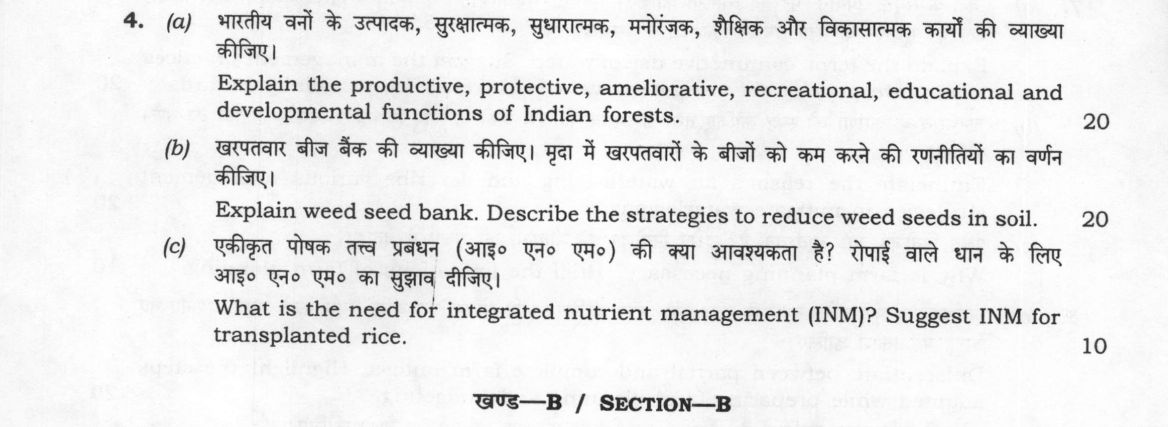
Explain the productive, protective, ameliorative, recreational, educational and developmental functions of Indian forests. 20 marks
Explain weed seed bank. Describe the strategies to reduce weed seeds in soil. 20 marks
What is the need for integrated nutrient management (INM)? Suggest INM for transplanted rice. 10 marks
हिंदी में प्रश्न पढ़ें
भारतीय वनों के उत्पादक, सुरक्षात्मक, सुधारात्मक, मनोरंजक, शैक्षिक और विकासात्मक कार्यों की व्याख्या कीजिए। (20 अंक)
खरपतवार बीज बैंक की व्याख्या कीजिए। मृदा में खरपतवारों के बीजों को कम करने की रणनीतियों का वर्णन कीजिए। (20 अंक)
एकीकृत पोषक तत्व प्रबंधन (आई० एन० एम०) की क्या आवश्यकता है? रोपाई वाले धान के लिए आई० एन० एम० का सुझाव दीजिए। (10 अंक)
Model answer
Written by UPSC Answer Check against this question's marking rubric, to the expected length. UPSC does not publish answers for Mains — this is one way to score well, not an official key.
Functions of Indian Forests
Indian forests provide multi-dimensional ecological, economic, and developmental services regulated under the framework of the National Forest Policy 1988.
Productive functions: Forests yield valuable timber (teak and rosewood from the Western Ghats) and essential Non-Timber Forest Products (NTFPs), including tendu leaves, bamboo, and resins. These forest products sustain extensive commercial wood industries and rural cottage enterprises.
Protective functions: Forest canopies intercept high-intensity rainfall, reducing kinetic splash erosion, while extensive root networks stabilize topsoil. This process safeguards critical catchments in the fragile Shivalik hills and mitigates storm surges and coastal erosion via mangrove buffers in the Sundarbans.
Ameliorative functions: Dense vegetation regulates carbon cycles through substantial carbon sequestration, particularly within Himalayan moist temperate forests. Forests also moderate microclimates by enhancing evapotranspiration, lowering ambient temperatures, and maintaining localized hydrological cycles.
Recreational functions: Natural forest ecosystems, such as Jim Corbett and Ranthambore National Parks, foster regulated ecotourism, providing aesthetic value, generating local employment, and generating revenue for wildlife conservation.
Educational and research functions: Undisturbed biomes act as primary living laboratories for evolutionary studies and biodiversity conservation, exemplified by research in Silent Valley and technical forestry research at the Forest Research Institute (FRI), Dehradun.
Developmental functions: Forests drive inclusive rural growth through Joint Forest Management (JFM) and the National Agroforestry Policy 2014, securing forest-dwelling tribal livelihoods via legal collection rights over minor forest produce and sustainable silvopastoral systems.
Weed Seed Bank Dynamics and Reduction Strategies
The weed seed bank is the total reservoir of viable weed seeds and vegetative propagules present on the soil surface and throughout the soil profile. The highest concentration occurs in the top 0–10 cm plough layer. Seeds persist across multiple seasons due to physiological dormancy mechanisms, thick impermeable seed coats, and chemical inhibitors that prevent premature germination until optimal hydrothermal conditions occur.
Reducing the weed seed bank requires target-specific strategies:
Cultural strategies: The stale seedbed technique involves early seedbed preparation and light irrigation to induce a premature flush of weed emergence, which is then destroyed prior to crop sowing. Rotating crops with varied canopy architectures and life cycles disrupts weed species dominance and life-cycle completion.
Mechanical strategies: Deep mouldboard plowing inverts the soil, burying surface seeds below their maximum emergence depth to cause fatal germination or prolonged decay. Conversely, selective shallow inter-tillage exposes deep-seated dormant seeds to lethal surface desiccation.
Biological strategies: Biofumigation via the incorporation of glucosinolate-rich Brassica cover crops releases volatile isothiocyanates that inhibit weed seed germination. Planting fast-growing smother crops (e.g., cowpea) suppresses weed reproduction and subsequent seed rain.
Chemical and integrated strategies: Soil-applied pre-emergence herbicides (such as pendimethalin or pretilachlor) arrest cell division in germinating weed radicles. Integrating these cultural, mechanical, and chemical tactics under Integrated Pest Management (IPM) under NAPCC steadily exhausts the dormant seed reservoir over successive cropping seasons.
Integrated Nutrient Management (INM) in Transplanted Rice
INM combines inorganic fertilizers, organic manures, and bio-inoculants to sustain soil fertility and crop productivity. The urgent need for INM arises from declining factor productivity in intensive monocultures, imbalanced NPK application ratios, widespread micronutrient deficiencies (notably Zinc and Iron in submerged soils), deteriorating physical and biological soil health, rising chemical input costs, and environmental hazards like nitrate leaching into groundwater. The Soil Health Card Scheme emphasizes this balanced approach.
For transplanted rice, INM is implemented through:
Organic manures and residue recycling: In-situ green manuring with Sesbania aculeata (dhaincha) or Crotalaria juncea (sunnhemp), incorporated 45–50 days after sowing (supplying 60–80 kg N/ha), supplemented by 5–10 t/ha of well-decomposed Farmyard Manure (FYM). Composted paddy straw is recycled back into the soil to replenish potassium and silica.
Biofertilizers: Dual cropping of Azolla caroliniana or Azolla pinnata (which contributes 20–30 kg N/ha upon decomposition), along with seedling root dip or field inoculation using Blue Green Algae (BGA) and Phosphate Solubilizing Bacteria (PSB) to enhance phosphorus availability in reduced soil conditions.
Inorganic fertilizer scheduling: Soil-test-targeted chemical fertilization involves applying 100% of the recommended phosphorus (via DAP) and potash (MOP) as a basal dose, combined with 25 kg/ha zinc sulphate. Nitrogen application is split into three equal stages (basal, active tillering, and panicle initiation) and dynamically calibrated using a Leaf Colour Chart (LCC) to synchronize nitrogen supply with crop demand and prevent volatilization losses.
Way Forward
Sustaining agroecological productivity requires recognizing functional links across landscapes. Forest ecosystems supply litter biomass that enriches the soil organic pools essential for rice INM, while boundary vegetation management prevents the influx of invasive forest-edge weeds into arable seed banks. Synchronizing the National Forest Policy with the Soil Health Card framework and integrated weed management provides a viable path to long-term agricultural sustainability.
What "Explain" is asking you to do
Make the working of something clear — what sets it off, what follows from what, and what it produces. Explain is the Commission's mechanism word: it dominates the technical papers and the “explain why” stems, where the marks sit in the causal chain and not in the label.
Structure that answers it
State what it is → the initiating condition → the chain of cause, step by step → an instance where it plays out → what the chain produces
Where marks are lost
Describing what something looks like instead of why it works that way. Naming the stages without linking them reads as description too.
How this answer will be evaluated
Approach
Framework: Concept > Practice or process > Data > Indian application. (a) explain: definition/context > points in order > small example > short close | (b) describe: define > structure or process in order > labelled diagram > significance | (c) suggest: the problem in one line > implementable measures > who acts > conclusion Full marks: Precise definitions, specific agronomic practices, and clear INM dosages.
Key points expected
- Productive: timber, fuelwood, non-timber forest products (NTFPs)
- Protective: soil conservation, flood control, water table maintenance
- Ameliorative: microclimate regulation, air quality, noise reduction
- Recreational: eco-tourism, wildlife sanctuaries, national parks
- Definition: viable seeds in soil reservoir (active/dormant)
- Strategy: Crop rotation to break weed life cycles
- Strategy: Tillage (primary/secondary) to expose seeds to predation
- Strategy: Mulching to suppress germination and light
Evaluation rubric
Each sub-part is marked on its own, against the marks and word limit printed on the paper.
- (a) Define and detail the six specific functions of Indian forests. 20 marks
explain— definition/context → points in order → small example → short close
Must cover
- Productive: timber, fuelwood, non-timber forest products (NTFPs)
- Protective: soil conservation, flood control, water table maintenance
- Ameliorative: microclimate regulation, air quality, noise reduction
- Recreational: eco-tourism, wildlife sanctuaries, national parks
Loses marks
- Vague generalities without specific forest products or services
- Confusing 'protective' with 'security' or 'defense'
Earns more
- Educational: research centers, botanical gardens, field stations
- Developmental: employment generation, tribal livelihoods, rural economy
- Mention of specific forest types (e.g., Tropical Evergreen)
Extra mark
- Reference to specific NTFP species (e.g., Lac, Honey, Tendu)
- Mention of specific National Parks (e.g., Jim Corbett, Kaziranga)
- (b) Define weed seed bank and list strategies to reduce it in soil. 20 marks
describe— define → structure or process in order → labelled diagram → significance
Must cover
- Definition: viable seeds in soil reservoir (active/dormant)
- Strategy: Crop rotation to break weed life cycles
- Strategy: Tillage (primary/secondary) to expose seeds to predation
- Strategy: Mulching to suppress germination and light
Loses marks
- Confusing 'weed seed bank' with 'weed population'
- Listing only mechanical weeding without soil-specific strategies
Earns more
- Strategy: Use of herbicides (pre-emergence)
- Strategy: Solarization or biofumigation
- Mention of 'seed rain' reduction via crop hygiene
Extra mark
- Mention of specific weed species (e.g., Barnyard grass, Wild Oats)
- Reference to specific herbicide classes (e.g., Atrazine, Glyphosate)
- (c) State need for INM and provide a specific INM plan for transplanted rice. 10 marks
suggest— the problem in one line → implementable measures → who acts → conclusion
Must cover
- Need: Soil health, cost reduction, environmental protection
- INM Suggestion: Basal dose of NPK (e.g., 120:60:40 kg/ha)
- INM Suggestion: Splitting of Nitrogen (Basal + Tillering + Panicle)
- INM Suggestion: Integration of organic manure (FYM/Compost)
Loses marks
- Suggesting only chemical fertilizers without organic integration
- Vague advice like 'use less fertilizer' without specific doses
Earns more
- Mention of specific organic sources (e.g., Vermicompost, Green manure)
- Reference to soil testing for site-specific nutrient management
Extra mark
- Mention of specific bio-fertilizers (e.g., Azospirillum, PSB)
- Reference to specific government schemes (e.g., Soil Health Card)
Practice this exact question
Write your answer and it is marked point by point against the model answer above — what you covered, what you missed, what you got wrong.
Evaluate my answer →More from Agriculture 2025 Paper I
- Q1 Answer the following questions in about 150 words each: (a) Classify natural resources. D…
- Q2 (a) Enumerate the impact of climate change with reference to agricultural production. Pre…
- Q3 (a) List out the cereal- and millet-based cropping systems practised in India based on so…
- Q4 (a) Explain the productive, protective, ameliorative, recreational, educational and devel…
- Q5 Answer the following questions in about 150 words each: (a) Explain saltation, surface cr…
- Q6 (a) Enumerate the harmful effects of herbicide residues in soil. Discuss the remedial mea…
- Q7 (a) Explain the term 'conjunctive use of water'. Suggest the management practices to impr…