Paper I — Q8
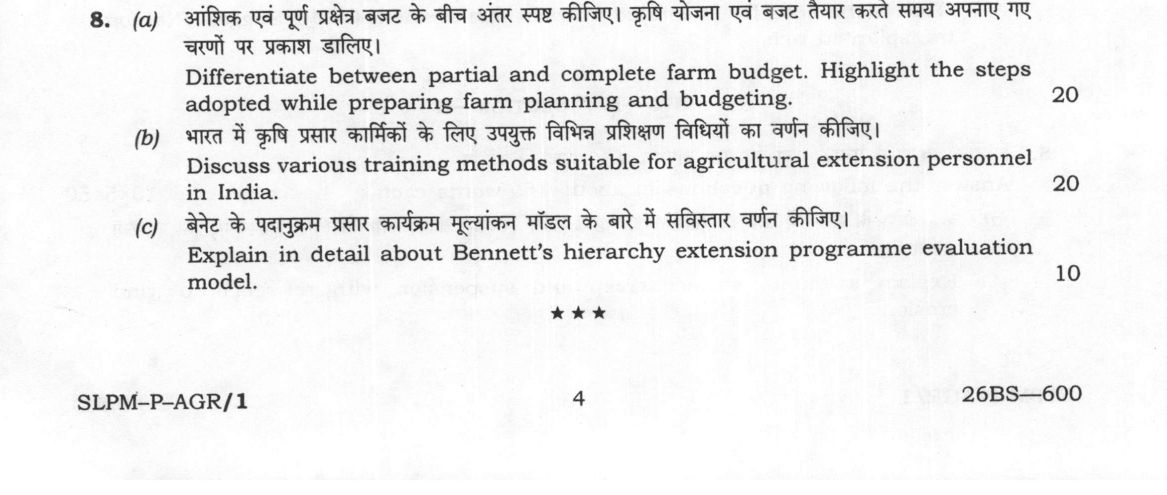
(a) Differentiate between partial and complete farm budget. Highlight the steps adopted while preparing farm planning and…
Differentiate between partial and complete farm budget. Highlight the steps adopted while preparing farm planning and budgeting. 20 marks
Discuss various training methods suitable for agricultural extension personnel in India. 20 marks
Explain in detail about Bennett's hierarchy extension programme evaluation model. 10 marks
हिंदी में प्रश्न पढ़ें
आंशिक एवं पूर्ण प्रक्षेत्र बजट के बीच अंतर स्पष्ट कीजिए। कृषि योजना एवं बजट तैयार करते समय अपनाए गए चरणों पर प्रकाश डालिए। (20 अंक)
भारत में कृषि प्रसार कर्मियों के लिए उपयुक्त विभिन्न प्रशिक्षण विधियों का वर्णन कीजिए। (20 अंक)
बेनेट के पदानुक्रम प्रसार कार्यक्रम मूल्यांकन मॉडल के बारे में सविस्तार वर्णन कीजिए। (10 अंक)
Model answer
Written by UPSC Answer Check against this question's marking rubric, to the expected length. UPSC does not publish answers for Mains — this is one way to score well, not an official key.
Farm planning and budgeting are foundational tools in agricultural economics, enabling producers to optimize resource allocation, manage risk, and assess enterprise viability.
Partial versus Complete Farm Budgeting A partial budget evaluates the net financial impact of a specific, minor operational adjustment or single enterprise substitution. It considers only incremental changes—added costs and reduced returns versus added returns and reduced costs—while excluding unaffected fixed costs. In contrast, a complete budget evaluates the total farm business reorganization. It encompasses all farm enterprises, accounting for total gross revenues alongside all fixed, overhead, and variable costs over a long-term horizon.
Steps in Farm Planning and Budgeting The preparation follows a logical sequence:
- Inventory assessment of existing farm assets, historical yields, and financial records.
- Goal setting targeting profit maximization, risk minimization, or household food security.
- Resource appraisal to identify constraints in land, water, labor, and capital.
- Enterprise selection and combination based on comparative agro-economic advantage.
- Budget formulation quantifying projected inputs, outputs, costs, and returns.
- Plan implementation through input procurement and labor scheduling.
- Monitoring and control to compare actual performance against targets and execute corrective measures.
Training Methods for Agricultural Extension Personnel Capacity building combines foundational pre-service education with periodic in-service training to bridge technological gaps. On-the-job methods include job rotation across agro-climatic zones, understudy assignments with senior scientists, and continuous coaching by Subject Matter Specialists. Off-the-job methods utilize interactive lectures, empirical case studies of progressive farming clusters, role play for communication skills, simulation exercises for contingency planning, and structured field visits to research stations. Institutionally, this is operationalized through a multi-tiered framework: MANAGE at the national apex, Extension Education Institutes (such as EEI Hyderabad) for regional pedagogical training, State Agricultural Management and Extension Training Institutes (SAMETI) at the state level, and Krishi Vigyan Kendras (KVKs) and the Agricultural Technology Management Agency (ATMA) at district and block levels.
Bennett's Hierarchy of Extension Programme Evaluation Bennett’s model establishes a seven-level hierarchy for evaluating extension programmes:
- Inputs: Time, staff, and budgetary resources invested.
- Activities: Events executed, such as method demonstrations, field days, and trainings.
- Participation: Number and demographic profile of farmers involved.
- Reactions: Participant interest and satisfaction with the activities.
- KASA Changes: Quantifiable shifts in Knowledge, Attitudes, Skills, and Aspirations.
- Practice Change: Individual on-farm adoption of recommended technologies.
- End Results: Ultimate socio-economic and environmental impacts, such as enhanced farm income and resource conservation.
The model operates on a cumulative logic: achieving lower levels is a necessary but not sufficient condition for achieving higher-level outcomes. High participation (Level 3) does not guarantee practice adoption (Level 6) or economic improvement (Level 7).
Way Forward Harmonizing micro-level farm budgeting with institutional extension training and Bennett's outcome-based evaluation provides the structural feedback required to transition Indian agriculture from input-intensive production to a resilient, market-led enterprise model.
What "Differentiate" is asking you to do
Fix the criteria on which the two differ and apply each criterion to both, so the pair can no longer be mixed up. Differentiate stems usually carry a further task attached — describe the mechanism, set out the principles, discuss the applications — and that task carries its own marks.
Structure that answers it
Criterion 1 applied to both → criterion 2 → criterion 3 → summary line or table → the attached second demand answered in full
Where marks are lost
Two standalone definitions placed side by side, leaving the reader to extract the difference. The second common loss is running out of space before the attached task, which is often worth as much as the differentiation.
How this answer will be evaluated
Approach
(a) compare: paired headings or table > key differences > significance > conclusion | (b) discuss: intro > 3-4 dimensions > example > balanced close | (c) explain: definition/context > points in order > small example > short close Full marks: Clear differentiation, detailed steps, specific Indian training methods, accurate model explanation.
Key points expected
- Define partial budget (single enterprise change)
- Define complete budget (whole farm operations)
- List steps: data collection, cost estimation, revenue projection
- Mention decision-making utility of budgeting
- Identify formal training (e.g., IARI, State Agricultural Universities)
- Identify on-the-job training (OJT) methods
- Mention specific methods: workshops, seminars, field visits
- Link training to extension service delivery
Evaluation rubric
Each sub-part is marked on its own, against the marks and word limit printed on the paper.
- (a) Differentiate partial vs complete farm budget and outline planning/budgeting steps. 20 marks
compare— paired headings or table → key differences → significance → conclusion
Must cover
- Define partial budget (single enterprise change)
- Define complete budget (whole farm operations)
- List steps: data collection, cost estimation, revenue projection
- Mention decision-making utility of budgeting
Loses marks
- Confusing partial budget with partial planning
- Omitting the 'steps' part of the question
- Vague definitions without distinguishing features
Earns more
- Example of partial budget (e.g., replacing crop A with B)
- Mentioning fixed vs variable costs in budgeting
- Reference to farm planning as a tool for resource allocation
Extra mark
- Mentioning specific Indian context (e.g., Kisan Credit Card linkage)
- (b) Discuss training methods for agricultural extension personnel in India. 20 marks
discuss— intro → 3-4 dimensions → example → balanced close
Must cover
- Identify formal training (e.g., IARI, State Agricultural Universities)
- Identify on-the-job training (OJT) methods
- Mention specific methods: workshops, seminars, field visits
- Link training to extension service delivery
Loses marks
- Listing methods without explaining their suitability
- Ignoring the 'Indian' context
- Confusing farmer training with extension personnel training
Earns more
- Mentioning specific institutions (e.g., ICAR, State Agri Universities)
- Discussing the role of training in adopting new technologies
- Mentioning refresher courses for existing staff
Extra mark
- Mentioning specific schemes or programs (e.g., PM-KISAN training)
- (c) Explain Bennett's hierarchy extension programme evaluation model. 10 marks
explain— definition/context → points in order → small example → short close
Must cover
- Define the model's purpose (evaluating extension programs)
- List the hierarchy levels (e.g., input, process, output, impact)
- Explain the flow of evaluation from lower to higher levels
- Mention the role of feedback in the model
Loses marks
- Confusing it with general program evaluation
- Omitting the 'hierarchy' aspect
- Vague explanation without specific levels
Earns more
- Mentioning specific indicators for each level
- Comparing it with other evaluation models (e.g., CIPP)
Extra mark
- Providing a simple diagram of the hierarchy
Practice this exact question
Write your answer and it is marked point by point against the model answer above — what you covered, what you missed, what you got wrong.
Evaluate my answer →More from Agriculture 2025 Paper I
- Q5 Answer the following questions in about 150 words each: (a) Explain saltation, surface cr…
- Q6 (a) Enumerate the harmful effects of herbicide residues in soil. Discuss the remedial mea…
- Q7 (a) Explain the term 'conjunctive use of water'. Suggest the management practices to impr…
- Q8 (a) Differentiate between partial and complete farm budget. Highlight the steps adopted w…