Paper I — Q3
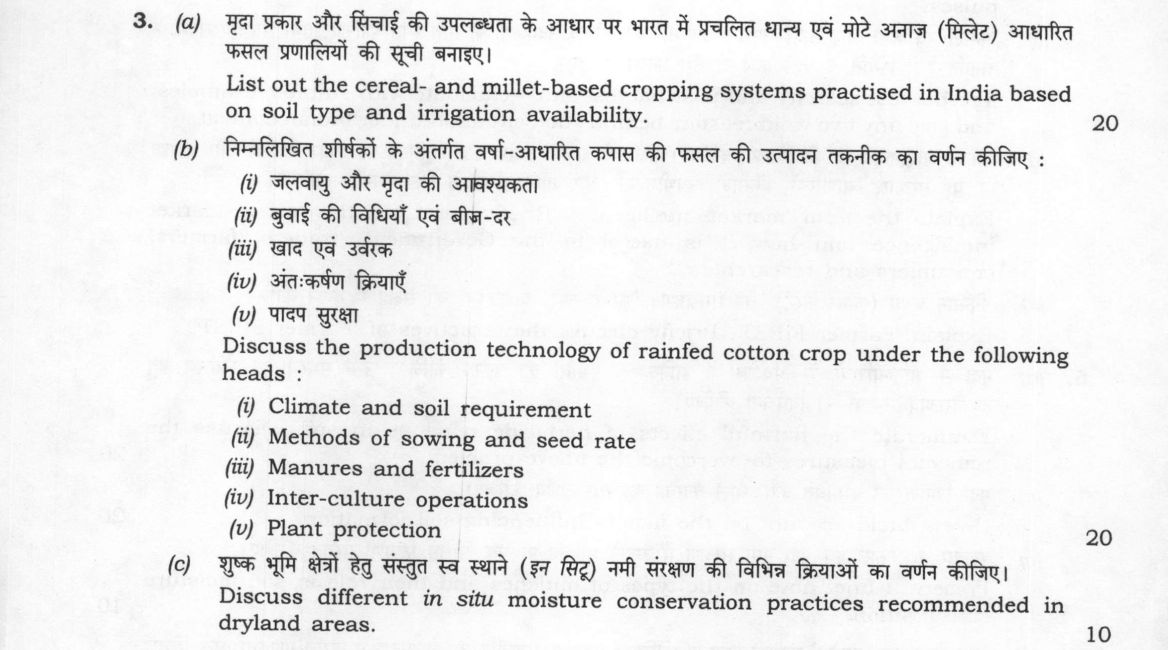
(a) List out the cereal- and millet-based cropping systems practised in India based on soil type and irrigation availability. (20…
List out the cereal- and millet-based cropping systems practised in India based on soil type and irrigation availability. 20 marks
Discuss the production technology of rainfed cotton crop under the following heads: Climate and soil requirement
Methods of sowing and seed rate
Manures and fertilizers
Inter-culture operations
Plant protection 20 marks
Discuss different in situ moisture conservation practices recommended in dryland areas. 10 marks
हिंदी में प्रश्न पढ़ें
मृदा प्रकार और सिंचाई की उपलब्धता के आधार पर भारत में प्रचलित धान्य एवं मोटे अनाज (मिलेट) आधारित फसल प्रणालियों की सूची बनाइए। (20 अंक)
निम्नलिखित शीर्षकों के अंतर्गत वर्षा-आधारित कपास की फसल की उत्पादन तकनीक का वर्णन कीजिए : जलवायु और मृदा की आवश्यकता
बुवाई की विधियाँ एवं बीज-दर
खाद एवं उर्वरक
अंतःकर्षण क्रियाएँ
पादप सुरक्षा (20 अंक)
शुष्क भूमि क्षेत्रों हेतु संस्तुत स्व स्थाने (इन सिटु) नमी संरक्षण की विभिन्न क्रियाओं का वर्णन कीजिए। (10 अंक)
Model answer
Written by UPSC Answer Check against this question's marking rubric, to the expected length. UPSC does not publish answers for Mains — this is one way to score well, not an official key.
India’s agricultural landscape is defined by a mosaic of cropping systems adapted to varying soil textures and water availability. Understanding these systems, alongside specific production technologies for key cash crops like cotton and moisture conservation strategies, is vital for sustainable dryland agriculture.
Cereal and Millet Cropping Systems Cropping systems in India are broadly classified based on soil type and irrigation status. In irrigated alluvial soils of the Indo-Gangetic plains, the dominant system is the rice-wheat rotation, often supplemented with pulses or oilseeds in the kharif season. In areas with limited irrigation or high water tables, rice-rice double cropping is practiced, though it depletes soil nutrients. Maize-wheat systems are common in black and red soils of central and southern India, particularly where irrigation is available for the rabi maize or wheat component.
In rainfed or semi-arid regions, millet-based systems prevail due to their drought tolerance. Pearl millet-mustard is a standard rotation in the black soils of Rajasthan and Maharashtra, where pearl millet (bajra) utilizes the monsoon moisture and mustard utilizes residual soil moisture. Sorghum-based systems, such as sorghum-pigeon pea or sorghum-mustard, are typical in red and lateritic soils of Karnataka, Andhra Pradesh, and Tamil Nadu. These systems rely on natural rainfall and are often intercropped with legumes to enhance soil nitrogen and reduce pest pressure.
Production Technology of Rainfed Cotton (i) Climate and Soil Requirement Rainfed cotton requires a warm climate with a frost-free period of at least 180 days. It thrives with 600–1200 mm of well-distributed rainfall, with the critical period being during boll development. The ideal soil is deep, well-drained black cotton soil (Vertisols) with a pH of 6.5–8.0. These soils have high water-holding capacity, which is crucial for buffering against monsoon gaps.
(ii) Methods of Sowing and Seed Rate Sowing is typically done in June-July, coinciding with the onset of monsoon. Methods include dibbling (manual or mechanical) and drilling. Broadcasting is discouraged as it complicates weeding and thinning. The seed rate varies significantly by variety type. For hybrid cotton, the recommended seed rate is low, approximately 2–3 kg/ha, due to high germination and vigor. For open-pollinated (desi) varieties, the rate is higher, around 10–15 kg/ha. Spacing is generally maintained at 90 cm between rows and 30–45 cm between plants.
(iii) Manures and Fertilizers Nutrient management in rainfed cotton is conservative to avoid leaching. Application of 10–15 t/ha of Farm Yard Manure (FYM) is recommended to improve soil organic matter and water retention. The fertilizer dose is lower than in irrigated systems, typically 60–80:30–40:30–40 kg/ha of NPK. Nitrogen is applied in two splits, while phosphorus and potassium are applied as basal doses. Micronutrient deficiencies, particularly Zinc (Zn) and Boron (B), are common in black soils and should be corrected through soil testing and foliar sprays.
(iv) Inter-culture Operations Timely inter-culture operations are critical for weed control and root development. Thinning is done 15–20 days after sowing to maintain plant population. Gap filling ensures uniform stand. Hoeing is performed 2–3 times during the early growth stages to control weeds and aerate the soil. Chemical weed control using pre-emergence herbicides like fluchloralin can be used, but hand weeding remains essential in rainfed conditions where herbicide efficacy may vary with moisture.
(v) Plant Protection Rainfed cotton is susceptible to pests and diseases. Major pests include bollworms (Helicoverpa armigera) and sucking pests like whitefly and aphids. Diseases like wilt (Fusarium) and leaf curl virus (transmitted by whitefly) are significant. An Integrated Pest Management (IPM) approach is recommended, involving the use of pheromone traps, yellow sticky traps, and selective insecticides only when economic thresholds are crossed. Biological control agents like Trichogramma spp. can also be deployed.
In Situ Moisture Conservation Practices In dryland areas, in situ moisture conservation aims to reduce runoff and increase infiltration. Contour bunding and graded bunding are structural measures to slow down water flow on slopes. Bench terracing is used in hilly regions to create flat steps for cultivation. Tied ridging involves making ridges across the slope with small gaps to trap water. Mulching with crop residues or plastic sheets reduces evaporation. Conservation tillage minimizes soil disturbance, preserving soil structure and moisture. These practices are often integrated with watershed development programs under schemes like PMKSY (Pradhan Mantri Krishi Sinchayee Yojana) to enhance water use efficiency.
Conclusion The success of rainfed agriculture in India hinges on the synergy between appropriate cropping systems, precise production technologies, and robust moisture conservation. By adopting drought-tolerant millet systems, optimizing rainfed cotton management with correct seed rates and nutrient doses, and implementing in situ water harvesting, farmers can enhance productivity and resilience. The integration of these practices under government schemes like PMKSY offers a viable pathway for sustainable dryland farming, ensuring food security and livelihood stability in water-scarce regions.
What "Discuss" is asking you to do
Lay the issue out from more than one side — how it arose, what is claimed for it, what is held against it, and where it now stands. UPSC attaches discuss to broad topics with several live dimensions, so coverage of the dimensions earns more than the strength of your opinion.
Structure that answers it
Set the issue up → the case as it is made → the case against → the dimension both sides leave out → where the balance now lies
Where marks are lost
Listing facts with no thread between them, or arguing one side throughout and calling it a discussion.
How this answer will be evaluated
Approach
Framework: Concept > Practice or process > Data > Indian application. (a) enumerate: list the items in order > one line each > no commentary | (b) discuss: intro > 3-4 dimensions > example > balanced close | (c) discuss: intro > 3-4 dimensions > example > balanced close Full marks: Precise, specific, and well-structured answers with named varieties, doses, and schemes.
Key points expected
- Distinguish between irrigated and rainfed systems
- Identify specific soil types (e.g., alluvial, black, red)
- Name specific crops (e.g., wheat, rice, bajra, jowar)
- Link specific crops to specific soil/irrigation combinations
- Specify climate/soil requirements for rainfed cotton
- State sowing methods and seed rate (kg/ha)
- List manure/fertilizer doses (NPK)
- Describe inter-culture operations (weeding, earthing up)
Evaluation rubric
Each sub-part is marked on its own, against the marks and word limit printed on the paper.
- (a) List cereal and millet cropping systems categorized by soil type and irrigation status. 20 marks
enumerate— list the items in order → one line each → no commentary
Must cover
- Distinguish between irrigated and rainfed systems
- Identify specific soil types (e.g., alluvial, black, red)
- Name specific crops (e.g., wheat, rice, bajra, jowar)
- Link specific crops to specific soil/irrigation combinations
Loses marks
- Listing crops without soil/irrigation context
- Vague generalizations (e.g., 'crops grown in India')
Earns more
- Mention specific regions (e.g., Punjab, Deccan)
- Include pulse-based rotations (e.g., wheat-chickpea)
- Reference specific millet varieties (e.g., little millet)
Extra mark
- Reference specific state cropping patterns
- Mention specific soil parameters (e.g., pH, texture)
- (b) Detail production technology of rainfed cotton across five specific agronomic heads. 20 marks
discuss— intro → 3-4 dimensions → example → balanced close
Must cover
- Specify climate/soil requirements for rainfed cotton
- State sowing methods and seed rate (kg/ha)
- List manure/fertilizer doses (NPK)
- Describe inter-culture operations (weeding, earthing up)
Loses marks
- Ignoring the 'rainfed' constraint
- Vague agronomic advice without specific doses
- Missing any of the five sub-heads
Earns more
- Name specific cotton varieties (e.g., Bt hybrids)
- Mention specific pest/disease control measures
- Reference specific soil types (e.g., black cotton soil)
Extra mark
- Mention specific government schemes for cotton
- Reference specific research station recommendations
- (c) Explain in situ moisture conservation practices for dryland areas. 10 marks
discuss— intro → 3-4 dimensions → example → balanced close
Must cover
- Define in situ moisture conservation
- List specific practices (e.g., mulching, contour bunding)
- Explain how each practice conserves moisture
- Link practices to dryland conditions
Loses marks
- Confusing in situ with ex situ practices
- Vague descriptions without specific techniques
- Ignoring the 'dryland' context
Earns more
- Mention specific dryland crops
- Reference specific soil types (e.g., sandy, loamy)
- Include specific implementation details
Extra mark
- Reference specific government dryland schemes
- Mention specific research findings on moisture conservation
Practice this exact question
Write your answer and it is marked point by point against the model answer above — what you covered, what you missed, what you got wrong.
Evaluate my answer →More from Agriculture 2025 Paper I
- Q1 Answer the following questions in about 150 words each: (a) Classify natural resources. D…
- Q2 (a) Enumerate the impact of climate change with reference to agricultural production. Pre…
- Q3 (a) List out the cereal- and millet-based cropping systems practised in India based on so…
- Q4 (a) Explain the productive, protective, ameliorative, recreational, educational and devel…
- Q5 Answer the following questions in about 150 words each: (a) Explain saltation, surface cr…
- Q6 (a) Enumerate the harmful effects of herbicide residues in soil. Discuss the remedial mea…