Paper I — Q6
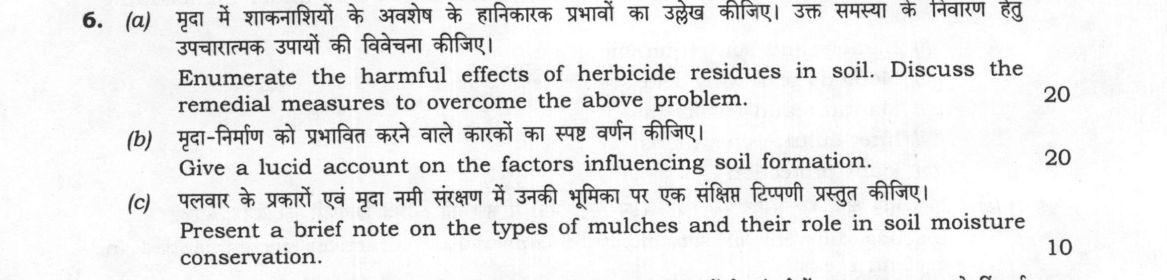
(a) Enumerate the harmful effects of herbicide residues in soil. Discuss the remedial measures to overcome the above problem. (20…
Enumerate the harmful effects of herbicide residues in soil. Discuss the remedial measures to overcome the above problem. 20 marks
Give a lucid account on the factors influencing soil formation. 20 marks
Present a brief note on the types of mulches and their role in soil moisture conservation. 10 marks
हिंदी में प्रश्न पढ़ें
मृदा में शाकनाशियों के अवशेष के हानिकारक प्रभावों का उल्लेख कीजिए। उक्त समस्या के निवारण हेतु उपचारात्मक उपायों की विवेचना कीजिए। (20 अंक)
मृदा-निर्माण को प्रभावित करने वाले कारकों का स्पष्ट वर्णन कीजिए। (20 अंक)
पलवार के प्रकारों एवं मृदा नमी संरक्षण में उनकी भूमिका पर एक संक्षिप्ट टिप्पणी प्रस्तुत कीजिए। (10 अंक)
Model answer
Written by UPSC Answer Check against this question's marking rubric, to the expected length. UPSC does not publish answers for Mains — this is one way to score well, not an official key.
Harmful Effects and Remediation of Herbicide Residues
Herbicide persistence in the soil matrix creates multifaceted ecological and agronomic challenges. The primary harmful effects are:
- Microbial Toxicity: Residues suppress beneficial soil bacteria and fungi, severely inhibiting biological nitrogen fixation and nitrification pathways.
- Carryover Phytotoxicity: Chemical persistence causes seedling injury or mortality in succeeding rotation crops, while persistent molecules bioaccumulate along trophic chains.
- Physicochemical Degradation: Herbicide complexes accelerate soil organic matter depletion and alter soil pH and cation exchange dynamics.
- Environmental Contamination: Runoff and leaching contaminate groundwater reserves and cause unintended toxicity to non-target edaphic fauna.
To overcome these problems, comprehensive remedial strategies include microbial bioaugmentation using catabolic bacterial strains such as Pseudomonas and Bacillus spp. for rapid biodegradation; phytoremediation utilizing hyperaccumulator plant species; adsorption through soil amendments with biochar and activated carbon to immobilize residues; the inclusion of tolerant crops within rotational cropping systems; and the adoption of Integrated Weed Management (IWM) to systematically minimize synthetic herbicide dependency.
Factors Influencing Soil Formation
Pedogenesis is governed by Hans Jenny’s state-factor equation, S = f(Cl, O, R, P, T):
- Climate (Cl): The active driver; precipitation dictates the intensity of leaching and eluviation, while temperature controls chemical weathering and organic matter decay rates.
- Organisms (O): Flora, fauna, and microflora drive humification, nitrogen fixation, nutrient cycling, and physical bioturbation.
- Topography/Relief (R): Slope gradient and aspect determine surface runoff, erosion intensity, drainage, and local microclimate.
- Parent Material (P): Igneous, sedimentary, or metamorphic lithology defines the initial chemical makeup, texture, and mineral matrix.
- Time (T): The chronological duration required for horizon differentiation and profile maturity.
Pedogenic processes represent continuous interactions among these factors. For instance, intense leaching under high precipitation and temperature on crystalline parent rocks yields laterite soils, whereas cool, humid climates interacting with coniferous vegetation and time drive podzolization. Similarly, young alluvial soils reflect the dominant interaction of topography, fluvial parent material, and short pedogenic time.
Mulches and Soil Moisture Conservation
Mulches are classified into two broad categories: organic mulches (paddy straw, crop residues, green manure, and compost) which gradually enrich soil organic carbon, and inorganic mulches (polyethylene plastic films including black, transparent, and biodegradable variants, as well as gravel and reflective sheets).
Mulches conserve moisture primarily by establishing a physical barrier that drastically curtails soil evaporation. They moderate diurnal soil temperature extremes to reduce atmospheric evaporative demand, enhance structural porosity to facilitate rainwater infiltration, and completely suppress weed emergence, thereby eliminating transpirational water loss. Deploying plasticulture in semi-arid and rainfed tracts under the Per Drop More Crop initiative remains vital for optimizing crop water-use efficiency and sustaining dryland agroecosystems.
What "Enumerate" is asking you to do
Produce the complete set of items asked for, countable and correctly named. The examiner marks against a checklist, so a missing item costs and an elaborated one gains nothing — where discussion is wanted the stem asks for it as a separate sub-part.
Structure that answers it
One line naming the basis on which the set is drawn → items numbered, each in a phrase or a single line → the discussion sub-part taken up separately, after the list is complete
Where marks are lost
Treating it as an essay. Six items named in six lines score better than three items explained at length.
How this answer will be evaluated
Approach
(a) discuss: intro > 3-4 dimensions > example > balanced close | (b) account for: state the phenomenon > the causes in order of weight > conclusion | (c) write short notes: define > 3-4 key features > one example > one-line significance Full marks: Comprehensive coverage of all points with specific examples and clear mechanisms.
Key points expected
- Effects on soil microbial activity
- Impact on plant growth and yield
- Bioaccumulation in food chain
- Remedial measures like bio-remediation
- Parent material (residual vs transported)
- Climate (temperature and rainfall effects)
- Topography (slope and drainage)
- Time (soil profile development)
Evaluation rubric
Each sub-part is marked on its own, against the marks and word limit printed on the paper.
- (a) List harmful effects of herbicide residues and discuss remedial measures. 20 marks
discuss— intro → 3-4 dimensions → example → balanced close
Must cover
- Effects on soil microbial activity
- Impact on plant growth and yield
- Bioaccumulation in food chain
- Remedial measures like bio-remediation
Loses marks
- Vague generalities without specific mechanisms
- Ignoring the remedial measures section
Earns more
- Specific herbicide examples (e.g., 2,4-D)
- Role of soil organic matter in degradation
- Regulatory limits (MRLs) in India
Extra mark
- Specific microbial species for degradation
- Recent Indian case study on contamination
- (b) Provide a lucid account of the factors influencing soil formation. 20 marks
account for— state the phenomenon → the causes in order of weight → conclusion
Must cover
- Parent material (residual vs transported)
- Climate (temperature and rainfall effects)
- Topography (slope and drainage)
- Time (soil profile development)
Loses marks
- Listing factors without explaining their influence
- Confusing soil formation with soil erosion
Earns more
- Role of biota (plants and microorganisms)
- Dobrovolsky's equation (S=f(P,C,O,R,T))
- Examples of Indian soil types (e.g., Alluvial)
Extra mark
- Specific Indian soil profile example
- Reference to specific pedogenic processes
- (c) Brief note on types of mulches and their role in soil moisture conservation. 10 marks
write short notes— define → 3-4 key features → one example → one-line significance
Must cover
- Types: Organic (straw, leaves) vs Inorganic (plastic)
- Mechanism: Reducing evaporation from soil surface
- Temperature moderation of soil profile
- Weed suppression benefits
Loses marks
- Confusing mulching with irrigation
- Ignoring the 'types' aspect of the question
Earns more
- Specific examples (e.g., rice straw, polyethylene)
- Impact on soil structure and aeration
Extra mark
- Quantitative data on moisture retention
- Specific Indian crop application (e.g., in vegetables)
Practice this exact question
Write your answer and it is marked point by point against the model answer above — what you covered, what you missed, what you got wrong.
Evaluate my answer →More from Agriculture 2025 Paper I
- Q3 (a) List out the cereal- and millet-based cropping systems practised in India based on so…
- Q4 (a) Explain the productive, protective, ameliorative, recreational, educational and devel…
- Q5 Answer the following questions in about 150 words each: (a) Explain saltation, surface cr…
- Q6 (a) Enumerate the harmful effects of herbicide residues in soil. Discuss the remedial mea…
- Q7 (a) Explain the term 'conjunctive use of water'. Suggest the management practices to impr…
- Q8 (a) Differentiate between partial and complete farm budget. Highlight the steps adopted w…