Paper I — Q5
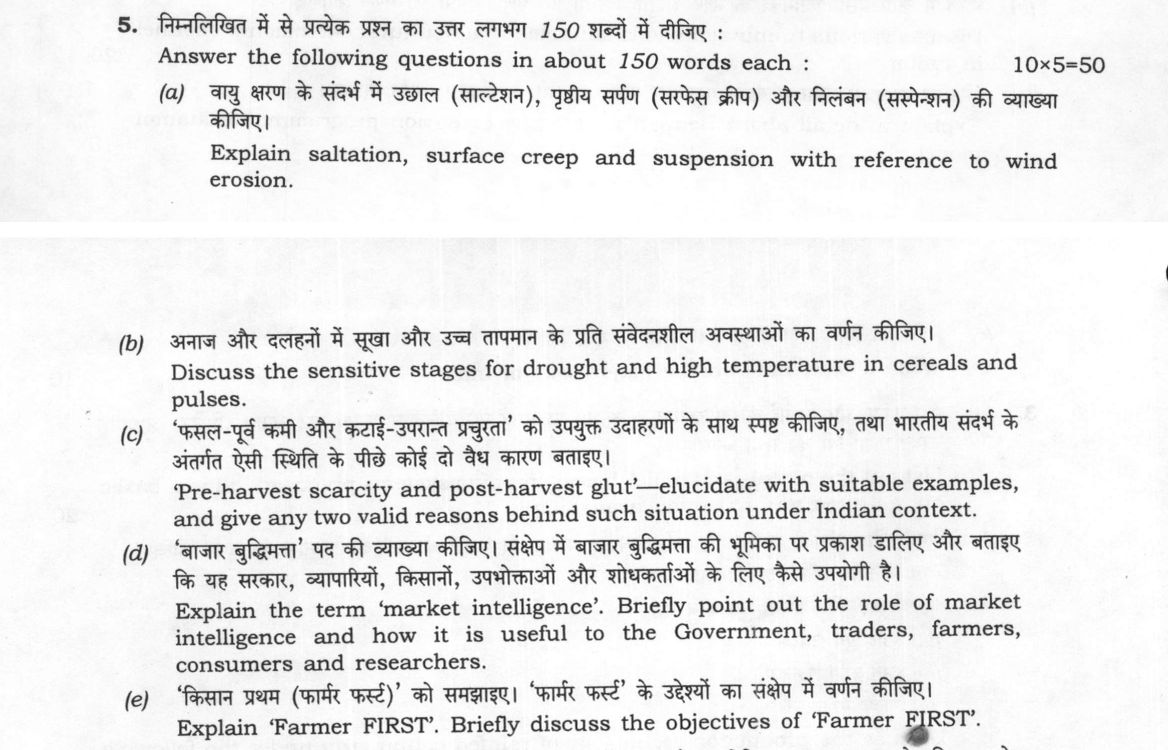
Answer the following questions in about 150 words each: (a) Explain saltation, surface creep and suspension with reference to…
Answer the following questions in about 150 words each:
Explain saltation, surface creep and suspension with reference to wind erosion. 10 marks
Discuss the sensitive stages for drought and high temperature in cereals and pulses. 10 marks
'Pre-harvest scarcity and post-harvest glut'—elucidate with suitable examples, and give any two valid reasons behind such situation under Indian context. 10 marks
Explain the term 'market intelligence'. Briefly point out the role of market intelligence and how it is useful to the Government, traders, farmers, consumers and researchers. 10 marks
Explain 'Farmer FIRST'. Briefly discuss the objectives of 'Farmer FIRST'. 10 marks
हिंदी में प्रश्न पढ़ें
निम्नलिखित में से प्रत्येक प्रश्न का उत्तर लगभग 150 शब्दों में दीजिए :
वायु क्षरण के संदर्भ में उछाल (साल्टेशन), पृष्ठीय सर्पण (सरफेस क्रीप) और निलंबन (सस्पेंशन) की व्याख्या कीजिए। (10 अंक)
अनाज और दलहनों में सूखा और उच्च तापमान के प्रति संवेदनशील अवस्थाओं का वर्णन कीजिए। (10 अंक)
'फसल-पूर्व कमी और कटाई-उपरांत प्रचुरता' को उपयुक्त उदाहरणों के साथ स्पष्ट कीजिए, तथा भारतीय संदर्भ के अंतर्गत ऐसी स्थिति के पीछे कोई दो वैध कारण बताइए। (10 अंक)
'बाजार बुद्धिमत्ता' पद की व्याख्या कीजिए। संक्षेप में बाजार बुद्धिमत्ता की भूमिका पर प्रकाश डालिए और बताइए कि यह सरकार, व्यापारियों, किसानों, उपभोक्ताओं और शोधकर्ताओं के लिए कैसे उपयोगी है। (10 अंक)
'किसान प्रथम (फार्मर फर्स्ट)' को समझाइए। 'फार्मर फर्स्ट' के उद्देश्यों का संक्षेप में वर्णन कीजिए। (10 अंक)
Model answer
Written by UPSC Answer Check against this question's marking rubric, to the 150-word length. UPSC does not publish answers for Mains — this is one way to score well, not an official key.
Wind Erosion Mechanisms Wind erosion operates through three distinct transport modes based on particle size. Saltation involves particles of 0.1–0.5 mm, which constitute 30–50% of total transport; these grains bounce along the surface, impacting soil and dislodging finer particles. Surface creep affects larger particles (0.5–2 mm), accounting for 5–25% of movement, where grains roll or slide due to the impact of saltating particles. Suspension carries the finest particles (<0.1 mm) into the atmosphere, enabling long-distance transport. In India, this process is critical in the Thar Desert and Rajasthan, where deflation removes topsoil, reducing agricultural productivity and causing dust storms that degrade air quality and soil fertility in downwind regions.
Drought and Heat Sensitivity Cereals and pulses exhibit specific physiological vulnerabilities to abiotic stress. In cereals like wheat and rice, the booting and anthesis stages are most sensitive to drought, as water deficit disrupts pollen development and grain set. High temperatures during meiosis and pollen development cause sterility, significantly reducing yield. For pulses, such as gram and arhar, the flowering and pod-filling stages are critical; heat stress during these phases leads to flower drop and poor seed filling. Understanding these sensitive windows allows for targeted interventions, such as timely irrigation or heat-tolerant varieties, to mitigate yield losses in climate-vulnerable Indian agriculture.
Pre-Harvest Scarcity and Post-Harvest Glut The paradox of "pre-harvest scarcity and post-harvest glut" describes the volatile price cycles in perishable commodities. For instance, onion prices spiked in 2019 due to supply constraints, only to crash post-harvest when the crop arrived in bulk. Similarly, tomato prices fluctuated drastically in 2023. Two primary reasons drive this in India: first, the high perishability of these crops limits storage options, forcing immediate sale upon harvest; second, speculative hoarding by intermediaries creates artificial scarcity pre-harvest, followed by a market flood when the hoarded stock is released alongside fresh produce, crashing prices and harming farmers.
Market Intelligence Market intelligence refers to the systematic collection and analysis of real-time data on prices, demand-supply dynamics, and trade flows. In India, platforms like AGMARKNET and eNAM provide this data, enabling stakeholders to make informed decisions. For the Government, it aids in formulating export-import policies and stabilizing prices through timely intervention. Traders use it to optimize logistics and minimize losses. Farmers benefit by identifying optimal times and locations for selling produce, ensuring better realization. Consumers gain from price transparency, while researchers utilize the data to model market trends and develop predictive tools for agricultural planning.
Farmer FIRST 'Farmer FIRST' stands for Farmer's First: Innovation, Research, Science and Technology. It is a paradigm shift introduced by ICAR in 2016 to align agricultural research with the actual needs of farmers. The core objective is to move away from technology-push models to a demand-driven approach. This involves participatory technology development, where farmers are active partners in the research process. By focusing on innovation diffusion and income enhancement, Farmer FIRST aims to ensure that scientific advancements are relevant, adoptable, and economically viable for the farming community, thereby bridging the gap between research stations and farm fields.
What "Explain" is asking you to do
Make the working of something clear — what sets it off, what follows from what, and what it produces. Explain is the Commission's mechanism word: it dominates the technical papers and the “explain why” stems, where the marks sit in the causal chain and not in the label.
Structure that answers it
State what it is → the initiating condition → the chain of cause, step by step → an instance where it plays out → what the chain produces
Where marks are lost
Describing what something looks like instead of why it works that way. Naming the stages without linking them reads as description too.
How this answer will be evaluated
Approach
Framework: Agricultural Science: Physical Processes, Crop Physiology, and Agri-Economics. (a) explain: definition/context > points in order > small example > short close | (b) discuss: intro > 3-4 dimensions > example > balanced close | (c) explain: definition/context > points in order > small example > short close | (d) explain: definition/context > points in order > small example > short close | (e) explain: definition/context > points in order > small example > short close Full marks: Precise definitions, specific examples, and clear distinction between concepts.
Key points expected
- Saltation vs Surface Creep vs Suspension
- Reproductive stage sensitivity in crops
- Seasonality and storage as causes of price volatility
- Stakeholder-specific utility of market intelligence
- Farmer-centric research paradigm shift
Evaluation rubric
Each sub-part is marked on its own, against the marks and word limit printed on the paper.
- (a) Define and distinguish the three modes of wind transport based on particle size and movement. 10 marks · 150 words
explain— definition/context → points in order → small example → short close
Must cover
- Saltation: bouncing movement of medium particles
- Surface creep: rolling/sliding of larger particles
- Suspension: fine particles carried high in air
- Link each mode to specific particle size range
Loses marks
- Confusing saltation with surface creep
- Ignoring the role of wind velocity
Earns more
- Mention of 'deflation' as the overall process
- Reference to 'loess' or 'dust storms' for suspension
- Mention of 'sand dunes' for saltation
Extra mark
- Diagrammatic representation of the three zones
- Specific particle size ranges (e.g., <0.05mm for suspension)
- (b) Identify specific growth stages in cereals and pulses where drought/heat causes maximum yield loss. 10 marks · 150 words
discuss— intro → 3-4 dimensions → example → balanced close
Must cover
- Cereals: Reproductive stages (booting, flowering, grain filling)
- Pulses: Flowering and pod formation stages
- Mechanism: Heat stress on pollen viability
- Mechanism: Drought stress on grain filling
Loses marks
- Vague references to 'growth period' without specific stages
- Ignoring the difference between cereals and pulses
Earns more
- Mention of 'terminal heat stress' in wheat
- Reference to 'shattering' in pulses due to heat
- Distinction between drought and heat sensitivity
Extra mark
- Specific temperature thresholds (e.g., >35°C for wheat)
- Mention of 'vernalization' sensitivity in cereals
- (c) Explain the paradox of pre-harvest shortage and post-harvest surplus with Indian examples and reasons. 10 marks · 150 words
explain— definition/context → points in order → small example → short close
Must cover
- Definition of 'pre-harvest scarcity' (high prices)
- Definition of 'post-harvest glut' (price crash)
- Reason 1: Seasonality of production (monsoon dependence)
- Reason 2: Inadequate storage infrastructure (cold chain)
Loses marks
- Failing to provide two distinct reasons
- Ignoring the 'Indian context' requirement
Earns more
- Example: Onion or Potato price volatility
- Mention of 'hoarding' or 'speculation' as a factor
- Reference to 'buffer stock' policy
Extra mark
- Mention of 'e-NAM' as a solution
- Reference to specific year of onion crisis
- (d) Define market intelligence and detail its utility for five specific stakeholders. 10 marks · 150 words
explain— definition/context → points in order → small example → short close
Must cover
- Definition: Systematic collection/analysis of market data
- Utility for Government: Policy formulation (MSP, subsidies)
- Utility for Farmers: Price prediction, crop planning
- Utility for Traders: Inventory management, risk mitigation
Loses marks
- Missing any of the five stakeholders
- Vague utility descriptions (e.g., 'helps everyone')
Earns more
- Utility for Consumers: Price transparency, choice
- Utility for Researchers: Trend analysis, R&D direction
- Mention of 'e-NAM' or 'Agmarknet' as tools
Extra mark
- Mention of 'Big Data' or 'AI' in market intelligence
- Reference to 'Market Intelligence Cell' (MIC)
- (e) Define 'Farmer FIRST' and list its specific objectives. 10 marks · 150 words
explain— definition/context → points in order → small example → short close
Must cover
- Definition: Farmer First, Research Second (policy shift)
- Objective 1: Farmer-centric research priorities
- Objective 2: Technology transfer to farmers
- Objective 3: Addressing farmer needs (income, risk)
Loses marks
- Confusing with 'Farmer First' (spelling)
- Listing generic agricultural goals instead of specific objectives
Earns more
- Mention of 'ICAR' or 'Agricultural Universities' role
- Reference to 'Farmer Producer Organizations' (FPOs)
- Mention of 'extension services' improvement
Extra mark
- Reference to specific 'Farmer FIRST' policy document
- Mention of 'participatory research' models
Practice this exact question
Write your answer and it is marked point by point against the model answer above — what you covered, what you missed, what you got wrong.
Evaluate my answer →More from Agriculture 2025 Paper I
- Q2 (a) Enumerate the impact of climate change with reference to agricultural production. Pre…
- Q3 (a) List out the cereal- and millet-based cropping systems practised in India based on so…
- Q4 (a) Explain the productive, protective, ameliorative, recreational, educational and devel…
- Q5 Answer the following questions in about 150 words each: (a) Explain saltation, surface cr…
- Q6 (a) Enumerate the harmful effects of herbicide residues in soil. Discuss the remedial mea…
- Q7 (a) Explain the term 'conjunctive use of water'. Suggest the management practices to impr…
- Q8 (a) Differentiate between partial and complete farm budget. Highlight the steps adopted w…