Paper I — Q2
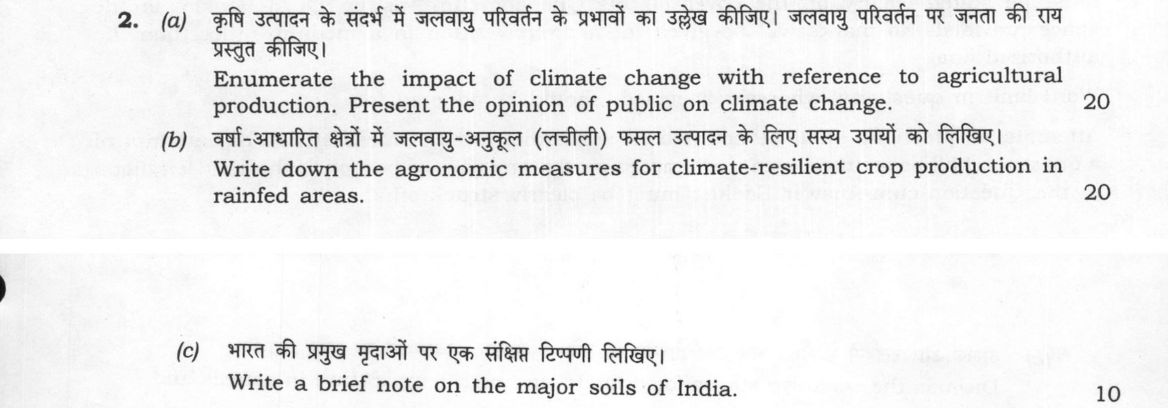
(a) Enumerate the impact of climate change with reference to agricultural production. Present the opinion of public on climate…
Enumerate the impact of climate change with reference to agricultural production. Present the opinion of public on climate change. 20 marks
Write down the agronomic measures for climate-resilient crop production in rainfed areas. 20 marks
Write a brief note on the major soils of India. 10 marks
हिंदी में प्रश्न पढ़ें
कृषि उत्पादन के संदर्भ में जलवायु परिवर्तन के प्रभावों का उल्लेख कीजिए। जलवायु परिवर्तन पर जनता की राय प्रस्तुत कीजिए। (20 अंक)
वर्षा-आधारित क्षेत्रों में जलवायु-अनुकूल (लचीली) फसल उत्पादन के लिए सस्य उपायों को लिखिए। (20 अंक)
भारत की प्रमुख मृदाओं पर एक संक्षिप्त टिप्पणी लिखिए। (10 अंक)
Model answer
Written by UPSC Answer Check against this question's marking rubric, to the expected length. UPSC does not publish answers for Mains — this is one way to score well, not an official key.
Climate change is fundamentally altering India’s agricultural landscape, posing existential threats to food security and rural livelihoods.
Impacts of Climate Change on Agriculture The biophysical impacts are severe and multifaceted. Rising temperatures and erratic monsoon patterns have led to significant yield reductions in staple crops like wheat and rice. Heat stress in the Indo-Gangetic plains and the Deccan region is particularly detrimental, affecting grain filling and quality. Concurrently, shifting pest and disease dynamics, such as the spread of fall armyworm and rice blast, are exacerbated by warmer winters. Water stress is intensifying due to glacial retreat in the Himalayas and declining groundwater levels, while extreme events like floods and droughts cause sudden, catastrophic losses.
Economically, these biophysical shocks translate into price volatility and farm income loss. Small and marginal farmers, who constitute the majority of India’s agricultural workforce, are disproportionately affected, leading to increased rural distress.
Public opinion on climate change in India is nuanced. Surveys by the Centre for Science and Environment (CSE) and the Yale Program on Climate Change Communication indicate a high level of awareness regarding environmental degradation. However, there is a distinct gap between abstract risk perception and lived experience. Many farmers exhibit a form of "climate skepticism" not due to denial of science, but because their immediate concerns are local and immediate—such as the failure of a specific monsoon or a heat wave—rather than global trends. In regions like the Deccan, the lived experience of erratic rainfall has made adaptation a survival imperative, yet knowledge gaps persist regarding long-term mitigation strategies.
Agronomic Measures for Climate-Resilient Rainfed Production In rainfed areas, which cover about 55% of India’s cultivated land, agronomic interventions must focus on moisture conservation and stress tolerance.
First, moisture conservation practices are critical. These include contour bunding, terracing, and mulching to reduce runoff and evaporation. Residue management, such as retaining crop stubble, helps retain soil moisture and improve organic matter.
Second, the adoption of drought-tolerant and heat-resistant varieties is essential. The International Crops Research Institute for the Semi-Arid Tropics (ICRISAT) has developed high-yielding millet varieties (like foxtail and finger millet) that thrive in low-rainfall conditions. Similarly, the Sahbhagi dhan variety has been promoted for its tolerance to waterlogging and heat in the eastern plains.
Third, cropping system adjustments play a vital role. Intercropping legumes with cereals improves soil health and diversifies income. Contingency cropping plans, such as shifting to short-duration varieties during delayed monsoon onset, mitigate risk.
Fourth, integrative agronomic practices like agroforestry help stabilize microclimates and provide alternative income sources. Precision water application techniques, such as drip irrigation, ensure efficient use of scarce water resources. While institutional support through schemes like the Pradhan Mantri Krishi Sinchayee Yojana (PMKSY) facilitates infrastructure, the on-farm agronomic focus remains on optimizing biological and physical inputs to enhance resilience.
Major Soils of India India’s soil diversity is vast, classified into several major groups. Alluvial soils dominate the Indo-Gangetic plains, known for their fertility but prone to waterlogging. Black cotton soils (Vertisols) of the Deccan plateau are deep and clayey, ideal for cotton but susceptible to cracking. Red and yellow soils (Ultisols/Alfisols) are found in the Eastern and Western Ghats, often deficient in nitrogen and phosphorus. Arid soils (Aridisols) in the Thar desert are saline and low in organic matter.
Other significant groups include Mountain soils, which are young and acidic, found in the Himalayas; Saline and alkaline soils, prevalent in coastal and arid regions; and Peaty and marshy soils, found in the deltas of the Ganga and Brahmaputra.
The soil-climate nexus is crucial. According to the National Bureau of Soil Health and Land Use Planning (NBSS&LUP), a significant portion of India’s land is degraded, reducing its carbon sequestration potential. ISRO’s Desertification and Land Degradation Atlas (2016) estimates that approximately 29.32% of India’s land is degraded. Different soil types have varying vulnerabilities; for instance, alluvial soils are prone to erosion during extreme rainfall, while arid soils are vulnerable to salinization due to rising sea levels and groundwater tables.
Conclusion Addressing climate change in agriculture requires a holistic approach that integrates biophysical adaptation with socio-economic resilience. By prioritizing moisture-conserving agronomic practices, adopting stress-tolerant varieties, and managing soil health, India can build a robust agricultural system capable of withstanding the shocks of a changing climate.
What "Enumerate" is asking you to do
Produce the complete set of items asked for, countable and correctly named. The examiner marks against a checklist, so a missing item costs and an elaborated one gains nothing — where discussion is wanted the stem asks for it as a separate sub-part.
Structure that answers it
One line naming the basis on which the set is drawn → items numbered, each in a phrase or a single line → the discussion sub-part taken up separately, after the list is complete
Where marks are lost
Treating it as an essay. Six items named in six lines score better than three items explained at length.
How this answer will be evaluated
Approach
Framework: Concept > Practice or process > Data > Indian application. (a) enumerate: list the items in order > one line each > no commentary | (b) suggest: the problem in one line > implementable measures > who acts > conclusion | (c) write short notes: define > 3-4 key features > one example > one-line significance Full marks: Comprehensive, specific, and well-structured answers with named examples and data.
Key points expected
- Impacts on crop yield and phenology
- Shifts in pest and disease patterns
- Water stress and irrigation demand
- Summary of public perception/opinion
- Water conservation techniques (e.g., mulching, contour bunding)
- Drought-tolerant varieties or cultivars
- Soil health management (organic matter, cover crops)
- Staggered sowing or intercropping strategies
Evaluation rubric
Each sub-part is marked on its own, against the marks and word limit printed on the paper.
- (a) List impacts of climate change on agriculture and summarize public opinion. 20 marks
enumerate— list the items in order → one line each → no commentary
Must cover
- Impacts on crop yield and phenology
- Shifts in pest and disease patterns
- Water stress and irrigation demand
- Summary of public perception/opinion
Loses marks
- Vague generalities without specific agricultural links
- Ignoring the 'public opinion' component
Earns more
- Specific data on temperature/rainfall shifts
- Reference to specific crops (e.g., rice, wheat)
- Mention of economic impact on farmers
Extra mark
- Citing a specific IPCC report or study
- Mentioning a specific public survey or poll
- (b) List agronomic measures for climate-resilient crop production in rainfed areas. 20 marks
suggest— the problem in one line → implementable measures → who acts → conclusion
Must cover
- Water conservation techniques (e.g., mulching, contour bunding)
- Drought-tolerant varieties or cultivars
- Soil health management (organic matter, cover crops)
- Staggered sowing or intercropping strategies
Loses marks
- Generic advice not specific to rainfed areas
- Focusing only on irrigation (which is not rainfed)
Earns more
- Specific named varieties (e.g., drought-tolerant sorghum)
- Mention of specific government schemes (e.g., PM-KISAN)
- Details on spacing or dosage for specific crops
Extra mark
- Reference to a specific state's rainfed agriculture policy
- Mention of a specific research institute (e.g., ICAR-SSSA)
- (c) Provide a brief note on the major soils of India. 10 marks
write short notes— define → 3-4 key features → one example → one-line significance
Must cover
- Identification of major soil types (e.g., Alluvial, Black, Red)
- Key characteristics of each type
- Geographical distribution of major types
- Agricultural suitability of each type
Loses marks
- Listing soil types without characteristics
- Ignoring geographical distribution
Earns more
- Mention of specific crops suited to specific soils
- Reference to soil erosion or degradation issues
Extra mark
- Mention of a specific soil survey or map
- Reference to a specific soil conservation technique
Practice this exact question
Write your answer and it is marked point by point against the model answer above — what you covered, what you missed, what you got wrong.
Evaluate my answer →More from Agriculture 2025 Paper I
- Q1 Answer the following questions in about 150 words each: (a) Classify natural resources. D…
- Q2 (a) Enumerate the impact of climate change with reference to agricultural production. Pre…
- Q3 (a) List out the cereal- and millet-based cropping systems practised in India based on so…
- Q4 (a) Explain the productive, protective, ameliorative, recreational, educational and devel…
- Q5 Answer the following questions in about 150 words each: (a) Explain saltation, surface cr…