Paper I — Q7
(a) Explain the term 'conjunctive use of water'. Suggest the management practices to improve poor quality irrigation water with…
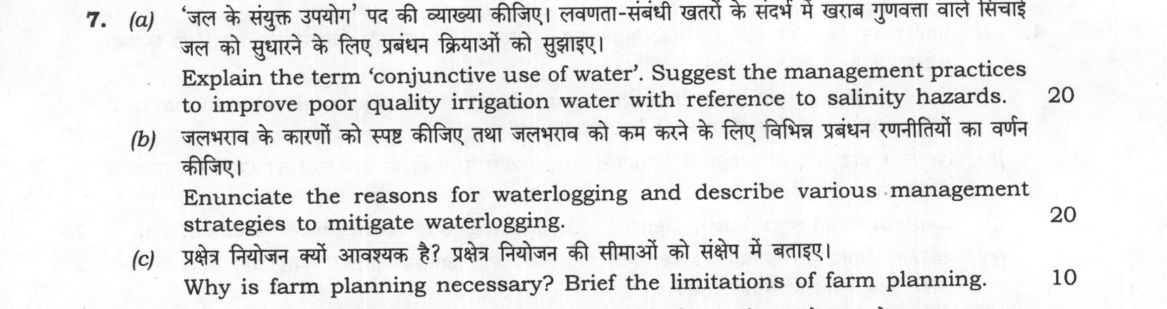
Explain the term 'conjunctive use of water'. Suggest the management practices to improve poor quality irrigation water with reference to salinity hazards. 20 marks
Enunciate the reasons for waterlogging and describe various management strategies to mitigate waterlogging. 20 marks
Why is farm planning necessary? Brief the limitations of farm planning. 10 marks
हिंदी में प्रश्न पढ़ें
'जल के संयुक्त उपयोग' पद की व्याख्या कीजिए। लवणता-संबंधी खतरों के संदर्भ में खराब गुणवत्ता वाले सिंचाई जल को सुधारने के लिए प्रबंधन क्रियाओं को सुझाइए। (20 अंक)
जलभराव के कारणों को स्पष्ट कीजिए तथा जलभराव को कम करने के लिए विभिन्न प्रबंधन रणनीतियों का वर्णन कीजिए। (20 अंक)
प्रक्षेत्र नियोजन क्यों आवश्यक है? प्रक्षेत्र नियोजन की सीमाओं को संक्षेप में बताइए। (10 अंक)
Model answer
Written by UPSC Answer Check against this question's marking rubric, to the expected length. UPSC does not publish answers for Mains — this is one way to score well, not an official key.
Conjunctive Use and Salinity Management
Conjunctive use of water refers to the planned, coordinated exploitation of surface and groundwater reservoirs to optimize water supply, mitigate seasonal deficits, and prevent hydrologic imbalances like waterlogging and salinization. Irrigation water quality deteriorates due to high Electrical Conductivity (EC, causing osmotic stress and physiological drought), high Sodium Adsorption Ratio (SAR, causing soil dispersion and crusting), and elevated Residual Sodium Carbonate (RSC, precipitating calcium and raising pH).
Managing such poor-quality water relies on systematic dilution and amelioration:
- Blending saline groundwater with canal water reduces total EC and SAR before application, whereas cyclic use deploys good-quality canal water during sensitive germination stages and poorer water during later vegetative phases.
- Leaching requirement (LR) must be satisfied through calculated over-irrigation to flush salts below the root zone, complemented by organic mulching to arrest capillary rise and evaporative salt deposition.
- Amelioration of high RSC/sodic water requires gypsum application to substitute exchangeable sodium with calcium, combined with organic amendments (FYM, pressmud) to improve soil aggregation.
- High-frequency drip irrigation maintains high matric potential, diluting soil solution salts, while subsurface drainage and cultivating salt-tolerant cultivars (e.g., KRL-210 wheat, CSR mustard developed by ICAR-CSSRI) ensure sustained crop productivity.
Waterlogging: Causes and Mitigation
Waterlogging occurs when the groundwater table rises into the crop root zone, saturating soil pores, driving out oxygen, and inducing root asphyxiation and denitrification. Natural causes include heavy precipitation, riverine backwater flooding, poor natural gradients, and subsurface impermeable clay or kankar pans. Anthropogenic causes include extensive seepage from unlined canals (as observed in the Indira Gandhi Canal command), over-irrigation, obstruction of natural drainage pathways by infrastructure, and lack of field drainage.
Mitigation strategies combine preventive and curative measures:
- Preventive strategies focus on canal lining to eliminate seepage, adopting precision micro-irrigation to avert deep percolation, and scheduling irrigation based on soil-moisture deficits.
- Curative strategies involve surface drains to evacuate storm runoff and horizontal subsurface drainage (perforated corrugated PVC tile drains) to de-saturate root zones and evacuate saline effluent.
- Vertical drainage through operational tubewells dynamically lowers the water table while yielding water for conjunctive use.
- Bio-drainage utilizes deep-rooted, high-transpiration vegetation (e.g., Eucalyptus tereticornis, Casuarina) along canal banks to bio-pump shallow groundwater.
Farm Planning: Necessity and Limitations
Farm planning is an advance operational blueprint that systematically allocates scarce farm resources (land, labour, capital, and water) across enterprises. It is necessary to optimize input-use efficiency, minimize climatic and market risks through enterprise diversification, ensure sustainable land intensification, and align cropping patterns with agro-ecological capacity and local water availability.
However, farm planning in India is constrained by:
- Structural constraints, primarily severe land fragmentation and shrinking operational holdings (averaging ~1.08 ha), which restrict scale economies.
- Resource and capital limitations that impede investment in modern micro-irrigation and tile drainage infrastructure.
- Environmental and market uncertainties, including erratic monsoon patterns and farm-gate price volatility, which disrupt predetermined enterprise plans.
- Inadequate access to reliable, real-time agro-meteorological forecasts and customized farm-level extension advisory.
Integrating farm-level planning with regional conjunctive water use and drainage management provides the necessary operational pathway for climate-resilient agriculture in degraded canal commands.
What "Explain" is asking you to do
Make the working of something clear — what sets it off, what follows from what, and what it produces. Explain is the Commission's mechanism word: it dominates the technical papers and the “explain why” stems, where the marks sit in the causal chain and not in the label.
Structure that answers it
State what it is → the initiating condition → the chain of cause, step by step → an instance where it plays out → what the chain produces
Where marks are lost
Describing what something looks like instead of why it works that way. Naming the stages without linking them reads as description too.
How this answer will be evaluated
Approach
Framework: Concept > Practice or process > Data > Indian application. (a) explain: definition/context > points in order > small example > short close | (b) describe: define > structure or process in order > labelled diagram > significance | (c) justify: claim > 3-4 reasons > evidence > conclusion Full marks: Comprehensive coverage of all parts with specific examples, data, and Indian applications
Key points expected
- Definition of conjunctive use of water
- Management practices for salinity hazards
- Reference to salinity hazards
- Specific irrigation water quality improvement
- Reasons for waterlogging
- Management strategies to mitigate waterlogging
- Description of various strategies
- Linkage between causes and mitigation
Evaluation rubric
Each sub-part is marked on its own, against the marks and word limit printed on the paper.
- (a) Define conjunctive use and detail management practices for saline irrigation water. 20 marks
explain— definition/context → points in order → small example → short close
Must cover
- Definition of conjunctive use of water
- Management practices for salinity hazards
- Reference to salinity hazards
- Specific irrigation water quality improvement
Loses marks
- Vague agronomic advice without specific practices
- Ignoring the salinity hazard aspect
- Confusing conjunctive use with just water conservation
Earns more
- Mention of specific salinity indices (EC, SAR)
- Reference to drainage systems
- Mention of specific crops tolerant to salinity
- Reference to soil testing
Extra mark
- Mention of specific Indian schemes for water management
- Reference to specific soil types affected by salinity
- (b) List reasons for waterlogging and describe management strategies to mitigate it. 20 marks
describe— define → structure or process in order → labelled diagram → significance
Must cover
- Reasons for waterlogging
- Management strategies to mitigate waterlogging
- Description of various strategies
- Linkage between causes and mitigation
Loses marks
- Listing reasons without corresponding mitigation strategies
- Vague management strategies without specific techniques
- Ignoring the 'various' aspect by giving only one strategy
Earns more
- Mention of specific drainage methods
- Reference to crop selection for waterlogged soils
- Mention of land leveling techniques
- Reference to specific Indian regions with waterlogging
Extra mark
- Mention of specific government schemes for drainage
- Reference to specific soil types prone to waterlogging
- (c) Explain why farm planning is necessary and brief its limitations. 10 marks
justify— claim → 3-4 reasons → evidence → conclusion
Must cover
- Necessity of farm planning
- Limitations of farm planning
- Brief explanation of both aspects
- Balanced view of planning
Loses marks
- Only discussing necessity without limitations
- Only discussing limitations without necessity
- Vague statements without specific examples
Earns more
- Mention of specific benefits of farm planning
- Reference to specific limitations like data availability
- Mention of economic factors in planning
- Reference to specific Indian farming contexts
Extra mark
- Mention of specific farm planning tools or models
- Reference to specific government initiatives for farm planning
Practice this exact question
Write your answer and it is marked point by point against the model answer above — what you covered, what you missed, what you got wrong.
Evaluate my answer →More from Agriculture 2025 Paper I
- Q4 (a) Explain the productive, protective, ameliorative, recreational, educational and devel…
- Q5 Answer the following questions in about 150 words each: (a) Explain saltation, surface cr…
- Q6 (a) Enumerate the harmful effects of herbicide residues in soil. Discuss the remedial mea…
- Q7 (a) Explain the term 'conjunctive use of water'. Suggest the management practices to impr…
- Q8 (a) Differentiate between partial and complete farm budget. Highlight the steps adopted w…