Paper II — Q1
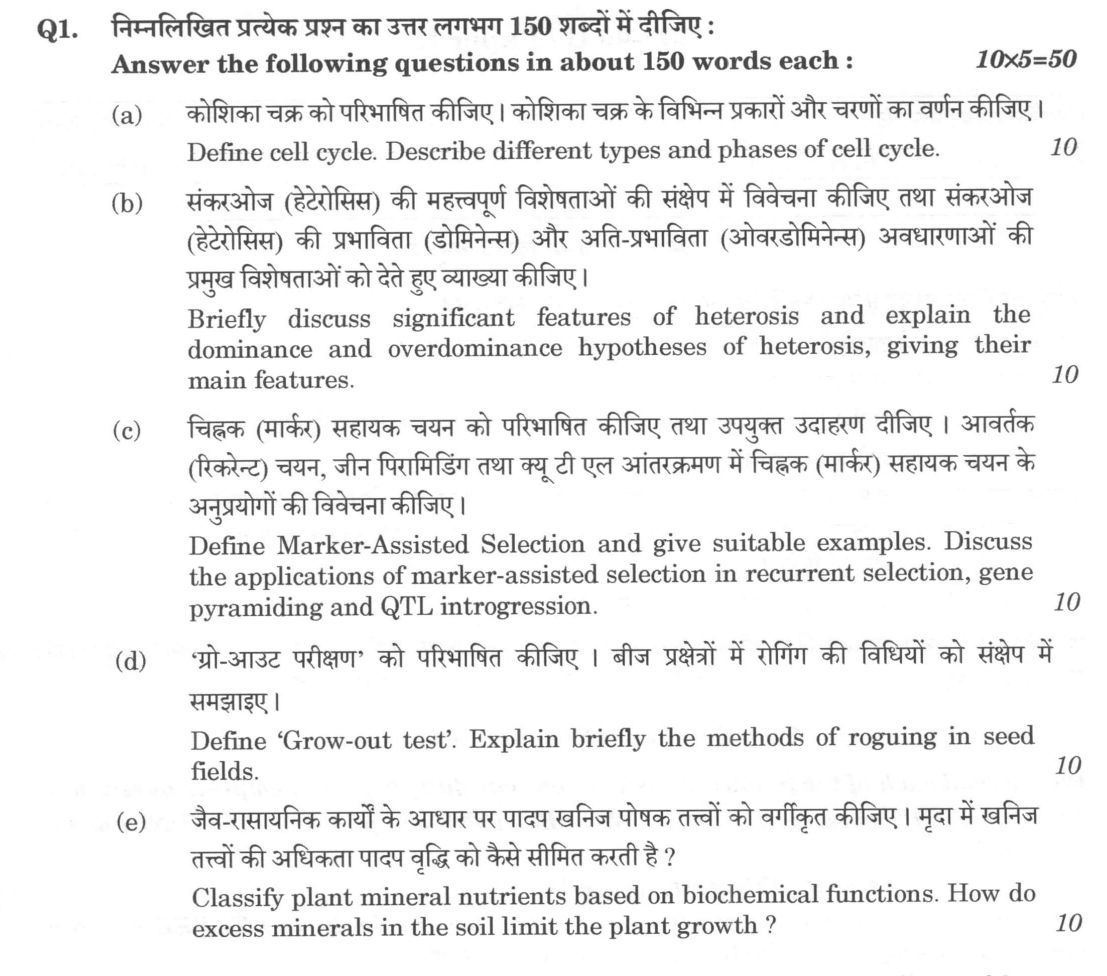
Answer the following questions in about 150 words each: (a) Define cell cycle. Describe different types and phases of cell…
Answer the following questions in about 150 words each:
Define cell cycle. Describe different types and phases of cell cycle. 10 marks
Briefly discuss significant features of heterosis and explain the dominance and overdominance hypotheses of heterosis, giving their main features. 10 marks
Define Marker-Assisted Selection and give suitable examples. Discuss the applications of marker-assisted selection in recurrent selection, gene pyramiding and QTL introgression. 10 marks
Define 'Grow-out test'. Explain briefly the methods of roguing in seed fields. 10 marks
Classify plant mineral nutrients based on biochemical functions. How do excess minerals in the soil limit the plant growth? 10 marks
हिंदी में प्रश्न पढ़ें
निम्नलिखित प्रत्येक प्रश्न का उत्तर लगभग 150 शब्दों में दीजिए :
कोशिका चक्र को परिभाषित कीजिए। कोशिका चक्र के विभिन्न प्रकारों और चरणों का वर्णन कीजिए। (10 अंक)
संकरओज (हेटेरोसिस) की महत्वपूर्ण विशेषताओं की संक्षेप में विवेचना कीजिए तथा संकरओज (हेटेरोसिस) की प्रभाविता (डोमिनेंस) और अति-प्रभाविता (ओवरडोमिनेंस) अवधारणाओं की प्रमुख विशेषताओं को देते हुए व्याख्या कीजिए। (10 अंक)
चिह्नक (मार्कर) सहायक चयन को परिभाषित कीजिए तथा उपयुक्त उदाहरण दीजिए। आवर्तक (रिकरेंट) चयन, जीन पिरामिडिंग तथा क्यू टी एल अंतर्क्रमण में चिह्नक (मार्कर) सहायक चयन के अनुप्रयोगों की विवेचना कीजिए। (10 अंक)
'ग्रो-आउट परीक्षण' को परिभाषित कीजिए। बीज प्रक्षेत्रों में रोगिंग की विधियों को संक्षेप में समझाइए। (10 अंक)
जैव-रासायनिक कार्यों के आधार पर पादप खनिज पोषक तत्वों को वर्गीकृत कीजिए। मृदा में खनिज तत्वों की अधिकता पादप वृद्धि को कैसे सीमित करती है ? (10 अंक)
Model answer
Written by UPSC Answer Check against this question's marking rubric, to the 150-word length. UPSC does not publish answers for Mains — this is one way to score well, not an official key.
(a) Cell Cycle
The cell cycle is the genetically controlled, ordered sequence of cellular events involving genome duplication, macromolecular synthesis, and division into daughter cells.
Types of Cell Cycle: The mitotic cell cycle occurs in somatic tissues to enable growth, repair, and asexual reproduction, producing two genetically identical diploid daughter cells. The meiotic cell cycle occurs in specialised reproductive germ cells and comprises two successive divisions following a single round of DNA replication, yielding four genetically distinct haploid gametes.
Phases of the Cell Cycle: The cycle alternates between Interphase and the M (Mitotic/Meiotic) phase. Interphase consists of Gap 1 (G₁), where active synthesis of RNA, enzymes, and structural proteins occurs; the Synthesis (S) phase, characterized by nuclear DNA replication and centrosome duplication; and Gap 2 (G₂), where proteins necessary for spindle apparatus assembly, such as tubulin, are synthesised. Cells that exit active division enter the quiescent, non-dividing G₀ phase. The M phase executes nuclear division (prophase, metaphase, anaphase, telophase) followed by cytokinesis. Transition across these phases is strictly regulated at three primary checkpoints—G₁/S, G₂/M, and the Spindle Assembly Checkpoint—mediated by Cyclin-Dependent Kinases (CDKs) to maintain genomic stability.
(b) Heterosis and its Genetic Hypotheses
Heterosis, or hybrid vigour, describes the phenotypic superiority of an F₁ hybrid over its parental inbreds in terms of economic yield, biomass, growth rate, reproductive fitness, and tolerance to biotic and abiotic stresses. Its primary features include enhanced physiological efficiency, greater developmental homeostasis, increased enzymatic activity, and wider environmental adaptability.
Dominance Hypothesis: Formulated by Bruce (1910) and Davenport (1908) and extended by Keeble and Pellew, this hypothesis attributes hybrid vigour to the cumulative action of favourable dominant alleles that mask deleterious, vigour-reducing recessive alleles present in the parental inbreds. Under this model, vigour genes are dominant and linked across loci. While the hypothesis predicts that fully homozygous inbreds possessing all favourable dominant genes can theoretically equal F₁ vigour, complete recovery is prevented by tight repulsive linkages.
Overdominance Hypothesis: Proposed independently by East (1908) and Shull (1908), this model asserts that the heterozygous state per se (A_1A₂) at a single locus is physiologically superior to either of the corresponding homozygous conditions (A_1A₁ or A_2A₂). This superiority arises from complementary allelic products, alternate metabolic pathways, or improved enzyme kinetics in heterozygotes. Unlike the dominance hypothesis, heterosis under overdominance cannot be fixed in a homozygous true-breeding line.
(c) Marker-Assisted Selection (MAS)
Marker-Assisted Selection (MAS) is an indirect selection method wherein target traits are selected based on molecular DNA markers (such as SSRs, Indels, or SNPs) tightly linked to the genes or Quantitative Trait Loci (QTLs) of interest, rather than relying solely on phenotypic evaluation. For instance, MAS using SSR markers enabled the breeding of Improved Pusa Basmati 1 by introgressing bacterial blight resistance genes.
Applications of MAS: In Marker-Assisted Recurrent Selection (MARS), molecular markers distributed across the genome are used across successive recombination cycles to accumulate favourable polygenic alleles in breeding populations without multi-location phenotypic trials at every cycle.
In Gene Pyramiding, MAS enables the simultaneous stacking of multiple non-allelic genes conferring resistance to distinct pathogen races or abiotic stresses into a single agronomic background. Because phenotyping cannot distinguish between single and stacked resistance genes, markers targeting specific loci (such as combining Xa21, xa13, and Xa5 for durable bacterial blight resistance in rice) are essential.
In QTL Introgression, MAS facilitates the transfer of genomic segments controlling complex quantitative traits from unadapted wild relatives or landraces into elite cultivars while minimizing linkage drag (e.g., introgression of the flood-tolerance Sub1A QTL into the mega-variety Swarna).
(d) Grow-Out Test and Roguing in Seed Production
A Grow-out Test (GOT) is an official field-testing procedure designed to assess the genetic purity and varietal identity of a given seed lot by cultivating representative plant samples to maturity and evaluating distinctive morphological and phenological traits against an authentic control sample.
Methods of Roguing: Roguing is the systematic identification and physical uprooting of off-types (plants deviating from established varietal descriptors), diseased plants, and objectionable weed species from seed production plots.
At the Vegetative Stage, plants exhibiting abnormal vigour, divergent leaf shape, atypical foliage colour, anthocyanin pigmentation, or growth habit are identified and removed along with invasive weed competitors.
At the Pre-Flowering and Flowering Stage, roguing focuses on eliminating plants showing variations in days to heading, floral architecture, panicle/tassel morphology, anther colour, or male sterility prior to anthesis to prevent pollen contamination in seed crops.
At the Maturity/Pre-Harvest Stage, roguing targets variants showing deviations in maturity duration, glume pigmentation, earhead/pod shape, grain characteristics, and seed-borne pathological infections such as loose smut. Strict execution ensures compliance with Indian Minimum Seed Certification Standards, which prescribe maximum permissible off-type limits (typically ≤ 0.05% in Foundation seed and ≤ 0.10% in Certified seed).
(e) Biochemical Classification of Plant Nutrients and Mineral Toxicity
Based on biochemical functions and assimilation pathways (Mengel and Kirkby classification), essential mineral elements are grouped into four categories: Group 1 comprises Nitrogen and Sulphur, which are integrated into carbon compounds, forming amino acids, proteins, nucleic acids, and coenzymes. Group 2 includes Phosphorus, Boron, and Silicon, functioning in esterification, structural integrity of cell walls, and high-energy phosphate transfer (ATP). Group 3 consists of Potassium, Calcium, Magnesium, Manganese, Sodium, and Chlorine, existing in ionic form to govern osmoregulation, enzyme activation, and membrane permeability. Group 4 contains Iron, Copper, Zinc, Molybdenum, and Nickel, functioning as prosthetic groups in electron transport systems and oxidation-reduction metalloenzymes.
Growth Limitation by Excess Soil Minerals: Excessive mineral concentrations suppress plant growth through three primary mechanisms. First, excessive soluble salts decrease soil water potential, inducing physiological drought and osmotic stress that restrict root water and nutrient uptake. Second, specific ion toxicity (e.g., excessive Na⁺, Cl⁻, or Al³⁺) damages cellular membranes, disrupts cytosolic enzyme activities, and causes foliar necrosis. Third, mineral excess induces competitive nutrient antagonisms (e.g., excess K⁺ inhibits Mg²⁺ and Ca²⁺ uptake; high P precipitates Zn²⁺ and Fe²⁺ into insoluble complexes), leading to severe secondary nutritional deficiencies.
What "Describe" is asking you to do
Give a full, ordered account of the thing named — its parts, stages or mechanism — in the sequence in which it actually exists or occurs. Most describe questions come from the science optionals, where the marks sit in correct technical detail and, where the stem says so, a labelled diagram.
Structure that answers it
One-line identification of the subject → the parts or stages in their real order, each with its defining detail → labelled diagram where the subject is structural → closing line on function or significance
Where marks are lost
Loose general prose where the examiner is ticking named parts, correct terminology and their sequence; and in the General Studies papers, turning to evaluation before the description is finished.
How this answer will be evaluated
Approach
(a) describe: define > structure or process in order > labelled diagram > significance | (b) discuss: intro > 3-4 dimensions > example > balanced close | (c) discuss: intro > 3-4 dimensions > example > balanced close | (d) explain: definition/context > points in order > small example > short close | (e) highlight: name the salient points > one line of substance each > close Full marks: Precise definitions, clear distinction between concepts, specific examples, and logical flow.
Key points expected
- Precise definition of cell cycle
- Distinction between mitotic and meiotic cycles
- Sequence of interphase (G1, S, G2) and M phase
- Mention of cytokinesis
- Definition of heterosis (hybrid vigour)
- Explanation of dominance hypothesis (masking deleterious recessives)
- Explanation of overdominance hypothesis (superiority of heterozygotes)
- Comparison of the two hypotheses
Evaluation rubric
Each sub-part is marked on its own, against the marks and word limit printed on the paper.
- (a) Definition of cell cycle and description of its types and phases. 10 marks · 150 words
describe— define → structure or process in order → labelled diagram → significance
Must cover
- Precise definition of cell cycle
- Distinction between mitotic and meiotic cycles
- Sequence of interphase (G1, S, G2) and M phase
- Mention of cytokinesis
Loses marks
- Confusing mitosis with meiosis
- Omitting the S phase (DNA synthesis)
Earns more
- Reference to cell cycle checkpoints
- Mention of quiescent phase (G0)
Extra mark
- Labelled diagram of cell cycle phases
- (b) Features of heterosis and explanation of dominance/overdominance hypotheses. 10 marks · 150 words
discuss— intro → 3-4 dimensions → example → balanced close
Must cover
- Definition of heterosis (hybrid vigour)
- Explanation of dominance hypothesis (masking deleterious recessives)
- Explanation of overdominance hypothesis (superiority of heterozygotes)
- Comparison of the two hypotheses
Loses marks
- Conflating dominance with overdominance
- Failing to define heterosis
Earns more
- Mention of inbreeding depression as a contrast
- Reference to specific crops (e.g., maize, rice)
Extra mark
- Mention of specific heterosis types (positive/negative)
- (c) Definition of MAS and its applications in recurrent selection, pyramiding, and introgression. 10 marks · 150 words
discuss— intro → 3-4 dimensions → example → balanced close
Must cover
- Definition of Marker-Assisted Selection (MAS)
- Application in recurrent selection (e.g., disease resistance)
- Application in gene pyramiding (stacking multiple genes)
- Application in QTL introgression (transferring specific traits)
Loses marks
- Failing to define MAS
- Vague description of applications without specific terms
Earns more
- Mention of specific markers (RFLP, SSR, SNP)
- Example of a specific gene (e.g., Xa21 in rice)
Extra mark
- Mention of MAS vs. conventional selection efficiency
- (d) Definition of grow-out test and methods of roguing in seed fields. 10 marks · 150 words
explain— definition/context → points in order → small example → short close
Must cover
- Definition of grow-out test (germination/viability check)
- Purpose of roguing (maintaining genetic purity)
- Method: Removal of off-types (morphological differences)
- Method: Removal of diseased or weak plants
Loses marks
- Confusing grow-out test with field trial
- Failing to explain the purpose of roguing
Earns more
- Mention of timing (flowering stage)
- Reference to specific crop examples (e.g., wheat, rice)
Extra mark
- Mention of specific rogue characteristics (e.g., height, color)
- (e) Classification of mineral nutrients by function and effects of excess minerals. 10 marks · 150 words
highlight— name the salient points → one line of substance each → close
Must cover
- Classification: Structural (Ca, Mg) vs. Metabolic (N, P, K)
- Classification: Enzymatic co-factors vs. Osmotic regulators
- Mechanism: Ion antagonism (e.g., K vs. Ca)
- Mechanism: Osmotic stress or toxicity (e.g., Na, Cl)
Loses marks
- Listing nutrients without functional classification
- Vague statement about 'excess is bad' without mechanism
Earns more
- Mention of micronutrients (Fe, Zn, Mn)
- Specific example of toxicity (e.g., Al toxicity in acidic soil)
Extra mark
- Mention of specific soil pH effects on nutrient availability
Practice this exact question
Write your answer and it is marked point by point against the model answer above — what you covered, what you missed, what you got wrong.
Evaluate my answer →More from Agriculture 2025 Paper II
- Q1 Answer the following questions in about 150 words each: (a) Define cell cycle. Describe d…
- Q2 (a) Explain mutagenesis with its classification. Discuss briefly the mechanisms of action…
- Q3 (a) Why do fruit plants need to be propagated vegetatively ? Explain the advantages and d…
- Q4 (a) What do you understand by water transport in xylem ? Explain the Cohesion-Tension the…