Paper II — Q3
(a) Why do fruit plants need to be propagated vegetatively ? Explain the advantages and disadvantages of asexual and sexual…
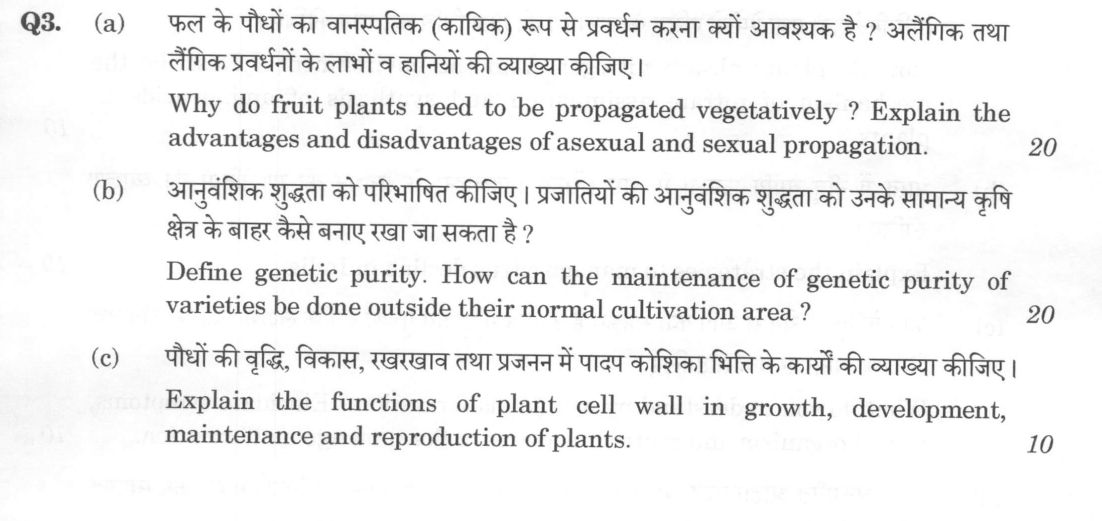
Why do fruit plants need to be propagated vegetatively ? Explain the advantages and disadvantages of asexual and sexual propagation. 20 marks
Define genetic purity. How can the maintenance of genetic purity of varieties be done outside their normal cultivation area ? 20 marks
Explain the functions of plant cell wall in growth, development, maintenance and reproduction of plants. 10 marks
हिंदी में प्रश्न पढ़ें
फल के पौधों का वानस्पतिक (कायिक) रूप से प्रवर्धन करना क्यों आवश्यक है ? अलैंगिक तथा लैंगिक प्रवर्धनों के लाभों व हानियों की व्याख्या कीजिए। (20 अंक)
आनुवंशिक शुद्धता को परिभाषित कीजिए। प्रजातियों की आनुवंशिक शुद्धता को उनके सामान्य कृषि क्षेत्र के बाहर कैसे बनाए रखा जा सकता है ? (20 अंक)
पौधों की वृद्धि, विकास, रखरखाव तथा प्रजनन में पादप कोशिका भित्ति के कार्यों की व्याख्या कीजिए। (10 अंक)
Model answer
Written by UPSC Answer Check against this question's marking rubric, to the expected length. UPSC does not publish answers for Mains — this is one way to score well, not an official key.
Vegetative Propagation and Genetic Integrity in Horticulture
The propagation of fruit plants is predominantly vegetative due to the high degree of heterozygosity in these crops. Sexual reproduction (amphimixis) in heterozygous parents leads to segregation of traits in the F1 generation, resulting in progeny that are not true-to-type. Furthermore, many fruit species exhibit prolonged juvenility, meaning they take years to flower after seed sowing. Vegetative propagation bypasses this, allowing immediate fruiting and ensuring clonal uniformity. This is critical for maintaining specific market traits like size, color, and shelf life.
Advantages and Disadvantages of Propagation Modes Asexual propagation offers distinct advantages: it preserves the genetic identity of superior genotypes, ensures uniformity in orchards, and allows for the rapid multiplication of elite clones. However, it carries significant disadvantages. The lack of genetic variation makes clonal populations vulnerable to specific pests and diseases. Crucially, vegetative methods can transmit systemic viruses and viroids from mother plants to offspring, leading to decline in yield and quality over time. Conversely, sexual propagation (amphimixis) introduces genetic diversity and hybrid vigour (heterosis), which is essential for breeding new varieties with disease resistance or stress tolerance. Its disadvantages include the loss of desirable traits due to segregation, the long juvenile phase, and the inability to preserve specific elite genotypes exactly. In India, the National Horticulture Mission emphasizes the use of clean planting material to mitigate the risks of vegetative propagation, while institutions like the National Research Centre for Banana (NRCB) utilize meristem tip culture to produce virus-free banana stock, distinguishing it from micrografting techniques used more commonly in citrus.
Genetic Purity and Its Maintenance Genetic purity refers to the trueness of a variety to its original type, characterized by the absence of off-types and genetic contaminants. It is a prerequisite for seed certification under the Seeds Act, 1966, and the Plant Varieties and Farmers’ Rights (PPV&FR) Act, 2001, which mandates DUS (Distinctiveness, Uniformity, Stability) criteria for variety registration. Maintaining genetic purity outside the normal cultivation area is vital for preserving germplasm and producing foundation seeds. This is achieved through several methods:
- Isolation and Seed Villages: Establishing seed production centers in geographically isolated areas to prevent cross-pollination with local varieties.
- Off-Season Nursery Raising: Utilizing regions with different climatic zones, such as the Himalayan regions of Kashmir and Himachal Pradesh for potato seed production, to avoid the peak disease pressure present in the main growing regions.
- Tissue Culture: For vegetatively propagated crops, maintaining virus-free stock in vitro prevents the accumulation of pathogens that degrade genetic expression over generations.
- Protected Cultivation: Using physical barriers to control pollinators in cross-pollinated crops. The National Bureau of Plant Genetic Resources (NBPGR) plays a pivotal role in conserving such genetically pure germplasm, ensuring that the genetic base of Indian agriculture remains robust and diverse.
Functions of the Plant Cell Wall The plant cell wall, composed primarily of cellulose, hemicellulose, pectin, and lignin, is not merely a static boundary but a dynamic structure essential for plant life. In growth, the cell wall regulates cell expansion. The loosening of the wall matrix by enzymes like expansins allows turgor pressure to drive cell elongation. Without this controlled plasticity, plants could not grow. In development, the cell wall dictates morphogenesis. The pattern of cell division and the orientation of cellulose microfibrils determine cell shape and tissue differentiation. Pectin in the middle lamella facilitates cell adhesion, holding tissues together. For maintenance, the wall provides mechanical support, allowing plants to stand upright against gravity. Lignification in xylem vessels provides hydraulic strength. It also acts as a physical barrier against pathogens and herbivores, with cutin and suberin providing additional protection. In reproduction, the cell wall plays a critical role. During fertilization, the pollen tube grows through the stigma and style, guided by signals from the ovule. The cell wall of the egg cell interacts with the pollen tube to facilitate sperm release. Post-fertilization, the cell wall of the zygote undergoes modifications to support embryo development, and the formation of the seed coat (testa) from integuments provides protection for the next generation.
Conclusion In summary, the choice between vegetative and sexual propagation, the rigorous maintenance of genetic purity, and the understanding of cell wall dynamics are interconnected pillars of sustainable horticulture. India’s agricultural policy, through acts like the PPV&FR Act and initiatives by ICAR, aims to balance the need for uniform, high-yielding clones with the genetic diversity required for long-term resilience. Ensuring quality planting material through advanced techniques like tissue culture and strict seed certification is essential for doubling farmers' income and meeting global export quality standards.
What "Explain" is asking you to do
Make the working of something clear — what sets it off, what follows from what, and what it produces. Explain is the Commission's mechanism word: it dominates the technical papers and the “explain why” stems, where the marks sit in the causal chain and not in the label.
Structure that answers it
State what it is → the initiating condition → the chain of cause, step by step → an instance where it plays out → what the chain produces
Where marks are lost
Describing what something looks like instead of why it works that way. Naming the stages without linking them reads as description too.
How this answer will be evaluated
Approach
(a) explain: definition/context > points in order > small example > short close | (b) define: precise definition > the distinguishing feature > one example | (c) explain: definition/context > points in order > small example > short close Full marks: Comprehensive, accurate, with specific examples and clear structure.
Key points expected
- Reason: retention of parent's desirable traits (clonal fidelity)
- Reason: fruit plants often sterile or slow to maturity via seed
- Asexual advantages: uniformity, early fruiting, disease-free stock
- Sexual advantages: genetic diversity, hardiness, disease resistance
- Definition: uniformity of genotype and phenotype in a variety
- Method: Seed production under isolation (distance/time)
- Method: Field inspection and roguing of off-types
- Method: Seed certification and testing (germination, purity)
Evaluation rubric
Each sub-part is marked on its own, against the marks and word limit printed on the paper.
- (a) Justify vegetative propagation for fruit plants and compare asexual vs sexual methods. 20 marks
explain— definition/context → points in order → small example → short close
Must cover
- Reason: retention of parent's desirable traits (clonal fidelity)
- Reason: fruit plants often sterile or slow to maturity via seed
- Asexual advantages: uniformity, early fruiting, disease-free stock
- Sexual advantages: genetic diversity, hardiness, disease resistance
Loses marks
- Confusing vegetative with sexual propagation
- Failing to link vegetative propagation to commercial fruit quality
Earns more
- Asexual disadvantage: susceptibility to specific pathogens (e.g. virus)
- Sexual disadvantage: variability in offspring, long juvenile phase
- Specific examples: grafting for apple, layering for guava
Extra mark
- Mention of specific vegetative methods (cutting, grafting, tissue culture)
- (b) Define genetic purity and describe maintenance methods outside normal cultivation areas. 20 marks
define— precise definition → the distinguishing feature → one example
Must cover
- Definition: uniformity of genotype and phenotype in a variety
- Method: Seed production under isolation (distance/time)
- Method: Field inspection and roguing of off-types
- Method: Seed certification and testing (germination, purity)
Loses marks
- Vague definition of genetic purity
- Ignoring the 'outside normal cultivation area' constraint
Earns more
- Mention of specific isolation distances (e.g. 200m for wheat)
- Role of seed certification agencies (e.g. NHB, State agencies)
- Use of mechanical/physical barriers for isolation
Extra mark
- Reference to specific Indian seed certification standards
- (c) Explain functions of plant cell wall in growth, development, maintenance, and reproduction. 10 marks
explain— definition/context → points in order → small example → short close
Must cover
- Growth: provides turgor pressure and structural support
- Development: determines cell shape and differentiation
- Maintenance: protection against mechanical damage and pathogens
- Reproduction: role in pollen tube growth and seed coat formation
Loses marks
- Confusing cell wall with cell membrane functions
- Failing to address all four aspects (growth, development, maintenance, reproduction)
Earns more
- Mention of cellulose, hemicellulose, pectin composition
- Role in cell-to-cell communication (plasmodesmata)
- Specific examples: xylem vessels, pollen tube
Extra mark
- Diagram of cell wall layers (primary, secondary, middle lamella)
Practice this exact question
Write your answer and it is marked point by point against the model answer above — what you covered, what you missed, what you got wrong.
Evaluate my answer →More from Agriculture 2025 Paper II
- Q1 Answer the following questions in about 150 words each: (a) Define cell cycle. Describe d…
- Q2 (a) Explain mutagenesis with its classification. Discuss briefly the mechanisms of action…
- Q3 (a) Why do fruit plants need to be propagated vegetatively ? Explain the advantages and d…
- Q4 (a) What do you understand by water transport in xylem ? Explain the Cohesion-Tension the…
- Q5 Answer the following questions in about 150 words each : 10×5=50 (a) How do plants absorb…
- Q6 (a) Write the cultivation practices of grapes in respect of soil and climatic requirement…