Paper II — Q6
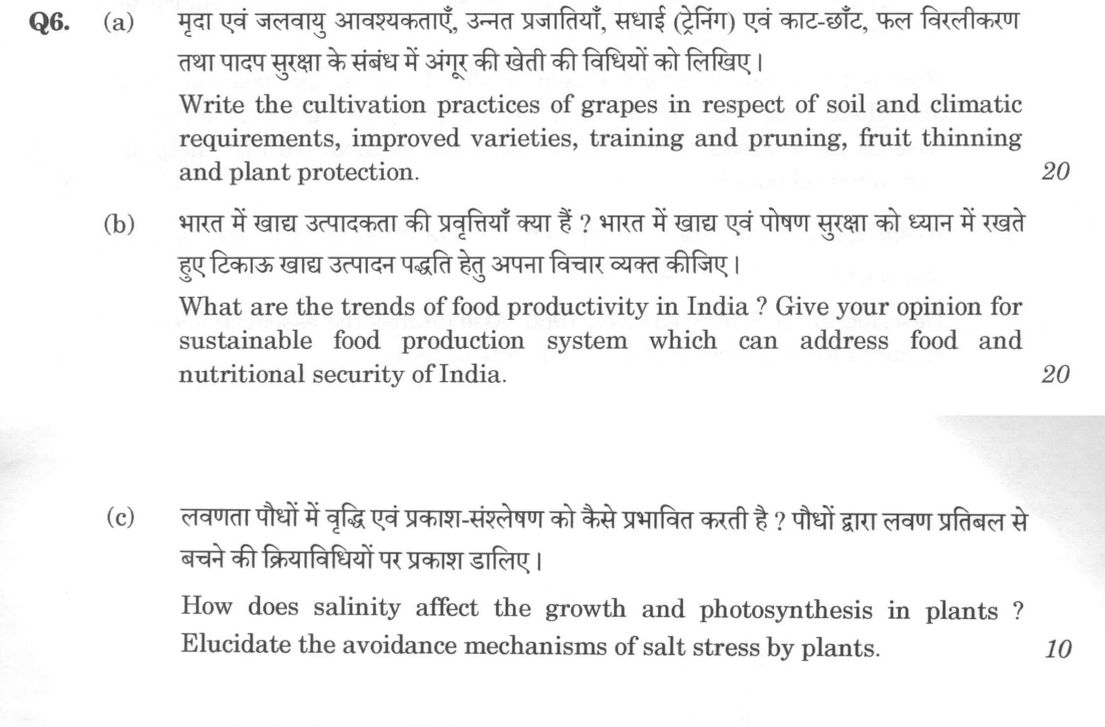
(a) Write the cultivation practices of grapes in respect of soil and climatic requirements, improved varieties, training and…
Write the cultivation practices of grapes in respect of soil and climatic requirements, improved varieties, training and pruning, fruit thinning and plant protection. 20 marks
What are the trends of food productivity in India ? Give your opinion for sustainable food production system which can address food and nutritional security of India. 20 marks
How does salinity affect the growth and photosynthesis in plants ? Elucidate the avoidance mechanisms of salt stress by plants. 10 marks
हिंदी में प्रश्न पढ़ें
मृदा एवं जलवायु आवश्यकताएं, उन्नत प्रजातियां, सधाई (ट्रेनिंग) एवं काट-छांट, फल बिरलीकरण तथा पादप सुरक्षा के संबंध में अंगूर की खेती की विधियों को लिखिए। 20
भारत में खाद्य उत्पादकता की प्रवृत्तियां क्या हैं ? भारत में खाद्य एवं पोषण सुरक्षा को ध्यान में रखते हुए टिकाऊ खाद्य उत्पादन पद्धति हेतु अपना विचार व्यक्त कीजिए। 20
लवणता पौधों में वृद्धि एवं प्रकाश-संश्लेषण को कैसे प्रभावित करती है ? पौधों द्वारा लवण प्रतिबल से बचने की क्रियाविधियों पर प्रकाश डालिए। 10
Model answer
Written by UPSC Answer Check against this question's marking rubric, to the expected length. UPSC does not publish answers for Mains — this is one way to score well, not an official key.
Grape Cultivation Practices
Soil and Climatic Requirements: Grape (Vitis vinifera) requires well-drained, deep sandy loam to loamy soil with a pH of 6.5 to 7.5, free from hard subsoil pans or salinity. It thrives in warm, dry sub-tropical and temperate climates with optimal growth temperatures between 15°C and 25°C, requiring 700 to 900 mm annual rainfall. Rain or high humidity during berry ripening causes fruit cracking and fungal epidemics.
Improved Varieties: Commercially cultivated varieties in India include Thompson Seedless, Sonaka, and Manik Chaman in Maharashtra and Northern plains, while Bangalore Blue, Gulabi, and Anab-e-Shahi are widely cultivated in Southern India.
Training and Pruning: Vines are trained primarily on the Bower (Pandal) system for vigorous table varieties to maximize light interception, or on Kniffin and Telephone (T-trellis) systems. In peninsular India, two annual prunings are practiced: foundation/back pruning to 1–2 buds (spurs) in April (summer) for vegetative growth, and forward/fruit pruning to 4–10 buds (canes) in October (autumn) to induce flowering and fruiting.
Fruit Thinning: Manual thinning of compact clusters and dipping flower clusters in Gibberellic Acid (GA3 at 10–40 ppm) during bloom and pea stages reduces berry overcrowding, elongates bunches, and promotes uniform berry enlargement.
Plant Protection: Major pests such as flea beetles, thrips, and mealybugs are managed via Integrated Pest Management (IPM), including systemic insecticides and biological control using Cryptolaemus montrouzieri. Key fungal diseases—downy mildew (Plasmopara viticola), powdery mildew (Uncinula necator), and anthracnose—are controlled using balanced canopies, prophylactic sprays of Bordeaux mixture, and targeted applications of metalaxyl or triazole fungicides.
Trends in Food Productivity and Sustainable Production Systems
Productivity Trends: India witnessed substantial cereal yield gains from under 1 t/ha in the 1960s to over 3 t/ha currently due to high-yielding varieties, irrigation, and chemical inputs. However, yield growth in the core rice-wheat cropping belt of the Indo-Gangetic Plains has plateaued. Persistent challenges include multi-nutrient deficiencies, declining factor productivity, groundwater depletion, and climate change-induced heat stress. Severe regional disparities persist between high-input north-western states (Punjab, Haryana) and the lower-yielding eastern states.
Sustainable Food and Nutritional Security Framework: Transitioning to a resilient food system requires: Conservation Agriculture and Precision Farming: Adopting zero-tillage, direct-seeded rice, residue retention, and drip-fertigation to restore soil organic carbon and enhance input-use efficiency. Agro-ecological Diversification: Expanding organic and natural farming to reduce synthetic chemical dependency while integrating legumes into cereal rotations. Nutri-Cereal Promotion: Mainstreaming climate-hardy millets (Shree Anna), accelerated by the UN International Year of Millets (2023), to improve climatically marginal crop zones. Biofortification and Policy Convergence: Scaling zinc-rich wheat (BHU-31) and iron-rich pearl millet (Dhanashakti), integrated with social safety nets like POSHAN Abhiyaan and the National Food Security Act, bridging the gap between caloric availability and hidden hunger.
Salinity Stress and Avoidance Mechanisms in Plants
Impact on Growth and Photosynthesis: Soil salinity exerts an initial osmotic stress, lowering soil water potential and causing physiological drought. Subsequent ion accumulation leads to specific ion toxicity from excess Na⁺ and Cl⁻, causing nutrient imbalances by reducing the K⁺/Na⁺ and Ca²⁺/Na⁺ ratios. Photosynthesis is impaired by stomatal closure (limiting intercellular CO₂ diffusion) and non-stomatal disruptions, including the destabilization of photosystem II (PSII) reaction centers, degradation of chlorophyll, and reduced RuBisCO enzymatic activity.
Avoidance Mechanisms: Plants avoid salt stress through distinct physiological adaptations: Salt Exclusion: Roots use selective ultrafiltration across Casparian strips and selective ion transporters (such as SOS1 and HKT1) to prevent Na⁺ translocation into the shoot transpiration stream. Salt Excretion: Halophytes extrude accumulated salts onto leaf surfaces through specialized salt glands and bladders. Succulence and Compartmentalization: Expanding leaf volume and cellular water content dilutes internal ionic concentrations. Concurrently, excess Na⁺ is sequestered into the central vacuole via tonoplast Na⁺/H⁺ antiporters (NHX). Osmotic Adjustment and Antioxidant Defense: Cells synthesize compatible osmoprotectants (proline, glycine betaine, polyols) to maintain turgor without interfering with metabolic pathways, alongside upregulating antioxidant enzymes (SOD, catalase, peroxidase) to neutralize reactive oxygen species (ROS).
A coherent synthesis of physiological stress management, input-efficient horticulture, and biofortified crop diversification provides the necessary foundation to ensure sustainable agricultural productivity and long-term nutritional security in India.
What "Elucidate" is asking you to do
Make a stated proposition plain and then prove it with instances. Elucidate stems almost always carry a claim or a named concept, and very often the words “with examples” or “with suitable diagrams” — the illustration is part of the directive, not decoration.
Structure that answers it
Plain-language statement of what the proposition means → the part that is obscure, resolved → first illustration → second illustration → why the proposition holds
Where marks are lost
Adding terminology; elucidate rewards removing it. The commoner loss is a clean explanation with no example, when the stem asked for examples.
How this answer will be evaluated
Approach
(a) explain: definition/context > points in order > small example > short close | (b) comment: context > arguments both sides > judgment > close | (c) explain: definition/context > points in order > small example > short close Full marks: Comprehensive, specific, and well-structured answers with named examples and data.
Key points expected
- Soil and climatic requirements for grapes
- Improved varieties (e.g., Table grapes vs Wine grapes)
- Training and pruning practices (e.g., V-shape, cordon)
- Fruit thinning and plant protection measures
- Trends in food productivity in India (e.g., Green Revolution impact)
- Opinion on sustainable food production system
- Addressing food security (availability/access)
- Addressing nutritional security (quality/diversity)
Evaluation rubric
Each sub-part is marked on its own, against the marks and word limit printed on the paper.
- (a) Comprehensive account of grape cultivation covering soil, climate, varieties, training, thinning, and protection. 20 marks
explain— definition/context → points in order → small example → short close
Must cover
- Soil and climatic requirements for grapes
- Improved varieties (e.g., Table grapes vs Wine grapes)
- Training and pruning practices (e.g., V-shape, cordon)
- Fruit thinning and plant protection measures
Loses marks
- Vague agronomic advice without specific practices
- Omitting any of the five requested sub-topics
Earns more
- Specific variety names (e.g., Anab-e-Shahi, Sultana)
- Specific pruning timing (e.g., winter vs summer)
- Specific disease names (e.g., Downy mildew, Botrytis)
Extra mark
- Mention of specific Indian state production data
- Reference to specific government schemes for viticulture
- (b) Analysis of Indian food productivity trends and opinion on sustainable production for security. 20 marks
comment— context → arguments both sides → judgment → close
Must cover
- Trends in food productivity in India (e.g., Green Revolution impact)
- Opinion on sustainable food production system
- Addressing food security (availability/access)
- Addressing nutritional security (quality/diversity)
Loses marks
- MSP-only solutions for food security
- Vague advice without specific sustainable practices
Earns more
- Mention of specific productivity data or trends
- Specific sustainable practices (e.g., organic, precision ag)
- Reference to specific nutritional deficiencies in India
Extra mark
- Reference to specific government schemes (e.g., PM-KISAN)
- Mention of specific research institutions (e.g., ICAR)
- (c) Explanation of salinity effects on growth/photosynthesis and elucidation of avoidance mechanisms. 10 marks
explain— definition/context → points in order → small example → short close
Must cover
- How salinity affects plant growth
- How salinity affects photosynthesis
- Elucidation of avoidance mechanisms by plants
- Specific physiological responses to salt stress
Loses marks
- Vague description of 'salt stress' without specific effects
- Omitting either growth or photosynthesis effects
Earns more
- Mention of specific ions (e.g., Na+, Cl-)
- Specific mechanisms (e.g., ion exclusion, osmotic adjustment)
- Reference to specific plant species or examples
Extra mark
- Mention of specific molecular mechanisms (e.g., SOS pathway)
- Reference to specific research findings on salt tolerance
Practice this exact question
Write your answer and it is marked point by point against the model answer above — what you covered, what you missed, what you got wrong.
Evaluate my answer →More from Agriculture 2025 Paper II
- Q3 (a) Why do fruit plants need to be propagated vegetatively ? Explain the advantages and d…
- Q4 (a) What do you understand by water transport in xylem ? Explain the Cohesion-Tension the…
- Q5 Answer the following questions in about 150 words each : 10×5=50 (a) How do plants absorb…
- Q6 (a) Write the cultivation practices of grapes in respect of soil and climatic requirement…
- Q7 (a) Discuss the production technologies of peas in relation to varieties, climate require…
- Q8 (a) What do you mean by new generation plant growth regulators? Enlist the different new…