Paper II — Q8
(a) What do you mean by new generation plant growth regulators? Enlist the different new generation plant growth regulators and…
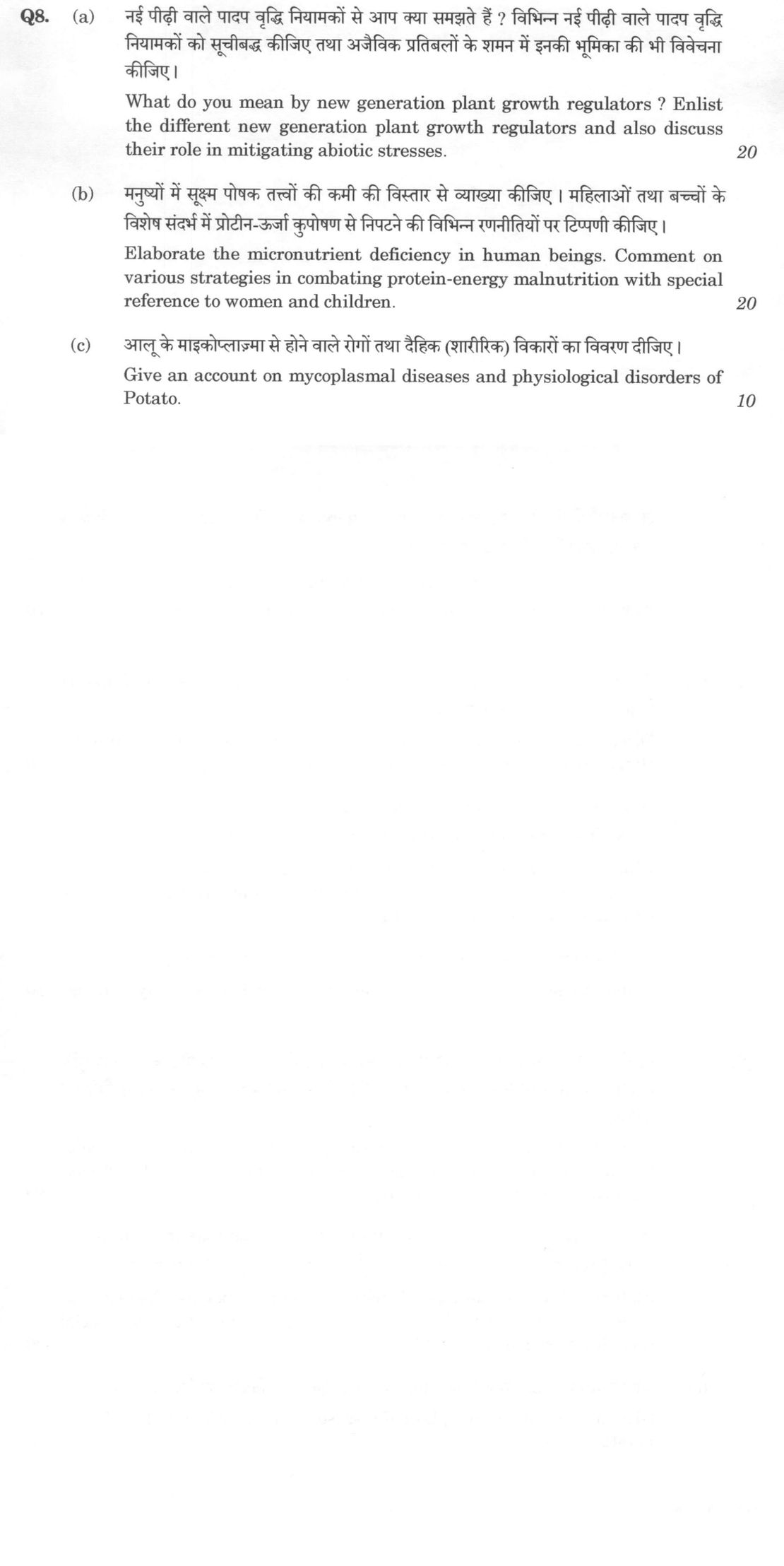
What do you mean by new generation plant growth regulators? Enlist the different new generation plant growth regulators and also discuss their role in mitigating abiotic stresses. 20 marks
Elaborate the micronutrient deficiency in human beings. Comment on various strategies in combating protein-energy malnutrition with special reference to women and children. 20 marks
Give an account on mycoplasmal diseases and physiological disorders of Potato. 10 marks
हिंदी में प्रश्न पढ़ें
नई पीढ़ी वाले पादप वृद्धि नियामकों से आप क्या समझते हैं? विभिन्न नई पीढ़ी वाले पादप वृद्धि नियामकों को सूचीबद्ध कीजिए तथा अजैविक प्रतिबलों के शमन में इनकी भूमिका की भी विवेचना कीजिए। (20 अंक)
मनुष्यों में सूक्ष्म पोषक तत्वों की कमी की विस्तार से व्याख्या कीजिए। महिलाओं तथा बच्चों के विशेष संदर्भ में प्रोटीन-ऊर्जा कुपोषण से निपटने की विभिन्न रणनीतियों पर टिप्पणी कीजिए। (20 अंक)
आलू के माइकोप्लाज्मा से होने वाले रोगों तथा दैहिक (शारीरिक) विकारों का विवरण दीजिए। (10 अंक)
Model answer
Written by UPSC Answer Check against this question's marking rubric, to the expected length. UPSC does not publish answers for Mains — this is one way to score well, not an official key.
New Generation Plant Growth Regulators and Abiotic Stress Mitigation
New generation plant growth regulators (PGRs) refer to recently identified, low-molecular-weight signaling molecules that regulate plant development and stress responses, distinct from classical auxins, cytokinins, and gibberellins. Unlike classical PGRs, which primarily drive growth, these newer classes often function as stress-responsive signals. Key examples include brassinosteroids, derived from cholesterol; jasmonates, synthesized from linolenic acid; salicylic acid, derived from phenylalanine; strigolactones, originating from carotenoid metabolism; and peptide hormones like systemins.
Their role in mitigating abiotic stresses is profound. Brassinosteroids enhance drought and salinity tolerance by modulating stomatal closure and upregulating antioxidant enzymes, thereby reducing oxidative damage. Jasmonates play a dual role; while primarily associated with herbivory, they also mediate osmotic stress responses by regulating ion homeostasis and root architecture. Salicylic acid is crucial for heat and chilling stress tolerance, acting as a signal for thermotolerance by inducing heat-shock proteins and stabilizing membranes. Strigolactones assist in nutrient deficiency stress, particularly phosphorus and nitrogen, by promoting root hair development and symbiotic associations with mycorrhizae, thus enhancing nutrient uptake under limiting conditions.
Micronutrient Deficiencies and Protein-Energy Malnutrition
Micronutrient deficiencies in humans are widespread in India, with significant health implications. Iron-deficiency anemia remains the most prevalent, with NFHS-5 data indicating that 57.0% of women and 67.1% of children aged 6–59 months suffer from anemia. Zinc deficiency impairs immune function and growth, while iodine deficiency disorders lead to cognitive impairment and goiter. Vitamin A deficiency causes night blindness and increased susceptibility to infections. These deficiencies are often interlinked with protein-energy malnutrition (PEM), which stunts physical and cognitive development.
Strategies to combat PEM, with special reference to women and children, are multi-pronged. The Integrated Child Development Services (ICDS) scheme provides supplementary nutrition and health check-ups to children below five and pregnant/lactating women. The Mid-Day Meal Scheme ensures school children receive at least one hot cooked meal, addressing both hunger and micronutrient gaps. The POSHAN Abhiyaan (National Nutrition Mission) focuses on reducing anemia, stunting, and wasting through convergence of existing programs. Biofortification is another critical strategy, involving the cultivation of nutrient-dense crops like iron-rich pearl millet and zinc-rich wheat to address dietary gaps at the source. Supplementary nutrition programs specifically target pregnant and lactating women to prevent intergenerational transmission of malnutrition.
Mycoplasmal Diseases and Physiological Disorders of Potato
Mycoplasmal diseases, now termed phytoplasma diseases, are caused by wall-less bacteria transmitted by insect vectors. In potato, purple top wilt and aster yellows are notable examples, characterized by leaf curling, yellowing, and stunting. These are primarily transmitted by leafhoppers. Witches' broom, another phytoplasma-induced disorder, results in dense clusters of shoots. It is important to distinguish these from psyllid yellows, which is a non-phytoplasma disorder caused by psyllid feeding.
Physiological disorders in potato are non-infectious and often related to environmental or cultural factors. Hollow heart is caused by rapid tuber growth due to excess nitrogen, leading to a hollow cavity in the center. Internal brown spot results from waterlogging and high soil moisture, causing brown discoloration in the vascular ring. Blackheart is a disorder associated with high levels of reducing sugars and low oxygen, leading to blackening of the tuber flesh. Stem-end browning occurs due to calcium deficiency or rapid growth, causing brown discoloration at the stem end of the tuber.
Conclusion
The integration of new generation PGRs for stress resilience, robust nutritional interventions for human health, and precise management of potato disorders highlights the interconnectedness of crop science and public health. A holistic approach, combining genetic advancements, policy implementation, and agronomic best practices, is essential for sustainable agricultural productivity and improved human well-being in India.
What "Discuss" is asking you to do
Lay the issue out from more than one side — how it arose, what is claimed for it, what is held against it, and where it now stands. UPSC attaches discuss to broad topics with several live dimensions, so coverage of the dimensions earns more than the strength of your opinion.
Structure that answers it
Set the issue up → the case as it is made → the case against → the dimension both sides leave out → where the balance now lies
Where marks are lost
Listing facts with no thread between them, or arguing one side throughout and calling it a discussion.
How this answer will be evaluated
Approach
Framework: Concept > Practice or process > Data > Indian application. (a) discuss: intro > 3-4 dimensions > example > balanced close | (b) comment: context > arguments both sides > judgment > close | (c) account for: state the phenomenon > the causes in order of weight > conclusion Full marks: Comprehensive, specific, and well-structured answers with clear distinctions and relevant examples.
Key points expected
- Definition distinguishing new generation from traditional PGRs
- Enlistment of specific new generation PGRs (e.g., brassinosteroids, cytokinins)
- Mechanism of action in mitigating abiotic stresses (drought, salinity)
- Discussion of physiological responses to stress
- Elaboration on specific micronutrient deficiencies (Iron, Zinc, Iodine)
- Strategies for combating protein-energy malnutrition (PEM)
- Special reference to women and children
- Discussion of specific interventions or programs
Evaluation rubric
Each sub-part is marked on its own, against the marks and word limit printed on the paper.
- (a) Define new generation PGRs, list them, and explain their role in abiotic stress mitigation. 20 marks
discuss— intro → 3-4 dimensions → example → balanced close
Must cover
- Definition distinguishing new generation from traditional PGRs
- Enlistment of specific new generation PGRs (e.g., brassinosteroids, cytokinins)
- Mechanism of action in mitigating abiotic stresses (drought, salinity)
- Discussion of physiological responses to stress
Loses marks
- Confusing new generation with traditional PGRs
- Vague description of stress mitigation mechanisms
- Failure to distinguish between biotic and abiotic stress
Earns more
- Mention of specific stress types (drought, salinity, cold)
- Reference to specific plant species or crops
- Explanation of molecular pathways involved
- Comparison with traditional PGRs
Extra mark
- Citation of specific research or data on efficacy
- Mention of commercial products or formulations
- (b) Elaborate on micronutrient deficiency and strategies for protein-energy malnutrition in women/children. 20 marks
comment— context → arguments both sides → judgment → close
Must cover
- Elaboration on specific micronutrient deficiencies (Iron, Zinc, Iodine)
- Strategies for combating protein-energy malnutrition (PEM)
- Special reference to women and children
- Discussion of specific interventions or programs
Loses marks
- General discussion without specific micronutrients
- Failure to address women and children specifically
- Vague strategies without specific interventions
Earns more
- Mention of specific micronutrients (Iron, Zinc, Iodine, Vitamin A)
- Reference to government schemes (e.g., ICDS, POSHAN Abhiyaan)
- Discussion of biofortification or food fortification
- Mention of specific health impacts of deficiency
Extra mark
- Citation of specific data on prevalence of deficiency
- Reference to specific international or national guidelines
- (c) Provide an account of mycoplasmal diseases and physiological disorders of Potato. 10 marks
account for— state the phenomenon → the causes in order of weight → conclusion
Must cover
- Description of mycoplasmal diseases of potato
- Description of physiological disorders of potato
- Symptoms and causes of these conditions
- Impact on potato production
Loses marks
- Confusing mycoplasmal with fungal or viral diseases
- Vague description of symptoms or causes
- Failure to distinguish between mycoplasmal and physiological disorders
Earns more
- Mention of specific mycoplasmal diseases (e.g., Purple top)
- Mention of specific physiological disorders (e.g., internal blackening)
- Discussion of management or control measures
- Reference to specific potato varieties affected
Extra mark
- Mention of specific research or data on prevalence
- Reference to specific management practices
Practice this exact question
Write your answer and it is marked point by point against the model answer above — what you covered, what you missed, what you got wrong.
Evaluate my answer →More from Agriculture 2025 Paper II
- Q5 Answer the following questions in about 150 words each : 10×5=50 (a) How do plants absorb…
- Q6 (a) Write the cultivation practices of grapes in respect of soil and climatic requirement…
- Q7 (a) Discuss the production technologies of peas in relation to varieties, climate require…
- Q8 (a) What do you mean by new generation plant growth regulators? Enlist the different new…