Paper II — Q7
(a) Discuss the production technologies of peas in relation to varieties, climate requirement, sowing time, seed rate and plant…
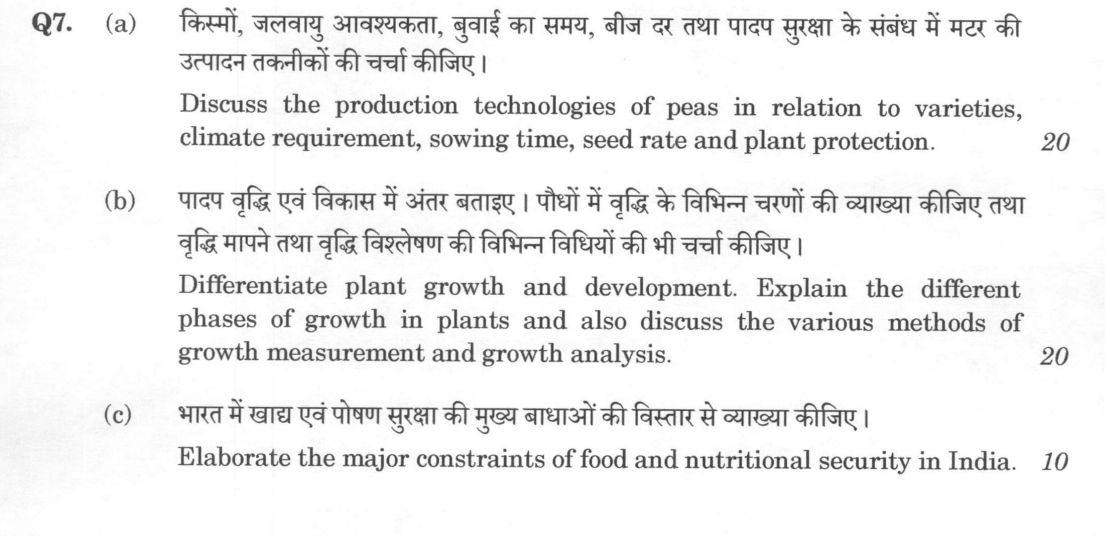
Discuss the production technologies of peas in relation to varieties, climate requirement, sowing time, seed rate and plant protection. 20 marks
Differentiate plant growth and development. Explain the different phases of growth in plants and also discuss the various methods of growth measurement and growth analysis. 20 marks
Elaborate the major constraints of food and nutritional security in India. 10 marks
हिंदी में प्रश्न पढ़ें
किस्मों, जलवायु आवश्यकता, बुवाई का समय, बीज दर तथा पादप सुरक्षा के संबंध में मटर की उत्पादन तकनीकों की चर्चा कीजिए। (20 अंक)
पादप वृद्धि एवं विकास में अंतर बताइए। पौधों में वृद्धि के विभिन्न चरणों की व्याख्या कीजिए तथा वृद्धि मापने तथा वृद्धि विश्लेषण की विभिन्न विधियों की भी चर्चा कीजिए। (20 अंक)
भारत में खाद्य एवं पोषण सुरक्षा की मुख्य बाधाओं की विस्तार से व्याख्या कीजिए। (10 अंक)
Model answer
Written by UPSC Answer Check against this question's marking rubric, to the expected length. UPSC does not publish answers for Mains — this is one way to score well, not an official key.
Pea (Pisum sativum) production and plant physiology are pivotal to India’s agricultural resilience and nutritional outcomes. A comprehensive understanding of these domains, alongside the systemic challenges of food security, is essential for sustainable development.
Part (a): Production Technologies of Peas Pea cultivation is highly sensitive to varietal selection and climatic conditions. Varieties are broadly classified into tall (e.g., Arkel, Bonneville, Lincoln) and dwarf (e.g., Pant Uphar, VL-3) types. Tall varieties require staking, while dwarf types are preferred for mechanized harvesting. Peas are cool-season crops, thriving in temperatures of 10–25°C. They are frost-sensitive, particularly during flowering, which necessitates precise sowing windows. In North India, the Rabi season sowing occurs from October to November. In the northern hills, where the climate is cooler, sowing is typically conducted from March to April to avoid frost damage during reproductive stages. Seed rate varies by purpose: for seed production, 75–100 kg/ha is recommended, whereas for early vegetable harvest, a higher density of 100–120 kg/ha is required to maximize yield per unit area. Plant protection relies on Integrated Pest Management (IPM). Key pests include aphids and diseases such as powdery mildew and rust. Management involves the use of resistant varieties, timely fungicide application, and biological control agents to minimize chemical residue, ensuring both yield and food safety.
Part (b): Plant Growth and Development Growth and development are distinct but interrelated processes. Growth is an irreversible, quantitative increase in size, mass, or volume, whereas development is a progressive, qualitative change in form and function, encompassing differentiation and maturation. Growth follows a sigmoid curve with four distinct phases: the lag phase (slow initial growth), the log or exponential phase (rapid cell division), the deceleration phase (slowing growth due to resource limitation), and the stationary phase (growth ceases).
Measuring growth involves direct methods that quantify physical changes. These include linear measurements using auxanometers to track stem elongation, fresh and dry weight determinations to assess biomass accumulation, and leaf area measurement via planimeters or digital imaging to evaluate photosynthetic capacity. Beyond direct measurement, growth analysis employs indices to understand efficiency. The Relative Growth Rate (RGR) is calculated as the change in mass per unit time per unit initial mass (g g⁻¹ day⁻¹). The Net Assimilation Rate (NAR) measures the increase in dry mass per unit leaf area (g m⁻² day⁻¹). The Crop Growth Rate (CGR) indicates the increase in dry mass per unit ground area per day (g m⁻² day⁻¹). These metrics allow agronomists to diagnose crop health and optimize inputs.
Part (c): Constraints of Food and Nutritional Security Despite production gains, India faces significant constraints in food and nutritional security. Production challenges include fragmented landholdings, soil degradation, and water scarcity exacerbated by climate change. Distribution bottlenecks persist due to inefficiencies in the Public Distribution System (PDS), high post-harvest losses in the supply chain, and price volatility that affects affordability. Nutritional constraints remain critical, with widespread protein-energy malnutrition and micronutrient deficiencies (hidden hunger) stemming from dietary monotony. Institutional gaps include limited MSP coverage for pulses and oilseeds, procurement limitations, and implementation challenges under the National Food Security Act (NFSA) 2013.
Conclusion Addressing these challenges requires an integrated approach. Linking pea production technologies to nutritional security is vital, as peas are a rich source of plant protein. Leveraging growth analysis for precision agriculture can enhance yields and efficiency. Policy interventions such as PM-KISAN, POSHAN Abhiyaan, and the promotion of climate-resilient varieties must be strengthened to bridge the gap between production and consumption, ensuring holistic food and nutritional security for all.
What "Discuss" is asking you to do
Lay the issue out from more than one side — how it arose, what is claimed for it, what is held against it, and where it now stands. UPSC attaches discuss to broad topics with several live dimensions, so coverage of the dimensions earns more than the strength of your opinion.
Structure that answers it
Set the issue up → the case as it is made → the case against → the dimension both sides leave out → where the balance now lies
Where marks are lost
Listing facts with no thread between them, or arguing one side throughout and calling it a discussion.
How this answer will be evaluated
Approach
Framework: Concept > Practice or process > Data > Indian application. (a) discuss: intro > 3-4 dimensions > example > balanced close | (b) explain: definition/context > points in order > small example > short close | (c) explain: definition/context > points in order > small example > short close Full marks: Comprehensive coverage of all sub-parts with specific data, named varieties/schemes, and clear differentiation/analysis.
Key points expected
- Named pea varieties (e.g., Arka Maitri, Pusa Sem)
- Specific climate requirements (temperature, rainfall)
- Sowing time and seed rate (kg/ha)
- Plant protection measures (pests/diseases)
- Clear differentiation of growth vs development
- Phases of growth (lag, log, stationary)
- Methods of growth measurement (absolute/relative)
- Growth analysis parameters (RLR, LWR, NAR)
Evaluation rubric
Each sub-part is marked on its own, against the marks and word limit printed on the paper.
- (a) Production technologies of peas covering varieties, climate, sowing, seed rate, and protection. 20 marks
discuss— intro → 3-4 dimensions → example → balanced close
Must cover
- Named pea varieties (e.g., Arka Maitri, Pusa Sem)
- Specific climate requirements (temperature, rainfall)
- Sowing time and seed rate (kg/ha)
- Plant protection measures (pests/diseases)
Loses marks
- Vague agronomic advice without specific doses
- Confusing pea with other legumes
- Ignoring plant protection section
Earns more
- Spacing details (row-to-row/plant-to-plant)
- Fertilizer dose (NPK)
- Specific insecticide/fungicide names
- Harvesting and post-harvest handling
Extra mark
- Specific cultivar release year
- Recent government scheme for pulses
- (b) Differentiate growth/development; explain growth phases, measurement, and analysis. 20 marks
explain— definition/context → points in order → small example → short close
Must cover
- Clear differentiation of growth vs development
- Phases of growth (lag, log, stationary)
- Methods of growth measurement (absolute/relative)
- Growth analysis parameters (RLR, LWR, NAR)
Loses marks
- Confusing growth with development
- Missing growth analysis parameters
- No mention of measurement methods
Earns more
- Growth curve diagram
- Formulas for RLR/LWR/NAR
- Example of growth analysis in a crop
- Factors affecting growth phases
Extra mark
- Specific researcher associated with growth analysis
- Recent application in crop improvement
- (c) Major constraints of food and nutritional security in India. 10 marks
explain— definition/context → points in order → small example → short close
Must cover
- Production constraints (water, land, climate)
- Post-harvest losses and supply chain issues
- Nutritional deficiencies (micronutrients)
- Economic/access constraints (poverty, distribution)
Loses marks
- Only listing constraints without elaboration
- Ignoring nutritional aspect (focusing only on food quantity)
- Vague generalities without Indian context
Earns more
- Specific schemes (PM-POSHAN, PDS)
- Data on food wastage/losses
- Regional disparities in nutrition
- Impact of climate change on food security
Extra mark
- Specific NIN data on malnutrition
- Recent policy intervention details
Practice this exact question
Write your answer and it is marked point by point against the model answer above — what you covered, what you missed, what you got wrong.
Evaluate my answer →More from Agriculture 2025 Paper II
- Q4 (a) What do you understand by water transport in xylem ? Explain the Cohesion-Tension the…
- Q5 Answer the following questions in about 150 words each : 10×5=50 (a) How do plants absorb…
- Q6 (a) Write the cultivation practices of grapes in respect of soil and climatic requirement…
- Q7 (a) Discuss the production technologies of peas in relation to varieties, climate require…
- Q8 (a) What do you mean by new generation plant growth regulators? Enlist the different new…