Paper II — Q5
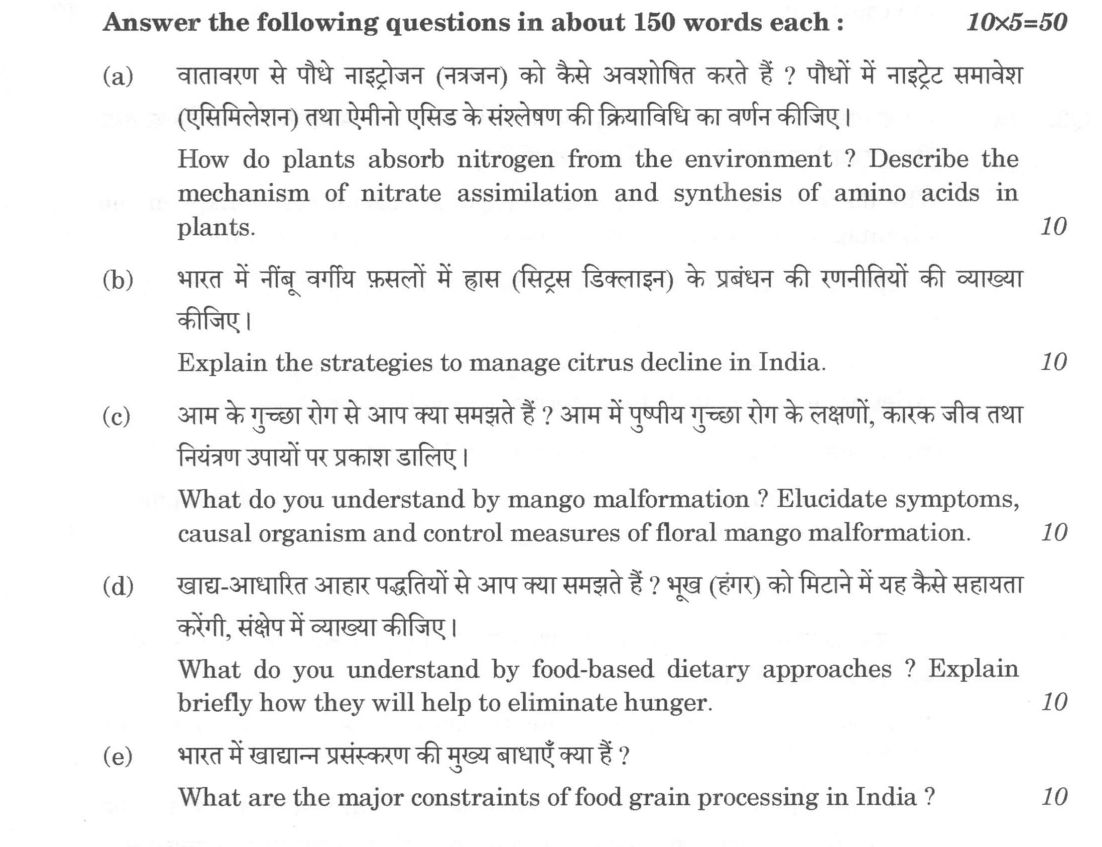
Answer the following questions in about 150 words each : 10×5=50 (a) How do plants absorb nitrogen from the environment ?…
Answer the following questions in about 150 words each : 10×5=50
How do plants absorb nitrogen from the environment ? Describe the mechanism of nitrate assimilation and synthesis of amino acids in plants. 10 marks
Explain the strategies to manage citrus decline in India. 10 marks
What do you understand by mango malformation ? Elucidate symptoms, causal organism and control measures of floral mango malformation. 10 marks
What do you understand by food-based dietary approaches ? Explain briefly how they will help to eliminate hunger. 10 marks
What are the major constraints of food grain processing in India ? 10 marks
हिंदी में प्रश्न पढ़ें
निम्नलिखित प्रत्येक प्रश्न का उत्तर लगभग 150 शब्दों में दीजिए : 10×5=50
वातावरण से पौधे नाइट्रोजन (नत्रजन) को कैसे अवशोषित करते हैं ? पौधों में नाइट्रेट समावेश (एसिमिलेशन) तथा एमीनो एसिड के संश्लेषण की क्रियाविधि का वर्णन कीजिए। 10
भारत में नींबू वर्गीय फसलों में हास (सिट्रस डिक्लाइन) के प्रबंधन की रणनीतियों की व्याख्या कीजिए। 10
आम के गुच्छा रोग से आप क्या समझते हैं ? आम में पुष्पीय गुच्छा रोग के लक्षणों, कारक जीव तथा नियंत्रण उपायों पर प्रकाश डालिए। 10
खाद्य-आधारित आहार पद्धतियों से आप क्या समझते हैं ? भुख (हंगर) को मिटाने में यह कैसे सहायता करेंगी, संक्षेप में व्याख्या कीजिए। 10
भारत में खाद्यान्न प्रसंस्करण की मुख्य बाधाएं क्या हैं ? 10 marks
Model answer
Written by UPSC Answer Check against this question's marking rubric, to the 150-word length. UPSC does not publish answers for Mains — this is one way to score well, not an official key.
(a) Nitrogen Absorption and Assimilation
Plants absorb mineral nitrogen from the soil solution through root epidermal and cortical cells via active transport systems mediated by nitrate (NO₃⁻) and ammonium (NH₄⁺) transporters (NRT and AMT families).
Once absorbed, nitrate assimilation begins in the cytoplasm, where nitrate is reduced to nitrite (NO₂⁻) by the enzyme Nitrate Reductase (NR) utilizing NADH or NADPH. Nitrite is rapidly transported into plastids or chloroplasts, where Nitrite Reductase (NiR) reduces it to ammonium (NH₄⁺) using reduced ferredoxin.
Because free ammonium is toxic, it is promptly assimilated into amino acids via the Glutamine Synthetase–Glutamine:2-oxoglutarate aminotransferase (GS-GOGAT) cycle. Glutamine Synthetase fixes NH₄⁺ onto glutamate to yield glutamine. GOGAT then transfers the amide group to α-ketoglutarate (2-oxoglutarate), generating two molecules of glutamate. Transaminases subsequently transfer the amino group from glutamate to other keto-acids to synthesize the full spectrum of cellular amino acids.
(b) Strategies to Manage Citrus Decline in India
Citrus decline is a multi-factorial syndrome characterized by root decay, dieback, and productivity collapse, requiring an integrated management approach:
Integrated Nutrient Management: Correct nutritional disorders through balanced NPK application based on soil-leaf analysis, supplemented with targeted foliar sprays of zinc sulphate (0.5%), ferrous sulphate (0.4%), copper sulphate, and manganese to rectify frequent micronutrient deficiencies.
Rootstock Selection: Propagate commercial scions on tolerant or resistant rootstocks such as Rangpur lime (Citrus limonia) or Cleopatra mandarin (Citrus reshni) to impart tolerance against soil-borne pathogens, salinity, and moisture stress.
Pathogen and Nematode Control: Manage Phytophthora root rot and gummosis through soil drenching and trunk painting with Metalaxyl-Mancozeb or Fosetyl-Al, combined with soil applications of biocontrol agents such as Trichoderma harzianum.
Water and Soil Management: Implement drip irrigation to prevent excess moisture and collar wetting, avoid water stagnation through proper drainage, and apply organic mulches to regulate soil temperature and root health.
(c) Mango Malformation
Mango malformation is a serious morphogenetic disorder classified into vegetative and floral types. While vegetative malformation (bunchy top) is linked to Fusarium subglutinans, floral malformation is caused primarily by the fungus Fusarium mangiferae, often aggravated by the mango bud mite (Aceria mangiferae).
Symptoms of floral malformation include severe hypertrophy and shortening of the primary and secondary branches of the panicle, resulting in compact, crowded, and bunched floral heads. The axis thickens, flower buds remain green and open late, male flowers predominate over hermaphrodite flowers, and affected panicles set virtually no fruit, persisting on the tree as dry, blackened masses.
Control measures involve:
- Sanitation: Pruning malformed panicles along with 15–20 cm of healthy basal shoot tissue and burning them immediately.
- Chemical Application: Foliar spray of Planofix/NAA at 200 ppm during October–November (prior to flower bud differentiation) to suppress malformed panicle emergence.
- Fungicide and Acaricide Sprays: Application of systemic fungicides such as Carbendazim (0.1%) or Benomyl at the bud-burst stage, tank-mixed with acaricides like Dicofol to suppress the mite vector.
(d) Food-Based Dietary Approaches to Eliminate Hunger
Food-based dietary approaches are holistic, sustainable strategies that address undernutrition and micronutrient deficiencies by improving the production, availability, access, and consumption of diverse, nutrient-dense foods. These approaches encompass dietary diversification, biofortification of staple crops, nutrition-sensitive agriculture, and adherence to Food-Based Dietary Guidelines formulated by bodies like the ICMR-National Institute of Nutrition (ICMR-NIN).
These approaches eliminate hunger by addressing both chronic caloric deficits and "hidden hunger" (micronutrient deficiencies in iron, zinc, and vitamin A). By integrating biofortified crops (such as zinc-rich rice and iron-rich pearl millet) and promoting homestead production of pulses, millets, green leafy vegetables, and animal-source foods, food-based approaches enhance the bioavailable nutrient density of daily diets. This builds long-term metabolic resilience among vulnerable populations, reduces stunting and anemia, and provides a sustainable, localized pathway to achieving UN Sustainable Development Goal 2 (Zero Hunger) without perpetual reliance on synthetic supplementation.
(e) Major Constraints of Food Grain Processing in India
The food grain processing sector in India faces several structural, operational, and infrastructural bottlenecks:
High Post-Harvest Losses: Poor handling, threshing, and cleaning at the farm level result in 10–15% aggregate post-harvest losses, reducing raw material quality before processing.
Fragmented Supply Chains and Inadequate Storage: Long intermediary chains and a severe deficit of modern bulk handling facilities, hermetic silos, and climate-controlled storage lead to insect infestation, moisture absorption, and mycotoxin contamination.
Inefficiencies in Procurement and Buffer Stocking: Procurement and storage under open-air Cover and Plinth (CAP) systems by the Food Corporation of India (FCI) cause grain deterioration and delayed transit to processing units.
Technological Obsolescence: The sector is dominated by unorganized, small-scale custom mills using outdated machinery (such as traditional hullers instead of modern rubber-roll shellers), resulting in high grain breakage, low recovery rates, and poor by-product valorization (e.g., loss of rice bran oil and broken grain value chains).
High Capital Costs: Modernization is constrained by limited access to institutional credit for small processors and high power tariffs. Addressing these through cluster-based modernization under PM-FME is vital for value-addition.
What "Elucidate" is asking you to do
Make a stated proposition plain and then prove it with instances. Elucidate stems almost always carry a claim or a named concept, and very often the words “with examples” or “with suitable diagrams” — the illustration is part of the directive, not decoration.
Structure that answers it
Plain-language statement of what the proposition means → the part that is obscure, resolved → first illustration → second illustration → why the proposition holds
Where marks are lost
Adding terminology; elucidate rewards removing it. The commoner loss is a clean explanation with no example, when the stem asked for examples.
How this answer will be evaluated
Approach
Framework: Concept > Practice or process > Data > Indian application. (a) describe: define > structure or process in order > labelled diagram > significance | (b) explain: definition/context > points in order > small example > short close | (c) explain: definition/context > points in order > small example > short close | (d) explain: definition/context > points in order > small example > short close | (e) highlight: name the salient points > one line of substance each > close Full marks: Precise mechanisms, specific Indian examples, and clear structure.
Key points expected
- Nitrate reduction to nitrite via nitrate reductase
- Nitrite reduction to ammonium via nitrite reductase
- Ammonium assimilation via GS-GOGAT pathway
- Formation of glutamine and glutamate
- Identification of causal agents (Tristeza, Phytoplasma)
- Use of disease-free planting material
- Quarantine and regulatory measures
- Biological control or resistant rootstocks
Evaluation rubric
Each sub-part is marked on its own, against the marks and word limit printed on the paper.
- (a) Mechanism of nitrate assimilation and amino acid synthesis in plants. 10 marks · 150 words
describe— define → structure or process in order → labelled diagram → significance
Must cover
- Nitrate reduction to nitrite via nitrate reductase
- Nitrite reduction to ammonium via nitrite reductase
- Ammonium assimilation via GS-GOGAT pathway
- Formation of glutamine and glutamate
Loses marks
- Confusing nitrogen fixation with nitrate assimilation
- Omitting the GS-GOGAT cycle
Earns more
- Mention of nitrogen fixation by Rhizobium
- Role of ATP in the process
- Location of enzymes (chloroplast/cytosol)
Extra mark
- Specific enzyme names (e.g., NADH-nitrate reductase)
- (b) Strategies to manage citrus decline in India. 10 marks · 150 words
explain— definition/context → points in order → small example → short close
Must cover
- Identification of causal agents (Tristeza, Phytoplasma)
- Use of disease-free planting material
- Quarantine and regulatory measures
- Biological control or resistant rootstocks
Loses marks
- Vague advice without specific pathogens
- Ignoring the Indian context
Earns more
- Mention of specific Indian schemes (e.g., NHB)
- Role of ICAR institutes
- Grafting techniques
Extra mark
- Specific rootstock names (e.g., Cleopatra mandarin)
- (c) Symptoms, causal organism, and control of mango malformation. 10 marks · 150 words
explain— definition/context → points in order → small example → short close
Must cover
- Causal organism: Xylella fastidiosa
- Vector: Psyllids (Diaphorina citri)
- Symptoms: Malformed flowers, reduced fruit set
- Control: Vector management and pruning
Loses marks
- Confusing with other mango diseases
- Omitting the vector
Earns more
- Mention of 'Mango Malformation' as a specific disease
- Chemical control of psyllids
- Sanitation of orchards
Extra mark
- Specific insecticide names
- (d) Food-based dietary approaches and their role in eliminating hunger. 10 marks · 150 words
explain— definition/context → points in order → small example → short close
Must cover
- Definition of food-based approaches
- Focus on local food systems
- Nutritional diversity vs. calorie count
- Link to sustainable agriculture
Loses marks
- Focusing only on food aid
- Ignoring the nutritional aspect
Earns more
- Mention of 'Food Security' vs 'Food Safety'
- Role of smallholder farmers
- Post-harvest loss reduction
Extra mark
- Specific Indian schemes (e.g., PDS, Mid-day Meal)
- (e) Major constraints of food grain processing in India. 10 marks · 150 words
highlight— name the salient points → one line of substance each → close
Must cover
- Lack of modern processing infrastructure
- High post-harvest losses
- Fragmented supply chain
- Limited value addition
Loses marks
- Vague generalities
- Ignoring the Indian context
Earns more
- Power supply issues in rural areas
- Lack of cold chain storage
- Small scale of processing units
Extra mark
- Specific data on post-harvest losses
Practice this exact question
Write your answer and it is marked point by point against the model answer above — what you covered, what you missed, what you got wrong.
Evaluate my answer →More from Agriculture 2025 Paper II
- Q2 (a) Explain mutagenesis with its classification. Discuss briefly the mechanisms of action…
- Q3 (a) Why do fruit plants need to be propagated vegetatively ? Explain the advantages and d…
- Q4 (a) What do you understand by water transport in xylem ? Explain the Cohesion-Tension the…
- Q5 Answer the following questions in about 150 words each : 10×5=50 (a) How do plants absorb…
- Q6 (a) Write the cultivation practices of grapes in respect of soil and climatic requirement…
- Q7 (a) Discuss the production technologies of peas in relation to varieties, climate require…
- Q8 (a) What do you mean by new generation plant growth regulators? Enlist the different new…