Paper II — Q4
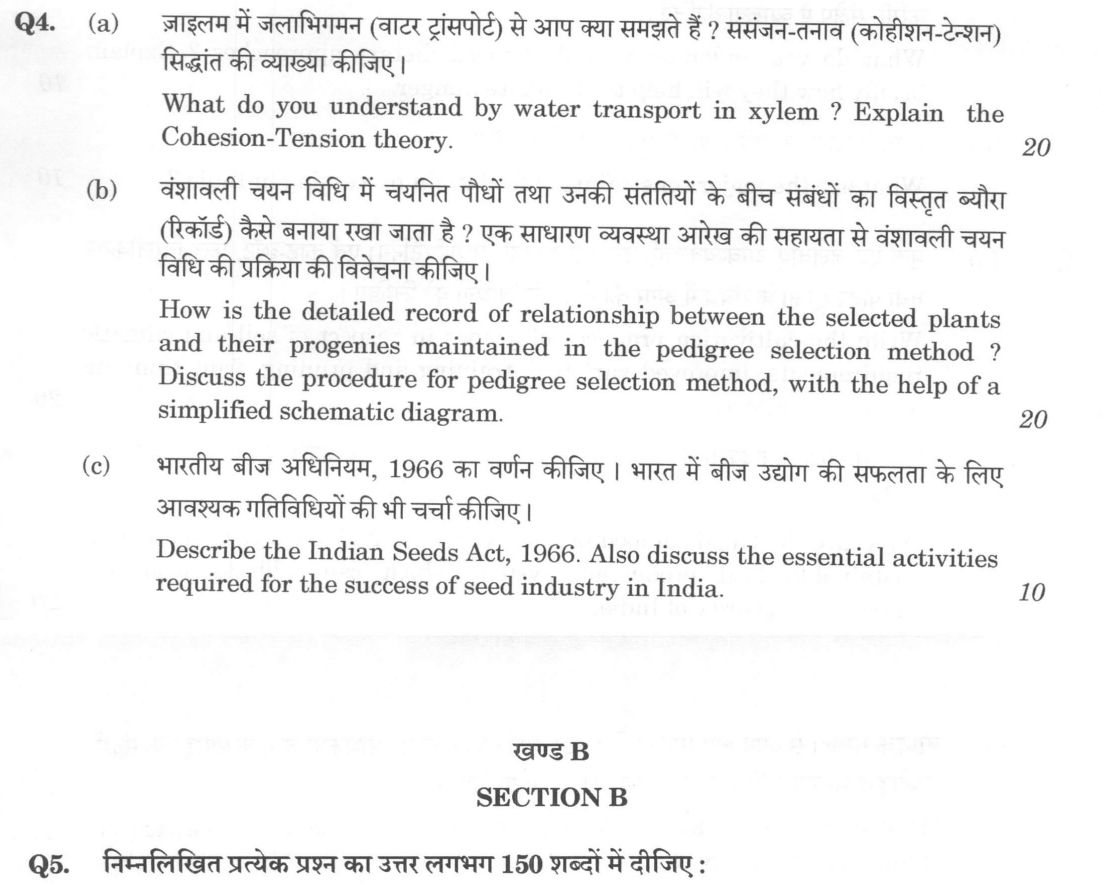
(a) What do you understand by water transport in xylem ? Explain the Cohesion-Tension theory. (20 marks) (b) How is the detailed…
What do you understand by water transport in xylem ? Explain the Cohesion-Tension theory. 20 marks
How is the detailed record of relationship between the selected plants and their progenies maintained in the pedigree selection method ? Discuss the procedure for pedigree selection method, with the help of a simplified schematic diagram. 20 marks
Describe the Indian Seeds Act, 1966. Also discuss the essential activities required for the success of seed industry in India. 10 marks
हिंदी में प्रश्न पढ़ें
जाइलम में जलाभिगमन (वाटर ट्रांसपोर्ट) से आप क्या समझते हैं ? संसर्जन-तनाव (कोहेशन-टेंशन) सिद्धांत की व्याख्या कीजिए। (20 अंक)
वंशावली चयन विधि में चयनित पौधों तथा उनकी संततियों के बीच संबंधों का विस्तृत ब्यौरा (रिकॉर्ड) कैसे बनाया रखा जाता है ? एक साधारण व्यवस्था आरेख की सहायता से वंशावली चयन विधि की प्रक्रिया की विवेचना कीजिए। (20 अंक)
भारतीय बीज अधिनियम, 1966 का वर्णन कीजिए। भारत में बीज उद्योग की सफलता के लिए आवश्यक गतिविधियों की भी चर्चा कीजिए। (10 अंक)
Model answer
Written by UPSC Answer Check against this question's marking rubric, to the expected length. UPSC does not publish answers for Mains — this is one way to score well, not an official key.
Water Transport and Pedigree Selection in Plant Breeding
Water transport in xylem is the upward movement of water from roots to leaves, driven by transpiration. This process is best explained by the Cohesion-Tension theory, proposed by Dixon and Joly. The mechanism relies on three physical properties: cohesion, adhesion, and tension. Cohesion refers to the hydrogen bonding between water molecules, allowing them to form a continuous column. Adhesion is the attraction between water molecules and the hydrophilic walls of the xylem vessels, which helps maintain the column's integrity against gravitational pull. Transpiration at the leaf surface creates a negative pressure, or tension, within the xylem. This tension pulls the cohesive water column upwards. Evidence for this theory includes pressure bomb experiments, which demonstrate that xylem sap is under tension, and the observation that water columns break (cavitate) when tension exceeds the cohesive strength, a risk mitigated by the small diameter of xylem conduits and strong cohesion rather than adhesion alone. This efficient hydraulic system ensures that plants maintain turgor and metabolic functions, which is critical for the development of high-quality seeds in breeding programs.
Pedigree Selection Method
Pedigree selection is a method of plant breeding where individual plants are selected based on their performance and their progeny are tested over multiple generations. The core of this method is the maintenance of detailed records linking each selected plant to its descendants. This record-keeping ensures that the genetic history of every line is traceable, allowing breeders to identify superior genotypes with precision.
The procedure involves several stages. Initially, a cross is made between two parents to produce the F1 generation. The F1 plants are self-pollinated to produce the F2 generation, where segregation begins. From the F2, individual plants are selected based on desired traits. These selected plants are then harvested separately, and their progenies are grown in the next generation (F3). This process of selecting individual plants and growing their progenies in separate rows continues until the F6 or F7 generation. At each stage, records are maintained using a specific notation system, often involving plant-to-row and head-to-row identifiers, to track which progeny came from which parent.
A simplified schematic of this process is as follows:
P: Parent A x Parent B ↓ F1: Uniform hybrid (Selfed) ↓ F2: Segregation occurs; Select individual plants (P1, P2, P3...) ↓ F3: Progeny rows of P1, P2, P3...; Select best rows ↓ F4: Progeny of selected F3 plants; Continue selection ↓ ... ↓ F6/F7: Uniform lines; Yield trials
This systematic recording allows for the identification of stable, superior lines. The integration of water stress tolerance traits, discussed in part (a), is often a key selection criterion in these progeny tests, ensuring that the final varieties are not only high-yielding but also resilient.
Indian Seeds Act, 1966 and Industry Activities
The Indian Seeds Act, 1966, was enacted to regulate the quality of certain seeds and to ensure that seeds sold in the market meet specified standards. The Act establishes the Central Seed Committee and the Central Seed Laboratory, which are responsible for setting standards and testing seeds, respectively. It mandates the certification of seeds by authorized agencies to ensure that they meet minimum requirements for germination, purity, and viability for notified varieties. Certification is a voluntary process for growers, but it is essential for the sale of certified seeds. The Act also provides for the registration of seed varieties and the enforcement of truth-in-labeling, ensuring that the information on seed packets is accurate.
For the success of the seed industry in India, several essential activities are required. First, there must be a robust system for the production of breeder seed, which is the highest genetic purity seed used to produce foundation seed. Second, the multiplication of foundation seed into certified seed must be efficient and widely accessible. Third, adequate infrastructure for seed testing is necessary to verify quality parameters. Finally, strong linkages between farmers and extension services are crucial to ensure that farmers have access to quality seeds and the knowledge to use them effectively. The Seed Policy of 2002 further supported this by encouraging private sector participation in hybrid seed development, thereby enhancing the availability and variety of seeds in the market.
In conclusion, the physiological efficiency of water transport underpins the viability of breeding programs, while the pedigree selection method provides the genetic framework for developing superior varieties. The regulatory framework of the Seeds Act, 1966, ensures that these varieties are of high quality and reliably labeled, supporting the overall growth of the Indian seed industry.
What "Explain" is asking you to do
Make the working of something clear — what sets it off, what follows from what, and what it produces. Explain is the Commission's mechanism word: it dominates the technical papers and the “explain why” stems, where the marks sit in the causal chain and not in the label.
Structure that answers it
State what it is → the initiating condition → the chain of cause, step by step → an instance where it plays out → what the chain produces
Where marks are lost
Describing what something looks like instead of why it works that way. Naming the stages without linking them reads as description too.
How this answer will be evaluated
Approach
Framework: Concept > Practice or process > Data > Indian application. (a) explain: definition/context > points in order > small example > short close | (b) discuss: intro > 3-4 dimensions > example > balanced close | (c) describe: define > structure or process in order > labelled diagram > significance Full marks: Comprehensive coverage of all parts with accurate technical details, clear diagrams, and specific examples.
Key points expected
- Define water transport in xylem
- Explain Cohesion-Tension theory
- Mention transpiration pull
- Mention cohesion and adhesion
- Explain pedigree record maintenance
- Describe pedigree selection procedure
- Include simplified schematic diagram
- Mention progeny testing
Evaluation rubric
Each sub-part is marked on its own, against the marks and word limit printed on the paper.
- (a) Define water transport in xylem and explain the Cohesion-Tension theory. 20 marks
explain— definition/context → points in order → small example → short close
Must cover
- Define water transport in xylem
- Explain Cohesion-Tension theory
- Mention transpiration pull
- Mention cohesion and adhesion
Loses marks
- Confusing xylem and phloem transport
- Ignoring cohesion-tension mechanism
- Vague description of water movement
Earns more
- Mention root pressure
- Mention capillary action
- Mention water potential gradient
- Mention xylem structure
Extra mark
- Mention Dixon and Joly
- Mention Hagen-Poiseuille equation
- (b) Explain how pedigree records are maintained and discuss the procedure with a schematic diagram. 20 marks
discuss— intro → 3-4 dimensions → example → balanced close
Must cover
- Explain pedigree record maintenance
- Describe pedigree selection procedure
- Include simplified schematic diagram
- Mention progeny testing
Loses marks
- Missing schematic diagram
- Confusing pedigree with mass selection
- Ignoring progeny relationship records
Earns more
- Mention selection criteria
- Mention generations of selection
- Mention data recording methods
- Mention statistical analysis
Extra mark
- Mention specific crop examples
- Mention modern pedigree software
- (c) Describe the Indian Seeds Act, 1966 and discuss essential activities for seed industry success. 10 marks
describe— define → structure or process in order → labelled diagram → significance
Must cover
- Describe Indian Seeds Act, 1966
- Mention essential activities for seed industry
- Mention seed certification
- Mention seed quality control
Loses marks
- Confusing Seeds Act with other agricultural acts
- Ignoring seed industry activities
- Vague description of Act provisions
Earns more
- Mention seed production technology
- Mention seed storage and distribution
- Mention seed research and development
- Mention seed policy and regulations
Extra mark
- Mention specific seed industry statistics
- Mention recent seed policy updates
Practice this exact question
Write your answer and it is marked point by point against the model answer above — what you covered, what you missed, what you got wrong.
Evaluate my answer →More from Agriculture 2025 Paper II
- Q1 Answer the following questions in about 150 words each: (a) Define cell cycle. Describe d…
- Q2 (a) Explain mutagenesis with its classification. Discuss briefly the mechanisms of action…
- Q3 (a) Why do fruit plants need to be propagated vegetatively ? Explain the advantages and d…
- Q4 (a) What do you understand by water transport in xylem ? Explain the Cohesion-Tension the…
- Q5 Answer the following questions in about 150 words each : 10×5=50 (a) How do plants absorb…
- Q6 (a) Write the cultivation practices of grapes in respect of soil and climatic requirement…
- Q7 (a) Discuss the production technologies of peas in relation to varieties, climate require…