Paper II — Q2
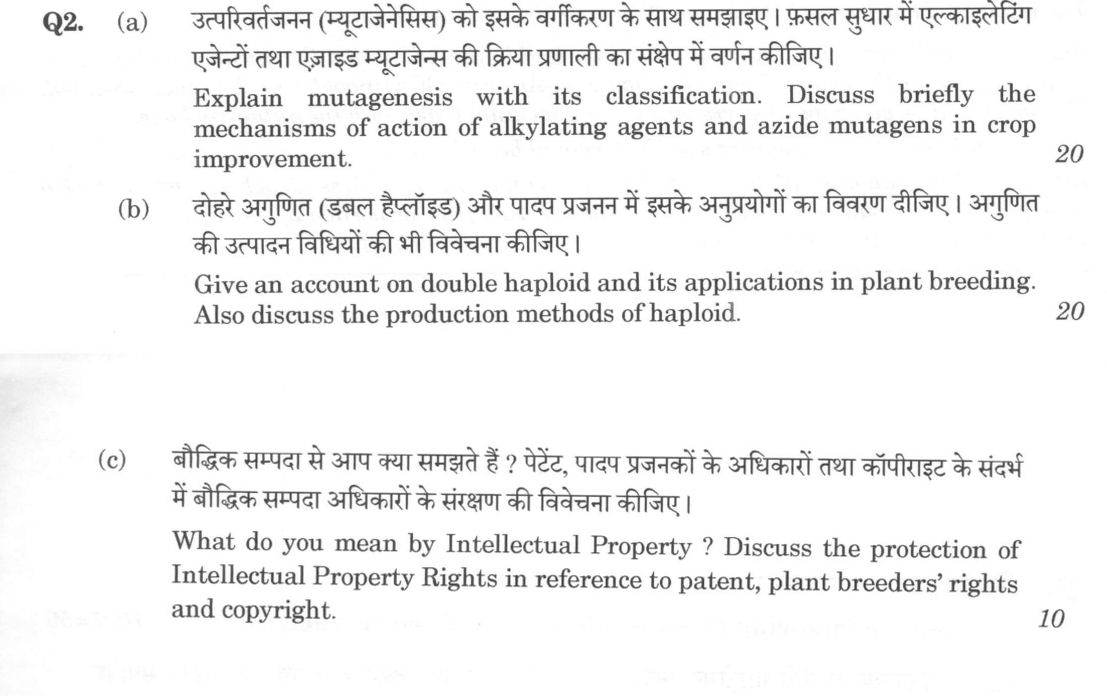
(a) Explain mutagenesis with its classification. Discuss briefly the mechanisms of action of alkylating agents and azide mutagens…
Explain mutagenesis with its classification. Discuss briefly the mechanisms of action of alkylating agents and azide mutagens in crop improvement. 20 marks
Give an account on double haploid and its applications in plant breeding. Also discuss the production methods of haploid. 20 marks
What do you mean by Intellectual Property? Discuss the protection of Intellectual Property Rights in reference to patent, plant breeders' rights and copyright. 10 marks
हिंदी में प्रश्न पढ़ें
उत्परिवर्तजन (म्यूटाजेनेसिस) को इसके वर्गीकरण के साथ समझाइए। फसल सुधार में एल्काइलेटिंग एजेंटों तथा एजाइड म्यूटाजेंस की क्रिया प्रणाली का संक्षेप में वर्णन कीजिए। (20 अंक)
दोहरे अगुणित (डबल हैप्लॉइड) और पादप प्रजनन में इसके अनुप्रयोगों का विवरण दीजिए। अगुणित की उत्पादन विधियों की भी विवेचना कीजिए। (20 अंक)
बौद्धिक सम्पदा से आप क्या समझते हैं ? पेटेंट, पादप प्रजनकों के अधिकारों तथा कॉपीराइट के संदर्भ में बौद्धिक सम्पदा अधिकारों के संरक्षण की विवेचना कीजिए। (10 अंक)
Model answer
Written by UPSC Answer Check against this question's marking rubric, to the expected length. UPSC does not publish answers for Mains — this is one way to score well, not an official key.
Mutagenesis and Haploid Breeding
Induced mutagenesis is a cornerstone of crop improvement, accelerating genetic variation to overcome the limitations of natural mutation rates. It involves the deliberate application of physical or chemical agents to alter the DNA sequence, creating heritable changes that can be selected for desirable agronomic traits.
Classification and Mechanisms of Action Mutagens are broadly classified into physical, chemical, and biological agents. Physical mutagens include ionizing radiation (X-rays, gamma rays) which cause double-strand breaks, and non-ionizing radiation (UV light) which induces pyrimidine dimers. Chemical mutagens are further categorized into base analogues, intercalating agents, and alkylating agents. Biological mutagens, such as transposons and certain viruses, insert or disrupt genetic sequences.
Alkylating agents, such as Ethyl Methanesulfonate (EMS) and Methyl Methanesulfonate (MMS), function by transferring alkyl groups to nucleophilic sites on DNA bases. EMS is a potent alkylator that predominantly forms O⁶-alkylguanine. This modified base pairs with thymine instead of cytosine during replication, leading to GC→AT transitions. In contrast, MMS acts primarily via SN2 mechanisms, methylating N⁷-guanine and N³-adenine, which can lead to depurination and subsequent base substitutions. EMS has been instrumental in generating point mutations in rice, enhancing traits like yield and stress tolerance.
Sodium Azide (NaN₃) operates through a distinct metabolic pathway. It is not a direct DNA alkylator but is metabolically converted into L-azidoalanine. This amino acid analogue is incorporated into proteins during translation, causing mispairing and replication errors that result in mutations. This mechanism has been effectively utilized in mutagenesis programs for barley and sorghum, generating diverse germplasm for breeding.
Double Haploids and Haploid Production Double Haploids (DH) are completely homozygous lines derived from haploid embryos. Their primary advantage is the immediate fixation of heterozygous recombinants, eliminating the need for multiple generations of selfing. This "instant homozygosity" drastically shortens breeding cycles.
Haploids are produced through several methods. Anther and microspore culture involve the in vitro regeneration of haploid plants from pollen grains, a technique widely used in cereals. Wide hybridization, such as the Bulbosum technique in barley, involves crossing the crop with a distant relative to produce haploid seeds. Chromosome elimination, exemplified by maize crossed with haploid inducer stocks, results in the loss of the inducer’s chromosomes, leaving a haploid embryo. Ovary and ovule culture are also employed in species where anther culture is inefficient.
Applications of DH technology include the rapid development of inbred lines for hybrid seed production, particularly in maize and wheat. It facilitates the selection of recessive traits, which are masked in heterozygous backgrounds, and aids in mutation studies and reverse breeding. In India, institutions like the Central Rice Research Institute (CRRI), Cuttack, and the Indian Institute of Wheat and Barley Research (IIWBR), Karnal, have successfully deployed DH lines to accelerate the development of high-yielding varieties.
Intellectual Property Rights Intellectual Property (IP) refers to intangible creations of the mind, such as inventions, designs, and artistic works, which are protected by law to encourage innovation. In agriculture, IP protection balances breeder incentives with public interest.
Patents under the Indian Patents Act, 1970 (amended 2005), protect novel, non-obvious, and useful inventions. While plants and animals are excluded, biotechnological processes for producing them are patentable. Plant Breeders’ Rights (PBR) are governed by the Protection of Plant Varieties and Farmers’ Rights (PPV&FR) Act, 2001. This sui generis system grants rights to new varieties that are distinct, uniform, and stable (DUS). Crucially, it includes a "farmer’s privilege," allowing farmers to save and exchange seeds, a feature absent in strict patent regimes. Copyright protects agricultural databases, software, and training materials.
The distinction is critical: patents offer 20 years of protection with strict novelty requirements, while PBRs offer 15–18 years and accommodate traditional farming practices. India’s PPV&FR Act represents a balanced approach, fostering private sector investment in breeding while preserving the rights of smallholder farmers to use and exchange seeds.
In conclusion, the integration of precise mutagenesis techniques, efficient haploid production, and a robust IP framework is essential for modern crop improvement. This triad ensures that genetic gains are realized rapidly, fixed efficiently, and protected legally, thereby enhancing food security and agricultural productivity in India.
What "Explain" is asking you to do
Make the working of something clear — what sets it off, what follows from what, and what it produces. Explain is the Commission's mechanism word: it dominates the technical papers and the “explain why” stems, where the marks sit in the causal chain and not in the label.
Structure that answers it
State what it is → the initiating condition → the chain of cause, step by step → an instance where it plays out → what the chain produces
Where marks are lost
Describing what something looks like instead of why it works that way. Naming the stages without linking them reads as description too.
How this answer will be evaluated
Approach
Framework: Concept > Practice or process > Data > Indian application. (a) explain: definition/context > points in order > small example > short close | (b) account for: state the phenomenon > the causes in order of weight > conclusion | (c) discuss: intro > 3-4 dimensions > example > balanced close Full marks: Precise mechanisms, specific chemical names, clear distinction between IP types, Indian examples.
Key points expected
- Define mutagenesis and list physical/chemical classifications
- Explain alkylating agent mechanism (e.g., EMS, MMS)
- Explain azide mutagen mechanism (e.g., sodium azide)
- Link mechanism to crop improvement application
- Define double haploid (DH) and its significance
- List production methods (anther, pollen, somatic)
- Explain application in fixing heterozygosity
- Discuss speed of breeding cycle reduction
Evaluation rubric
Each sub-part is marked on its own, against the marks and word limit printed on the paper.
- (a) Definition, classification, and mechanisms of alkylating/azide mutagens. 20 marks
explain— definition/context → points in order → small example → short close
Must cover
- Define mutagenesis and list physical/chemical classifications
- Explain alkylating agent mechanism (e.g., EMS, MMS)
- Explain azide mutagen mechanism (e.g., sodium azide)
- Link mechanism to crop improvement application
Loses marks
- Confusing mutagenesis with transgenesis
- Vague description of chemical action without mechanism
- Ignoring the classification part of the question
Earns more
- Mention specific chemical names (EMS, MMS, NaN3)
- Describe base-pair substitution or frameshift results
- Mention M2/M3 generation selection process
Extra mark
- Mention specific Indian variety developed via mutagenesis
- Reference specific IARI or ICAR mutagenesis lab
- (b) Definition of double haploid, production methods, and breeding applications. 20 marks
account for— state the phenomenon → the causes in order of weight → conclusion
Must cover
- Define double haploid (DH) and its significance
- List production methods (anther, pollen, somatic)
- Explain application in fixing heterozygosity
- Discuss speed of breeding cycle reduction
Loses marks
- Confusing haploid with double haploid
- Failing to distinguish production methods
- Vague application without mentioning breeding speed
Earns more
- Mention specific species (e.g., wheat, maize, rice)
- Detail the role of colchicine in doubling
- Mention specific techniques like Haploid Inducing Gene (HIG)
Extra mark
- Mention specific Indian DH line or variety
- Reference specific ICAR institute for DH production
- (c) Definition of IP and protection via patent, PBR, and copyright. 10 marks
discuss— intro → 3-4 dimensions → example → balanced close
Must cover
- Define Intellectual Property (IP)
- Explain Patent protection (process/product)
- Explain Plant Breeders' Rights (PBR)
- Explain Copyright protection (software/data)
Loses marks
- Confusing patent with PBR
- Ignoring copyright in the context of biotech
- Vague definition of IP without specific examples
Earns more
- Mention specific Indian Acts (Patent Act, PVP Act)
- Differentiate between product and process patents
- Mention UPOV convention
Extra mark
- Mention specific Indian PBR granted variety
- Reference specific IP office (IPO India)
Practice this exact question
Write your answer and it is marked point by point against the model answer above — what you covered, what you missed, what you got wrong.
Evaluate my answer →More from Agriculture 2025 Paper II
- Q1 Answer the following questions in about 150 words each: (a) Define cell cycle. Describe d…
- Q2 (a) Explain mutagenesis with its classification. Discuss briefly the mechanisms of action…
- Q3 (a) Why do fruit plants need to be propagated vegetatively ? Explain the advantages and d…
- Q4 (a) What do you understand by water transport in xylem ? Explain the Cohesion-Tension the…
- Q5 Answer the following questions in about 150 words each : 10×5=50 (a) How do plants absorb…