Paper I — Q1
(a) Classify the minerals required by animals and discuss the functions of calcium in animals. (10 marks) (b) Discuss the…
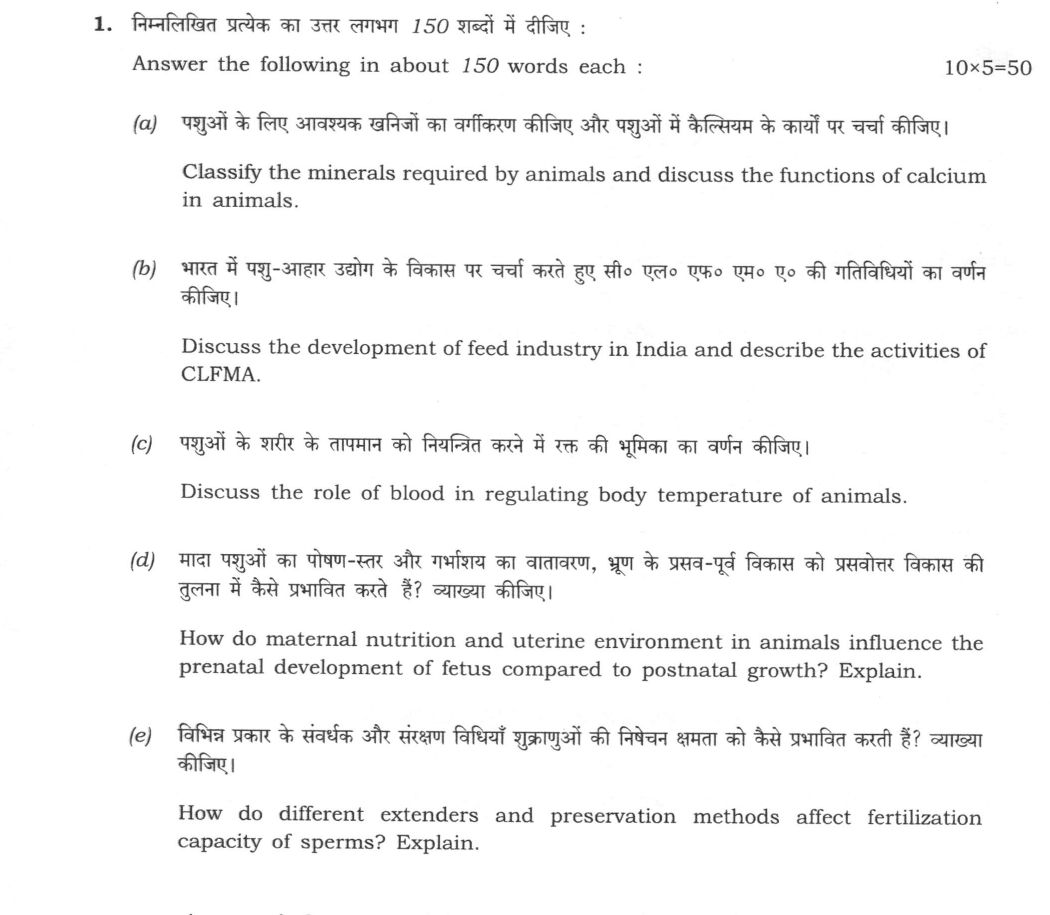
Answer the following in about 150 words each :
Classify the minerals required by animals and discuss the functions of calcium in animals. 10 marks
Discuss the development of feed industry in India and describe the activities of CLFMA. 10 marks
Discuss the role of blood in regulating body temperature of animals. 10 marks
How do maternal nutrition and uterine environment in animals influence the prenatal development of fetus compared to postnatal growth? Explain. 10 marks
How do different extenders and preservation methods affect fertilization capacity of sperms? Explain. 10 marks
हिंदी में प्रश्न पढ़ें
निम्नलिखित प्रत्येक का उत्तर लगभग 150 शब्दों में दीजिए :
पशुओं के लिए आवश्यक खनिजों का वर्गीकरण कीजिए और पशुओं में कैल्सियम के कार्यों पर चर्चा कीजिए। (10 अंक)
भारत में पशु-आहार उद्योग के विकास पर चर्चा करते हुए सी० एल० एफ० एम० ए० की गतिविधियों का वर्णन कीजिए। (10 अंक)
पशुओं के शरीर के तापमान को नियन्त्रित करने में रक्त की भूमिका का वर्णन कीजिए। (10 अंक)
मादा पशुओं का पोषण-स्तर और गर्भाशय का वातावरण, भ्रूण के प्रसव-पूर्व विकास को प्रसवोत्तर विकास की तुलना में कैसे प्रभावित करते हैं? व्याख्या कीजिए। (10 अंक)
विभिन्न प्रकार के संवर्धक और संरक्षण विधियों शुक्राणुओं की निषेचन क्षमता को कैसे प्रभावित करती हैं? व्याख्या कीजिए। (10 अंक)
Model answer
Drafted with AI by UPSC Answer Check against this question's marking rubric, to the 150-word length. UPSC does not publish answers for Mains — this is one way to score well, not an official key. How we build rubrics and answers.
(a) Classification of minerals and functions of calcium (10 marks)
Minerals are classified by the amount needed:
- Macrominerals (more than about 100 mg/kg of diet): calcium, phosphorus, magnesium, sodium, potassium, chlorine and sulphur.
- Microminerals (trace elements): iron, copper, zinc, manganese, cobalt, iodine, selenium, molybdenum and chromium.
Some elements, such as fluorine, lead and arsenic, are toxic at high levels.
Functions of calcium:
- About 99% is in bones and teeth, giving strength and acting as a reserve.
- Blood clotting, nerve impulse transmission and muscle contraction, including the heart.
- Enzyme activation, membrane permeability, and an intracellular messenger role.
- Milk synthesis and eggshell formation.
Blood calcium (about 9 to 11 mg/dl) is regulated by parathyroid hormone, calcitonin and vitamin D. Deficiency causes rickets, osteomalacia, milk fever and thin eggshells; the dietary Ca:P ratio should be about 1.5 to 2:1.
(b) Development of the feed industry in India and activities of CLFMA (10 marks)
Until the 1960s animals were fed mainly on crop residues, grazing and oilseed cakes. The commercial compound feed industry began in the 1960s with dairy cooperative cattle-feed plants (Amul, Kanjari, 1964) and grew with Operation Flood and the poultry expansion of the 1970s and 1980s, then with broiler, layer, pig and aquafeed. It now produces tens of millions of tonnes a year, poultry being the largest user, with a shift to larger mills, additives and BIS quality standards. Problems are raw-material prices and supply (maize, soybean meal, fish meal), adulteration and the lack of a comprehensive feed law.
CLFMA (Compound Livestock Feed Manufacturers Association of India) represents manufacturers. It puts industry views to government on policy, taxes and raw-material supply; promotes quality and safe feed; holds conferences, exhibitions and training; shares market and technical information; and encourages research and good practice.
(c) Role of blood in regulating body temperature (10 marks)
- Heat transport: blood carries heat from muscles, liver and other organs to the skin and respiratory tract, where it is lost. Plasma water has a high specific heat, so it carries much heat with little temperature rise.
- Skin blood flow: in heat, the hypothalamus causes cutaneous vasodilation; skin, ear and limb flow rises, heat is lost by radiation, conduction and convection, and sweat glands are supplied for evaporation. In cold, vasoconstriction conserves heat.
- Arteriovenous anastomoses and countercurrent arteries and veins shunt flow or exchange heat.
- Selective brain cooling: in ruminants the carotid rete cools blood going to the brain with cooler venous blood from the nose.
- Panting and sweating depend on blood supply, and hormones (thyroxine, adrenaline) carried in blood change heat production.
In dehydration, low blood volume reduces heat loss, so the animal is at risk of heat stress.
(d) Maternal nutrition and uterine environment: prenatal versus postnatal development (10 marks)
Prenatal growth depends wholly on the dam. About two-thirds of fetal growth occurs in late gestation, so under-nutrition then lowers birth weight, viability and vigour. Under-nutrition in mid-gestation can reduce muscle-fibre number and organ development, which is not regained later; this fetal programming has lasting effects on growth, carcass and metabolism.
The uterine environment sets the ceiling on fetal size: uterine size and blood flow, placental size and type, litter size (crowding in pigs), maternal age, size and parity, heat stress and disease. Embryo-transfer studies (large-breed embryo in a small-breed dam) show that the dam's uterus, and not only fetal genes, limits fetal size.
After birth, growth depends on the animal's own genes, colostrum, milk, feed, health and management, so it is far more modifiable, and compensatory growth can recover much of an early setback. Prenatal effects are set early and are less reversible.
(e) Effect of extenders and preservation methods on fertilising capacity of sperm (10 marks)
Extenders dilute semen and protect sperm, so their composition affects fertilising capacity.
- Glucose or fructose gives energy; citrate, Tris or phosphate buffers keep pH and osmotic pressure right.
- Egg yolk (lecithin, lipoproteins) or milk protects against cold shock: egg yolk-citrate for chilled cattle semen, Tris-egg yolk-glycerol for frozen semen.
- Cryoprotectants (glycerol 5 to 7%, DMSO) reduce ice-crystal and osmotic damage, but excess is toxic.
- Antibiotics control bacteria, and antioxidants such as vitamin E limit lipid peroxidation.
Preservation: liquid at 15 to 18 °C (boar, poultry; days), chilled at 4 to 5 °C (bull, ram; one to three days), and frozen in liquid nitrogen at −196 °C (bull, in straws; years). Cooling, freezing and thawing injure the membrane, acrosome and mitochondria, so motility and fertility fall, and only about half of the sperm survive freezing; more sperm per dose are therefore used.
How this answer will be evaluated
Evaluation rubric
Each sub-part is marked on its own, against the marks and word limit printed on the paper.
- (a) (a) Classify the minerals required by animals; discuss the functions of calcium (10, about 150 words). 10 marks · 150 words
Must cover
- Macrominerals (Ca, P, Mg, Na, K, Cl, S) versus microminerals (Fe, Cu, Zn, Mn, Co, I, Se, Mo)
- Calcium: bones and teeth (about 99%)
- Calcium: blood clotting, nerve and muscle function, enzyme activation, milk and eggshell
- Regulation and deficiency (PTH, calcitonin, vitamin D; rickets, milk fever); Ca:P ratio
Loses marks
- Classifying vitamins instead of minerals.
- Listing calcium sources instead of functions.
- Over the word limit.
Earns more
- Basis of classification (quantity needed).
- Toxic elements.
Extra mark
- Blood calcium range
- (b) (b) Discuss the development of the feed industry in India; describe the activities of CLFMA (10, about 150 words). 10 marks · 150 words
Must cover
- Origin: crop residues and oilseed cakes; 1960s cooperative cattle-feed plants
- Growth through Operation Flood and the poultry, aqua and pig industries
- Present state and problems: raw materials, quality and adulteration, standards
- CLFMA: industry body; policy representation, quality, conferences, information, research
Loses marks
- Describing only feed ingredients.
- Confusing CLFMA with a government body.
- Over the word limit.
Earns more
- Poultry as the largest user.
- BIS standards and feed law.
Extra mark
- Amul Kanjari plant (1964)
- (c) (c) Discuss the role of blood in regulating body temperature of animals (10, about 150 words). 10 marks · 150 words
Must cover
- Blood carries heat from core organs to skin and respiratory tract
- Vasodilation and vasoconstriction of skin vessels controlled by the hypothalamus
- Evaporative heat loss depends on blood supply; countercurrent exchange and AV anastomoses
- Selective brain cooling (carotid rete) and hormonal effects; dehydration and heat stress
Loses marks
- Describing the hypothalamic centre alone.
- Confusing blood with sweating mechanisms.
- Over the word limit.
Earns more
- Specific heat of plasma water.
- Hormones (thyroxine, adrenaline).
Extra mark
- Heat conservation in cold
- (d) (d) How do maternal nutrition and uterine environment influence prenatal development of fetus compared to postnatal growth (10, about 150 words). 10 marks · 150 words
Must cover
- Maternal nutrition: two-thirds of fetal growth in late gestation; effects on birth weight and vigour
- Mid-gestation under-nutrition and muscle fibre number; fetal programming
- Uterine factors: size, blood flow, placenta, litter size, maternal age and parity, heat stress; embryo-transfer evidence
- Comparison: postnatal growth depends on own genes, milk, feed and management, and is more modifiable
Loses marks
- Describing only lactation nutrition.
- No comparison with postnatal growth.
- Over the word limit.
Earns more
- Compensatory growth.
- Effect of over-feeding on dystocia.
Extra mark
- Colostrum
- (e) (e) How do different extenders and preservation methods affect fertilising capacity of sperm (10, about 150 words). 10 marks · 150 words
Must cover
- Extender components: energy, buffers, egg yolk or milk, cryoprotectant, antibiotics
- Protection against cold shock and ice damage; glycerol level and toxicity
- Preservation methods: liquid, chilled, frozen in liquid nitrogen with species examples
- Effects on motility, acrosome, membrane and fertility; only about half survive freezing
Loses marks
- Describing artificial insemination technique.
- Unsupported figures for survival or fertility.
- Over the word limit.
Earns more
- Antioxidants and lipid peroxidation.
- Osmotic and pH effects.
Extra mark
- Sexed or freeze-dried semen
What "Classify" is asking you to do
Sort into categories on a stated basis, and make the basis explicit before you sort. A classification is judged on whether the categories are exhaustive, mutually exclusive and drawn on a single consistent principle.
Structure that answers it
State the basis of classification → category one with its members → category two → category three → note the overlaps and borderline cases
Where marks are lost
Categories that are not mutually exclusive, or a basis of division left unstated.
Practice this exact question
Write your answer and it is marked point by point against the model answer above — what you covered, what you missed, what you got wrong.
Evaluate my answer →More from Animal Husbandry & Veterinary Science 2026 Paper I
- Q1 Answer the following in about 150 words each : (a) Classify the minerals required by anim…
- Q2 (a) Discuss the salient features of feeding broiler chicks for meat production. (20 marks…
- Q3 (a) Explain why animals with high metabolic rate require more complex excretory and circu…
- Q4 (a) “Silent heat is not a disease, but a failure of management.” Critically evaluate this…