Paper I — Q2
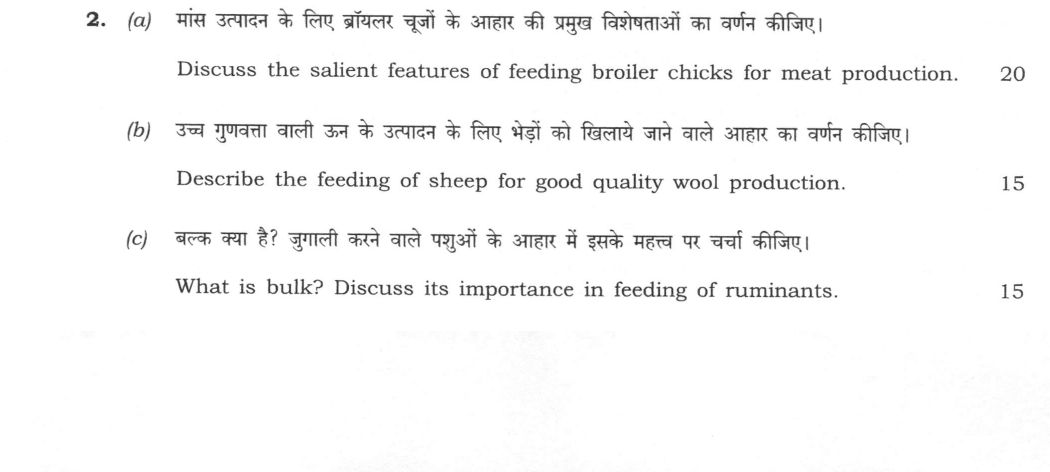
(a) Discuss the salient features of feeding broiler chicks for meat production. (20 marks) (b) Describe the feeding of sheep for…
Discuss the salient features of feeding broiler chicks for meat production. 20 marks
Describe the feeding of sheep for good quality wool production. 15 marks
What is bulk? Discuss its importance in feeding of ruminants. 15 marks
हिंदी में प्रश्न पढ़ें
मांस उत्पादन के लिए ब्रॉयलर चूजों के आहार की प्रमुख विशेषताओं का वर्णन कीजिए। (20 अंक)
उच्च गुणवत्ता वाली ऊन के उत्पादन के लिए भेड़ों को खिलाये जाने वाले आहार का वर्णन कीजिए। (15 अंक)
बल्क क्या है? जुगाली करने वाले पशुओं के आहार में इसके महत्व पर चर्चा कीजिए। (15 अंक)
Model answer
Drafted with AI by UPSC Answer Check against this question's marking rubric, to the expected length. UPSC does not publish answers for Mains — this is one way to score well, not an official key. How we build rubrics and answers.
(a) Salient features of feeding broiler chicks for meat production (20 marks)
A broiler reaches about 2 kg in five to six weeks, so feeding is aimed at rapid growth and efficient feed conversion (feed conversion ratio about 1.6 to 1.8). Feed is 65 to 70% of the production cost.
Salient features:
- Phase feeding: the nutrient need changes with age, so three or four feeds are given: pre-starter or starter (0 to about 2–3 weeks) with about 22 to 23% crude protein and 2,900 to 3,000 kcal ME/kg; grower (to about 4–5 weeks) with about 20 to 21% protein and about 3,000 to 3,100 kcal; and finisher (to market) with about 18 to 19% protein and about 3,100 to 3,200 kcal. The energy is higher and protein lower with age.
- High energy and balanced protein: an adequate energy to protein ratio, using maize and fat, with soybean meal and fish meal for protein. Digestible amino acids, especially lysine and methionine, are balanced, and not just the crude protein.
- Minerals and vitamins: calcium about 0.9 to 1%, available phosphorus about 0.45%, with a trace mineral and vitamin premix; a coccidiostat where needed.
- Feed form: crumbles for chicks and pellets afterwards improve intake and conversion, compared with mash, and reduce wastage.
- Ad libitum feeding with enough feeder and drinker space, and clean, cool water always available (water intake is about twice the feed intake).
- Additives that support gut health and growth, such as enzymes, probiotics, prebiotics and organic acids, in place of antibiotic growth promoters.
- Quality and safety: fresh feed free of aflatoxin and other mycotoxins, and a properly stored feed.
- Lighting programme, and withdrawal of feed for six to eight hours before catching, to empty the gut.
(b) Feeding of sheep for good quality wool production (15 marks)
Wool is a protein, keratin, rich in sulphur-containing amino acids (cystine and methionine), so wool growth needs an adequate, steady supply of protein and sulphur, along with energy. Wool growth follows the feed intake, and a poor or uneven diet gives thin, weak, uneven fibre, with breaks in the staple.
Feeding:
- Good pasture, browse and legumes (for example lucerne) are the base of the diet; in the dry season, hay, silage and tree fodder support them.
- Concentrate supplement (about 200 to 250 g a day, of grain and oil cake) in the dry season, in pregnancy and lactation, and before shearing.
- Protein of good quality, especially with sulphur amino acids; rumen-bypass protein (or a protected methionine) reaches the intestine, because rumen microbes break down much dietary protein. Urea-molasses blocks may be used with a nitrogen to sulphur ratio of about 10:1.
- Minerals: sulphur; copper (deficiency causes steely, straight, colourless wool), zinc, cobalt, iodine and selenium; a mineral lick is given.
- Vitamin A and clean water.
- Ewe nutrition in pregnancy influences the number of secondary follicles in the lamb, and so its later fleece.
Other: worm control, avoiding stress and sudden diet changes, and shearing at the right time.
(c) Bulk and its importance in feeding of ruminants (15 marks)
Bulk is the property of a feed of occupying a large volume for its weight, that is, its low bulk density (volume per unit weight). Roughages such as straw, hay and silage are bulky, and concentrates such as grain and cake are compact. Bulk is related mainly to the fibre content.
Importance in ruminants:
- Rumen fill and intake: bulky, low-digestibility feed stays in the rumen and fills it, so intake is limited by fill, not by energy need, and this physically regulates the feed intake. High-yielding animals need concentrates to reduce the bulk and obtain enough nutrients.
- Rumination and saliva: coarse, bulky fibre stimulates chewing the cud and secretion of saliva, whose bicarbonate buffers the rumen and keeps the pH near 6 to 7.
- Rumen health: enough bulk (effective fibre) prevents acidosis, laminitis and displaced abomasum, and supports a rumen mat and a healthy fibre-digesting flora.
- Milk fat: the fibre gives acetate, the precursor of milk fat, so low bulk causes low milk fat.
- Gut motility and satiety.
Too much bulk limits energy intake and production, and too little causes digestive disorders. Balanced rations therefore use a roughage to concentrate ratio, commonly between about 60:40 and 40:60 for dairy animals, and processing (chopping, pelleting) alters the bulk.
How this answer will be evaluated
Evaluation rubric
Each sub-part is marked on its own, against the marks and word limit printed on the paper.
- (a) (a) Discuss the salient features of feeding broiler chicks for meat production (20). 20 marks
Must cover
- Phase feeding: starter, grower, finisher with protein and energy levels
- High energy with balanced protein and amino acids (lysine, methionine)
- Minerals, vitamins and feed form (crumbles, pellets); ad libitum feed and clean water
- Additives, aflatoxin-free feed, feed withdrawal before catching; feed conversion and cost
Loses marks
- Layer or breeder feeding values.
- Protein levels that are wrong for the phase.
- Ignoring the phase concept.
Earns more
- Numerical targets (FCR, market weight).
- Lighting programme.
Extra mark
- Enzymes, probiotics in place of antibiotic growth promoters
- (b) (b) Describe the feeding of sheep for good quality wool production (15). 15 marks
Must cover
- Wool is keratin, rich in sulphur amino acids; protein, sulphur and energy needed
- Good pasture, browse and legumes; concentrate supplement in dry season and pregnancy
- Rumen-bypass protein and N:S ratio; minerals (copper, zinc, cobalt, iodine, selenium)
- Steady plane of nutrition; effect of poor feeding on fibre; ewe nutrition and follicles
Loses marks
- Describing meat-sheep feeding.
- Ignoring sulphur amino acids.
- Over-concentrate diets without roughage.
Earns more
- Vitamin A and water.
- Worm control and shearing time.
Extra mark
- Copper deficiency and steely wool
- (c) (c) What is bulk; discuss its importance in feeding of ruminants (15). 15 marks
Must cover
- Definition: volume occupied per unit weight of feed; low bulk density; roughages versus concentrates
- Rumen fill limits intake; high-yielding animals need concentrates
- Rumination, saliva buffering, pH and prevention of acidosis
- Milk fat, gut motility, roughage:concentrate ratio, effect of too much or too little bulk
Loses marks
- Defining bulk as weight of feed.
- Confusing bulk with dry matter content.
- Ignoring importance for rumen function.
Earns more
- Examples of bulky feeds.
- Effect of processing on bulk.
Extra mark
- Effective fibre
What "Discuss" is asking you to do
Lay the issue out from more than one side — how it arose, what is claimed for it, what is held against it, and where it now stands. UPSC attaches discuss to broad topics with several live dimensions, so coverage of the dimensions earns more than the strength of your opinion.
Structure that answers it
Set the issue up → the case as it is made → the case against → the dimension both sides leave out → where the balance now lies
Where marks are lost
Listing facts with no thread between them, or arguing one side throughout and calling it a discussion.
Practice this exact question
Write your answer and it is marked point by point against the model answer above — what you covered, what you missed, what you got wrong.
Evaluate my answer →More from Animal Husbandry & Veterinary Science 2026 Paper I
- Q1 Answer the following in about 150 words each : (a) Classify the minerals required by anim…
- Q2 (a) Discuss the salient features of feeding broiler chicks for meat production. (20 marks…
- Q3 (a) Explain why animals with high metabolic rate require more complex excretory and circu…
- Q4 (a) “Silent heat is not a disease, but a failure of management.” Critically evaluate this…
- Q5 Write notes on/Answer the following in about 150 words each : (a) Impact of genetic drift…