Paper I — Q3
(a) Explain why animals with high metabolic rate require more complex excretory and circulatory system. (20 marks) (b) Explain…
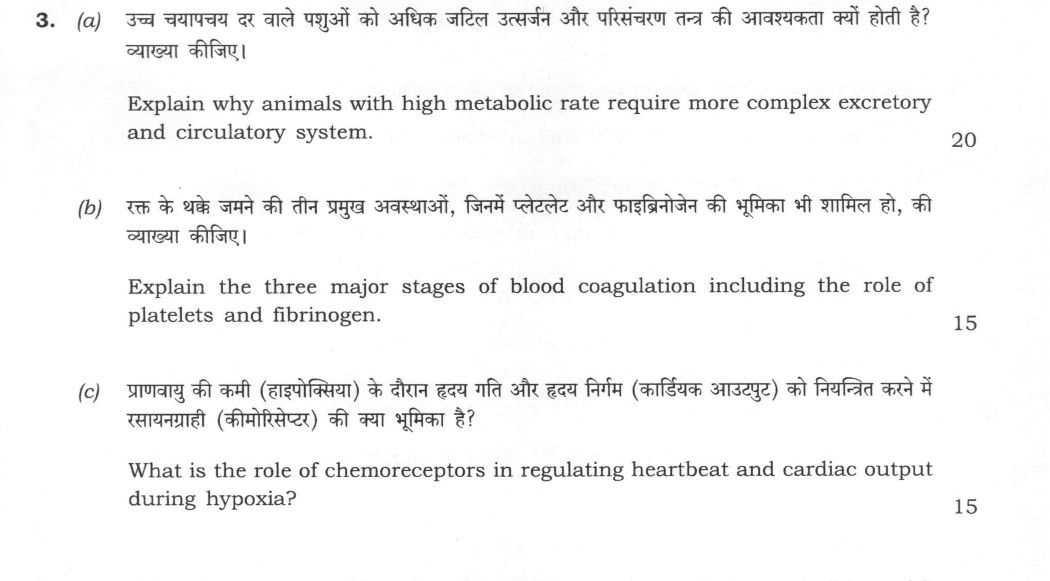
Explain why animals with high metabolic rate require more complex excretory and circulatory system. 20 marks
Explain the three major stages of blood coagulation including the role of platelets and fibrinogen. 15 marks
What is the role of chemoreceptors in regulating heartbeat and cardiac output during hypoxia? 15 marks
हिंदी में प्रश्न पढ़ें
उच्च चयापचय दर वाले पशुओं को अधिक जटिल उत्सर्जन और परिसंचरण तंत्र की आवश्यकता क्यों होती है? व्याख्या कीजिए। (20 अंक)
रक्त के थक्के जमने की तीन प्रमुख अवस्थाओं, जिनमें प्लेटलेट और फाइब्रिनोजेन की भूमिका भी शामिल हो, की व्याख्या कीजिए। (15 अंक)
प्राणवायु की कमी (हाइपोक्सिया) के दौरान हृदय गति और हृदय निर्गम (कार्डियक आउटपुट) को नियन्त्रित करने में रसायनग्राही (कीमोरिसेप्टर) की क्या भूमिका है? (15 अंक)
Model answer
Drafted with AI by UPSC Answer Check against this question's marking rubric, to the expected length. UPSC does not publish answers for Mains — this is one way to score well, not an official key. How we build rubrics and answers.
(a) Why animals with a high metabolic rate need more complex excretory and circulatory systems (20 marks)
Metabolic rate per unit of body mass is highest in small, warm-blooded animals (birds and small mammals), roughly in proportion to mass to the power of 0.75, so a shrew or a sparrow uses far more oxygen per gram than an elephant or a lizard. A high metabolic rate means faster oxygen use and faster production of carbon dioxide, heat, water and nitrogenous and acid wastes. It has two consequences.
Circulatory system: oxygen and nutrients must be delivered, and carbon dioxide and heat removed, quickly. This needs:
- A four-chambered heart in birds and mammals, with complete separation of oxygenated and deoxygenated blood, so that the systemic circuit gets fully oxygenated blood at high pressure and the pulmonary circuit is a low-pressure one. Fish (two chambers) and amphibians and most reptiles (three chambers) mix blood and manage on a low metabolic rate.
- A high heart rate and cardiac output (a mouse about 600 beats a minute, an elephant about 30), and a strong ventricle.
- Dense capillary beds, a high haemoglobin and red-cell content, and efficient regulation of blood flow to active tissues.
- Blood is also the route by which heat reaches the skin for thermoregulation.
Excretory system: the higher intake and breakdown of protein and the higher metabolic rate produce large amounts of urea (or uric acid in birds), acids and metabolic water that must be cleared while conserving water. This needs:
- Large numbers of nephrons, a high renal blood flow (about a fifth to a quarter of the cardiac output) and a high glomerular filtration rate.
- Long loops of Henle and a countercurrent mechanism, which concentrate urine to save water (long-looped juxtamedullary nephrons); in birds, reptilian-type and mammalian-type nephrons and the excretion of uric acid, which saves water.
- Precise regulation of acid-base, water and electrolytes by the kidney under the control of antidiuretic hormone, aldosterone and the renin-angiotensin system.
Thus, the more complex circulatory and excretory systems keep the internal environment constant despite a high rate of turnover.
(b) Three stages of blood coagulation with the role of platelets and fibrinogen (15 marks)
Coagulation is the change of blood from a liquid to a gel, by a cascade of clotting factors, to stop bleeding. In the classical scheme it has three stages.
Stage 1, formation of prothrombin activator: after injury, the extrinsic pathway (tissue factor released from damaged tissue with factor VII) and the intrinsic pathway (contact of blood with collagen, activating factor XII, then XI, IX and VIII) both lead to the activation of factor X. Activated factor X (Xa) combines with factor V, calcium ions and platelet phospholipid (platelet factor 3) to form prothrombin activator.
Stage 2, conversion of prothrombin to thrombin: prothrombin activator, on the platelet surface, splits the plasma protein prothrombin (factor II, made in the liver, with vitamin K) to thrombin.
Stage 3, conversion of fibrinogen to fibrin: thrombin splits soluble fibrinogen (factor I, made in the liver) into fibrin monomers, which polymerise into loose threads. Thrombin also activates factor XIII, which cross-links the threads into a strong, stable mesh that traps red cells and platelets and forms the clot. Thrombin also gives positive feedback by activating factors V and VIII.
Role of platelets: they stick to damaged vessel wall and collagen (with von Willebrand factor) and to each other (aggregation, with ADP and thromboxane A₂) to form the primary platelet plug; they release serotonin (vasoconstriction) and clotting factors; they provide the phospholipid surface for stages 1 and 2; and they cause clot retraction, which pulls the edges of the wound together. Afterwards, plasmin dissolves the clot (fibrinolysis).
(c) Role of chemoreceptors in regulating heartbeat and cardiac output during hypoxia (15 marks)
Peripheral chemoreceptors are the carotid bodies (at the carotid bifurcation) and the aortic bodies (on the aortic arch). Their glomus cells are stimulated by a fall in arterial PO₂ (mainly below about 60 mm Hg), and also by a rise in PCO₂ and H⁺. Their afferents go by the glossopharyngeal (carotid) and vagus (aortic) nerves to the nucleus of the tractus solitarius in the medulla, which acts on the respiratory and the cardiovascular centres. (Central chemoreceptors in the medulla respond mainly to CO₂ and H⁺, not to hypoxia.)
Effects during hypoxia:
- Respiratory: increased rate and depth of breathing (hyperventilation), the main response.
- Cardiovascular: chemoreceptor stimulation activates the sympathetic system and inhibits the vagal cardiac centre through the vasomotor and cardio-inhibitory centres. Sympathetic outflow to blood vessels causes vasoconstriction in the skin, gut and muscle, which raises blood pressure and diverts blood to the brain and heart.
- Heart rate: the direct chemoreceptor effect is a slowing (bradycardia), but the hyperventilation and lung inflation reflexes reverse it, so in the intact animal the net effect is tachycardia and a rise in cardiac output, helped by catecholamines from the adrenal medulla.
- Local effect: hypoxia dilates the coronary and cerebral vessels.
In severe, prolonged hypoxia (PO₂ below about 40 mm Hg) the medullary centres and the myocardium are depressed directly, so heart rate and output fall.
How this answer will be evaluated
Evaluation rubric
Each sub-part is marked on its own, against the marks and word limit printed on the paper.
- (a) (a) Explain why animals with a high metabolic rate require more complex excretory and circulatory systems (20). 20 marks
Must cover
- High metabolic rate means greater oxygen use and greater production of CO₂, heat, water and nitrogenous and acid wastes
- Circulatory: four-chambered heart with complete separation, high pressure, high heart rate and cardiac output, dense capillaries, haemoglobin
- Excretory: many nephrons, high renal blood flow and GFR, long loop of Henle and urine concentration, uric acid in birds
- Comparison with fish, amphibians and reptiles with lower rates
Loses marks
- Describing human anatomy without the link to metabolic rate.
- Missing either system.
- Stating that ectotherms have four-chambered hearts.
Earns more
- Metabolic scaling with body mass.
- Blood as carrier of heat for thermoregulation.
Extra mark
- Hormonal control (ADH, aldosterone, RAAS)
- (b) (b) Explain the three major stages of blood coagulation including the role of platelets and fibrinogen (15). 15 marks
Must cover
- Stage 1: formation of prothrombin activator by extrinsic and intrinsic pathways (factor X, Va, Ca²⁺, platelet phospholipid)
- Stage 2: prothrombin to thrombin
- Stage 3: fibrinogen to fibrin, cross-linked by factor XIII
- Platelets: plug formation, adhesion, aggregation, phospholipid surface, clot retraction
Loses marks
- Getting the order of stages wrong.
- Omitting calcium or platelets.
- Confusing the platelet plug with the clot.
Earns more
- Vitamin K and liver origin of factors.
- Thrombin positive feedback.
Extra mark
- Fibrinolysis by plasmin
- (c) (c) Role of chemoreceptors in regulating heartbeat and cardiac output during hypoxia (15). 15 marks
Must cover
- Peripheral chemoreceptors: carotid and aortic bodies, stimulated by low PO₂ (also high PCO₂, H⁺)
- Afferents via glossopharyngeal and vagus nerves to the NTS in the medulla
- Respiratory response (hyperventilation) and sympathetic vasoconstriction raising blood pressure
- Heart: direct bradycardia but net tachycardia and increased cardiac output through lung inflation reflex and catecholamines
Loses marks
- Stating that central chemoreceptors detect hypoxia.
- Only the respiratory response, with no cardiac effect.
- Confusing chemoreceptors with baroreceptors.
Earns more
- Central chemoreceptors respond to CO₂ and H⁺ and not to hypoxia.
- Severe hypoxia depresses the heart.
Extra mark
- Coronary and cerebral vasodilation
What "Explain" is asking you to do
Make the working of something clear — what sets it off, what follows from what, and what it produces. Explain is the Commission's mechanism word: it dominates the technical papers and the “explain why” stems, where the marks sit in the causal chain and not in the label.
Structure that answers it
State what it is → the initiating condition → the chain of cause, step by step → an instance where it plays out → what the chain produces
Where marks are lost
Describing what something looks like instead of why it works that way. Naming the stages without linking them reads as description too.
Practice this exact question
Write your answer and it is marked point by point against the model answer above — what you covered, what you missed, what you got wrong.
Evaluate my answer →More from Animal Husbandry & Veterinary Science 2026 Paper I
- Q1 Answer the following in about 150 words each : (a) Classify the minerals required by anim…
- Q2 (a) Discuss the salient features of feeding broiler chicks for meat production. (20 marks…
- Q3 (a) Explain why animals with high metabolic rate require more complex excretory and circu…
- Q4 (a) “Silent heat is not a disease, but a failure of management.” Critically evaluate this…
- Q5 Write notes on/Answer the following in about 150 words each : (a) Impact of genetic drift…
- Q6 (a) Explain the genetic mechanism behind inbreeding depression. Why does continuous inbre…