Paper I — Q5
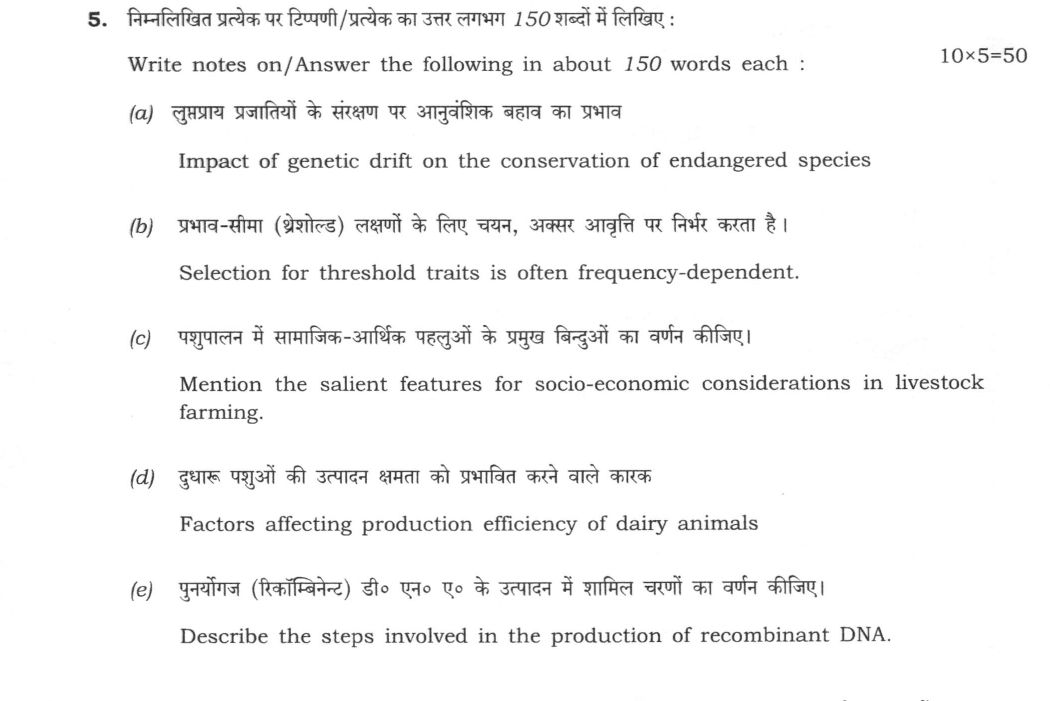
(a) Impact of genetic drift on the conservation of endangered species (10 marks) (b) Selection for threshold traits is often…
Write notes on/Answer the following in about 150 words each :
Impact of genetic drift on the conservation of endangered species 10 marks
Selection for threshold traits is often frequency-dependent. 10 marks
Mention the salient features for socio-economic considerations in livestock farming. 10 marks
Factors affecting production efficiency of dairy animals 10 marks
Describe the steps involved in the production of recombinant DNA. 10 marks
हिंदी में प्रश्न पढ़ें
निम्नलिखित प्रत्येक पर टिप्पणी/प्रत्येक का उत्तर लगभग 150 शब्दों में लिखिए :
लुप्तप्राय प्रजातियों के संरक्षण पर आनुवंशिक बहाव का प्रभाव (10 अंक)
प्रभाव-सीमा (थ्रेशोल्ड) लक्षणों के लिए चयन, अक्सर आवृत्ति पर निर्भर करता है। (10 अंक)
पशुपालन में सामाजिक-आर्थिक पहलुओं के प्रमुख बिंदुओं का वर्णन कीजिए। (10 अंक)
दुधारू पशुओं की उत्पादन क्षमता को प्रभावित करने वाले कारक (10 अंक)
पुनर्योगज (रिकॉम्बिनेट) डी० एन० ए० के उत्पादन में शामिल चरणों का वर्णन कीजिए। (10 अंक)
Model answer
Drafted with AI by UPSC Answer Check against this question's marking rubric, to the 150-word length. UPSC does not publish answers for Mains — this is one way to score well, not an official key. How we build rubrics and answers.
(a) Impact of genetic drift on the conservation of endangered species (10 marks)
Genetic drift is the random change of allele frequencies from one generation to the next, caused by chance sampling of gametes in a finite population. Its size is about p(1 − p)/2N_e per generation, so it is strongest in small populations, which is the case for endangered species.
Impact:
- Loss of alleles and of heterozygosity at a rate of about 1/(2N_e) per generation, so genetic variation and adaptability fall.
- Fixation of alleles, including mildly harmful ones, and accumulation of deleterious mutations (drift load).
- Inbreeding depression, lower fertility and survival, and poorer disease resistance, which can lead to an extinction vortex.
- Bottleneck and founder effects: a sudden fall in numbers, or a few founders, permanently reduces diversity even if numbers recover.
Conservation measures: keep a large effective population size (an even sex ratio helps); equalise family sizes; minimise kinship in mating; translocate animals for gene flow (genetic rescue); keep studbooks; and freeze semen, embryos and cells.
(b) Selection for threshold traits is often frequency-dependent (10 marks)
A threshold trait is one that is expressed as a discrete category (present or absent, for example twinning, disease susceptibility, calving difficulty), but is controlled by an underlying continuous variable, the liability, which is polygenic and affected by the environment. The trait appears when the liability exceeds a threshold.
Justification: the heritability observed on the 0/1 scale depends on the incidence (frequency) p: h²(obs) = h²(liability) × z²/[p(1 − p)], where z is the height of the normal curve at the threshold. It is highest when p is near 50%: at p = 0.5 it is about 0.64 × h², but at p = 0.05 only about 0.22 × h². So the response to selection depends on how frequent the trait is; selection is efficient at intermediate frequencies, and slows when the trait becomes rare or nearly universal. Since selection itself changes the incidence, the heritability on the observed scale changes across generations. Selection should therefore use threshold models on the liability scale.
(c) Salient features of socio-economic considerations in livestock farming (10 marks)
- Livelihood and employment: livestock supports millions of small and marginal farmers and landless families, and gives regular, year-round income and work, with milk providing daily cash.
- Contribution to the economy: about 30% of agricultural gross value added and about 5% of the national total, and India is the world's largest milk producer.
- Women's role: a large share of the work in feeding, milking and care is done by women, so livestock empowers them.
- Nutrition security: milk, eggs, meat and fish supply protein and micronutrients.
- Risk cover and assets: animals are savings and insurance against crop failure, and give draught power, manure and fuel.
- Social and cultural: cooperative models such as Amul, social status, and religious and cultural sentiments about some species.
- Constraints: fodder shortage, disease, poor market, credit and insurance, and low productivity of animals.
- Policy support: dairy and animal-husbandry credit, insurance, vaccination and breed-improvement missions.
(d) Factors affecting production efficiency of dairy animals (10 marks)
- Genetic: breed, sire and dam merit, and crossbreeding and selection.
- Nutrition: a balanced ration with sufficient green and dry fodder, concentrate and minerals, and clean water; feed is 60 to 70% of the cost of milk.
- Reproduction: age at first calving, calving interval (ideally 12 to 13 months), service period and conception rate, since fertility decides the milk per day of life.
- Health: mastitis, foot-and-mouth disease, metabolic disorders and parasites, with vaccination and prompt treatment.
- Management: housing, hygiene, correct milking practice and frequency, a dry period of about 60 days, and handling.
- Environment: heat stress and humidity, season and shelter.
- Physiological: stage and number of lactation, and age.
- Economics and records: cost control, and record-keeping to cull poor producers.
Together they determine milk yield per lactation, lifetime production and feed conversion.
(e) Steps in the production of recombinant DNA (10 marks)
- Isolation of the gene of interest: by restriction digestion of genomic DNA, by making cDNA from mRNA, by PCR amplification, or by chemical synthesis.
- Choice of vector: a plasmid (or phage, cosmid, BAC) with an origin of replication, a selectable marker such as an antibiotic-resistance gene, and a multiple cloning site.
- Cutting: the gene and the vector are cut with the same restriction endonuclease, giving complementary sticky ends.
- Ligation: DNA ligase joins the gene into the vector, giving recombinant DNA.
- Transformation: the recombinant DNA is put into a host, commonly Escherichia coli, by calcium chloride and heat shock or electroporation.
- Selection and screening: transformed cells are selected on antibiotic medium, and recombinants identified by blue-white screening (lacZ), colony hybridisation or PCR.
- Expression and scale-up: the clones are grown in a fermenter for expression, and the product harvested and purified.
Examples: insulin, bovine somatotropin, hepatitis B vaccine and chymosin.
How this answer will be evaluated
Evaluation rubric
Each sub-part is marked on its own, against the marks and word limit printed on the paper.
- (a) (a) Impact of genetic drift on the conservation of endangered species (10, about 150 words). 10 marks · 150 words
Must cover
- Definition: random change of allele frequencies by sampling in a finite population; stronger in small populations
- Loss of alleles and heterozygosity, fixation, inbreeding depression
- Bottleneck and founder effects; extinction vortex
- Conservation measures: large N_e, even sex ratio, gene flow or translocation, studbooks, gene banks
Loses marks
- Confusing drift with selection or mutation.
- Describing only inbreeding.
- Over the word limit.
Earns more
- Rate of heterozygosity loss (1/2N_e).
- Drift load of deleterious alleles.
Extra mark
- Genetic rescue
- (b) (b) Selection for threshold traits is often frequency-dependent (10, about 150 words). 10 marks · 150 words
Must cover
- Threshold trait: discrete expression from a continuous underlying liability
- Observed-scale heritability depends on incidence (h² = h²liability × z²/pq)
- Response to selection is greatest at intermediate frequency and falls at extremes
- Selection changes the incidence; use liability-scale or threshold models
Loses marks
- Treating threshold trait as a Mendelian trait.
- Stating that heritability is constant.
- Over the word limit.
Earns more
- Numerical illustration (0.5 versus 0.05 incidence).
- Examples (twinning, disease susceptibility, calving difficulty).
Extra mark
- Sire and progeny testing
- (c) (c) Mention the salient features of socio-economic considerations in livestock farming (10, about 150 words). 10 marks · 150 words
Must cover
- Livelihood, income and employment for small and marginal farmers and landless
- Contribution to economy (about 30% of agricultural GVA) and world's largest milk producer
- Women's role and empowerment; nutrition security
- Risk cover and assets, cooperatives, cultural aspects, constraints and policy support
Loses marks
- Purely technical description of animal production.
- Unsupported or wrong statistics.
- Over the word limit.
Earns more
- Draught power, manure and fuel.
- Constraints such as fodder and disease.
Extra mark
- Amul model
- (d) (d) Factors affecting production efficiency of dairy animals (10, about 150 words). 10 marks · 150 words
Must cover
- Genetic: breed and selection
- Nutrition: balanced ration, fodder, water
- Reproduction: age at first calving, calving interval, service period
- Health, management, environment (heat stress) and records
Loses marks
- Listing only nutrition.
- Ignoring reproduction or health.
- Over the word limit.
Earns more
- Lactation stage and dry period.
- Economics of feed cost.
Extra mark
- Feed conversion and lifetime production
- (e) (e) Describe the steps involved in the production of recombinant DNA (10, about 150 words). 10 marks · 150 words
Must cover
- Isolation of the gene (restriction digestion, cDNA, PCR, synthesis)
- Vector with ori, marker and cloning site
- Cutting with same restriction enzyme and ligation with DNA ligase
- Transformation, selection and screening (blue-white), expression and purification
Loses marks
- Steps out of order.
- Omitting ligase or selection.
- Over the word limit.
Earns more
- Sticky ends explained.
- Host such as E. coli and methods of transformation.
Extra mark
- Products (insulin, bovine somatotropin, hepatitis B vaccine)
What "Write short notes" is asking you to do
Five or six self-contained answers, marked separately, typically 10 marks and about 150 words each. Each note must carry its own definition, its two or three defining features and a line on why it matters; a common introduction or conclusion across the notes earns nothing.
Structure that answers it
Per note: one-line definition or identification → two or three features, mechanisms or named examples → one line of significance or Indian application
Where marks are lost
Writing the first two notes at essay length and rationing the rest. Each note is marked on its own, so marks surrendered on a compressed or unattempted note cannot be won back by the long ones.
Practice this exact question
Write your answer and it is marked point by point against the model answer above — what you covered, what you missed, what you got wrong.
Evaluate my answer →More from Animal Husbandry & Veterinary Science 2026 Paper I
- Q2 (a) Discuss the salient features of feeding broiler chicks for meat production. (20 marks…
- Q3 (a) Explain why animals with high metabolic rate require more complex excretory and circu…
- Q4 (a) “Silent heat is not a disease, but a failure of management.” Critically evaluate this…
- Q5 Write notes on/Answer the following in about 150 words each : (a) Impact of genetic drift…
- Q6 (a) Explain the genetic mechanism behind inbreeding depression. Why does continuous inbre…
- Q7 (a) How do you estimate the cost of milk production in organised and unorganised dairy se…
- Q8 (a) (i) How do you assess the training needs of rural farmers to ensure that they are rel…